Referral dependence and outbound fatigue create inconsistent pipelines that cap your firm’s valuation. Sustainable IT services lead generation requires treating SEO as a long-term equity asset. You must bridge the Technical Authority Gap by aligning search strategy with the buyer journey across awareness, consideration, and decision stages. We measure success in Google and answer engine citations instead of raw traffic. Start with the economics and intent, then build the pages that close.
IT services lead generation is the system an MSP uses to attract, qualify, and convert buyers who are actively looking to hire or switch IT providers. Done through SEO, it turns organic search and AI citations into a predictable flow of qualified meetings rather than one-off referrals.
Key Takeaways
- Sustainable IT services lead generation treats SEO as a long-term equity asset measured in qualified meetings, SQL conversion, and pipeline influenced rather than raw traffic.
- Architect the site around revenue pages first: 3 to 6 core service pages, 2 to 4 vertical pages, and a location layer only where you have genuine local presence.
- Target high-intent switchers ("switch MSP", "replace IT provider", "MSP transition plan") with bottom-of-funnel pages, since these prospects are less price-sensitive and ready to move.
- Engineer machine-readable trust through E-E-A-T signals, specific certifications, real engineer photos, and case studies structured like investment memos.
- In the zero-click AI era, use atomic answer blocks, service-page FAQs with schema, and citeable proof so engines like Perplexity and ChatGPT cite your firm.
1. Master the Economics of MSP Lead Acquisition
Many MSPs chase traffic volume while revenue remains stagnant because their SEO strategy ignores actual contract values. You must stop chasing vanity keywords without knowing what a lead should cost relative to your average MRR and retention. This misalignment wastes budget on IT services lead generation that never converts into high-value managed contracts.
Build a model that treats marketing as an investment with explicit payback expectations:
- Define core offers like managed security with specific retention targets.
- Calculate acceptable cost per lead (CPL) based on your unique close rates and sales cycles.
- Use PPC for immediate demand capture and SEO for compounding, lower blended CPL.
Track three investor-grade KPIs to ensure M&A readiness and RevOps discipline:
- Qualified meetings booked.
- SQL conversion rates.
- Total pipeline influenced.
Clean CRM attribution proves your organic traffic is a predictable revenue asset rather than rented attention. This transparency directly increases your firm’s enterprise valuation during due diligence.
Build Organic Equity: Request an M&A Readiness SEO + RevOps Audit to transform your digital presence into a high-valuation asset.
2. Architect Your Site Around Revenue Pages Not Blog Posts
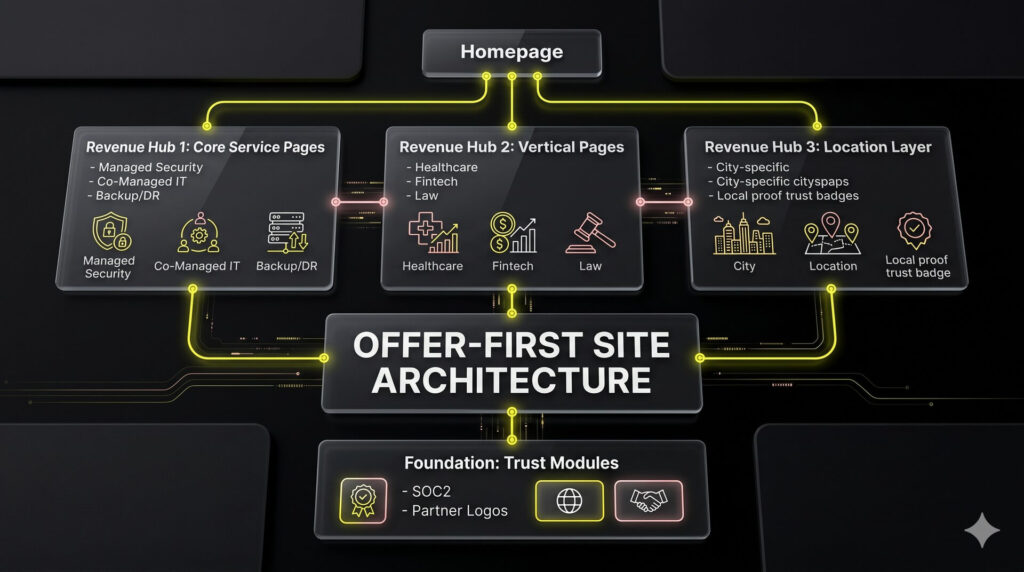
Most MSP websites function as passive brochures rather than lead-generation engines. Decision-makers in a crisis do not start with a blog. They search for service capabilities, industry compliance, and local relevance. Shift from a blog-first strategy to an offer-first architecture to capture this high-intent demand.
Prioritize bottom-funnel Revenue Pages to build a scalable foundation for IT services lead generation:
- 3 to 6 Core Service Pages: Focus on high-margin offers like Managed Security/MDR, Co-Managed IT, and Backup/DR.
- 2 to 4 Vertical Pages: Target niches where you have a competitive edge, such as healthcare, fintech, or law. Tie these services directly to regulatory compliance and EBITDA-impacting outcomes.
- Location Layer: Deploy IT support in [City] pages only when you can prove local boots-on-the-ground relevance.
Conversion requires a primary CTA to book a discovery assessment and a secondary lead magnet like a security checklist. Bridge the Technical Authority Gap with trust modules featuring SOC2 certifications, partner logos, and case snippets. This structure ensures every piece of content leads to a conversion-focused destination. It is the bedrock of strategic [SEO for MSPs].
3. Capture High-Intent Switchers with Transition-Focused SEO
Ranking for broad terms like IT support attracts low-intent traffic and tire-kickers. High-performance IT services lead generation focuses instead on the decision-stage moment where prospects seek to replace an incumbent provider. These searchers are typically less price-sensitive because they are currently suffering from SLA breaches, poor responsiveness, or technical neglect.
Prioritize keyword clusters signaling an immediate intent to move:
- Switch MSP or replace IT provider
- MSP transition plan or how to switch MSP without downtime
- Email migration MSP or M365 tenant migration managed
- IT provider not responding or MSP contract exit
Avoid generic blog posts. Build a bottom-of-funnel (BOFU) landing page using this conversion-ready format:
1. Problem framing (addressing current provider neglect).
2. Low-risk migration approach (mitigating transition downtime fears).
3. Technical proof (case snippet of a seamless M365 tenant migration).
4. Direct consultation CTA.
5. FAQ addressing compliance, data security, and contract exits.
This structure captures prospects at their peak buying intent. It effectively bridges the Technical Authority Gap by demonstrating migration expertise before the first discovery call.
4. Accelerate Sales Cycles with High-Authority MOFU Assets
Most MSPs waste budget on top-of-funnel interest only to stall in six-month sales cycles. This occurs when traffic lacks a bridge to confidence. Without middle-of-funnel (MOFU) assets, sales teams spend dozens of hours providing basic education that your website should automate.
To dominate IT services lead generation, deploy assets that provide a clear plan and proof. Focus on content answering the critical how and how much of IT transitions:
- Comparison Pages: Compare service models like Outsourced IT vs. in-house, Co-managed vs. Fully Managed, or MDR vs. MSSP.
- ROI Content: Use a Cost of Downtime calculator or budget template to ground technical talks in EBITDA impact.
- Webinar-as-SEO: Host quarterly Cyber Readiness sessions and publish the landing page with a transcript to capture long-tail search volume.
Gate content only when it provides deep decision-making value; otherwise, use ungated access with a strong CTA. Every download must trigger a short email sequence routing prospects toward a bottom-of-funnel (BOFU) assessment or case study. This handoff converts technical authority into a high-velocity revenue engine.

5. Turn Technical Expertise Into Machine-Readable Trust
In high-stakes IT, trust must be engineered into your digital footprint. Buyers and search algorithms both demand E-E-A-T: Experience, Expertise, Authoritativeness, and Trustworthiness. Generic claims carry zero weight in technical categories where competence is the primary filter. You must bridge the Technical Authority Gap by making your expertise both human-obvious and machine-readable.
High-performing IT services lead generation relies on transparency. Replace stock photos with actual leadership and list specific certifications such as CISSP, Microsoft Solutions Partner, or AWS Certified Security. Dedicated How we work pages detailing onboarding, SLAs, and escalation paths significantly reduce the perceived risk of switching providers.
Structure case studies like investment memos to prove technical ROI:
- Baseline: Infrastructure or security status before intervention.
- Intervention: Specific strategic and technical steps taken.
- Outcome: Measurable results like a 30% ticket reduction or zero-trust implementation.
Finally, add trust packaging to money pages using accurate compliance badges and process diagrams. In technical B2B, stock photography is a trust-killer. Showing real engineers proves a legitimate SOC exists behind the curtain.
6. Dominate Local Discovery and Entity Validation
MSPs often lose near me and city-specific queries because their entity signals are weak or inconsistent. This technical authority gap allows smaller competitors to capture IT services lead generation by maintaining a robust map presence. You must make your firm obviously real across the digital ecosystem to capture this high-intent traffic.
Start by optimizing your Google Business Profile (GBP) exceptionally well. Complete all categories, services, descriptions, photos, and Q&A sections while publishing regular updates. Ensure NAP (Name, Address, Phone) consistency across Apple Maps, Yelp, and major citations to establish technical trust.
Implement a review velocity system involving asking, reminding, and replying, tied to ticket resolutions or quarterly business reviews. High volume and quality responses signal reliability to human buyers and answer engines. Maintain active profiles on third-party platforms to link back to your service pages:
- Clutch
- G2
- UpCity
Focus on organic volume, recency, and response quality to build investor-grade reputation equity. Never buy reviews. These signals prove your firm is a grounded enterprise, ensuring you remain the primary recommendation in local and shortlist AI-search results.
7. Optimize the Technical Foundation to Capture High-Intent Leads
Slow page speeds and plugin-bloat suppress rankings and waste expensive clicks. In the competitive landscape of IT services lead generation, technical SEO is a critical revenue lever. To capture high-intent buyers, you must treat your website like a high-performance engine rather than a legacy server room.
Prioritize these technical hygiene factors to improve Core Web Vitals and search authority:
- Compress images and reduce third-party script bloat to improve loading times.
- Prune thin location pages and establish coherent internal linking between service clusters.
- Enforce HTTPS and clear, compliance-focused messaging to establish authority.
- Eliminate disruptive popups that erode trust, particularly on cybersecurity offer pages.
Your conversion layer must be frictionless to maximize enterprise valuation. Present your value proposition immediately above the fold with a single primary CTA, a short form, and proof blocks to reduce sales friction. Bridge the Technical Authority Gap by tying every high-intent page to event tracking for form submissions and calendar bookings. This ensures full-funnel attribution and prepares your firm for M&A-level scrutiny.
8. Secure Visibility in the Zero-Click AI Search Era
AI Overviews and answer engines like Perplexity shift search from blue links to citations. If your technical expertise isn’t the cited source, your firm is invisible in the discovery layer. This shift requires Generative Engine Optimization (GEO) to protect your IT services lead generation.
Transform technical knowledge into machine-readable atomic answers using these high-visibility elements:
- Atomic Answer Blocks: Use question-based H3 headers followed by concise 2 to 3 sentence answers. This structure is ideal for AI extraction and featured snippets.
- Service Page FAQs: Add FAQ sections directly to service pages. Use valid schema to capture high-intent queries within AI-mediated search results.
- Citeable Proof: Include specific stats, process steps, and clear definitions. AI models prioritize structured, authoritative data over vague marketing generalizations.
Reinforce your entity status through consistent business details and third-party mentions. When external reviews align with on-page data, AI engines prioritize your brand as a trusted authority. Align these answers with the buyer journey by addressing awareness, consideration, and decision queries to remain the primary recommendation in the zero-click era.
Define the MSP Buyer Before You Build Pages
Every wasted lead traces back to a fuzzy ideal customer profile. IT services lead generation only compounds when your service pages speak to a specific buyer with a specific trigger, not to every business with a computer. Before you write a single page, write down who you actually close and why they moved.
Build a one-page ICP that your content team and sales team both sign off on:
- Firmographics: Company size and revenue band you serve profitably, for example a 50 to 250-seat firm in the $5M to $50M revenue range where a full-time IT hire is too expensive but downtime is costly.
- Vertical and compliance: The regulated niches where you win, such as healthcare under HIPAA, financial services, or law, because compliance pressure raises urgency and lowers price sensitivity.
- Buying trigger: The event that starts the search, like an SLA breach, a failed audit, a ransomware scare, or an incumbent MSP that stopped answering the phone.
- Decision unit: Who signs. In a mid-market MSP deal the owner or CFO controls budget while an ops or IT lead vets capability, so your pages must satisfy both.
Map each ICP trait to a page. A HIPAA-focused profile earns a healthcare vertical page, a switcher trigger earns a transition-focused page, and a CFO reader earns a cost-of-downtime calculator. For the broader demand-capture playbook beyond SEO, see our MSP lead generation strategies. This alignment is what stops you ranking for traffic that never books a call.
In-House SEO vs Outsourced IT Lead Generation
The real choice is not build or buy, it is where your scarce technical time earns the most. Most MSP owners are the most credible subject-matter expert in the building and the worst-positioned person to publish weekly. Decide deliberately instead of defaulting.
- Build in-house when: You have a marketing hire who owns the roadmap, your engineers will give an hour a week to fact-check content, and you want the compounding SEO equity to sit inside the business ahead of a future exit.
- Outsource when: You need results inside 60 to 90 days, lack an in-house SEO or content operator, and would rather buy a proven process than learn one. A specialist agency ships service pages, technical fixes, and GEO faster than a first hire ramps.
- The hybrid most MSPs land on: Keep strategy, engineer interviews, and final approval in-house, and outsource execution, technical SEO, and citation building. You stay the authority; a partner does the volume.
Whichever model you pick, hold it to the same three KPIs from Section 1: qualified meetings booked, SQL conversion, and pipeline influenced. If you are weighing partners, our roundup of MSP lead generation agencies shows what a real vetting process looks like. Do not evaluate either path on traffic alone.
How to Build a 90-Day MSP Content Pipeline for Maximum Valuation
Most MSPs publish content out of order. They chase awareness before establishing the specific pages that close deals. This lack of prioritization wastes budget and delays revenue. Aligning execution with the buyer journey is the only way to bridge the Technical Authority Gap and turn IT services lead generation into a predictable pipeline engine.
Phase 1: Establish the Strategic Prerequisites
Complete all foundational work before producing content. Define your unit economics and target cost per lead based on your average monthly recurring revenue. Finalize your site architecture to ensure core service pages exist. High-intent traffic requires a clear conversion destination to move into the sales funnel.
Phase 2: The 30/60/90-Day Execution Roadmap
Follow this sequence to connect awareness to the pipeline.
Days 1 to 30 (Decision Foundation):
Upgrade core service pages for your highest-margin offerings. Insert trust modules featuring SOC2 badges and partner logos. Configure your CRM to track every conversion path from the first click.
Days 31 to 60 (MOFU Capture):
Build the bridge between curiosity and commitment. Publish three comparison assets and one webinar landing page. Deploy automated email nurture sequences to capture prospects who are currently researching but not yet ready to switch providers.
Days 61 to 90 (Scale and Credibility):
Target high-intent switchers. Publish two transition-focused bottom-funnel pages and two technical case studies styled as investment memos. Launch an automated Google Business Profile review workflow to validate local authority.
Phase 3: Measuring Full-Funnel Pipeline Impact
Track success by meetings booked per page type rather than raw traffic. Analyze assisted conversions to see how middle-funnel assets influence the total pipeline.
Book a strategy call with NUOPTIMA to turn your SEO and GEO into measurable revenue growth.
Where this fits in your MSP growth system
This is one piece of how NUOPTIMA makes MSPs and cybersecurity firms the provider buyers find on Google and in AI search. See how it connects to MSP SEO and GEO and AI-search, or get your free MSP lead forecast to see exactly where your firm shows up across ChatGPT, Gemini, and Perplexity today.