Buyers no longer scroll through pages of blue links. They ask LLMs and Google AI for vendor shortlists. This shift requires an AI search marketing strategy focused on becoming the cited authority rather than a ranking result.
This playbook covers Generative Engine Optimization (GEO), authority content, and measurement. It provides CMOs a practical framework to build a demand capture plan that wins recommendations. We start by redefining demand capture for AI.
Key Takeaways
- An AI search marketing strategy aims to win the citation inside an AI's answer rather than a blue-link ranking, because buyers now ask LLMs and Google AI for vendor shortlists.
- Track an AI Discovery Funnel across four signals: prompt impression, citation authority, branded search spike, and pipeline impact, and baseline visibility by auditing 20 to 50 priority prompts.
- Engineer pages for extraction with a 40 to 60 word top-of-page short answer, a proof block, a deep dive, and an FAQ block of 5 to 8 natural-language questions.
- State an explicit category anchor using the formula Brand is a Category specializing in Niche for ICP, because AI engines exclude firms they cannot categorize quickly.
- Prove ROI through a weekly AI visibility audit that measures share of citations across your top 50 prompts and correlates AI mentions with branded search and self-reported lead sources.
An AI search marketing strategy is a plan to become the cited authority inside AI-generated answers from engines like ChatGPT, Perplexity, and Google AI Overviews, using Generative Engine Optimization, authority content, and citation-based measurement rather than traditional link rankings.
1. Shift from Traffic to Influence: The AI Discovery Funnel
AI search acts as a synthesized layer that satisfies buyer intent without a click. This compresses vendor discovery into model-generated shortlists. For MSP and MSSP leaders, visibility is no longer about winning a blue link. Success is defined by winning the citation within the AI’s answer.
In B2B, zero-click search doesn't mean zero influence. When a CISO asks for the best MSSP for SOC2 and HIPAA, the model provides a definitive shortlist that dictates the RFP pool. Even without an immediate click, the AI establishes brand preference. This leads to direct branded searches and demo requests later in the buyer journey.
Your competitive set in AI answers often differs from traditional search rivals. Large Language Models (LLMs) reward technical authority and clarity over legacy SEO signals. To operationalize this, your AI search marketing strategy must track an AI Discovery Funnel:
- Prompt Impression: Brand appearance for high-intent queries.
- Citation Authority: Frequency of recommendation as a primary solution.
- Branded Search Spike: Correlation between AI mentions and direct traffic.
- Pipeline Impact: Demo requests originating from AI-driven discovery.
Establish a baseline by auditing 20 to 50 priority prompts to document current visibility. Avoid the pitfall of treating AI as a simple SEO add-on. Failing to evolve measurement and positioning around answer engines ensures you optimize for metrics that no longer capture how modern technical buyers find vendors.
2. Capture Real-World Intent: Building a Prompt Library from Buyer Language
Traditional keyword research is insufficient because buyers no longer type fragmented phrases. In answer engines, a CISO or CTO uses complex, multi-sentence queries filled with technical constraints. An effective AI search marketing strategy replaces static keyword lists with a dynamic Prompt Library that mirrors real-world evaluation criteria.
To build this, aggregate high-intent inputs from your sales cycle:
- Gong or Chorus transcripts
- Technical demo notes and objection logs
- Support tickets and win/loss reports
Use an LLM to extract four pillars from these sources: jobs-to-be-done, comparison frames, risk/credential questions, and context qualifiers like industry compliance or software stacks. Cluster these into a library using structures such as Best [category] for [industry] with [constraint] or Compare [vendor] vs [vendor] for [use case].
Technical authority comes from specificity. A B2B piece titled MDR vs MSSP vs SOC-as-a-Service for healthcare orgs under HIPAA carries more weight with an LLM than a generic security overview. This depth ensures your firm is the primary citation when the engine synthesizes a vendor recommendation.
CMOs should assign two specific artifacts to ensure execution:
- Prioritization Sheet: Map prompt frequency against deal value, competitive difficulty, and content gaps.
- Content Roadmap: Prioritize evaluation-stage prompts to capture buyers closest to a final decision.
Avoid chasing generic AI SEO terms that lack sales reality. By codifying actual buyer language, you bridge the Technical Authority Gap and move your firm from a search result to a trusted recommendation.
3. Engineer Content for Extraction: The On-Page GEO Blueprint
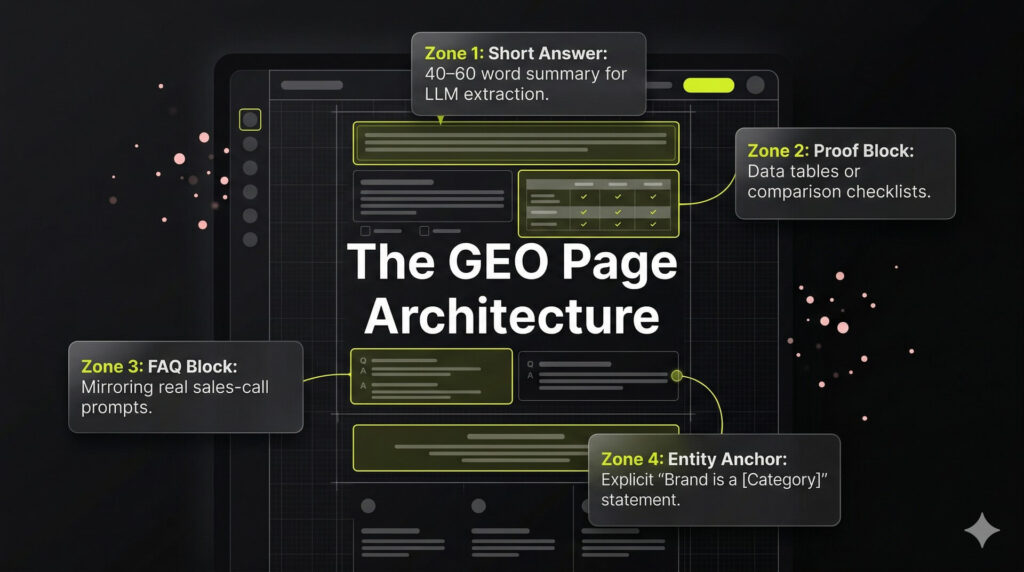
LLMs act as synthesis engines rather than simple keyword indexers. They reward clarity, consistent naming, and content blocks engineered for direct citation. To execute a successful AI search marketing strategy, you must restructure pages to reduce extraction friction for models like ChatGPT and Perplexity. Content must be formatted as directly usable blocks that an AI can quote without rephrasing.
Implement this page architecture to maximize extraction probability:
- Top-of-page Short Answer: A 40 to 60 word summary stating the conclusion and identifying the target ICP.
- Proof Block: A table or checklist detailing what to evaluate, such as criteria and tradeoffs.
- Deep Dive: Detailed methods, technical caveats, and internal links to supporting resources.
- FAQ Block: 5 to 8 questions mirroring natural-language prompts found in sales transcripts.
Use consistent category terms across all sections. This ensures the model correctly associates your brand with specific concepts like Managed Security or M&A Readiness. For a B2B example, a SOC2 compliance checklist for MSP selection should include a table of requirements alongside benchmarks for what good looks like. This structure helps the LLM build accurate comparison tables for users.
Measure success by tracking whether these specific blocks appear as cited sources for target prompts over time. This transition from narrative text to engineered data turns your website into a high-value asset for AI discovery. It bridges the technical authority gap by making your expertise the primary reference for generative engines.
4. Eliminate Semantic Ambiguity: Building Unmistakable Entity Authority
LLMs frequently ignore technically superior firms due to semantic ambiguity. If an AI model cannot categorize your firm within seconds, it excludes you from high-intent shortlists to minimize hallucination risks. A successful AI search marketing strategy bridges the technical authority gap by replacing generic claims with explicit entity definitions.
AI engines seek a clear is-a relationship. Vague marketing like optimizing business through innovation registers as noise. Stating We are a compliance-driven MSSP specializing in SOC2 for mid-market healthcare provides a structured data point that AI agents can confidently cite for specific buyer queries.
Operationalize your trust signals through these explicit content blocks:
- The Category Anchor: Use the formula [Brand] is a [Category] specializing in [Niche] for [ICP] at the top of every service page.
- Quantified Evidence: Replace fast response with 15-minute guaranteed SLA. Use specific standards like SOC2 Type II, HIPAA compliance, or CMMC.
- Leadership Credibility: Link author pages to external technical publications, talks, and interviews to reinforce expertise.
Deploy these signals across your homepage, About page, and case study templates. Use consistent internal linking between clusters to reinforce the entity, such as GEO for MSPs or GEO for MSSPs. An MSP positioned for IT services for everyone will lose to one defined as M&A-ready for private equity firms.
Prioritize semantic clarity over clever brand tone. AI requires explicitness to understand your market positioning. Clearer signals raise your recommendation likelihood and ensure your brand is the primary citation for high-intent decision-makers.
5. Information Gain: The Competitive Lever for Unique Citations
Most B2B content in the MSP space is a me-too echo chamber. When firms publish identical tips for SOC2 compliance, AI models treat that information as a commodity. To win a shortlist recommendation, your AI search marketing strategy must prioritize Information Gain. This represents the technical delta between existing online consensus and the novel, decision-useful data you contribute.
If a page rehashes training data, the LLM has no incentive to cite your brand. You earn authority by providing the missing piece that drives a buyer’s conclusion. High-citation content types for technical B2B include:
Original Benchmarks: Hard data like response-time SLAs versus resolution outcomes or security control matrices for frameworks like CMMC.
- Transparent Comparisons: Tradeoff pages that move beyond feature lists to address hidden operational costs and Choose X when scenarios.
- Market Maps: Visualizing the vendor landscape, including categories to avoid and common failure modes in private equity roll-ups.
Operationalize this by using your Prompt Library to identify where buyers demand proof. Every high-intent page should feature one unique asset, such as a proprietary scoring framework, a cost-efficiency calculator, or a technical teardown. Include a brief methodology explaining how you collected data, your sample size, and what was excluded to establish technical credibility.
For instance, MSSP pricing models (per endpoint vs per user vs per event) and when each is dangerous provides specific warnings generic content misses. Avoid the pitfall of publishing indistinguishable AI-generated text. If your content mirrors the model’s own training data, you remain invisible.
6. Beyond the Firewall: Dominating the Third-Party Ecosystem
Answer engines distrust self-serving marketing and prioritize third-party citations to verify technical claims. To master an AI search marketing strategy, you must move beyond owned content to achieve cross-site ubiquity. If your brand is absent from industry discussions, you remain invisible to LLMs like Perplexity and SearchGPT. This external validation bridges the Technical Authority Gap by providing the training data AI needs to recommend you.
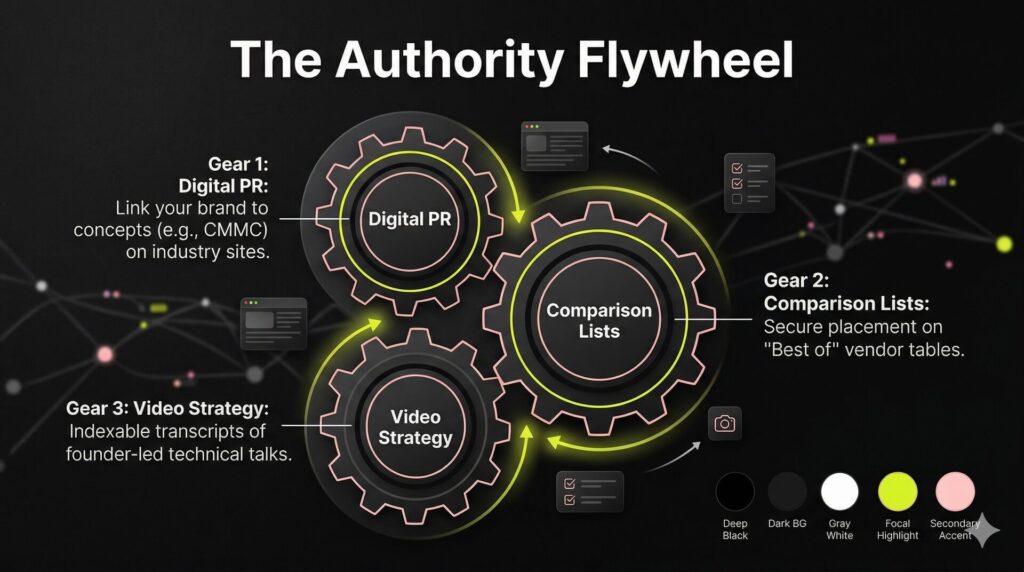
Focus on an authority flywheel built around three core pillars:
- Digital PR: Focus on category association by linking your brand to specific concepts like M&A Readiness on industry sites.
- Comparison Lists: Secure placements in credible best of lists and vendor comparison tables within the MSP space.
- YouTube Strategy: Publish founder-led webinars and conference talks. Ensure indexable transcripts are available, as AI models increasingly ingest video data to identify SMEs.
Operationalize this by building a Mention Map of publications and communities where your ICP learns. Pitch linkable assets like original benchmark tables, frameworks, or market maps instead of generic guest posts. For example, a research piece on CMMC readiness vendor selection should be repurposed into a blog post, a PDF summary, and a guest post for a compliance portal. This multi-channel approach creates the high-intent signals that move you into the AI's generated shortlist.
Avoid the pitfall of chasing generic backlink volume. Success requires concept association through repeat mentions in the right technical ecosystems. One citation on a respected cybersecurity blog outweighs fifty low-tier directory listings for building AI-ready authority.
7. The New Attribution: Proving ROI in a Zero-Click World
The primary executive objection to an AI search marketing strategy is the click gap. When LLMs provide technical solutions without referral links, traditional last-click attribution fails. To prove ROI to a board or private equity firm, marketing must shift from session counting to measuring brand influence where discovery happens upstream but value manifests as branded search spikes and direct requests.
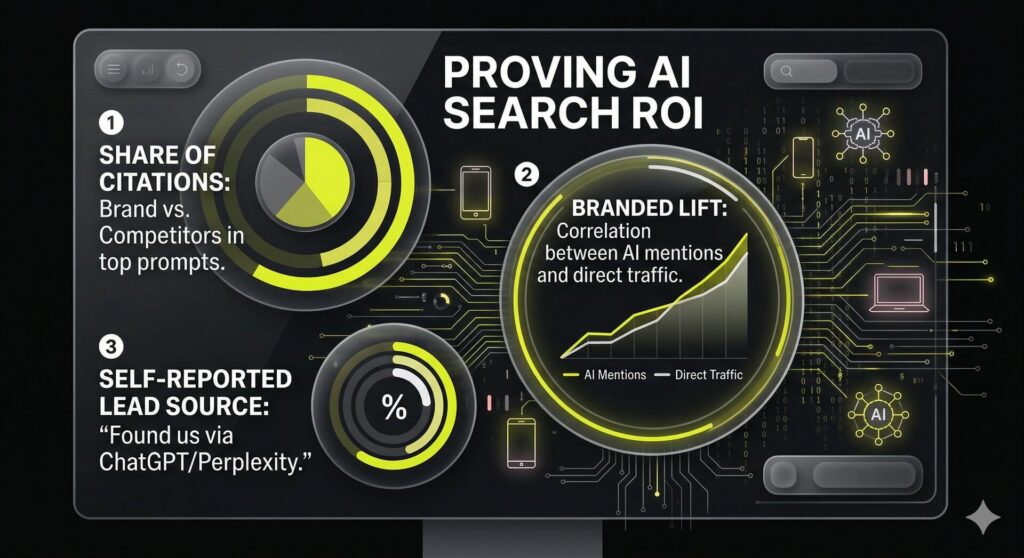
CMOs can implement a pragmatic measurement model through a Weekly AI Visibility Audit.
- Monitor Prompts: Test your 50 highest-intent category prompts (e.g., best MSSP for healthcare compliance).
- Share of Citations: Calculate how often your brand appears in the recommended set versus top competitors.
- Correlation Mapping: Map AI mention frequency against branded search volume and self-reported lead sources.
Update your instrumentation to capture this discovery. Add an explicit AI Tool (ChatGPT, Perplexity, Claude) option to your How did you hear about us? web forms. Track brand-plus-category queries in Search Console to identify prompt-driven intent. Use your CRM to tag leads mentioning AI during sales calls to build an AI-influenced pipeline view.
Report visibility trends and total influenced pipeline to leadership instead of vanity sessions. Proving your firm is the primary cited authority for complex technical queries demonstrates a valuation-multiplying market leadership essential for M&A readiness. For teams needing support building these frameworks and executing technical GEO, Nuoptima’s specialized services bridge the technical authority gap.
8. Platform Differentiation: Calibrating for Engine-Specific Trust
Your firm may lead on Perplexity while remaining invisible in Google AI Overviews. This gap persists because generative engines are not a monolith. Each model possesses unique trust biases and source preferences. To master your AI search marketing strategy, treat every engine as a distinct distribution surface with a specific algorithmic personality.
Effective execution requires a segmented approach to authority:
- Google AI (SGE/AIO): Deeply anchored in traditional web indexing. Success requires impeccable crawlability, high topical authority, and content structured for direct answers.
- Perplexity-style Engines: Function as real-time research tools. These prioritize third-party citations, industry best of lists, and independent reviews over owned marketing collateral.
- ChatGPT/SearchGPT Discovery: Favors unmistakable entity data and cite-ready content blocks. These require strong off-site corroboration to verify brand existence.
Operationalize this through an Engine Delta Log. For every high-intent prompt cluster, test across all three platforms and document source variations. Note whether the engine prefers FAQ or long-form technical guides and if your brand site is trusted as a primary citation.
Consider the query Best SOC2 MSSP. Perplexity often favors a third-party cybersecurity listicle, while Google AI might cite an authoritative guide. ChatGPT frequently prioritizes vendor explainer pages that define a specific compliance specialty. Avoid the pitfall of assuming one tactic translates across all engines. Continuous testing ensures technical authority remains visible regardless of the prospect’s chosen interface.