Stop choosing between a technical SEO backlog and a content calendar that feels like generic blogging. b2b content seo wins only when clusters mirror the full funnel and the technical buying committee simultaneously. This is revenue infrastructure engineered for 2026, delivering higher-intent visibility, logical internal linking, and definitive AI citations. Below are seven tactics, a step-by-step build workflow, and FAQs to resolve prioritization objections, allowing teams to justify budgets alongside standard market SEO pricing models. We begin with cluster architecture mapping awareness to conversion.
Key Takeaways
- B2B content SEO wins when clusters mirror the full funnel and the technical buying committee at once, treating content as revenue infrastructure rather than generic blogging.
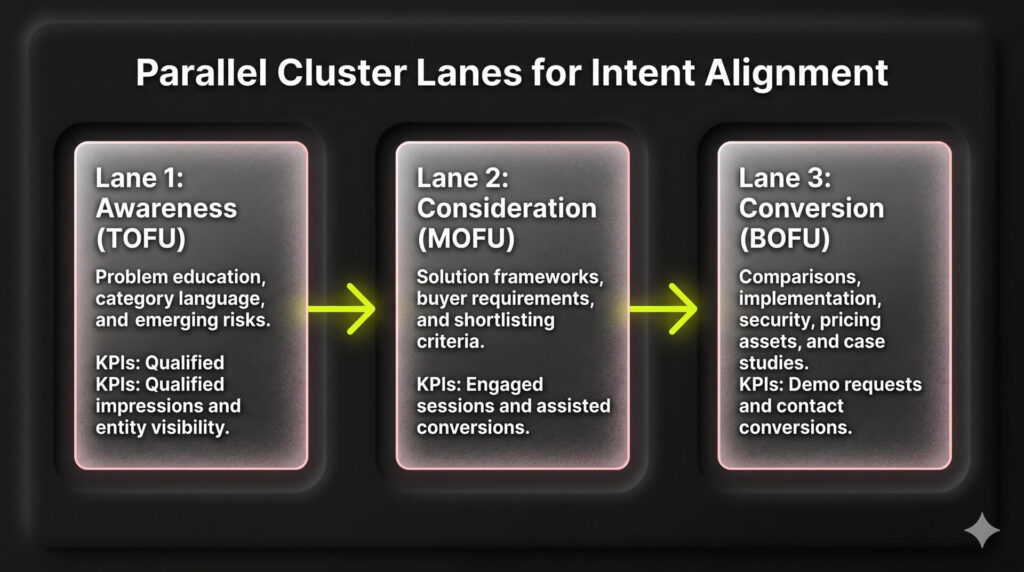
- Build three parallel cluster lanes per product category: awareness (TOFU) for reach and AI citations, consideration (MOFU) for solution frameworks, and conversion (BOFU) for comparisons and pricing.
- Ship multi-stakeholder pages that answer role-specific objections from the CFO (ROI), CISO (security), CTO (integration), and end-user (onboarding) to reduce sales-cycle friction.
- Make the product or solution page the pillar, not the blog, and route authority into it with circular internal linking so conversion-ready pages rank.
- A minimum viable B2B cluster is one pillar plus six to ten spokes, including at least one bottom-of-funnel comparison and one proof asset like a case study or ROI calculator.
B2B content SEO is the practice of building funnel-aligned topic clusters and multi-stakeholder pages that capture buyer intent across Google and generative engines, turning content into revenue infrastructure rather than standalone blog posts.
1. Build Parallel Cluster Lanes for Intent Alignment
Massive traffic volume often fails to generate pipeline because flat cluster architectures treat all queries as equal. To build revenue-first search infrastructure, deploy three parallel cluster lanes per product category to ensure demand capture. This prevents traffic stagnation by aligning supporting pages to specific stages of buyer intent.
- Awareness (TOFU): Focus on problem education, category language, and emerging risks to secure reach and AI citations.
- Consideration (MOFU): Deliver solution frameworks, buyer requirements, and vendor shortlisting criteria to satisfy research phases.
- Conversion (BOFU): Prioritize comparisons, implementation, security, or integration details, pricing assets, and case studies to capture demand.
B2B committees ask different decision questions. Practitioners require technical depth, while CMOs need ROI proof. Track performance using intent-specific KPIs:
- TOFU: Qualified impressions and entity visibility.
- MOFU: Engaged sessions and assisted conversions.
- BOFU: Demo requests and contact conversions.
2. Ship Multi-Stakeholder Pages to Dismantle Objections
B2B content SEO converts when it satisfies the entire buying committee, not just the primary user. High-ranking clusters often stall because they ignore role-specific objections that block procurement at the finish line.
To build a multi-stakeholder conversion engine, add these page types to your clusters:
- CFO Lane: ROI projections, payback period assumptions, and the quantified cost of inaction.
- CISO Lane: Security posture, compliance mapping, and data handling protocols.
- CTO Lane: API architecture, integration workflows, and scalability constraints.
- End-User Lane: Onboarding playbooks, change management, and workflow adoption.
Link these role-specific assets to your main solution pillar using intent-matched anchor text. This architecture proactively answers procurement-blocking objections, raising intent density and reducing sales-cycle friction by delivering the definitive proof every stakeholder needs to sign off.
3. Pivot to Product-Led Hubs for Direct Revenue Authority
B2B brands often fail because their blogs rank while product pages stagnate. To drive pipeline, shift your architecture by making the solution page the pillar. This product-led cluster earns topical relevance through spokes, routing authority directly into conversion-ready pages.
Build the hub around the category and core buyer pain. Supporting spokes must remove technical friction and provide concrete substance for the bottom-funnel:
- Integration and implementation guides
- Security, compliance, and ROI calculators
- “X vs. Y” comparisons and case studies
Maintain strict b2b content seo guardrails by keeping each spoke single-intent. Do not dilute the pillar with secondary keywords. Use circular internal linking: spokes link to the pillar to pass authority, while the pillar links to spokes for topical depth. Deploy a consistent above-the-fold CTA across the entire hub to capture intent as it manifests.
4. Deploy a Funnel-Stage Internal Linking Spec
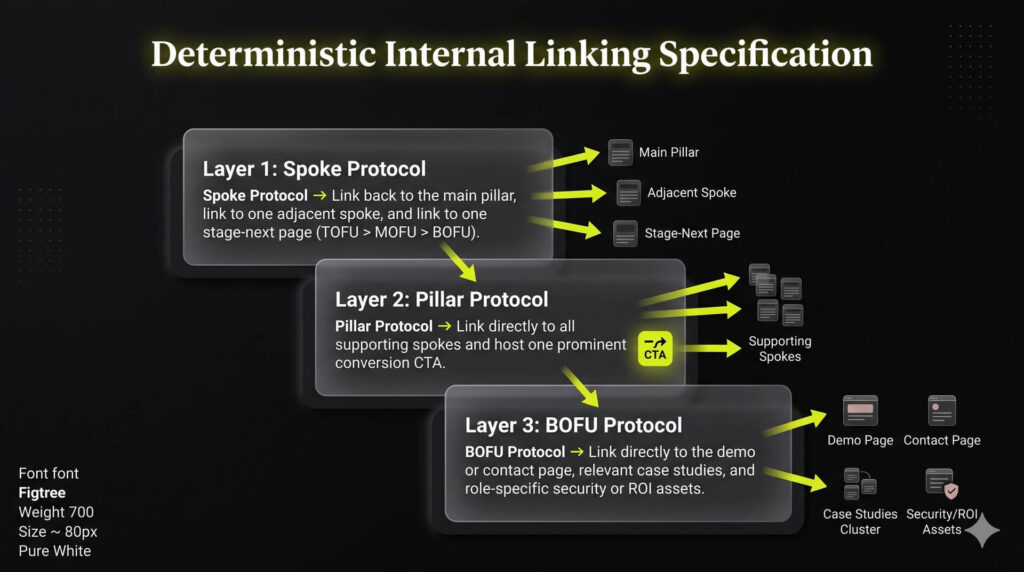
Content clusters fail to drive pipeline when internal linking is a “best effort” afterthought rather than a repeatable technical spec. Without a rigid protocol, authority dissipates instead of flowing toward high-value conversion pages. A deterministic spec solves the “disconnected content” problem by aligning site architecture to intent.
Implement a strict internal linking spec to compound authority without manual chaos:
- Spokes: Link to the pillar, one adjacent spoke, and one stage-next page (TOFU > MOFU > BOFU).
- Pillars: Link to all spokes and one conversion CTA.
- BOFU: Link to the demo/contact page, case studies, and role-specific security or ROI assets.
Track link targets in a spreadsheet and deploy via CMS modules for scalability. Run a final QA checklist to verify orphan detection, anchor relevance, and crawl depth. This infrastructure ensures B2B content SEO generates a compounding authority effect across all search surfaces.
5. Audit Technical Foundations vs. Content Gaps
Technical SEO sets the visibility ceiling while content clusters pull demand through it. If your infrastructure is broken, b2b content seo remains expensive noise. To resolve prioritization deadlocks, triage 5 to 10 conversion-path URLs, such as solution pages and comparison guides.
Audit these assets for specific blockers:
- Indexation status and canonical correctness
- Internal link depth and renderability
- Content duplication and entity clarity
If high-intent pages are not reliably crawled, indexed, or trusted by search engines and AI agents, fix technical debt first. If pages are technically sound but lack intent coverage for specific buyer roles, content clusters are the bigger lever.
This diagnostic creates a two-lane roadmap where technical fixes unblock visibility while clusters drive conversions. Success is measured by time-to-index, ranking stability, and the conversion rate of BOFU pages. This approach ensures every dollar invested produces measurable pipeline impact.
6. Engineer Clusters for LLM Citation and GEO Authority
B2B content SEO is splitting. AI Overviews and generative engines now cannibalize clicks. To maintain visibility, your clusters must pivot from rankable assets to citable sources. Your objective is to become the definitive entity an LLM retrieves to build its response.
Refine on-page execution to prioritize machine extractability:
- Citation Blocks: Add three declarative, entity-rich definitions per pillar. Include specific constraints and when-to-use scenarios.
- Structured Formatting: Use TL;DR summaries and Q&A sections to help models parse data.
- Verifiable Facts: Ground claims in numbers or industry standards to increase cite-worthiness.
Modernize your KPIs. Stop reporting rank alone. Track brand citations across AI surfaces and assisted conversions to measure true market share and visibility.
This is the NUOPTIMA advantage. As the AI-native SEO and GEO authority partner, we solve AI invisibility by building content infrastructure that compounds across Google and generative engines to drive predictable organic revenue.
7. Measure Pipeline Impact Over Vanity Traffic
Leadership prioritizes revenue infrastructure over viral volume; B2B topic clusters win on intent density and conversion assistance. Stagnant demos despite rising top-of-funnel (TOFU) traffic suggest structural content gaps. This indicates missing middle-of-funnel (MOFU) or bottom-of-funnel (BOFU) pages required to capture buyer intent.
Track these metrics to validate your b2b content seo investment:
- Assisted conversions from TOFU/MOFU assets to demo, contact, or case study pages
- BOFU engagement signals like scroll depth on security and integration sections and ROI calculator clicks
- Lead quality proxies including landing page conversion rates and downstream SQL data
Balance leading indicators like indexation, internal link health, and assisted journeys with lagging pipeline metrics, keeping in mind realistic expectations for how long does SEO take to work in complex B2B sectors. This model solves executive objections by connecting organic strategy directly to revenue. It reflects real B2B buying behavior where research cycles are long and attribution requires a multi-touch framework.
How to Execute Your B2B Content SEO Cluster Workflow This Week
Run this b2b content seo workflow when you need a core product category to rank and convert using a strategic map that satisfies committee stakeholders. This framework builds revenue infrastructure to capture Google searchers and generative engine retrievals.
Phase 1: Gather Your Inputs
Collect these data points to ground your cluster in commercial reality:
- One Pillar Candidate: Select a high-value product or category page.
- Competitor URLs: Identify three to five URLs currently outranking your target category.
- Sales Objections: List the top 10 reasons deals stall or procurement fails.
- Funnel Definitions: Confirm internal criteria for awareness, consideration, and conversion stages.
Phase 2: Execute the Implementation Steps
Follow this sequence to transition from a conceptual cluster to an implementable spec.
- Select the Pillar Type: Commit to either a blog pillar or a product-led pillar. Use a product-led pillar to drive direct revenue impact by centering the hub on a solution page.
- Map Three Intent Lanes: Assign specific page types to the TOFU, MOFU, and BOFU lanes. Use educational guides for awareness, solution frameworks for consideration, and pricing or implementation specs for conversion.
- Add Committee Spokes: Include non-negotiable pages that dismantle stakeholder objections. Create specific spokes for the CFO regarding ROI, the CISO regarding security, and the CTO regarding integrations or adoption.
- Define Internal Linking Rules: Document linking logic in a centralized sheet. Mandate that every spoke links back to the pillar to pass entity authority. Use stage-next links to guide users from awareness assets to consideration and conversion pages.
- Deploy GEO Citation Blocks: Add declarative sections to the pillar and top three spokes. Include clear definitions, constraints, and when-to-use scenarios. These entity-rich blocks facilitate LLM extraction and increase AI visibility.
- Set Performance KPIs: Measure success through indexation health, assisted conversions on demo pages, and AI visibility signals. You will see improved topical authority as your brand becomes the cited answer in search results.
If your team requires specialized help to compete in AI answer engines, visit nuoptima.com and explore our generative engine optimization (GEO) services to secure your brand’s authority.
FAQ
AI search makes topic clusters more critical than ever. Generative engines and Google AI Overviews use clusters to establish entity coverage and semantic authority. These structures create the internal linking signals and topical depth needed for a brand to become a citable source. To remain relevant, brands must transform clusters into authoritative knowledge bases featuring extractable citation blocks specifically designed for LLM retrieval and synthesis.
A minimum viable B2B cluster consists of one pillar page and six to ten supporting spokes. Revenue impact comes from intent coverage rather than sheer page volume. Prioritize including one bottom-of-funnel comparison and one high-authority proof asset, like a case study or ROI page, in the initial build. Only expand the cluster once the core pages achieve stable indexation and consistent internal linking signals.
The fastest way to drive a pipeline is to build clusters from the bottom up. Start with conversion-centric assets such as product comparisons, security specifications, and ROI calculators before creating top-of-funnel educational content. This approach captures high-intent buyers immediately. Route all internal link equity toward these conversion paths and use paid amplification to accelerate engagement on your most valuable consideration-stage pages.
Technical SEO defines your visibility ceiling. Before scaling, you must guarantee crawl and indexation reliability through clean canonicals, correct sitemaps, and a lack of accidental noindex tags. A clear information architecture is necessary to avoid orphaned pages that dissipate authority. Additionally, use templates that support consistent heading structures and schema deployment. These prerequisites ensure that search engines and AI crawlers can effectively parse and index your topical depth.
Engage a specialist partner when your team lacks the capacity to dominate both Google rankings and AI answer engines like ChatGPT and Perplexity simultaneously. If organic leads are flat or your technical roadmap ignores generative engine optimization, professional intervention is required to secure your market share. NUOPTIMA offers strategic advisory and full-scale execution for brands that need to be the definitive answer.
Visit nuoptima.com and our GEO services page to learn more.
Where this fits in your MSP growth system
This is one piece of how NUOPTIMA makes MSPs and cybersecurity firms the provider buyers find on Google and in AI search. See how it connects to MSP content marketing and MSP SEO, or get your free MSP lead forecast to see exactly where your firm shows up across ChatGPT, Gemini, and Perplexity today.