Relevance puts your brand in the running. Trust wins the selection. Modern seo trust signals are technical evidence that a real entity stands behind your content. They are not cosmetic badges. This framework covers machine-readable entity signals, on-site credibility, and off-site reputation. Strategic changes drive visibility this week while authority compounds over 90 days. NUOPTIMA ensures your brand is the cited answer across Google and generative engines through our specialist GEO services.
Key Takeaways
- SEO trust signals are technical evidence that a real entity stands behind your content, not cosmetic badges, and they cover machine-readable entity signals, on-site credibility, and off-site reputation.
- Start with a machine-readable entity identity: deploy Organization JSON-LD with a stable @id, plus sameAs links to authoritative profiles like LinkedIn, Wikidata, or Crunchbase.
- Link every author byline to a profile with credentials and Person schema, and add a reviewedBy field on YMYL topics to signal editorial scrutiny.
- Authority is never self-asserted: prioritise independent, high-signal mentions over raw backlink volume to build credible off-site trust.
- Apply AggregateRating schema only on policy-compliant service pages, never sitewide, to surface reviews without triggering manual actions.
SEO trust signals are machine-readable and on-site signals (entity schema, verified authorship, independent mentions, and reputation data) that prove a real, credible entity stands behind your content so search and AI engines cite it.
1. Establish a Machine-Readable Entity Identity
AI engines ignore content if they cannot map it to a verified entity. Entity resolution is the foundation of SEO trust signals. Generative engines and LLMs require a machine-readable ID to distinguish your brand and grant citations.
To eliminate ambiguity and accrue authority, follow this implementation checklist:
- Deploy Organization JSON-LD with a stable @id URI, legal name, logo, and contact point.
- Use sameAs links to authoritative profiles like LinkedIn, Wikidata, or Crunchbase.
- Maintain identical branding and NAP data across the footer, About page, and schema.
Success is confirmed when the Rich Results Test passes, the @id is reused site-wide, and sameAs links are indexable. This technical architecture ensures your brand is eligible for citations in AI-generated answers.
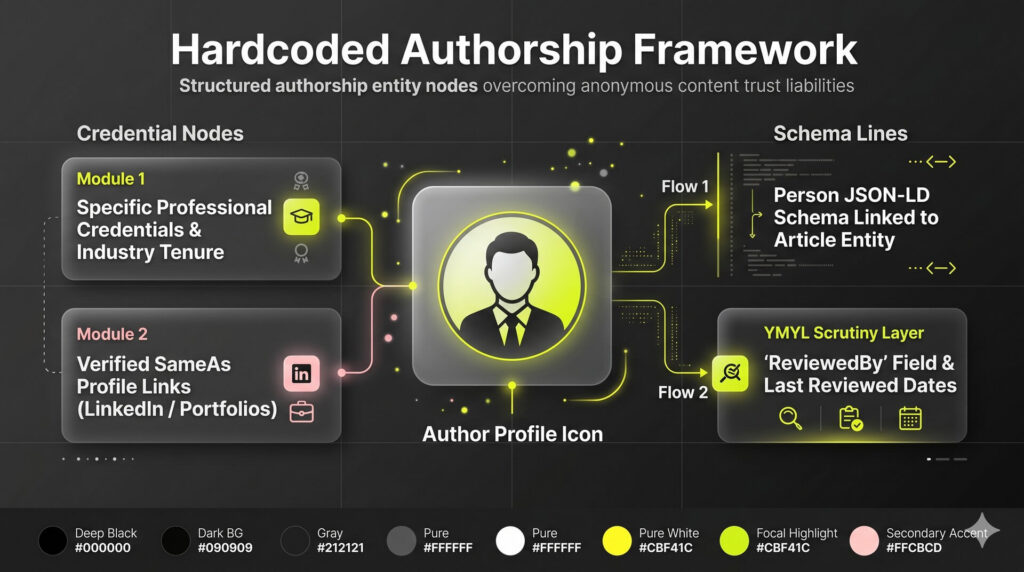
2. Hardcode Expertise via Verified Authorship and Editorial Review
Anonymous content is a ranking liability. Optimize SEO trust signals by transforming abstract expertise into machine-readable architecture. "Who wrote this" is the trust gate for users and AI raters.
Link every author byline to a dedicated profile. Treat these as entity nodes including:
- Specific professional credentials and industry tenure.
- Verified sameAs links to LinkedIn or portfolios.
- Person JSON-LD schema linking the author to the Article entity.
For YMYL topics, add a reviewedBy field to signal editorial scrutiny. Verify authors are real individuals with specific expertise, not generic personas. This architecture eliminates anonymous content perception, ensuring your brand is the cited authority in both Google and AI search results.
3. Engineer High-Intent Proof Through Proprietary Data Modules
Generic content fails to earn trust, backlinks, or AI citations. To secure market share, transform static pages into evidence-backed conversion engines that demonstrate practitioner status.
Embed proof modules above the fold on high-intent pages:
- Mini case studies: sequence the problem, approach, and measurable outcomes with specific dates.
- Visual assets: include screenshots, templates, or "what we did" sequences.
- Original benchmarks: share internal datasets with clear methodology notes.
Connect these modules to specific entities like client types, tool stacks, and industry constraints to reinforce topical relevance. This architecture ensures humans and LLM crawlers identify your brand as the definitive, citation-worthy source. Shifting from advice to demonstrated expertise stabilizes rankings and accelerates lead confidence.
4. Validate Brand Reputation with Independent Entity Mentions
Authority is never self-asserted. Without independent references, your domain remains a closed loop. Prioritize high-signal mentions over raw backlink volume to build authentic seo trust signals.
- Secure curated placements: industry lists, podcast notes, and conference speaker bios.
- Apply consistent entity pairing: [Brand Name] + [Service Category]. This forces LLMs to associate your brand with its primary attribute.
- Consolidate wins on a "Mentions" page to centralize proof and internal linking.
LLMs cite curated directories when recommending vendors. Absence from these sources makes your brand invisible in the AI answer layer. Audit progress via referring domains and convert unlinked mentions into links to maximize authority.
5. Surface Third-Party Reputation Without Triggering Schema Misuse
Users and search evaluators demand rapid external proof to verify authority. Mismatches between social proof and Google’s structured data policies frequently suppress visibility by flagging self-serving reviews. To build trust ethically, select two platforms your ICP prioritizes, such as Trustpilot for e-commerce or Clutch for B2B services.
Implement reputation signals with technical precision:
- Embed specific review excerpts with clear attribution and direct links to source profiles.
- Apply AggregateRating schema only on policy-compliant service pages.
- Never deploy review schema sitewide to avoid manual actions.
Place reputation blocks near primary CTAs to lower buyer skepticism and increase conversion rates. Operationally, automate a post-win request cadence and respond publicly to all feedback. This reinforces off-site trust signals that search systems corroborate while converting organic traffic into revenue.
6. Eliminate Technical Friction Points that Leak Trust
Trust is fragile. A single red flag can negate years of credibility work. These trust leaks suppress conversions by signaling a lack of operational maturity to savvy B2B buyers, highlighting why addressing zero-click SEO for IT services is crucial for modern MSP tech companies.
Audit revenue-driving pages against this checklist to stop leaks competitors often miss:
- Enforce HTTPS everywhere. Fix mixed content and deceptive redirects.
- Purge broken links, dead author pages, and outdated claims that suggest stagnation.
- Eliminate aggressive interstitials and "download gates" on trust-critical content.
- Replace generic stock imagery with real photos and scannable, accessible design.
Core Web Vitals serve as friction reducers, not just ranking badges. You are finished when top landing pages show zero critical UX or security errors.
7. Audit Basic Pages into Strategic Trust Assets
B2B buyers and AI search engines prioritize verifiable entities. Anonymous sites fail to close high-ticket contracts because they lack baseline transparency. Transform generic compliance pages into strategic assets to lower the perceived risk of brand engagement.
- About: Detail specific history, team expertise, and your operating model to highlight differentiators.
- Contact: Include real email addresses, physical locations, and clear response expectations.
- Legal: Maintain comprehensive privacy, service, and refund terms to establish technical credibility.
Push these trust signals into the crawl path by linking About and Contact pages in the global footer. Embed "About the Author" or "About the Company" blocks on money pages to reduce sales friction. Transparency signals operational maturity to humans and AI crawlers, converting traffic into qualified pipelines.
8. Substantiate Claims with Authoritative Citations
Unsupported assertions read as low-value marketing, collapsing trust with sophisticated buyers. In semantic SEO, citations reinforce entity relationships and topical precision. For GEO, these signals improve extractability and brand credibility within synthesized AI answers. Factual claims must link to primary, authoritative sources to transform generic copy into verifiable technical authority.
- Standardization: Use consistent citation styles and avoid low-value link dumps.
- Transparency: Publish a “Research Standards” page to document editorial rigor and link to it from all articles.
- Tactical Tip: Embed “Key Takeaway” blocks. These are engineered for AI engines to extract and cite in generative summaries.
- Governance: Implement quarterly refreshes for statistics and screenshots to ensure content remains evergreen and machine-credible.
9. Implement Rigorous Trust Protocols for YMYL Content
YMYL (Your Money, Your Life) topics face a higher trust threshold than general niches. Google’s standards create a trust ceiling that relevance alone cannot breach. To protect rankings and maximize seo trust signals, deploy this integrity checklist:
- Verified Credentials: Map bylines to licenses and professional affiliations using Person schema.
- Reviewer Oversight: Use formal review steps and display "Last Reviewed" dates for sensitive advice.
- Transparency: Embed disclaimers, escalation paths, and contact details for user recourse.
- Reputation Requirements: Secure third-party press and reviews to verify authority via external entities.
Route authority from informational clusters into YMYL pages only after these basics are hardcoded. This bridges the trust gap that nullifies relevance and stalls your organic pipeline.
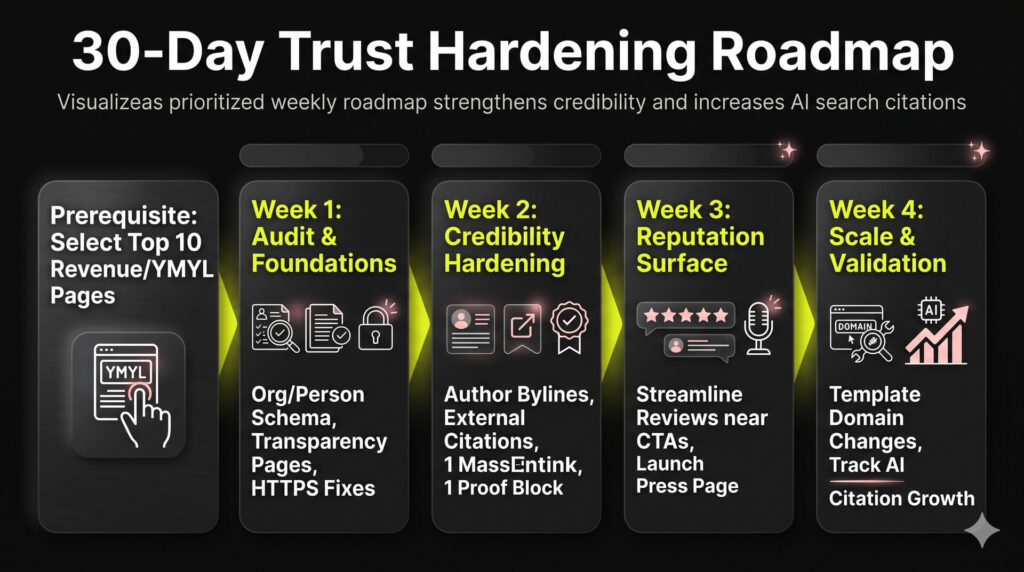
How to Implement SEO Trust Signals: A 30-Day Roadmap
Implement this roadmap to strengthen seo trust signals without exhausting developer bandwidth. Focus on high-impact pages first to capture immediate organic revenue.
Prerequisite: Asset Selection
Pick your top 10 pages based on revenue intent, traffic volume, and YMYL sensitivity. These assets act as your primary authority testing grounds for entity resolution.
Week 1: Audit and Entity Foundations
Establish a machine-readable identity by deploying Organization and Person schema. Review your About, Contact, and Privacy Policy pages to ensure baseline transparency. Fix all HTTPS errors and critical crawl issues to remove technical barriers to trust.
Week 2: Content Credibility Hardening
Attach detailed author bylines to every target page and link them to verified social profiles via Person schema nodes. Support major claims with citations from high-authority external sources. Integrate one proof block, such as a case study or proprietary data set, to validate your expertise.
Week 3: Reputation Surface
Streamline your review acquisition workflow. Surface high-intent customer testimonials near primary CTAs to boost conversion rates. Launch or refresh a dedicated Press page to aggregate third-party mentions and independent media citations.
Week 4: Scale and Performance Validation
Apply successful trust modules as template changes across the entire domain. Monitor Google Search Console to track rich snippet performance and indexing speed. Document the before-and-after metrics to measure improvements in AI search citation growth.
If you want this executed as an SEO + GEO system, book NUOPTIMA to explore our GEO services.