Most teams built their legacy stacks for Google rankings, yet modern visibility requires winning AI engine citations simultaneously. SEO managers do not buy software; they buy speed and defensible pipeline. This workflow-first selection method for ai seo tools prioritizes research, content creation, optimization, and AI tracking. Use these ROI-focused criteria to justify spend and build authority. Before building your stack, define which search visibility surface you are optimizing for.
Key Takeaways
- Select AI SEO tools by workflow (research, content, optimization, AI tracking) and ROI, not features, since managers buy speed and defensible pipeline.
- Evaluate tools across three visibility surfaces: classic SERP rankings, Google AI Overviews, and direct LLM citations in engines like ChatGPT and Perplexity.
- Establish one primary intelligence suite like Semrush or Ahrefs as your single source of truth before adding generative tools, because AI only accelerates a flawed strategy.
- A lean stack is one intelligence suite, one content optimizer, one LLM for drafting, and a lightweight AI-visibility tracker, expanded only when KPIs justify it.
- Keep any tool that moves a revenue-aligned KPI or speeds execution, and cut any that only offers proprietary scores.
1. Differentiate Between Google Rankings and AI Citations
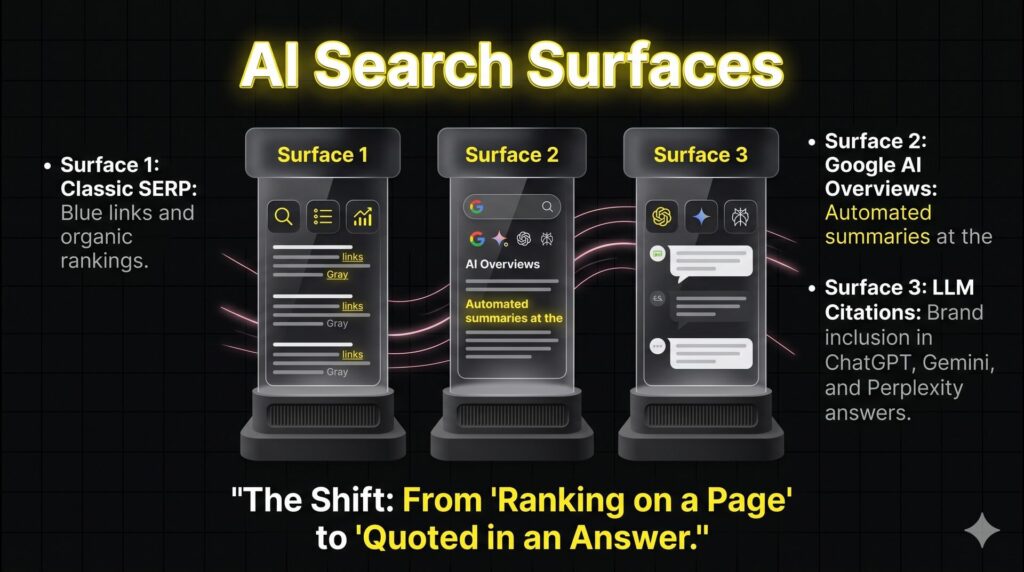
Traditional Google rankings no longer guarantee pipeline. Buyers increasingly research via ChatGPT, Gemini, and Perplexity, shifting the goal from being ranked on a page to being quoted in an answer. To build a future-proof stack, your ai seo tools must distinguish between three surfaces:
- Classic SERP Rankings: Traditional organic blue links.
- Google AI Overviews: Summaries that often reduce clicks but influence intent.
- LLM Citations: Direct brand inclusion in generative engine responses.
Evaluate tools by their ability to measure visibility at the prompt or topic level. Generic brand-level mentions are insufficient, as you need visibility into cited URLs to optimize the specific assets fueling AI responses. Use specialized prompt trackers or Semrush’s AI features to report monthly on AI share-of-voice alongside rankings. This ensures you invest in citation authority rather than just AI-generated filler content.
2. Solidify Your Data Foundation Before Scaling
AI is a force multiplier for poor strategy. Flawed data foundations mean automation only accelerates the path to zero ROI. Establish a primary intelligence suite like Semrush or Ahrefs as your single source of truth for:
- Keyword research and intent mapping
- Competitive SERP analysis
- Rank tracking
Select platforms based on trusted data coverage and workflows like scheduled reports and project exports. Prioritize suites with AI assistants that flag high-impact technical issues to reduce analysis time.
Standardize definitions for topic, cluster, priority, and expected business outcome before adding generative ai seo tools. This anchors automation to reliable data and prevents tool sprawl. Without this alignment, you risk scaling content that ranks but fails to drive pipeline. Precise intent mapping is a strategic requirement that AI amplifies but cannot invent.
3. Prioritize Entity Mapping for GEO Visibility
AI engines assemble answers using relationships between entities rather than keywords. To dominate, your ai seo tools must transition from keyword hunting to entity mapping. Prioritize platforms offering topic clustering and gap analysis tied to real user questions and buyer stages. This ensures your content architecture is retrievable by generative systems.
Evaluate software by its ability to map prompts to specific pages and entities. Effective tools surface competitor inclusion in AI answers, revealing who gets cited for specific sub-questions. Use this data to design self-contained FAQ blocks and answer paragraphs that engines lift cleanly.
The definitive outcome metric is your brand’s inclusion rate across relevant prompts. This solves the gap where brands rank in traditional search but remain uncited by LLMs. Aligning research with AI retrieval ensures your brand is the trusted source generative engines recommend to buyers.
4. Deploy Content Optimizers for Structure over Scores
Treating content scores as a final grade creates robotic copy that ignores E-E-A-T and misses AI citation filters. View ai seo tools like Surfer, Clearscope, or Frase as structural blueprints, not sources of truth. These platforms excel at:
- Building content briefs and heading structures.
- Identifying missing subtopics and intent gaps.
- Standardizing technical on-page elements.
Select software based on brief quality and suggested questions. Prioritize tools that protect readability and prevent optimizer voice from degrading the user experience.
Governance is your differentiator. An editor pass must verify factual accuracy, include unique examples, and ensure the text contains extractable answers for AI summaries. Monitor time-to-brief and refresh velocity to maintain a competitive advantage. This framework scales content refreshes without producing generic pages that fail to earn trust.
5. Implement Workflow Controls for AI-Generated Content
Publishing raw AI drafts dilutes brand authority and risks search penalties. To bridge the AI-content risk gap, determine if you need ai seo tools for high-volume drafting or targeted acceleration of sections like intros and FAQs. The decision is less about the writer and more about which workflow controls you implement.
Selection criteria must prioritize:
- Brand voice alignment
- Collaborative features
- Source traceability
An engineered, multi-pass workflow is your primary differentiator. This sequence includes research synthesis, outlining, section-by-section drafting, readability passes, and final conversion audits.
Pair LLMs like Jasper or Writesonic with a rigid editorial QA layer to ensure content remains citation-worthy. This reduces editor time per page while maintaining the high-value insights generative engines require for visibility. This system transforms AI from a liability into a repeatable engine that produces publishable drafts, not raw outputs.
6. Automate Technical Execution to Bypass Developer Bottlenecks
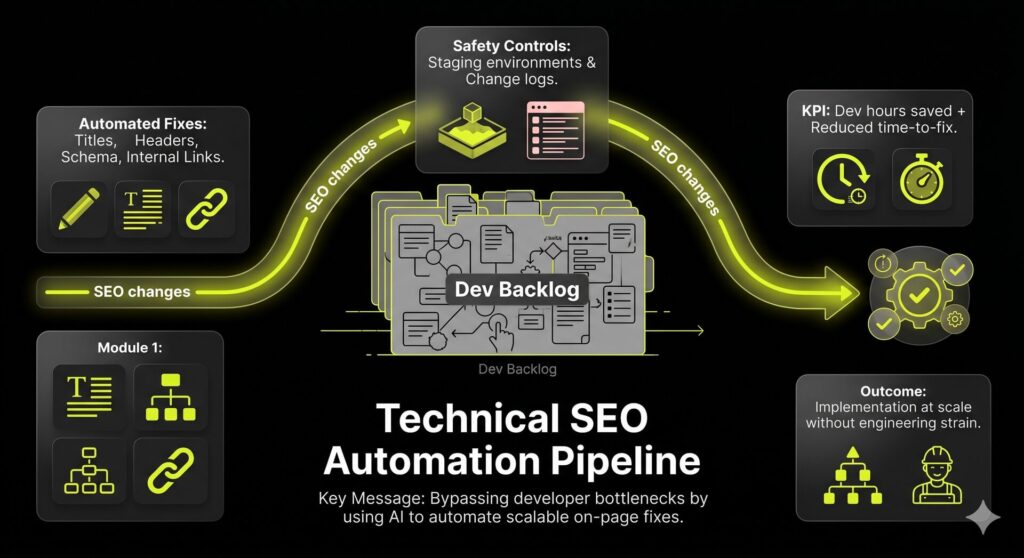
SEO strategies often die in developer backlogs. Manual implementation moves too slowly for the modern search landscape. Use ai seo tools to automate scalable on-page fixes like titles, headers, and internal link suggestions. This bypasses engineering sprint cycles and accelerates implementation across thousands of URLs.
Governance is mandatory for production automation. Select tools with staging environments, change logs, and rollback capabilities. Prioritize platforms like Alli AI for automated deployment or Botify and Oncrawl for enterprise-scale monitoring. These tools must handle bulk rules across entire directories to achieve legitimate scale.
The primary KPI is dev hours saved per month plus reduced time-to-fix for recurring issues. This shifts SEO from auditing to shipping. Your technical architecture remains optimized for Google and AI search crawlers without straining engineering resources.
7. Evaluate for Enterprise Integration and Programmatic Scale
Enterprise AI initiatives often stall because of data silos. High-performance ai seo tools must bridge the gap between discovery and execution through a unified stack to achieve programmatic scale.
Use this integration checklist for SEO managers:
- Data In: GSC/GA4, rank tracking, content inventory, and CRM pipeline labels.
- Execution Out: CMS publishing, ticketing (Jira or Asana), and reporting (Looker).
Select platforms offering API access and bulk workflows to run repeatable pipelines for programmatic SEO and content refreshes. Prioritize suites that connect SEO data into LLMs via dedicated connectors. This infrastructure prevents the manual copy-paste work that causes isolated tools to fail at scale.
The primary KPI is cycle time: the speed from insight to shipped change. Effective tools facilitate approval loops where AI suggests, humans approve, and the system logs changes. This reduces execution time from weeks to days.
8. Quantify Tool ROI to Secure Executive Buy-In
Translate your ai seo tools stack into a hard ROI narrative to secure executive buy-in. Categorize impact into three strategic buckets:
- Labor efficiency: Hours saved on research, brief generation, optimization, and reporting.
- Output velocity: Total pages refreshed and new content published per month.
- Visibility impact: Traditional ranking lift plus a measurable increase in AI engine citations.
Prioritize platforms with attribution capabilities that link specific optimizations to search outcomes. Leadership requires reporting on pipeline impact proxies rather than vanity metrics like proprietary scores. Establish a 30-day baseline to track metrics such as time-to-brief, time-to-refresh, and the frequency of your brand appearing in AI search summaries on ChatGPT and Perplexity.
Adopt a strict decision rule: retain tools that move a revenue-aligned KPI or significantly accelerate execution velocity. Cut any platform that offers scores without strengthening search authority or increasing output.
How to Implement Your AI SEO and GEO Roadmap
Tool trials are wasted without clear success metrics. Use this 30-day sprint to transform your ai seo tools from a technical experiment into a revenue-aligned production engine.
1. Establish Baselines and Priority Targets: Select 20 high-intent priority pages and 20 strategic prompts. Map baseline Google rankings alongside current AI mentions in ChatGPT and Perplexity. Define the specific answer your brand must own for each topic cluster.
2. Validate the Optimization Workflow: Run your brief and optimizer workflow on five pilot pages. Document the total editor time per asset and identify quality bottlenecks. Verify that the output meets E-E-A-T standards and includes extractable answers for generative engines.
3. Ship Technical Automation: Deploy technical automation for one repeatable fix class like schema rules or internal link suggestions. Use a tool with rollback capabilities to mitigate risk. This bypasses developer bottlenecks and accelerates site-wide updates across your directory.
4. Report Outcomes and Visibility Deltas: Quantify results for executive review. Report on total hours saved, pages shipped, ranking movement, and AI visibility deltas. Use these outcomes to justify keeping or expanding your current software stack.
Stack Blueprints for Scalable Visibility
- Lean: 1 primary intelligence suite, 1 content optimizer, and 1 LLM.
- Growth: Add AI visibility tracking, technical automation, and advanced reporting.
- Enterprise: Add log file correlation, custom API integrations, and strict governance layers.
For teams that want SEO and GEO engineered end-to-end, explore our GEO services at NUOPTIMA.
Where this fits in your MSP growth system
This is one piece of how NUOPTIMA makes MSPs and cybersecurity firms the provider buyers find on Google and in AI search. See how it connects to GEO and AI-search and answer engine optimization, or get your free MSP lead forecast to see exactly where your firm shows up across ChatGPT, Gemini, and Perplexity today.