Teams frequently deploy FAQPage schema only to find rich snippets never appear. Stop treating schema as a visual hack. In the current search landscape, faq schema seo serves as critical infrastructure for Google AI Overviews and generative engines. Shift your focus to building authoritative answer blocks that LLMs prioritize for brand citations. This six-step playbook and deployment checklist provide the framework to operationalize your strategy. We begin with exactly what changed and what still matters.
Key Takeaways
- Google restricted FAQ rich results in late 2023, but it still parses the underlying data, so FAQ schema now serves as AI infrastructure rather than a visual snippet hack.
- Generative engines like Gemini and Perplexity use FAQ schema as a structured index layer to ground answers and select sources for AI citations.
- Apply FAQ markup only to high-leverage pages (product, service, and high-intent guides) and cap it at three to six single-intent questions per page.
- Build atomic answer units: lead with a one-sentence direct response, add concrete constraints, and match on-page text to the schema exactly.
- Maintain a validation loop with the Rich Results Test and Search Console monitoring, since schema breaks silently during CMS and plugin updates.
1. Beyond the Snippet: FAQ Schema as AI Infrastructure
Google restricted FAQ rich results in late 2023. Elite SEO teams still prioritize the code. While expandable accordions disappeared for most commercial sites, Google continues to parse the underlying data. This highlights the critical distinction between schema processing and rich result rendering.
In a GEO landscape, faq schema seo acts as a structured index layer. Even when visual snippets stay hidden, the code provides a clean map of Q&A pairs for crawlers. Generative engines like Gemini and Perplexity use this architecture to ground answers and select sources for AI citations.
Your objective has shifted from capturing SERP real estate to securing the answer layer. This prevents wasted effort chasing legacy SERP features while preserving the strategic value of structured Q&A. Deploy FAQ schema as machine-ready infrastructure aligned with specific business outcomes:
- Securing AI citations and answer selection for GEO
- Maintaining eligibility for remaining Google rich results
- Driving scalable support deflection and user clarity
2. Strategic Target Selection: Where FAQ Schema Moves the Needle
Sitewide FAQ markup is a legacy tactic that dilutes entity authority. Stop marking up every URL. Prioritize pages where Q&A resolves buying friction and matches query intent. This ensures your schema supports both traditional rankings and AI answer assembly.
Focus on high-leverage targets that provide the structured data AI engines require to build authoritative citations:
- Product and service pages addressing pricing, implementation, and compatibility.
- High-intent guides covering setup steps, requirements, and troubleshooting.
Avoid low-leverage risks like thin blog posts where FAQs repeat H2s or promotional copy disguised as helpful questions. Use this heuristic to select three to six questions per page:
- Extract questions from support tickets, sales call objections, and Search Console queries.
- Only mark up answers that appear on the page verbatim.
This shift prioritizes machine comprehension over low-quality scale to secure Knowledge Graph ownership. Accuracy is the only currency in the generative answer layer.
3. Designing Atomic Answer Units for Extraction
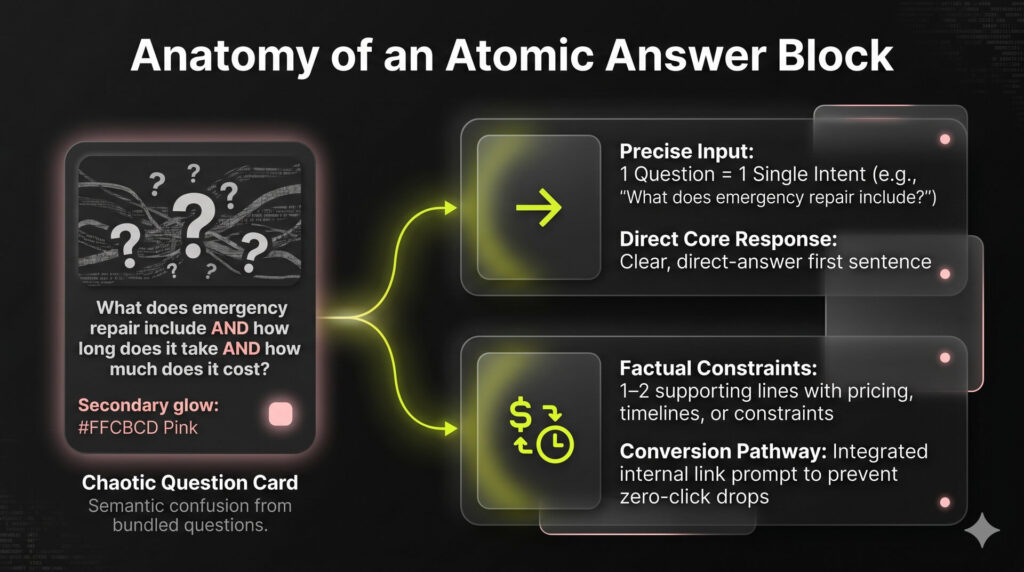
Bundled intents create semantic ambiguity, preventing AI engines from citing your brand. To dominate the answer layer, treat your faq schema seo as atomic units engineered for precise machine extraction.
Design questions with absolute precision. Use the exact phrasing found in support tickets or Google’s “People also ask” results. Ensure each FAQ addresses a single intent. Never bundle queries like “What is the cost and how do I sign up?” because this dilutes entity focus and confuses retrieval systems.
Structure answers as extractable data blocks. Lead with a one-sentence direct response, followed by 1 to 2 supporting lines containing concrete constraints:
- Specific numbers or pricing
- Timeframes and geographic locations
- Technical requirements or exceptions
Match on-page copy to schema text exactly to reinforce authority. Finally, include a short internal link prompt (e.g., “See our full integration guide”) to ensure visibility drives pipeline rather than zero-click dead ends.
4. Technical Implementation: Deploying Clean, Non-Conflicting Code
“Schema drift” happens when JSON-LD separates from page content. This leads to ignored data or manual actions. To dominate the answer layer, maintain strict technical parity between structured data and visible text.
The non-negotiable requirement is clean JSON-LD using the @type: FAQPage structure. Every mainEntity must map a single Question to its specific acceptedAnswer. This text must be visible on the page to avoid spam violations.
Audit for these common failure modes:
- Marking up content that is not presented to users.
- Over-marking with too many questions that dilute topical relevance.
- Conflicting structured data from overlapping plugins or scripts.
Platform-specific execution:
- WordPress: Block output is sufficient if you validate the JSON-LD via the Rich Results Test.
- Shopify or Headless: Use template or metafield-based injection to ensure per-page uniqueness.
Validating this architecture ensures your markup is processed and trusted instead of silently failing due to policy conflicts.
5. Operationalizing Quality Control: The FAQ Validation Loop
Treating schema as a one-time task erodes entity authority. Operationalizing quality control prevents invisible failures where schema is invalid, outdated, or inconsistent across releases.
Pre-publish Checklist
Verify visible FAQ blocks match JSON-LD text exactly. Discrepancies signal low quality to Google and generative engines. Use the Rich Results Test to ensure your faq schema seo is valid and extractable.
Post-publish Monitoring
Structured data breaks during technical updates. Monitor Google Search Console reports for errors. Establish a recurring QA cadence after CMS or plugin updates to catch silent failures before they impact citations.
Regression Patterns to Detect
Detect these integrity failures to protect authority:
- Duplicate FAQPage nodes that dilute topical focus.
- ‘Ghost schema’ where code remains without UI elements.
- Copy edits that update text but not schema.
Data integrity is the baseline for LLM brand citations.
6. Scaling FAQ Systems: Governance and Global Deployment
Scaling FAQ schema across thousands of pages fails when treated as a volume exercise rather than a governance challenge. Without guardrails, teams create maintenance debt or trigger spam filters through inconsistent implementation.
Deploy a hybrid scaling pattern. Use templated FAQs for shared objections like shipping or timelines, then layer in unique, per-page technical specifics to maximize faq schema seo impact. Implement via structured CMS components or metafields to prevent free-form JSON edits that break site architecture.
Strict governance protects your entity authority. Establish these guardrails:
- Cap questions at 3 to 6 per page to avoid content dilution.
- Define allowed topics per page category.
- Assign one owner for schema output to prevent competing plugins from emitting conflicting graphs.
Measure success through business outcomes rather than rich result appearances. Track support ticket deflection, on-page conversion lift, and utilize tools to track AI search engine citations effectively. Prune FAQs that are thin, promotional, or create maintenance debt without contributing to GEO visibility.
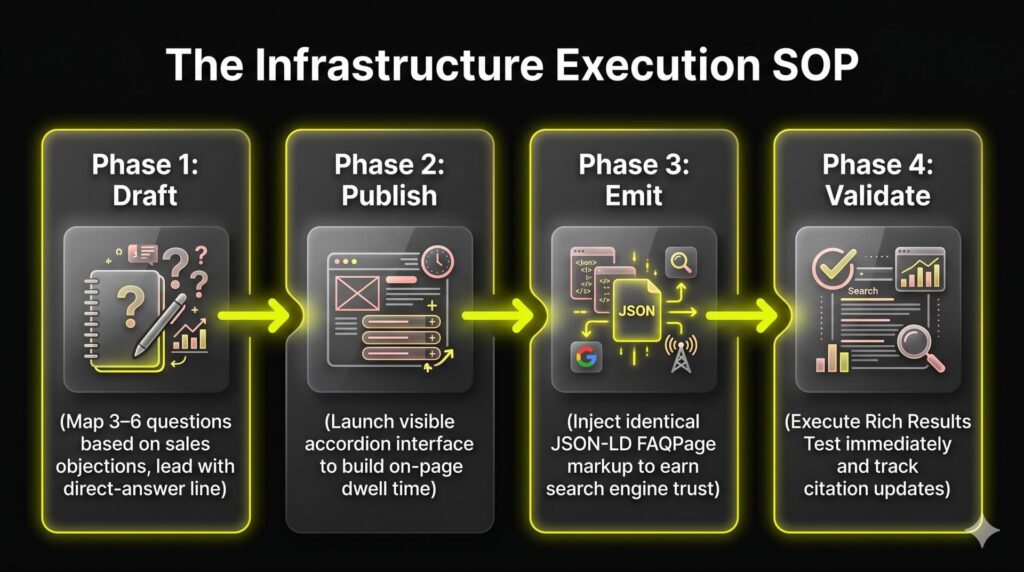
The FAQ Execution SOP: Scaling Answer Infrastructure
Deploy this repeatable workflow when launching new money pages, refreshing key commercial assets, or scaling FAQs across product and service templates. This process establishes your brand as the definitive authority in both traditional and generative search environments.
Inputs for Strategy
Secure these data points before drafting to ensure your faq schema seo targets actual revenue friction. Collect recurring sales objections and common support themes. Extract high-volume non-brand queries from Search Console. Identify specific on-page friction points where users currently drop off during the conversion funnel.
The 4-Step FAQ SOP
- Draft 3 to 6 FAQs per page: Assign one specific user intent to each question. Write a direct-answer first sentence to maximize the probability of an AI citation and improve extraction by large language models.
- Publish the visible UI component: Implement an accordion or list component so the text remains accessible to users. You will see improved on-page dwell time when users can resolve objections without leaving the page.
- Emit JSON-LD FAQPage markup: Generate structured data that matches the on-page text exactly. Identical text between your code and visible UI ensures search engine trust and prevents quality warnings.
- Validate and monitor: Submit the URL to the Rich Results Test immediately after deployment. Monitor Search Console for technical errors and conduct quarterly regression scans to ensure site updates have not broken the schema.
Handoff Clarity
Content leads own the Q&A strategy and copy. Developers and SEO specialists own schema emission, technical validation, and conflict prevention.
If you want FAQ blocks engineered specifically for Google visibility and AI citations, explore NUOPTIMA GEO services at nuoptima.com.
Visit Nuoptima to learn how our GEO services can help your brand become the definitive answer in modern search.
Where this fits in your MSP growth system
This is one piece of how NUOPTIMA makes MSPs and cybersecurity firms the provider buyers find on Google and in AI search. See how it connects to MSP SEO and GEO and AI-search, or get your free MSP lead forecast to see exactly where your firm shows up across ChatGPT, Gemini, and Perplexity today.