Most organic strategies fail because they prioritize vanity traffic over revenue. Effective landing page seo requires a precise balance between engineering high-conversion user experiences and providing the semantic signals that search engines and LLMs require for citations. This guide provides a practical checklist to ensure your pages remain conversion-first while becoming indexable and authoritative. Don’t just rank. Be the answer. We begin with structural indexability to ensure your technical foundation supports scalable organic pipeline growth.
1. Decouple SEO Indexability from PPC Isolation
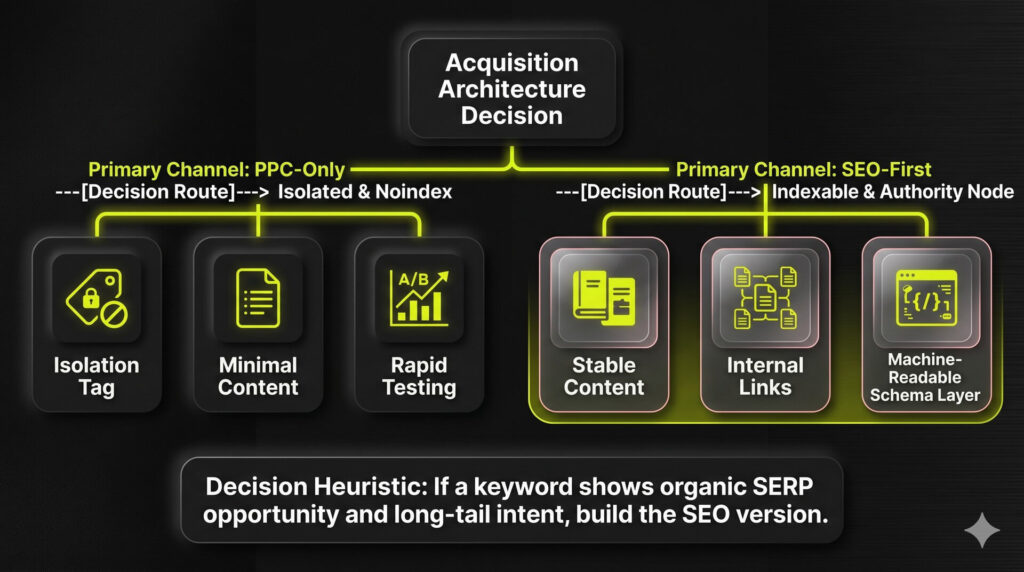
The most frequent failure in landing page seo is forcing one URL to serve incompatible goals. You must finalize your indexing architecture before writing copy to avoid sabotaging your organic revenue. SEO landing pages are indexable and contextual, supported by automated SEO reporting for MSPs; PPC pages are typically isolated and built for rapid testing.
Choose your implementation based on the primary acquisition channel:
- PPC-only: Use noindex tags, minimal content, and aggressive iteration cycles to maximize conversion speed.
- SEO-first: Deploy indexable URLs with stable content blocks, internal links, schema markup, and crawlable assets.
- Hybrid: Maintain one primary CTA, use expandable FAQs, and avoid intrusive popups that block content.
Follow this decision rule: if a keyword shows organic SERP opportunity and long-tail intent, build the SEO version. This strategy secures a sustainable pipeline and ensures your brand becomes the cited authority in LLM-driven search experiences.
Key Takeaways
- Effective landing page SEO balances high-conversion user experience with the semantic signals search engines and LLMs need to cite the page, so finalize your indexing architecture before writing copy.
- Landing page SEO is the strategic optimization of standalone pages to capture traditional rankings and LLM citations at the same time.
- Decouple channels: SEO-first pages are indexable with stable content, internal links, and schema, while PPC-only pages use noindex and aggressive iteration.
- Reverse engineer the SERP for structure, then add evidence blocks and 2 to 3 extractable answer sentences AI engines can quote directly.
- Only deploy FAQ or Review schema when the content is visible on-page, since incorrect schema creates LLM hallucination risk and ranking volatility.
| Attribute | SEO-first page | PPC-only page |
|---|---|---|
| Indexing | Indexable, one clean canonical | Noindex, isolated |
| Content depth | Stable blocks, internal links, schema | Minimal, conversion-focused |
| Iteration speed | Slower, authority compounds | Aggressive A/B testing |
| Primary goal | Rankings plus LLM citations | Fast conversion from paid clicks |
2. Reverse Engineer the SERP for Structural Relevance
Begin with a SERP scan for your primary and long-tail keywords to identify the rewarded format. Whether the intent is a service page or a guide, mirror the dominant architecture: H1 style, section order, and trust elements. Matching this structure provides the fastest path to relevance without keyword stuffing.
Differentiate with “evidence blocks” so the page is not a commodity clone. Include:
- Mini case studies and testimonials
- Proprietary data points
- Screenshots of results
Finally, add a GEO layer with 2 to 3 extractable “answer sentences.” These are clear definitions paired with specific outcomes that AI engines can quote, making them ideal for a Voice search SEO for MSP initiative. Landing page SEO is the strategic optimization of standalone pages to capture traditional rankings and LLM citations. This transforms your page from a search result into the authoritative answer.
3. Scale Visibility with Intent-Adjacent Keyword Clusters
Conversion pages fail when SEO-spam bloats copy and alienates buyers. To capture high-intent traffic without sacrificing pipeline, build a cluster of 5 to 10 variations by pairing primary intent terms with specific modifiers:
- Industry or use case (e.g., “for SaaS”)
- Location or “near me”
- Pricing and ICP-specific terms
Strategic placement matters more than keyword volume, especially when deploying a campaign centered on SEO for IT support services. Integrate variations naturally into the H1, the first 100 words, select H2s, image alt text, and internal anchor text. Avoid meta tag lists or repetitive service-stuffing that creates a robotic “SEO voice.”
Validate copy by reading the hero section aloud. If it sounds robotic, you are trading organic revenue for noise. Maintain crisp messaging to capture long-tail queries while preserving the authority required to convert.
4. Modularize Layouts for Scannability and Semantic Depth
Landing page SEO fails when pages are content deserts or unreadable text walls. Use a modular architecture to satisfy LLM retrieval and human scannability:
- Above the fold: Outcome-driven value prop and one primary CTA.
- Mid-page: Benefits and proof (logos, testimonials, case results).
- Below: Objections, FAQs, and technical details for evaluators.
Add SEO depth via expandable FAQ accordions, comparison tables, or “how it works” steps. These provide entity-rich signals for AI citations and LLM retrieval while maintaining a clean user experience.
Guard conversions by keeping one dominant action. Repeat the CTA at logical decision points at the top, middle, and bottom. Never assume SEO additions are performance-neutral. A/B test layout changes to ensure ranking gains do not cannibalize your revenue.
5. Execute Technical Sanity Checks to Prevent Search Invisibility
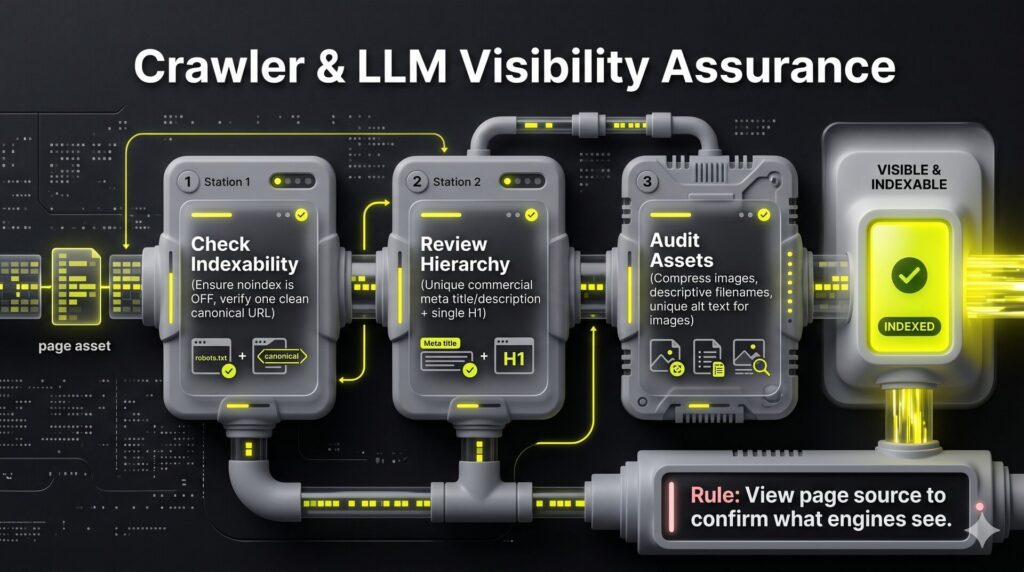
Landing pages often fail on silent technical errors during rapid deployment in Webflow, Unbounce, or Elementor. A forgotten noindex tag from staging or misconfigured canonical URL renders high-converting copy invisible to search engines and LLMs.
Run a technical sanity check before every launch:
- Verify indexability and ensure one clean canonical URL to prevent parameter-driven duplication.
- Craft unique title tags and meta descriptions aligned with commercial intent.
- Enforce a strict heading hierarchy with one H1 and logical H2s for sections.
- Compress images and use descriptive filenames with alt text to support relevance signals.
Control duplication when scaling industry or location-specific pages by requiring unique proof and distinct sections for each variation. Establish a QA habit: always view the page source to confirm what crawlers and generative engines actually see. This prevents technical errors that block indexing and ensures your organic authority compounds.
6. Deploy Strategic Schema for Machine-Readable Authority
Structured data converts landing pages into machine-readable assets. Incorrect schema is worse than none because it creates hallucination risks for LLMs and triggers ranking volatility. Align markup with the page’s specific entity:
- Service schema for agencies or consulting.
- Product or SoftwareApplication for SaaS.
- Organization basics for brand identity.
Only deploy FAQ or Review markup if the content exists visibly on-page. FAQ schema must answer real questions, and ratings require a policy-compliant source. Use validation tools to fix warnings that compromise rich snippet eligibility.
A robust GEO layer combines technical schema with clear entity statements to increase citation readiness. This ensures AI engines unambiguously identify your service and target audience. By transforming pages into queryable data assets, you expand SERP real estate and dominate generative answer layers.
7. Funnel Authority to Landing Pages via Strategic Content Clusters
Landing pages rarely earn backlinks naturally. The authority required for landing page seo typically resides in content clusters rather than the conversion page itself. Build a mini-cluster of 6 to 8 supporting posts targeting adjacent intent:
- Direct “how-to” queries
- Product or service comparisons
- Long-tail informational questions
Transfer this earned authority to your conversion page via strategic internal linking. Use descriptive, keyword-rich anchor text and place links contextually within your highest-authority posts. Ensure these links are placed prominently within sections that match the landing page’s intent, rather than hidden in footers or navigation menus.
Avoid internal link dilution by consolidating intent. Never create multiple competing landing pages for the same query. This architecture ensures your money pages benefit from the topical depth and entity authority of your entire domain.
Ready to implement this? Partner with nuoptima.com to engineer an organic pipeline that dominates both search results and AI citations.
8. Performance and Tracking Integrity: Protect Your Pipeline
Landing page SEO that reduces conversion rates is a net loss. Speed and tracking integrity are the guardrails connecting organic visibility to revenue. Use these performance priorities to maintain technical health:
- Compress images and defer non-critical scripts.
- Audit third-party tags to remove code bloat.
- Fix mobile layout shifts and small tap targets.
Integrity requires rigorous tracking QA. Use GTM preview mode to verify analytics tags and confirm that primary conversion events like form submissions or booked calls record accurately. If an “SEO enhancement” slows the page or obscures the CTA, it is a liability, not an improvement. For landing pages engineered for Google and generative answer engines, partner with our GEO services.
FAQ
An SEO landing page is a search-optimized destination engineered to be indexable, authoritative, and contextually relevant. Unlike standard marketing pages that often hide from crawlers to focus on a single conversion path, these pages target commercial keywords and long-tail queries. They must balance high-converting design with the semantic depth required for search engines and large language models to cite your brand as the definitive solution.
There is no magic word count for ranking in 2026. Your page needs sufficient depth to satisfy search intent and remove every logical objection in the buyer journey. Avoid filler text by using modular content blocks such as mini case studies, proprietary data points, and comparison tables. These elements provide the necessary semantic signals while maintaining a clean, professional user experience that successfully drives lead generation.
You can use one page for both channels, but it often involves a strategic trade-off between SEO depth and PPC simplicity. To make a hybrid page work, keep one primary call to action and ensure the page loads instantly. Use expandable FAQ accordions to house the content depth search engines need without distracting paid visitors from the conversion goal. Test your layouts aggressively to protect your return on ad spend.
Choose structured data that accurately represents your page entity. This typically includes Service, Product, or SoftwareApplication markup depending on your specific business model. Only deploy FAQ schema if the questions and answers are visible to the user on the page. Use validation tools to ensure your markup is error-free. This technical layer helps AI engines unambiguously identify your services and target audience in generative search results.
Avoid deleting expired or seasonal pages because this destroys the accumulated backlink equity and search authority. You have three primary options: update the content for the upcoming cycle, implement a 301 redirect to the closest evergreen alternative, or keep the page live with clear messaging stating the offer has ended. Conserving these URLs allows your organic domain authority to compound over multiple years and peak during high-intent seasons.
Generative Engine Optimization requires a shift toward content extractability and clear entity relationships. Write authoritative answer sentences that AI engines can easily ingest and cite. Strengthen your entity clarity by publishing verifiable proof and proprietary data that positions you as the authoritative source.
To build a strategy led by AI visibility, visit Nuoptima or consult our specialist GEO services to dominate the generative answer layer.
Where this fits in your MSP growth system
This is one piece of how NUOPTIMA makes MSPs and cybersecurity firms the provider buyers find on Google and in AI search. See how it connects to MSP SEO and GEO and AI-search, or get your free MSP lead forecast to see exactly where your firm shows up across ChatGPT, Gemini, and Perplexity today.