AI search and semantic retrieval now reward recognized entities and machine-verifiable relationships over basic keyword matching. To dominate the answer layer, your brand must become a verified entity that LLMs can confidently cite. As the AI-native authority in GEO and entity seo, NUOPTIMA builds the architecture required for this transformation. This guide enables you to map entities, build an entity home, deploy corroborative schema, and measure recognition. Start by aligning on what an entity is in SEO terms.
An entity in SEO is a distinct, machine-recognizable thing (a company, person, product, or place) that search engines and AI models understand as a verified node with defined relationships, not just a string of words. An example: your MSP becomes an entity Google and ChatGPT recognize, connected to its services, locations, certifications, and founders, so it can be confidently cited.
Key Takeaways
- An entity in SEO is a distinct, machine-recognizable thing such as a company, person, product, or place that search engines and AI models understand as a verified node with defined relationships, not just a string of words.
- AI engines cite entities they can verify, so an ambiguous brand simply does not get named in AI answers.
- Define one primary entity per page with a one-sentence definition and five to ten provable attributes, then test whether a machine could identify it with every keyword stripped out.
- Build a canonical entity home as the single source of truth, link every brand mention to it, and corroborate it with Organization schema and sameAs properties.
- NUOPTIMA's entity-home approach took Microminder from $0 to over $1M, and entity health is measured by recognition, reconciliation, and relationship rather than keyword rankings.
Why it matters for MSPs and cybersecurity firms
- AI engines cite entities they can verify, so an ambiguous brand simply does not get named in answers.
- Certifications and compliance relationships are exactly the trust signals cybersecurity buyers and LLMs both weigh.
- A clear entity makes your firm the recognized name in its city or niche, which referral-led growth alone never delivers.
We engineer one primary entity per page, then corroborate it with schema and consistent off-site facts until engines stop guessing who you are. That entity-home approach took Microminder from $0 to $1M+ and anchors our GEO services.
1. Define One Primary Entity per Page
Most entity SEO fails because teams optimize topics while leaving the core entity ambiguous. Ranking inconsistency occurs when engines cannot reconcile exactly what a page represents. Shift your strategy from strings to things. Keywords are surface signals, but entities are stored nodes in a knowledge graph, a fundamental paradigm shift required for any modern B2B AI SEO strategy.
Select one primary entity per page. Write a one-sentence definition using a clear noun, category, and differentiator. List five to ten provable attributes like founding year, integrations, or location. This locks the page to a single, machine-identifiable entity with verifiable data and canonical claims.
Finally, run a diagnostic: if you stripped every keyword, could a machine still identify the entity? If not, the content is too fuzzy for AI citation. Engineering this factual clarity ensures LLMs recognize your brand as the definitive answer.
2. Map Entity Relationships Before Production
Comprehensive guides often fail when they miss the entities Google expects to co-occur. Search engines and LLMs prioritize semantic completeness over word count, scanning for specific predicates that define a subject. Visualizing these relationships before production prevents semantic gaps and ensures content aligns with knowledge graph expectations.
Build a lightweight entity map by placing your primary entity at the center. Surround it with 10 to 30 related entities organized into rings:
- Definitions and alternatives
- Components and attributes
- Adjacent problems, tools, and standards
- Real-world examples
Frame every connection as a verb phrase. Statements like “Entity SEO improves recognition” or “Brand integrates with X” define predicates for search engines. This map becomes your one-page blueprint for content briefs, internal link architecture, and schema targets.
3. Build a Canonical Entity Home
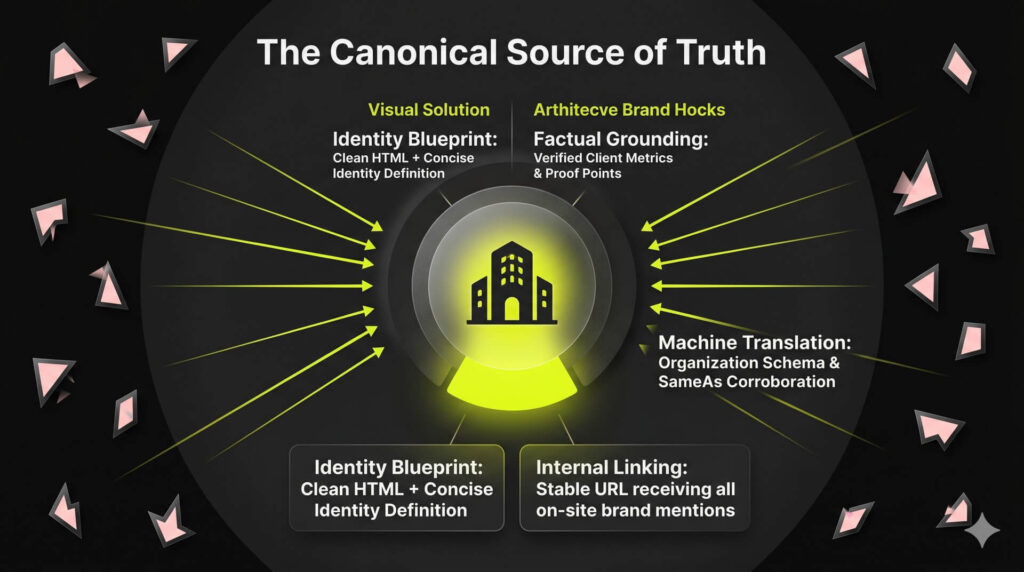
Brand signals often scatter across press releases, social bios, and fragmented service pages. This prevents algorithms from reconciling your identity into a single knowledge graph node. Establish a canonical “entity home” as the source of truth to centralize these signals. This hub is the foundation of high-performance entity seo.
Top-load this page with clarity on your identity and offerings. Every internal brand mention must link to this stable URL to reinforce authority. To ensure machine extractability, include:
- Clean HTML and concise definitions
- Verified proof points, such as client metrics
- Organization schema and sameAs properties to corroborate identity
NUOPTIMA serves as your AI-native SEO and GEO authority partner. We engineer these hubs so LLMs recognize your brand as the definitive source in the answer layer.
4. Deploy Corroborative Schema for Machine Verification
Schema often fails when it lacks visible corroboration. Search engines ignore JSON-LD data that does not mirror your on-page text. To master entity seo, treat schema as a machine-readable repetition of facts. This transforms vague content into high-confidence entity signals.
Prioritize implementation on entity-home and high-value money pages. Use WebPage with a mainEntity property to define the core subject. Add sameAs links to point to authoritative references like LinkedIn, Wikidata, or industry directories. Only use links that represent exact matches to avoid misclassification.
Encode every attribute stated on-page, including founders, locations, and services. Never hide facts only in the code. If a machine should read it, a human must see it first. This alignment increases parsing confidence across Google and AI search engines.
5. Encode Relationship Clarity with Internal Links
High content volume lacks value without semantic structure. AI cannot map how concepts connect on your domain if you treat internal links as mere PageRank conduits. Links are your on-site knowledge graph, designed to establish relationship clarity and entity reconciliation.
Link every entity mention back to its entity home (brand, product, or key personnel). Create relationship hubs: short pages defining how entities intersect, such as “Entity SEO vs. Topical Authority.” This semantic map allows generative engines to cite your brand as a definitive authority.
Anchor text must encode predicates that define connections. Use phrases that describe how entities interact:
- integrates with
- measured by
- depends on
Add an entity links checklist to every content brief to ensure consistent coverage. This infrastructure transforms your site into a coherent ecosystem. Engines then infer meaning from your internal connections rather than isolated keywords.
6. Balance Open Web Signals with Proprietary Data
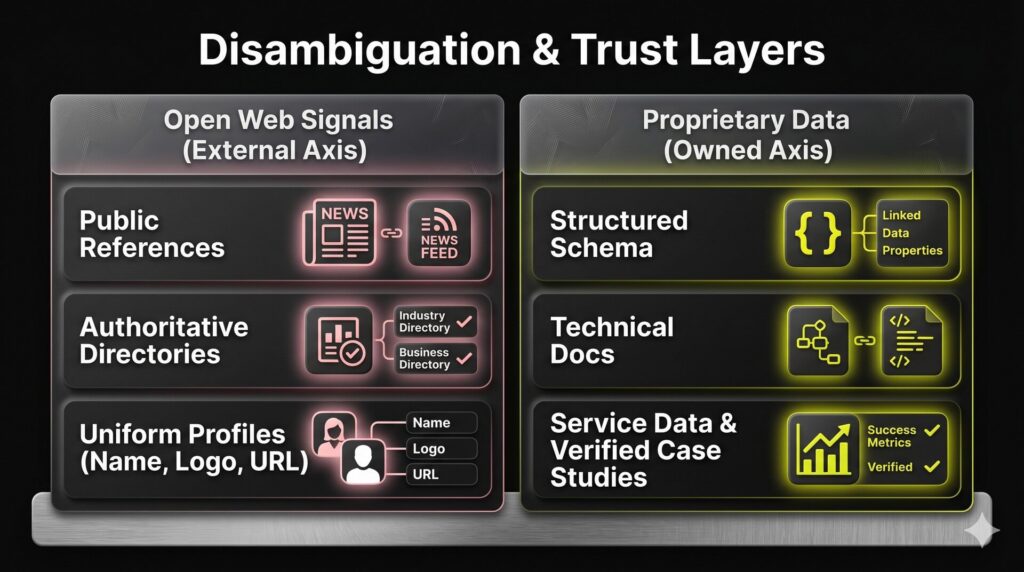
Teams often over-index on Wikipedia while ignoring the internal corroboration required for high-performance entity seo. This disconnect between public datasets and owned infrastructure prevents brands from appearing in AI-generated answers. Engines require consistent signals across two distinct layers to disambiguate and trust your brand identity.
Manage open web entities via public references and authoritative directories to anchor your identity externally. Simultaneously, establish proprietary entities on your “entity home” by deploying:
- Structured schema and metadata
- Technical documentation and policies
- Service data and case studies
Standardize your brand identity across key profiles using uniform:
- Brand names
- Logos
- URLs
Pursue high-quality mentions where authoritative sources describe your entity consistently, even without a backlink. Entity trust results from steady corroboration rather than a single technical markup change.
7. Audit Entity Health with AI-First KPIs
Keyword rankings and session volume cannot prove entity SEO works. Traditional metrics fail when LLMs synthesize your brand into a definitive answer. Measure machine trust by whether engines cite your entity for queries you never explicitly targeted.
Use a monthly health scorecard to verify machine understanding:
- Recognition: Ensure consistent naming across profiles and brand presence in AI answers.
- Reconciliation: Confirm your entity home surfaces when querying [brand] + [category].
- Relationship: Verify engines associate you with specific services, problems, and integrations.
Run monthly prompts in Perplexity or Gemini to log brand descriptors and citations. Track assisted conversions and pipeline influence rather than last-click traffic to properly measure the downstream impact of your MSP inbound marketing ecosystem. Authority in the answer layer drives revenue, even when visibility occurs without a direct click.
How to Execute an Entity SEO Sprint for AI Visibility
Entity SEO fails when treated as a mechanical schema task. This 95-minute sprint forces a relationship-first workflow to ensure AI engines cite your brand correctly. Run this sequence today to transition from basic keyword content to machine-verifiable entity authority.
Prerequisites (5 Minutes)
Select one primary entity, such as your brand or a flagship offering. Identify one specific target topic area you want AI engines like ChatGPT and Perplexity to associate with that entity.
Step 1: Map Your Entity Relationships (15 min)
Build a relationship map with the primary entity at the center. Surround it with 20 related sub-entities. Define every connection with a specific relationship verb like “solves,” “integrates with,” or “provides.” This map serves as the semantic blueprint for your entity seo consistency.
Step 2: Harden Your Entity Home (20 min)
Rewrite the lead section of your entity home page for absolute clarity. State who you are, what you provide, and the specific audience you serve. Add three to five verifiable proof points like client metrics or industry certifications. Ensure the page resides on a stable, permanent URL.
Step 3: Implement Corroborative Schema (20 min)
Deploy Organization or Person markup alongside WebPage mainEntity declarations. Add sameAs properties to five to ten corroborating profiles like LinkedIn, Wikidata, or industry directories. Ensure the markup mirrors the visible facts on the page to provide high-confidence signals to AI crawlers.
Step 4: Operationalize the Internal Link Graph (20 min)
Add 10 to 20 internal links that explicitly connect related entities back to the entity home and 2 to 3 relationship hubs. Use anchor text that defines the relationship logic. You will see generative engines begin to map your site architecture as a coherent knowledge graph.
Step 5: Establish Your Entity Health Baseline (15 min)
Run five baseline AI queries using specific prompts about your brand expertise. Document the citations, descriptors, and missing topical associations the AI currently identifies. This record provides the benchmark for measuring future entity authority gains.
Visit Nuoptima and view our GEO services page to work with a technical team that makes your brand the definitive answer in AI search.
If you need a GEO-first entity architecture that wins citations in AI search, visit Nuoptima to explore our specialized GEO services.
Where this fits in your MSP growth system
This is one piece of how NUOPTIMA makes MSPs and cybersecurity firms the provider buyers find on Google and in AI search. See how it connects to MSP SEO and GEO and AI-search, or get your free MSP lead forecast to see exactly where your firm shows up across ChatGPT, Gemini, and Perplexity today.