MSP buying guide

Best Security Information and Event Management (SIEM) Platforms for MSPs (2026)

Eight security information and event management platforms compared on who works the alerts, client separation, log retention and published prices, from each vendor's own pages.

8  platforms3  vendor-run alert desks6  publish a list price or estimate

8 platforms, 3 with vendor analysts on the alerts, verified November 20, 2026

A client's contract or cyber insurer wants logs kept and watched, and nobody on a small team wants the 2am alert. Sort security information and event management (SIEM) platforms by who answers it, then by searchable retention: Huntress Managed SIEM, Kaseya SIEM or Todyl for the vendor's analysts, Microsoft Sentinel for your own analysts on Microsoft 365-heavy clients, and Blumira, UTMStack or LimaCharlie for a year of logs in the price.

The prices do not compare. Vendors bill per data source, employee, user, device, agent tier or gigabyte (GB), and three of the eight keep their MSP price for a sales call. Nor does "24/7": on one page it means a vendor security operations center (SOC) watching every alert, on another, expert backup during a critical incident.

It is for MSP owners and security leads choosing one SIEM to run across many client tenants. It is not for a company buying for itself, or for anyone who wants a service rather than a platform; for that, see managed detection and response (MDR) and managed SOC providers for MSPs.

Where our money comes from

We do not sell any of these products, take commissions from any vendor on this page, or accept payment for placement.

methodology

How we chose and checked these platforms

  1. We included SIEM platforms sold to providers running many clients; managed detection services and logging-only tools went to Also considered.
  2. On November 20, 2026, we read each vendor's product, pricing, documentation and partner pages, plus Microsoft's published price list, for who works the alerts, client separation, log sources, professional services automation (PSA) links, compliance reports, retention and price.
  3. We trialed nothing, so "best for" means fit by each vendor's published scope.
  4. "Not listed" and "Not published" mean not found on the pages we reviewed.
  5. Companies with "MSP" in their name are excluded under our naming rule. ConnectWise SIEM could not be assessed because its pages did not load for us. No figures come from review sites, AI answers or other buying guides.
  6. Entries are grouped by who works the alerts, alphabetical within each group; numbering is navigational.

Last reviewed: November 20, 2026

comparison

The eight platforms at a glance

Who works the alerts, how clients are kept apart and what each vendor names, from vendors' own pages, verified November 20, 2026
ProductWho works the alertsClient separation (vendor's words)Log sources namedPSA namedCompliance reports named
Huntress Managed SIEMHuntress's 24/7 SOC; remediation "where supported""roll it out quickly and consistently across many clients"; Extended Retention set per organizationWindows events; firewall, VPN and DNS through syslog; Microsoft 365 and Entra ID through Managed ITDR; Duo, AWS, CrowdStrike, SentinelOne, CiscoIncident reports to Autotask, ConnectWise Manage, HaloPSA, Kaseya BMS or Syncro, one at a timeCompliance reporting included; frameworks not named on product pages; launch release ties extended retention to PCI DSS, CMMC and Essential Eight
Kaseya SIEMKaseya's analysts 24/7; co-managed optionAn organization per client, "a single security boundary", all listed on one Organizations page; custom indicators of compromise per client60+, including EDRs, RMMs, Fortinet, Palo Alto, pfSense, Okta, Duo, Google Workspace, Microsoft 365, AWS CloudTrailConnectWise, Autotask, Kaseya BMS, Halo, SyncroNot listed
TodylMXDR, "24x7 expert detection and response", in every package"Multi-tenant architecture for efficient client management""Dozens" of apps, identity providers and security tools; syslog collectors; named list not foundRMM and PSA support stated; none named on its SIEM pageCompliance dashboards; its governance, risk and compliance module names CIS v8.1, CMMC, HIPAA, NIST CSF and NIST 800-171
BlumiraYour team; "24/7 SecOps support" for critical incidents"Tenant-level data isolation per client"Microsoft 365, Azure, Google Workspace, firewalls, endpoint, identityConnectWise PSA (two-way ticket sync); Autotask PSA13+ frameworks, including HIPAA, PCI DSS, CMMC 2.0, NIST 800-171, SOC 2
LimaCharlieYour team; optional AI agentsAn organization per client with its own sensors, rules and sourcesAdapters for syslog, Windows event logs, AWS CloudTrail, Office 365 and moreHaloPSA extension in its docs (tickets, notes, time entries)18 framework reports, including HIPAA, PCI DSS and SOC 2, in its Cloud Security product
Microsoft SentinelYour teamA workspace per client, managed from your tenant through Azure LighthouseSyslog and CEF devices, AWS CloudTrail and Entra ID among Microsoft's listed connectors; free: Azure Activity, Office 365 audit logs, Defender alertsNot listedCMMC 2.0 and NIST 800-53 solutions with workbooks in Microsoft's catalog
UTMStackYour team; optional paid SOC Extension"every client separated on one server, with your branding"30+ built in; syslog, agent, cloud connectorsNot listedNine frameworks scored, including HIPAA, PCI DSS 4.0, CMMC 2.0, GDPR
WazuhYour teamMulti-tenant web interface, white label allowed, on the Platinum partner tierEndpoints, network devices, cloud workloads and applications; Office 365 audit logs in its docsNot listedPCI DSS, NIST 800-53, GDPR, SOC 2 and HIPAA tracking and reports

SOC is security operations center; VPN is virtual private network; DNS is domain name system; ITDR is identity threat detection and response; AWS is Amazon Web Services; EDR is endpoint detection and response; RMM is remote monitoring and management; MXDR is managed extended detection and response; PSA is professional services automation; HIPAA is the Health Insurance Portability and Accountability Act; PCI DSS is the Payment Card Industry Data Security Standard; CMMC is the Cybersecurity Maturity Model Certification; NIST is the National Institute of Standards and Technology; SOC 2 is System and Organization Controls 2; GDPR is the General Data Protection Regulation; CIS is the Center for Internet Security; CSF is Cybersecurity Framework; CEF is Common Event Format. Not listed = not found on the vendor pages we reviewed on November 20, 2026.

entries

The eight platforms, grouped by who works the alerts

The vendor's analysts work the alerts

The vendor's people watch and escalate around the clock; you decide how far they may act.

01

Huntress Managed SIEM

A managed SIEM run by Huntress's 24/7 security operations center and priced per data source.

Vendor SOCPer data sourcePublished price
Who works the alerts
Huntress's 24/7 SOC monitors, tunes, hunts and investigates; remediation "where supported"
Across clients
built so MSPs can "roll it out quickly and consistently across many clients"; Extended Retention applied per organization
Retention included
1 month searchable and 12 months in total, the rest in cold storage; the Extended Retention add-on gives 90 days searchable and 7 years cold
Published pricing
$4.00 a month per data source at list price, $8.49 with Extended Retention; 10 GB a month per source, pooled; volume pricing on request; Huntress's 50-seat minimum applies to reseller and direct buyers, not to clients served through an MSP
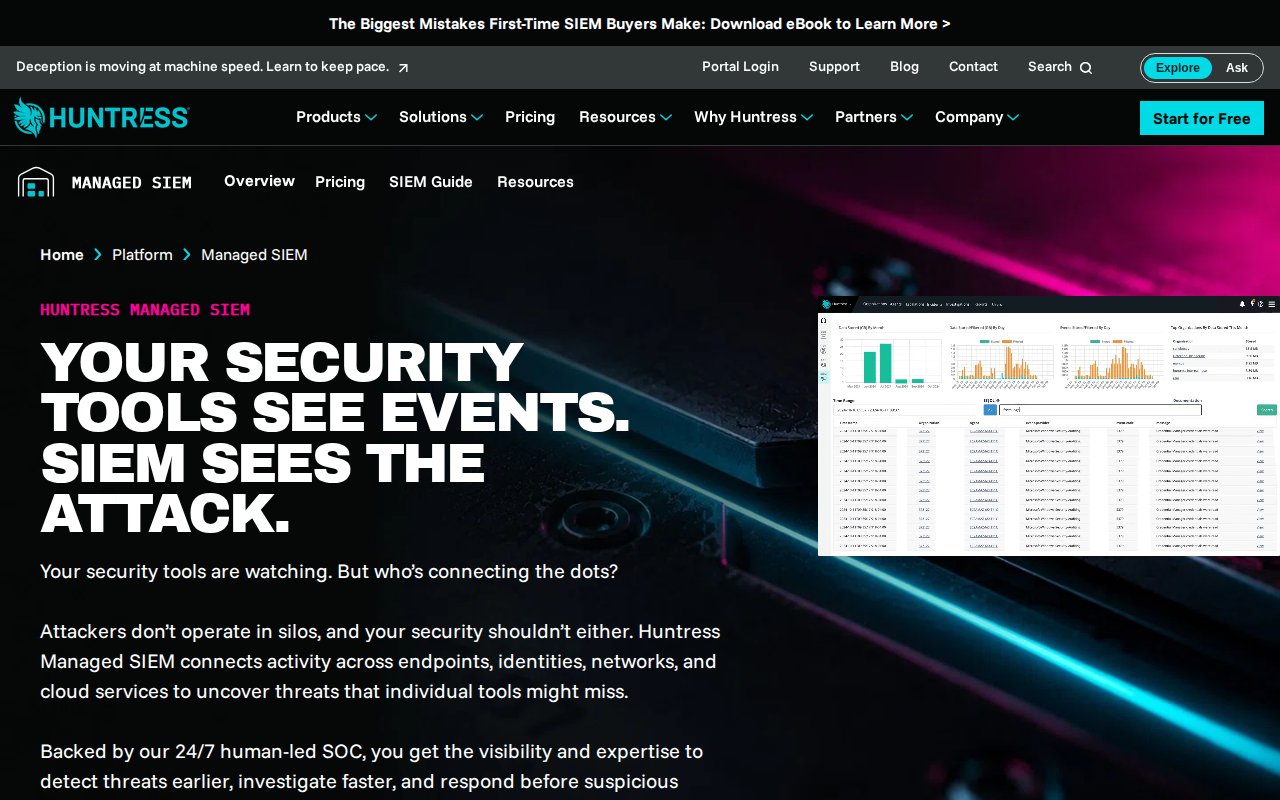
Huntress Managed SIEM page headline "Your security tools see events. SIEM sees the attack." beside a screenshot of its log search dashboard
www.huntress.com, captured November 20, 2026

Huntress Managed SIEM is run by Huntress's 24/7 SOC, whose analysts monitor, tune, hunt and investigate; "where supported", Huntress says, it can take remediation actions on your behalf. Named sources include Windows events, firewall logs through syslog collectors, Duo, and Microsoft 365 and Entra ID through Huntress's Managed identity threat detection and response (ITDR) product.

Huntress's billing and retention terms keep 1 month searchable and 12 months in total on the standard plan; older data must be rehydrated before you can search it, which Huntress says may cost $1 per GB beyond 500 GB a year. Each source adds 10 GB a month to one annual pool for your whole account; if it runs out, the oldest data is truncated. The price is $4.00 a month per source, or $8.49 with Extended Retention. If you do not renew, logs stay downloadable for 30 days.

Best fit:MSPs with nobody to take night alerts who want a published per-source price and a documented 30-day window to download logs if they leave.

Think twice if:you need more than a month searchable without Extended Retention or rehydrating cold data, you need every raw event kept, since Smart Filtering keeps only what Huntress deems security-relevant unless you ask Huntress to turn it off, and then all data counts against the pool, or you cannot commit to a minimum number of sources and an annual data pool.
02

Kaseya SIEM

Kaseya's SIEM console with a managed SOC, launched April 28, 2026, keeping 400 days of searchable logs.

Vendor SOCCo-managed option400 days searchable
Who works the alerts
"Kaseya's analysts monitor, triage and respond to threats 24/7"; co-managed option; SOC in Florida and Ireland
Across clients
each client is an organization, "a single security boundary" for alerts, data and user access, managed from one Organizations page; detection rules and indicators of compromise set per client
Retention included
400 days searchable
Published pricing
Not published on the pages we reviewed; user-based pricing, "Get a price quote"
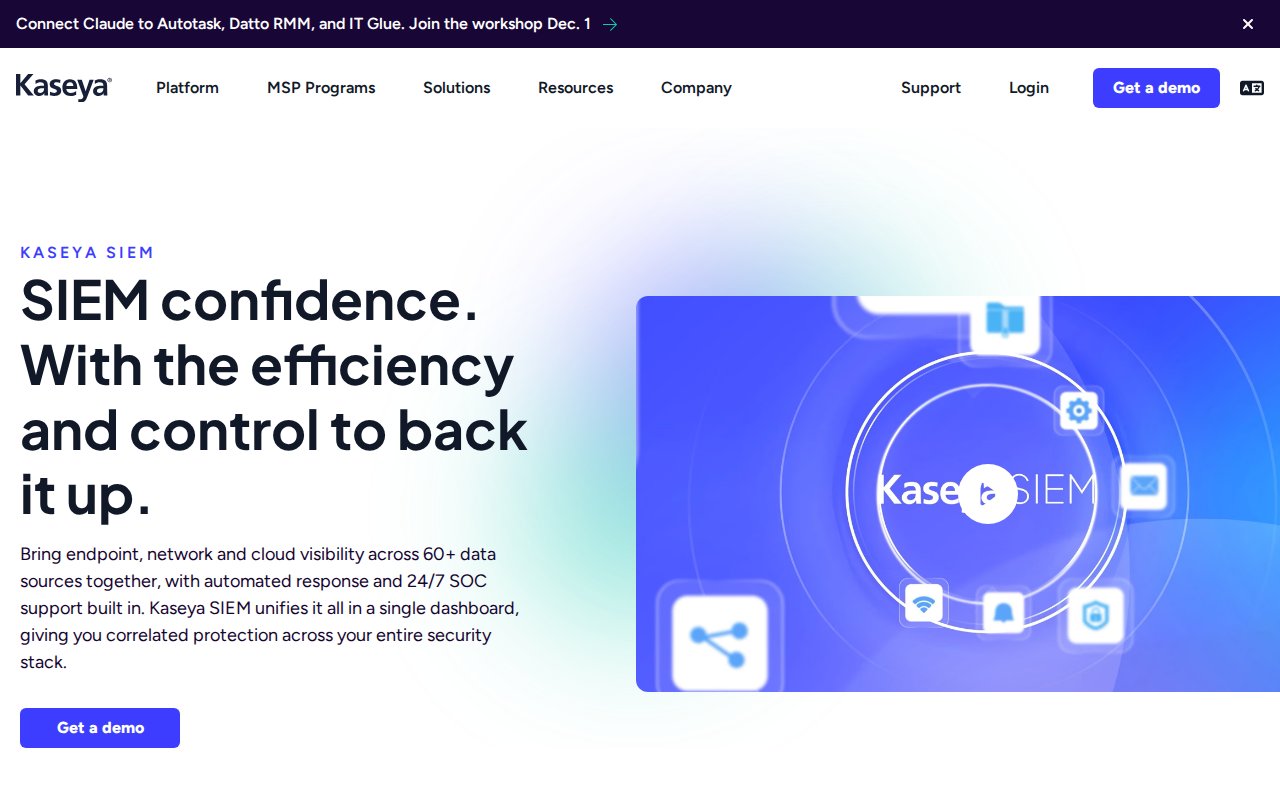
Kaseya SIEM page headline "SIEM confidence. With the efficiency and control to back it up." beside a Get a demo button and a Kaseya SIEM graphic
www.kaseya.com, captured November 20, 2026

Kaseya SIEM launched on April 28, 2026, built on Kaseya MDR, which Kaseya calls "the evolution of RocketCyber", so check which one a quote covers. Kaseya says its analysts "monitor, triage and respond to threats 24/7" from a SOC in Florida and Ireland, and a co-managed model lets your team share the work.

Retention is the headline: 400 days, searchable. Kaseya lists more than 60 sources, among them CrowdStrike, SentinelOne, Fortinet, pfSense, Okta and Microsoft 365, and alerts can go as tickets to five PSA tools, ConnectWise and Autotask among them. Pricing is per user, quote only. Its help center makes each client an organization, "a single security boundary" for alerts, data and access, and sets what the SOC may do per client.

Best fit:MSPs that want vendor analysts on the alerts, a co-managed option and more than a year of searchable logs, with tickets sent to ConnectWise, Autotask, Kaseya BMS, Halo or Syncro.

Think twice if:you would rather not buy a product launched April 28, 2026, you want a price before a sales call, since Kaseya SIEM is quote only, or you rely on webhook sources, which Kaseya lists as "coming soon".

03

Todyl

A managed SIEM sold inside Todyl's platform packages, with retention set by the package.

Vendor analystsPlatform packageSold through the channel
Who works the alerts
Todyl's MXDR service, "24x7 expert detection and response", in every package
Across clients
"Multi-tenant architecture for efficient client management"
Retention included
30 days on Essentials, 90 days on Advanced, 1 year on Complete
Published pricing
Not published on the pages we reviewed; "Contact Sales for Pricing" on all three packages
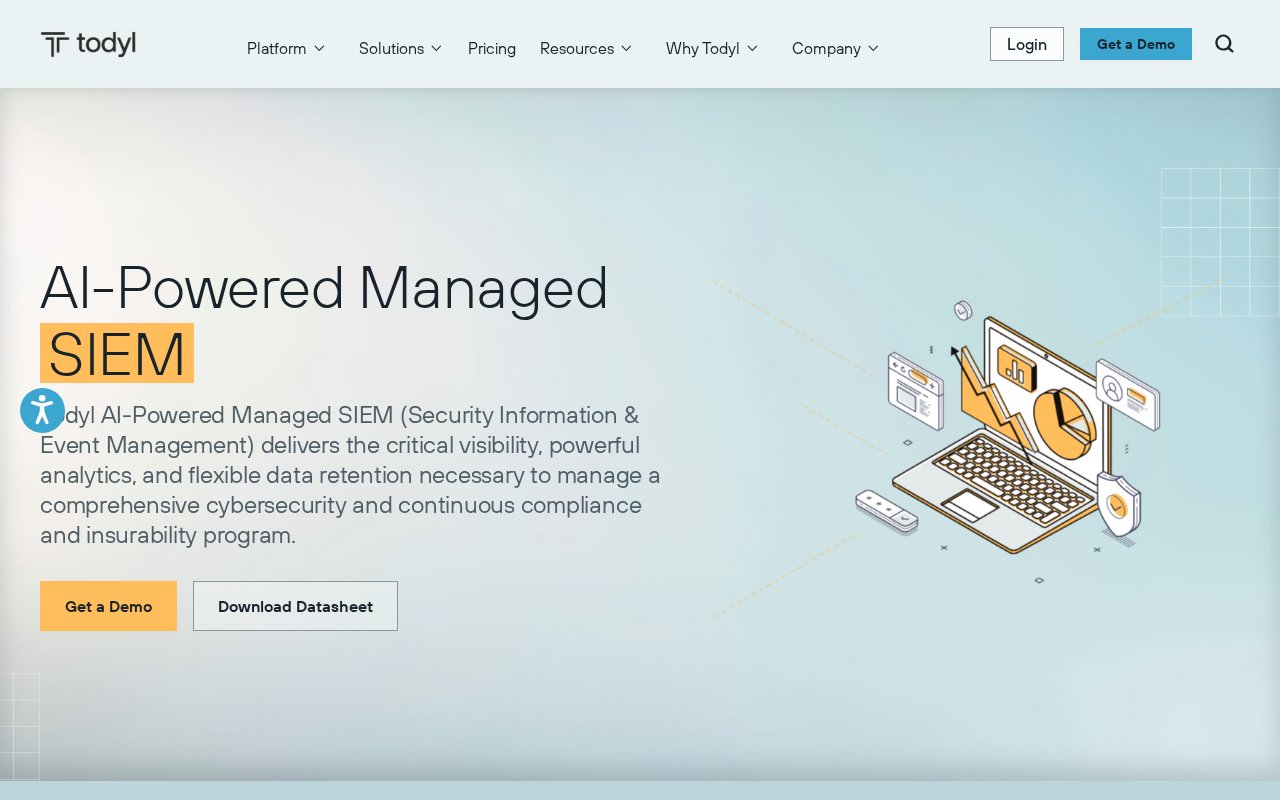
Todyl page headline "AI-Powered Managed SIEM" beside an illustration of a laptop with charts, above Get a Demo and Download Datasheet buttons
www.todyl.com, captured November 20, 2026

Todyl sells only through the channel, and its pricing page lists SIEM inside packages that also carry secure access service edge (SASE) networking, endpoint security, managed extended detection and response (MXDR) and governance, risk and compliance (GRC) tools, next to "modular deployment options". MXDR, "24x7 expert detection and response" in Todyl's words, comes with every package, so Todyl's analysts work the alerts.

Retention depends on the package: 30 days on Essentials, 90 on Advanced and a year on Complete, so name the package whenever you compare. Todyl describes a "multi-tenant architecture for efficient client management" and says it works with remote monitoring and management (RMM) and PSA tools, without naming them on the pages we reviewed. Compliance frameworks vary by package. All three packages say "Contact Sales for Pricing".

Best fit:MSPs that want network access, endpoint protection, SIEM and the analysts behind them from one vendor, sold through the channel.

Think twice if:you want SIEM on its own, since the pricing page lists it inside full platform packages and gives no detail on "modular deployment options", you need more than 30 days on the Essentials package, or you need a named PSA integration, since its SIEM page names none.

Your team runs it

Your staff run it across client tenants, with incident backup, a paid night shift or no vendor analysts at all.

04

Blumira

A cloud SIEM with detection and response tools and a program for MSPs, run by your team with Blumira's backup in critical incidents.

Tenant per client1 year retentionPer employee
Who works the alerts
your team; Blumira offers "24/7 SecOps support" for critical incidents
Across clients
one dashboard for every client, with "Tenant-level data isolation per client"
Retention included
1 year
Published pricing
MSP rates per employee by volume tier, "shared in conversation"; no setup fee; month to month; Blumira's direct list prices are $12, $16 and $21 per employee a month
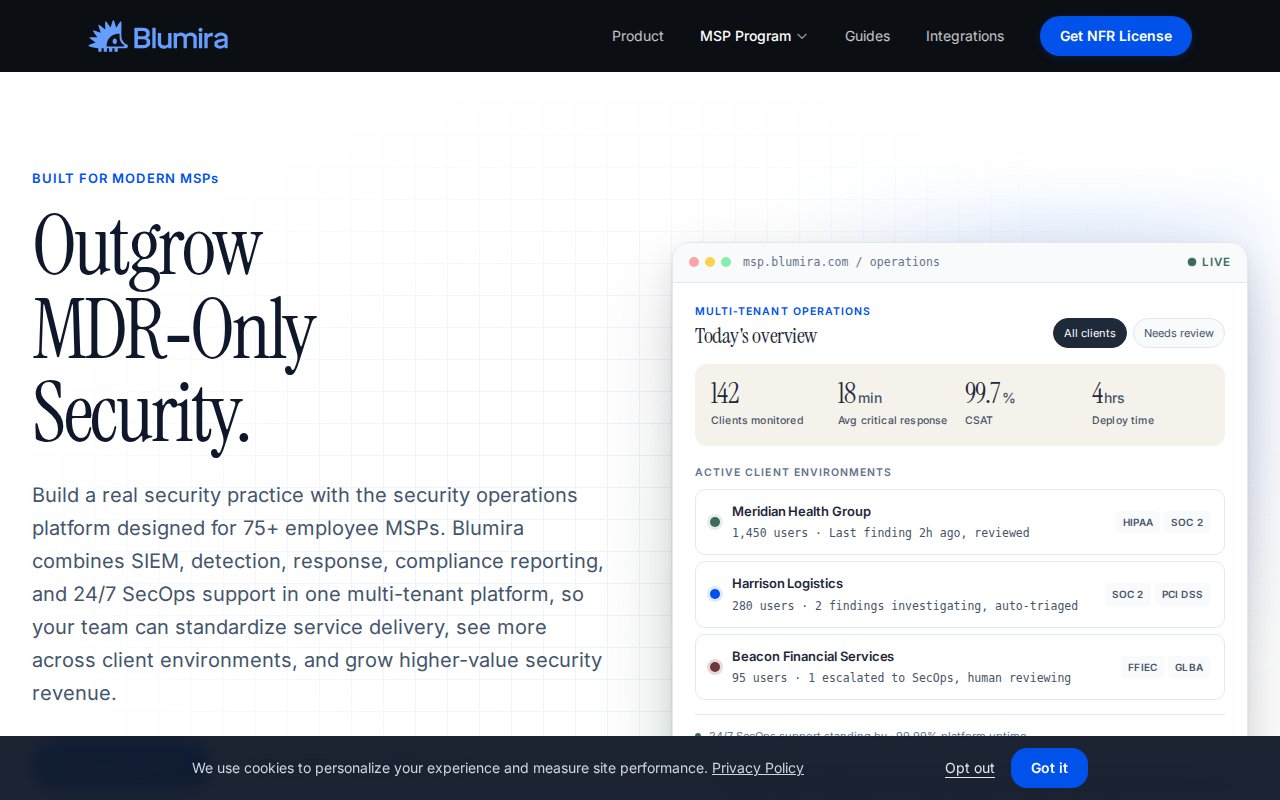
Blumira page for service providers headlined "Outgrow MDR-Only Security." beside a multi-tenant operations dashboard listing client environments with compliance tags
msp.blumira.com, captured November 20, 2026

Blumira combines a cloud SIEM with extended, endpoint and identity detection and response tools, and its program for MSPs puts every client in one dashboard with "tenant-level data isolation per client". Your team works the alerts; Blumira describes its "24/7 SecOps support" as "expert backup during critical incidents".

Every plan keeps a year of logs, and tickets sync both ways with ConnectWise PSA; Blumira's integrations page also lists Autotask PSA. Compliance is spelled out: report templates for 13 or more frameworks, scheduled per client, including HIPAA, PCI DSS and CMMC 2.0. MSP pricing is per employee in volume tiers, month to month with no setup fee, plus a free not-for-resale license for internal use. Direct prices run $12 to $21 per employee a month; MSP rates are not published.

Best fit:MSPs with their own staff on alerts who want a year of logs in the price, per-client compliance reports and a free license for internal use.

Think twice if:you want MSP rates before a call, since Blumira shares them in conversation, your PSA is neither ConnectWise nor Autotask, the two PSA tools Blumira lists, or you run a small shop, since its site for providers says "Built for 75+ employee MSPs".

05

LimaCharlie

A multi-tenant security platform for providers on which you build your own SIEM, priced per gigabyte and per endpoint.

Build your ownPer GB1 year storage
Who works the alerts
your team; no vendor SOC listed on the pages we reviewed; optional AI agents
Across clients
an organization per client with its own sensors, rules and sources; two organizations by default, more through support; one bill across tenants
Retention included
1 year
Published pricing
$0.20 per GB for telemetry sources; $3.00 per endpoint for endpoint detection and response; 2 endpoints free; no contracts, month to month
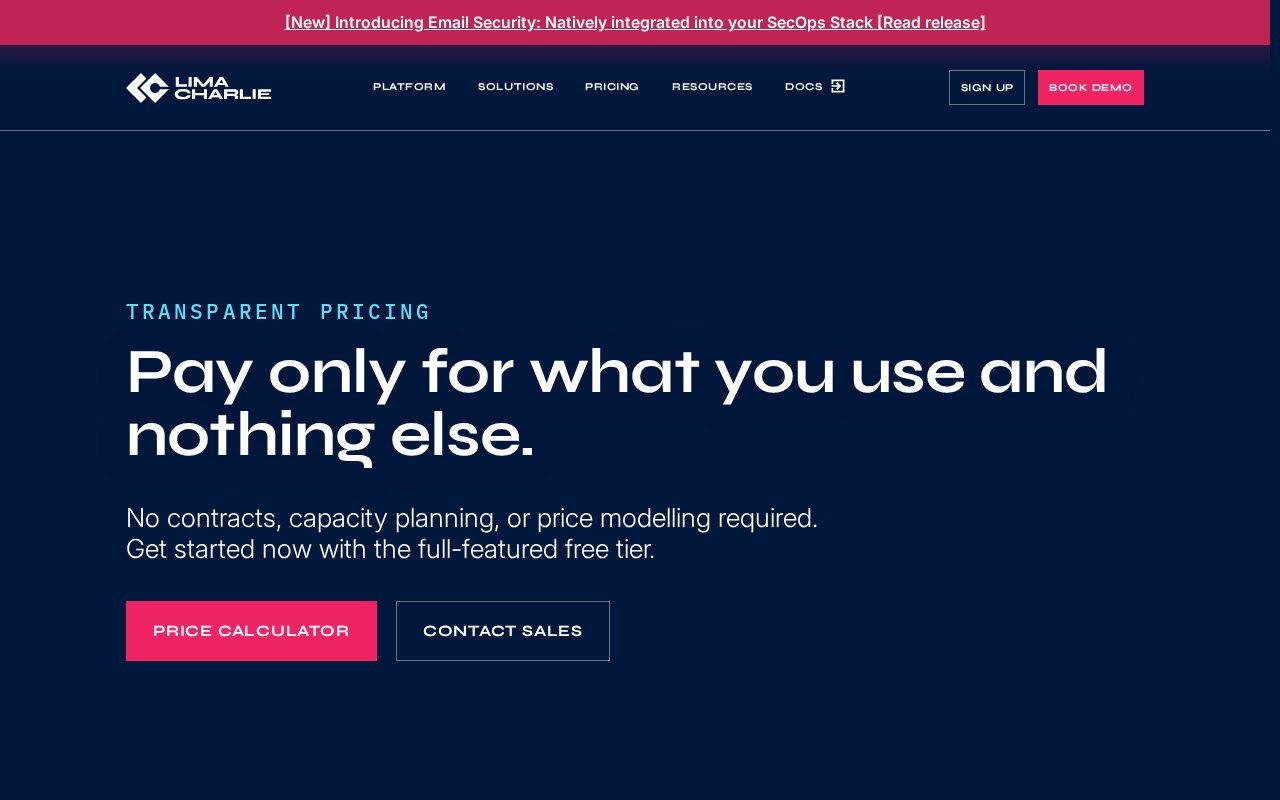
LimaCharlie pricing page under the label Transparent Pricing, headline "Pay only for what you use and nothing else." above Price Calculator and Contact Sales buttons
limacharlie.io, captured November 20, 2026

LimaCharlie is a platform on which you build a SIEM, not a packaged one, sold to managed security providers and detection and response firms. Each client becomes an organization with its own sensors, detection rules and data sources, all on one bill. New accounts get two organizations; more come through support.

No vendor SOC is listed on its pages, so your analysts work the alerts, with optional AI agents and detection rules you write, import or subscribe to. Pricing is published, month to month with no contract: $0.20 per GB for telemetry sources such as Microsoft 365 and Entra ID, and $3.00 per endpoint for endpoint detection and response (EDR), first two endpoints free, with a year of storage included. Framework reports, including HIPAA, come with its Cloud Security product at $150 per organization.

Best fit:MSPs with a security team that wants to write its own detections and pay by volume and endpoint, month to month, with a year of storage included.

Think twice if:you want a vendor SOC, since none is listed on its pages, you lack staff to write, import or subscribe to detection rules and tune them, or you need more than two client organizations before support raises the limit.

06

Microsoft Sentinel

Microsoft's cloud SIEM, billed per GB in each client's Azure subscription and run by your own analysts.

Per GB90 days at no chargeWorkspace per client
Who works the alerts
your team; Microsoft's guidance for providers treats the SOC as the provider's service
Across clients
a workspace per client, managed from your tenant through Azure Lighthouse; data connectors also need granular delegated admin privileges; after March 31, 2027, Sentinel runs only in the Microsoft Defender portal
Retention included
90 days at no charge; interactive retention extensible to two years at a per-GB monthly rate
Published pricing
$4.30 per GB pay-as-you-go (East US list price); after 90 days, $0.10 per GB a month, or $0.026 per GB a month in the data lake
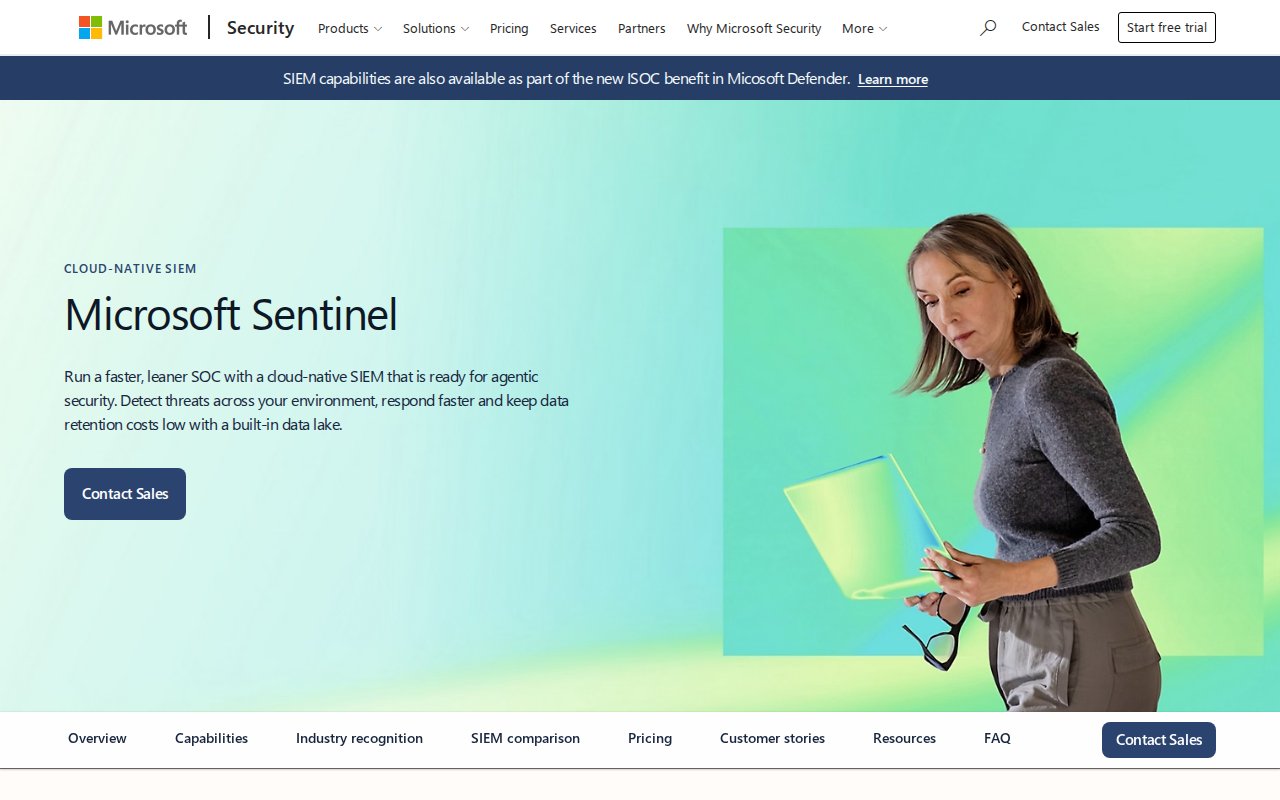
Microsoft Sentinel product page under the label Cloud-native SIEM, with a Contact Sales button beside a photo of a woman holding a laptop
www.microsoft.com, captured November 20, 2026

Microsoft Sentinel is a cloud SIEM that you run; Microsoft's guide for service providers treats the SOC as your service. Each client gets its own workspace, managed from your tenant through Azure Lighthouse, and data connectors also need granular delegated admin privileges (GDAP).

That workspace bills in the client's own Azure subscription, so the client pays Azure or you rebill it; we found no consolidated provider billing in Microsoft's documentation. The East US list price is $4.30 per GB, the first 90 days are retained at no charge, and interactive retention extends to two years at a monthly per-GB rate. Azure Activity and Office 365 audit logs ingest free. Microsoft's per-user grant for Entra ID sign-in and audit logs covers Microsoft 365 E5, E7, A5, F5 and G5 customers; Business Premium is not listed.

Best fit:MSPs with their own security analysts and Microsoft 365-heavy clients who are ready to pass on or rebill Azure costs per client.

Think twice if:you need someone else to watch alerts, since Microsoft provides the platform and leaves the SOC to you, you want one consolidated bill, since each client's workspace bills in that client's Azure subscription, or a client sends high log volumes, since cost rises with every GB.

07

UTMStack

An open-source SIEM, hosted or on your own servers, priced per device with every client separated under your brand.

Per device1 year searchableOptional paid night shift
Who works the alerts
your team; an optional paid SOC Extension covers nights, weekends, overflow and incidents
Across clients
"every client separated on one server, with your branding", each with its own users, sources and alerts
Retention included
1 year, all searchable; 2, 3 and 5 years "Added in your quote"
Published pricing
cloud estimates of $190 to $265 a month for 25 to 50 devices, $355 to $490 for 50 to 100 and $500 to $695 for 100 to 150, "An estimate, not a quote"
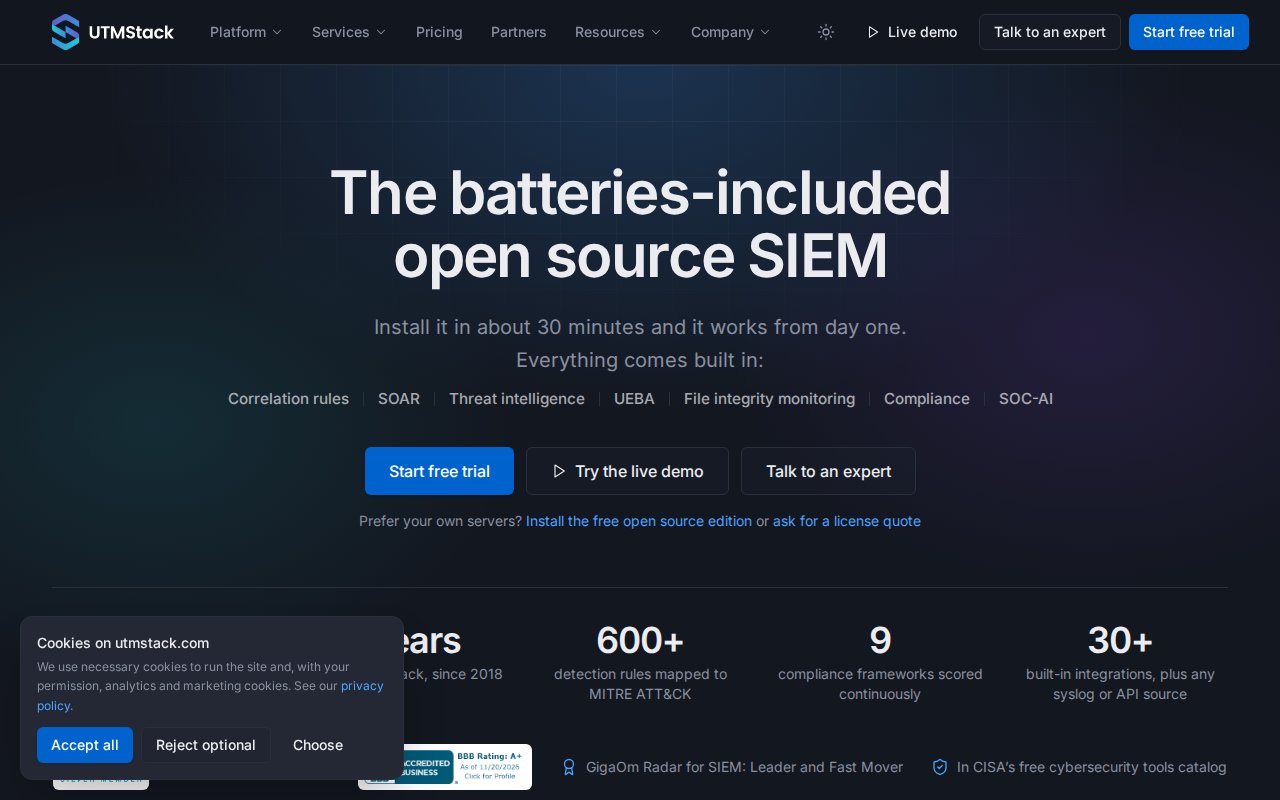
UTMStack homepage headline "The batteries-included open source SIEM" above Start free trial and Try the live demo buttons and counters for compliance frameworks and integrations
utmstack.com, captured November 20, 2026

UTMStack is an open-source SIEM you run in its cloud or on your own servers, with "every client separated on one server, with your branding". Your team works the alerts; a paid SOC Extension covers nights, weekends, overflow and incidents, priced on a call.

Pricing is per device with no ingest fees, and about three workstations count as one device. The cloud calculator shows bands from $190 to $265 a month for 25 to 50 devices up to $500 to $695 for 100 to 150, labeled "An estimate, not a quote". A year of logs is included, all searchable; 2, 3 and 5 years are "Added in your quote". UTMStack scores nine compliance frameworks, including HIPAA, PCI DSS 4.0 and CMMC 2.0.

Best fit:MSPs that bill per device and want a year of searchable logs with no ingest fees, plus the option of a vendor night shift later.

Think twice if:you need a firm price, since UTMStack's figures are estimates and retention beyond a year is priced only in a quote, or you need to know who owns the vendor, since no owner is named on the pages we reviewed.

08

Wazuh

An open-source security platform with SIEM, free to run yourself or bought hosted as Wazuh Cloud by agent tier.

Open sourceAgent tiersWhite-label partner console
Who works the alerts
your team; no vendor SOC found on the pages we reviewed
Across clients
the Platinum partner tier includes a multi-tenant web interface that partners may white label
Retention included
Wazuh Cloud Small, 1 month indexed and 3 months archived; Medium and Large, 3 months indexed and 1 year archived
Published pricing
Wazuh Cloud from $571 a month for 100 agents, $923 for 250 and $1,467 for 500; self-hosting free; partner program $3,200 (Gold) or $9,900 (Platinum) for the first year
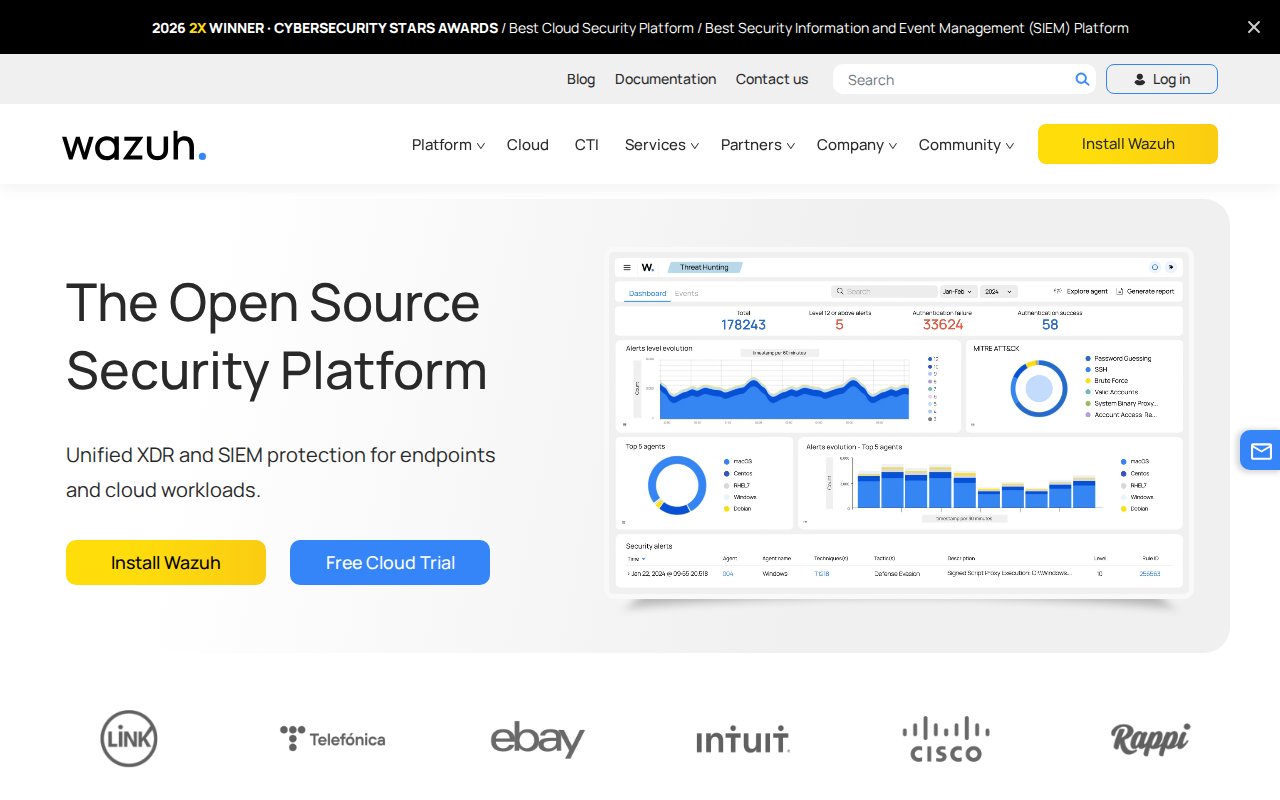
Wazuh homepage headline "The Open Source Security Platform" beside a threat hunting dashboard, with Install Wazuh and Free Cloud Trial buttons
wazuh.com, captured November 20, 2026

Wazuh is an open-source extended detection and response (XDR) and SIEM platform, free to run on your own servers or hosted as Wazuh Cloud. Its Platinum partner tier, $9,900 for the first year, adds a multi-tenant web interface that partners may white label; Gold, at $3,200, leaves it unchecked. We found no vendor SOC on Wazuh's pages, so your team works the alerts.

Wazuh Cloud is priced by active agents: 100 from $571 a month, 250 from $923, 500 from $1,467. Small indexes 1 month and archives 3; Medium and Large index 3 months and archive a year. Wazuh lists PCI DSS and System and Organization Controls 2 (SOC 2) compliance for Wazuh Cloud itself. Self-hosting costs no license fee, but building, tuning and running it is your staff's work.

Best fit:MSPs with engineers who can run an open-source platform, or that want hosted tiers at a published price and a white-label console through the Platinum partner tier.

Think twice if:you need vendor analysts, since none were found on Wazuh's pages, more than a month indexed on the Small tier, or you lack the staff to build and maintain a self-hosted install.

also considered

Also considered

  • N-able Adlumin: SIEM inside detection and response packages; 30 or 90 days; entry package covers Microsoft data only.
  • Seceon: a free not-for-resale tier for providers, up to 50 users; paid tiers by quote.
  • Blackpoint CompassOne LogIC: a "streamlined SIEM alternative" for logging and compliance, with 365 days of retention.
  • Stellar Cyber: a multi-tenant platform for managed security providers; quote only.
  • Guardsix, formerly Logpoint: priced per node, with a Europe-focused pitch.
  • FortiSIEM: licensed per managed device through Fortinet distributors.
  • Elastic Security: "as low as" $0.09 per GB ingested, with retention you set.
  • Graylog Security: from $18,000 a year at 10 GB a day.
  • Rapid7 Incident Command: 90 or 180 days of log retention by tier, each plus an add-on.
  • Gravwell: a free Community Edition for up to 13.9 GB a day.
decision aid

Log retention at 30, 90 and 365 days, and what it costs

Searchable logs can be queried straight away; cold or archived logs often must be restored first, sometimes for a fee. So searchable days and total days are different promises. The first table shows both; the second prices one client's logs where cost moves with volume.

Retention included and the cost of keeping logs longer, from vendors' own pages, November 20, 2026
ProductPricing unitSearchable retention included90 days365 daysLonger options (vendor's words)
Huntress Managed SIEMPer data source, $4.00 a month1 month; 12 months in total, older months in cold storageAdd-on: Extended Retention, 90 days searchable; card price $8.49 instead of $4.00 per sourceIncluded as cold storage; rehydrate to search, which Huntress says may cost $1 per GB beyond 500 GB a year"90 days active and 7 years cold" with the add-on
Kaseya SIEMPer user, quote400 daysIncludedIncludedNot published
TodylPackage, quote30 days Essentials, 90 Advanced, 1 year Complete; searchable share not statedIncluded on Advanced and CompleteIncluded on Complete onlyNot published; "flexible retention policies"
BlumiraPer employee; MSP rates not published1 yearIncludedIncluded"Long Term Storage Options" listed on direct Respond and Automate plans; length and price not published
LimaCharlie$0.20 per GB telemetry; $3.00 per endpoint1 yearIncludedIncludedNot published; data can be forwarded to your own storage
Microsoft Sentinel$4.30 per GB, East US90 days at no chargeIncluded$0.10 per GB a month after day 90, or $0.026 per GB a month in the data lakeInteractive "extensible for up to two years"; older data in the data lake
UTMStackPer device, estimate1 year, all searchableIncludedIncluded2, 3 and 5 years: Add-on, price not published ("Added in your quote")
WazuhWazuh Cloud tier by active agents, from $571 a monthIndexed: 1 month Small; 3 months Medium and LargeMedium and Large: Included; Small: archive onlyMedium and Large: Included (archive); Small: Not publishedCustom tier: retention and price not published

"Not published" means not found on the vendor pages we reviewed on November 20, 2026, not "not offered". If the pooled 10 GB a month per source runs out across your Huntress account, its billing terms say ingestion continues and the oldest data is truncated, so 12 months can shrink; its SIEM pricing page adds that overage charges can be applied. Sentinel figures are East US list prices and vary by region.

Our arithmetic on list prices read November 20, 2026, not a quote: one client sending 2 GB a day of billable data, such as firewall and Windows events, over a 30-day month (60 GB), at steady state after a year, platform cost only. At 365 days, data older than 90 days is 275 days at 2 GB, or 550 GB. Sentinel's free sources are left out. LimaCharlie's documentation bills external telemetry per GB ingested.

Worked example: one client at 2 GB a day, monthly platform cost at list prices, our arithmetic
Retention keptMicrosoft Sentinel, East US, pay-as-you-goLimaCharlie
30 days$258.00 (60 GB x $4.30); keeping less than 90 days saves nothing$12.00 (60 GB x $0.20)
90 days$258.00; the first 90 days are retained at no charge$12.00
365 days, analytics tier$313.00 ($258.00 plus 550 GB x $0.10)$12.00; 1 year of storage included
365 days, data lake for days 91 to 365$260.38 ($258.00 plus 550 GB / 6 x $0.026, at Microsoft's 6:1 compression); searching the lake costs $0.005 per GB scannedNot applicable

Endpoint sensors on LimaCharlie cost $3.00 per endpoint on top. Sentinel's pay-as-you-go rate applies because 2 GB a day sits far below its smallest commitment tier. Figures exclude your labor and any monitoring service.

No such arithmetic works for the other six, priced by source, user, employee, device, package or agent tier.

how to choose

How to choose a SIEM platform for your clients

Start with who answers the 2am alert. If nobody on your team can, shortlist Huntress Managed SIEM, Kaseya SIEM or Todyl. With staff for business hours only, Blumira's critical-incident support or UTMStack's paid SOC Extension sit in between, though we found no response commitment for your clients on either vendor's pages. Either way, name the person who owns tuning and escalation.

Set retention per client from its contracts, insurance terms and regulators. Kaseya SIEM includes 400 days; elsewhere, past a year is an add-on, a per-GB rate or not published. Check each client's sources by name rather than the vendor's count, ask for unfiltered logs if you need audit evidence, and fix patchy endpoint coverage first with one of the endpoint detection and response tools for MSPs we compared. Per user or per device passes through to a client price cleanly; per GB moves with volume. Last, exit: Huntress documents a 30-day download window after a non-renewing term and LimaCharlie can forward data to your own storage. Get the others' answer in writing.

Questions for the demo:

  • What may your analysts do without calling us?
  • How many days are searchable without a restore, and what does a restore cost?
  • Do you keep raw or filtered logs for each source we named?
  • How are clients separated, and can retention differ per client?
  • What is the price at our client count and term?
  • How do we export a client's logs if we leave?

Red flags

  • A "seven years" headline when the terms make it an add-on.
  • "24/7" with no statement of who acts.
  • A per-GB price with no retention rate beside it.
  • An estimate presented as a quote.
pricing

What these platforms cost (published prices only)

Six of the eight publish a list price or estimate, Blumira's for direct buyers, not MSPs. Kaseya SIEM and Todyl quote only. Per source, employee, user, device, agent tier and GB do not sit on one scale without a client's real counts and volume, so the table does not rank them.

Published prices and billing units, read November 20, 2026
ProductWhat is publishedBilling unit
Huntress Managed SIEM$4.00 a month per data source at list price; $8.49 with Extended Retention; volume pricing on requestPer data source, 10 GB a month pooled
Kaseya SIEMNot published; "Get a price quote"Per user
TodylNot published; "Contact Sales for Pricing"Package
BlumiraMSP rates "shared in conversation"; direct list prices $12 (Detect), $16 (Respond) and $21 (Automate) per employee a month, on annual termsPer employee, volume tiers for MSPs
LimaCharlie$0.20 per GB telemetry; $3.00 per endpoint; free for 2 endpointsPer GB and per endpoint
Microsoft Sentinel$4.30 per GB pay-as-you-go, East US; commitment tiers from $296 a day for 100 GB a day, plus a 50 GB a day promotional tier at $161.25 a day for sign-ups through December 31, 2026, held until March 31, 2027; $0.10 per GB a month after 90 days; data lake storage $0.026 per GB a monthPer GB
UTMStackCloud estimates $190 to $265 a month (25 to 50 devices), $355 to $490 (50 to 100), $500 to $695 (100 to 150); "An estimate, not a quote"Per device
WazuhWazuh Cloud from $571 a month (100 agents), $923 (250), $1,467 (500); self-hosting freeTier by active agents
Elastic Security (Also considered)"As low as" $0.09 per GB ingested and $0.017 per GB retained a monthPer GB
Graylog Security (Also considered)From $18,000 a yearBy daily volume from 10 GB a day, or annual consumption units

US dollars as published on November 20, 2026. Not published = not found on the vendor pages we reviewed.

N-able Adlumin and Stellar Cyber publish no price on the pages we reviewed. Huntress's card price rises from $4.00 to $8.49 per source with Extended Retention; the add-on is not listed alone. Sentinel bills each client's own Azure subscription. The platform is one line in the client's price, next to your labor; see what a per-user MSP price covers.

faq

Frequently asked questions

What does a SIEM cost for an MSP?

It depends on the unit. Huntress lists $4.00 a month per data source, Microsoft Sentinel $4.30 per GB in East US, and LimaCharlie $0.20 per GB. Blumira and Kaseya quote per employee or user, UTMStack estimates per device and Wazuh Cloud prices by agent tier. One client sending 2 GB a day to Sentinel comes to $258 a month at list price with 90 days kept, before your labor.

Do MSPs need a SIEM if clients already have EDR or MDR?

Not always. Endpoint tools see endpoints; a SIEM also collects firewall, identity and Microsoft 365 logs and keeps them for audits and investigations. One practitioner calls a SIEM nobody watches "a comfort blanket". Fix endpoint security first; a small team may get more from managed detection and response before adding one.

Who watches SIEM alerts at night?

That depends on the product. Vendor analysts work the alerts at Huntress, Kaseya SIEM and Todyl. Blumira offers critical-incident support, and UTMStack sells a SOC Extension for nights and weekends. On Microsoft Sentinel, Wazuh and LimaCharlie we found no vendor SOC, so it is your team. Ask in writing what the analysts may do without calling you.

How long should MSP clients keep logs?

No single rule covers every client; start from contracts, cyber insurance terms and regulations. HIPAA's six-year rule in section 164.316 of title 45 of the Code of Federal Regulations covers policies and documentation, not necessarily raw logs. Practitioners describe a HIPAA pattern of 90 to 180 days searchable, the rest archived. Included searchable retention here runs from 30 to 400 days.

Is open-source SIEM worth it for an MSP?

It can be, if you have the people. Wazuh and UTMStack's open-source edition are free to run on your own servers, but the cost moves to your staff, who build, tune and watch them. If nobody owns tuning and escalation, buy rather than build. Both sell hosted versions: Wazuh Cloud from $571 a month for 100 agents, UTMStack Cloud from an estimated $190 a month for 25 to 50 devices.

Screenshots captured from each vendor's live site on November 20, 2026.