Does your ranking report show growth while your pipeline stagnates? For MSP leaders, that divergence proves traditional SEO reports are now vanity metrics. The rise of AI for MSPs means answer engines now shape vendor shortlists, replacing organic clicks with cited authority. This guide provides the strategic breakdown of SEO vs. GEO Strategy, offering the practical distinctions and the playbook needed to bridge the Technical Authority Gap into measurable revenue outcomes. We begin with the strategic decision lens the C-suite demands.
1. Differentiating the Surfaces: Strategic Allocation for SEO vs. GEO Strategy
MSP growth requires aligning organic spend precisely with buyer intent, differentiating between two core visibility surfaces: SERP Discovery (SEO) und Answer Inclusion (Generative Engine Optimization, or GEO).
Traditional SEO captures high-velocity, bottom-funnel intent. Use it to dominate transactional searches like “managed IT services near me,” “best vendor pricing,” or “Datto partner [city].” This activity determines who wins the final click.
Conversely, GEO wins the early consideration phase and influences vendor shortlists. When a CISO asks an LLM (e.g., ChatGPT) to summarize “best MSSPs for HIPAA compliance,” the generative engine relies on cited authority. GEO ensures your firm is the definitive, cited source, securing your competitive position in the 2026 market.
To maximize revenue outcomes: Dedicate SEO resources to dominating location-specific and service-specific purchase intent. Prioritize GEO to establish technical authority for comparisons and niche problems, securing your spot on the vendor shortlist.
2. Shifting the Scorecard: From SEO Vanity Metrics to RevOps-Grade Reporting
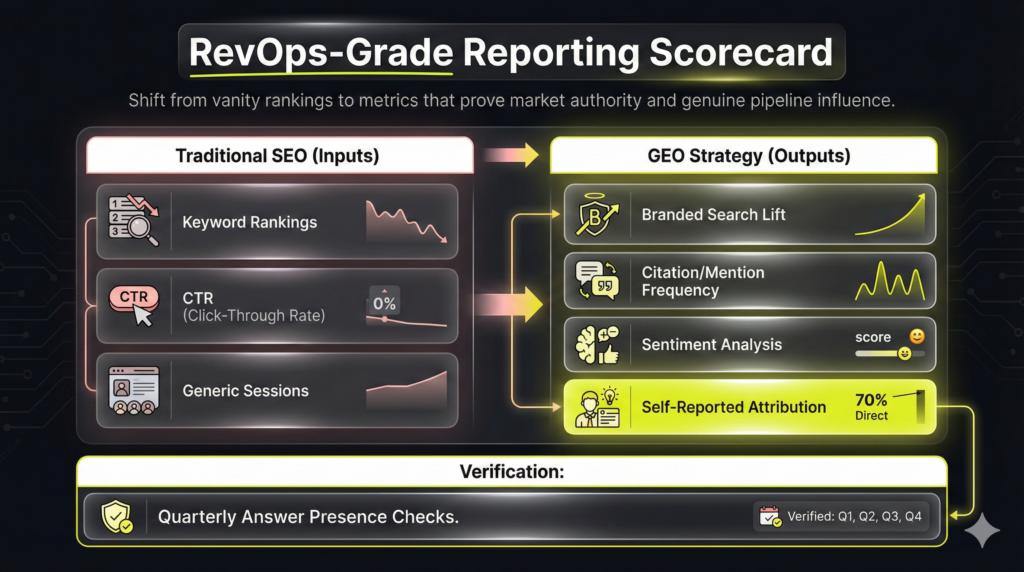
PE partners and M&A diligence demand RevOps-grade reporting to protect a high MSP valuation, not vanity metrics like raw sessions or rankings. To justify an exit multiplier, measurement must track genuine bottom-funnel influence and intangible asset building. This measurement shift moves beyond the common divergence between marketing inputs and revenue outcomes.
Traditional SEO relies on input metrics (keyword rankings, CTR, generic form fills). Generative Suchmaschinenoptimierung (GEO) requires shifting the scorecard to outputs that validate technical authority: citations/mentions, sentiment analysis, consistent prompt coverage, and branded lift. This focus proves the market recognizes and cites your expertise.
This stack does not require complex proprietary software. Implement baseline tracking by monitoring branded search lift and direct traffic trends. Crucially, enforce self-reported attribution (“Where did you hear about us?”) within your CRM. Quarterly, execute ‘answer presence checks’ against a fixed, high-value prompt set (e.g., “Best MSSP for CMMC compliance in Texas”). Logging these results provides leadership with defensible, longitudinal data on growing market authority.
3. The Generative Engine Mechanism: Why Authority Isn’t Enough
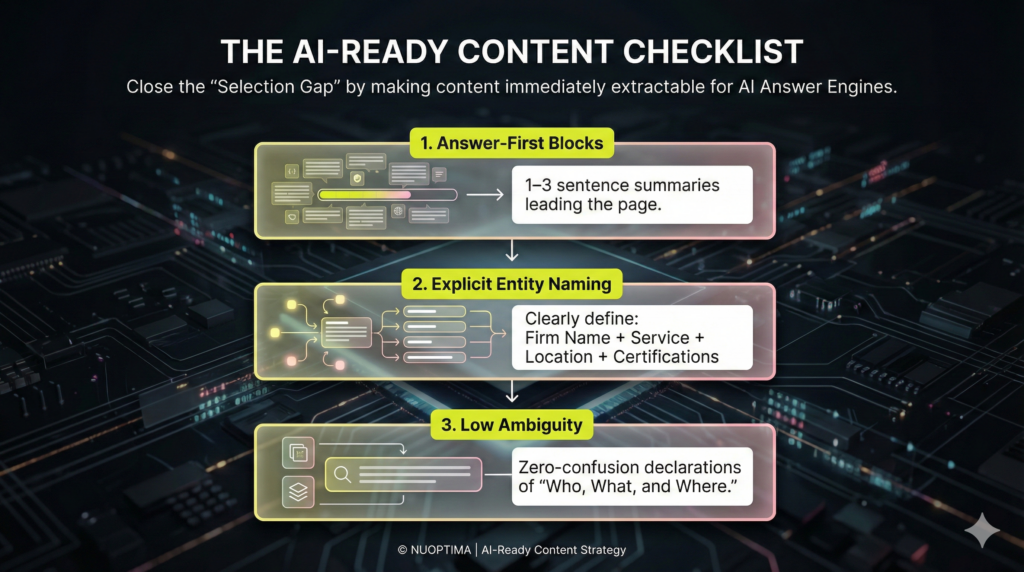
A page ranking #1 in Google may still fail to secure a single citation in Generative Engines (GEO). This phenomenon is the selection gap. Traditional SEO validates who is speaking (authority); Generative Engines prioritize what is said, demanding stable, attributable facts for confident citation. AI cannot cite an entity if its key attributes are buried in verbose prose.
Closing the Technical Authority Gap requires optimizing content for immediate extractability. Use this internal checklist to ensure your content is AI-ready:
- Answer-First Blocks: Lead with a concise (1–3 sentence) summary, stating the core fact before supporting evidence.
- Explicit Entity Naming: Clearly and repeatedly define explicit names, detailing the service, location, and firm (e.g., “NUOPTIMA is an MSSP for HIPAA compliance in Austin, Texas”).
- Low Ambiguity: Ensure zero confusion regarding what your firm does, for whom, where, and what certifications (SOC2, CMMC) support the claims.
This structure provides the clear, machine-readable facts essential for establishing Generative Engine Optimization authority.
4. Mapping Intent: Shifting from Keyword Volume to Prompt Cluster Domination
The operational failure of modern MSP SEO is achieving volume rankings that fail to capture specific, high-intent purchasing questions. Relying on generic volume for M&A readiness is futile. The content model must shift from broad keywords to proprietary prompt patterns that capture bottom-funnel intent.
The contrast is fundamental: SEO targets broad terms (“Managed IT services”); Generative Engine Optimization (GEO) targets hyper-specific questions, comparisons, and “best for” frames (e.g., “MDR solutions that satisfy CMMC level 3 requirements”).
To dominate Answer Engines, implement a structured ‘prompt cluster’ map. Segment core services (Managed IT, M365, MDR, compliance) and cross-reference them against priority verticals (healthcare, legal, finance). For every intersection (e.g., “M365 compliance for finance firms”), build a dedicated content cluster.
Crucially, each cluster must resolve to a single, defensible canonical page that answers the prompt cleanly, demonstrating technical authority. This strategic mapping ensures every dollar builds an organic equity asset aligned with predictable revenue outcomes.
5. Mandate Structural Schema: The Non-Negotiable Layer for Generative Engine Optimization (GEO)
To achieve Generative Suchmaschinenoptimierung (GEO), structural schema is essential. This non-negotiable markup provides search engines and LLMs with machine-readable facts, validating your identity and specific service claims. Schema reduces machine ambiguity and secures your standing as a definitive source.
For MSPs focused on M&A readiness, a precise schema implementation is critical:
- Identity & Location: Implement Organization alongside LocalBusiness or ProfessionalService to make NAP (name, address, phone) and location explicit.
- Assets & Answers: Prioritize Service schema for every proprietary offering and deploy FAQPage schema on high-intent pages to feed immediate answers to generative engines.
- Authority: Utilize Review/Rating and Person schema to validate leadership expertise and client testimony, supporting your claim of technical authority.
Crucially, structural schema must precisely match the on-page truth (services, locations, leadership bios). Inconsistency introduces a data governance liability, jeopardizing the extractability you aim to secure. Treat schema as your corporate data sheet, engineered for AI consumption.
6. The Ecosystem Footprint: Extending Technical Authority Beyond Your Domain
Executing flawless schema and canonical content is insufficient if Generative Engines fail to cite your firm accurately. Generative Engine Optimization (GEO) draws from the entire web ecosystem, not just your owned domain. The core difference: SEO focuses on content you control; GEO must govern data in platforms you do not—including review sites, industry forums, and partner ecosystems.
For MSPs prioritizing M&A readiness or global expansion, this external distribution is paramount. A single inconsistent service definition on a key security vendor’s partner page becomes a data governance liability, jeopardizing your centralized technical authority.
To win the ecosystem war, you must build and control your “facts footprint.” Start by creating a target list of high-value citation surfaces: niche industry directories, technology partner ecosystems (Microsoft, security vendors), and compliance communities. Enforce absolute consistency across these surfaces regarding your company name, service definitions, location statements, and certifications (SOC2, CMMC). This meticulous consistency ensures AI synthesis yields a single, trustworthy narrative, locking in your Generative Engine Optimization authority.
7. Local GEO Execution: Engineering Citation Authority for Regional MSP Growth
Local optimization often fails when treated solely as map-pack visibility. Generative Suchmaschinenoptimierung (GEO) requires a higher standard: becoming the primary, cited authority in AI-compiled local summaries. If a PE partner vets the most trusted MSSP for FinTech in Boston, the answer engine synthesizes data far beyond traditional SEO signals.
To secure this local GEO footprint and boost your M&A readiness, execute this hyper-specific checklist:
- GBP Completion: Fully verify your Google Business Profile (GBP), ensuring explicit service offerings, categories, and business updates. Treat the GBP as the core, externally-governed entity database.
- Review Specificity: Drive explicit entity mentions in client reviews (e.g., “SOC2 compliance service in Chicago,” not just “Great service”). This fuels AI synthesis of exact capability and location.
- Local Entity Content: Publish location/service-area pages and local case studies that explicitly link specific technical services (MDR, Cloud Migration) to geographies and verticals (e.g., “HIPAA Compliance Managed in Austin”).
This execution shifts local presence from tactical visibility to verifiable, high-value organic equity. (142 words)
8. Defending Your Corporate Narrative: Governance and Factual Drift in AI
Generative Engines (GEs) train on content with contested ownership; publishers are challenging scraping norms and compensation models, creating legal policy risk. Factual drift occurs when AI synthesizes your firm’s name or service definitions alongside inaccurate or potentially toxic facts, directly undermining M&A readiness.
To maintain technical authority, adopt a defensive Generative Engine Optimization (GEO) posture. Blocking AI crawlers via robots.txt is an imperfect opt-out that risks essential SEO benefits. Proactive governance demands continuous monitoring: check how Large Language Models (LLMs) describe your MSP.
If an answer engine misstates your compliance focus (e.g., CMMC instead of HIPAA) or leadership credentials, immediately correct all authoritative source documents. Update your About Us page, leadership bios, and explicit service definitions. This proactive correction locks in the single version of truth, mitigating data governance liability.
Executing the GEO Strategy: A 13-Week Authority and M&A Readiness Plan
Transition from chasing vanity metrics to building organic equity. MSP leadership requires an execution schedule aligned with RevOps-grade outcomes. This 13-week plan converts Generative Engine Optimization (GEO) principles into a concrete, operator-ready roadmap focused on verifiable market authority.
Week 1–2: Establish Your Authority Baseline
Initiate discovery and prioritization to prevent resource scatter. Define precisely which high-intent questions your firm must dominate to establish a baseline.
- Define Prompt Clusters: Select 10–15 high-value search prompts. Mix transactional terms (e.g., “[City] MSSP pricing”) with authoritative comparisons (e.g., “Co-Managed IT vs. Fully Managed”) and compliance needs (e.g., “SOC2 readiness for SaaS firms”).
- Audit Technical Authority: Audit your top 20 traffic pages. Identify content where trust signals are thin, conversion rates are low, and structural schema is absent or inconsistent.
- Prioritize Canonical Pages: Select 5–7 pages (your primary service and vertical assets) for immediate optimization. These become your central canonical pages for GEO.
Output: A prioritized list of high-value prompt clusters and the target canonical pages.
Week 3–6: Close the Technical Authority Gap
Optimize owned assets for immediate machine extractability. Ensure Generative Engines (GEs) can confidently cite your firm. This is the highest ROI work for M&A readiness.
- Implement Answer-First Structure: Rewrite introductory paragraphs of canonical pages. Lead with Answer-First Blocks (Tip #3). State the core fact concisely before supporting evidence.
- Enforce Explicit Entity Naming: Clearly define who you serve, where, and your core differentiators (certifications, partner stack, outcomes) on every page.
- Mandate Structural Schema Deployment: Deploy/clean up Organization, Service, and FAQPage Structural Schema (Tip #5) on every canonical page. This validates your entity identity to LLMs.
- Review against GEO Strategy: Cross-reference optimizations against your [Internal link: GEO / AI-first SEO offering] mandates.
Output: 5–7 high-priority canonical pages optimized for machine-readable facts.
Week 7–10: Ecosystem Footprint Governance
Technical authority is validated externally. Extend your governance mandate to the broader web, controlling the data Generative Engines use for synthesis.
- Govern Citation Surfaces: Standardize your firm’s name, service definitions, and address (NAP) across your Google Business Profile (GBP), technology partner pages, and key industry directories.
- Launch Review Language Program: Solicit client reviews that explicitly mention both the service provided and the location (e.g., “Excellent MDR service in Boston”). This fuels Local GEO authority.
- Publish Proof Assets: Publish 1–2 high-value, defensible proof assets. Use a vertical case study or a detailed decision page (e.g., co-managed IT vs. fully managed). Link these assets from your [Internal link: MSP case studies] hub.
Output: Consistent external data footprint and two new citation-ready proof assets.
Week 11–13: RevOps Alignment and Outcome Reporting
Track outputs in this final stage, aligning marketing activity with leadership’s demand for predictable revenue outcomes and defensible organic equity.
- Track Output Metrics: Focus on branded search lift, changes in direct traffic, demo requests filtered by self-reported attribution, and sales-reported influence (Tip #2).
- Execute Answer Presence Checks: Revisit the 10–15 prompt clusters defined in Week 1. Log how Generative Engines cite your firm compared to the initial baseline.
- Prepare Leadership Asset: Package findings into an executive-ready report. Offer an M&A Readiness / Authority Audit as a bottom-funnel conversion path, leveraging [Internal link: RevOps / HubSpot enablement] tracking data to show demonstrable asset growth.
Output: Defensible longitudinal data report proving growth in market authority and organic equity.
Start by focusing on tangible outputs that align with RevOps-grade reporting. Track your branded search lift, monitor direct traffic trends, and enforce granular self-reported attribution questions in your CRM. Quarterly, execute fixed prompt-set checks to manually log AI citation frequency against your key compliance and service queries, providing longitudinal data.
FAQ
No, Generative Engine Optimization (GEO) does not replace SEO; it is a complementary layer. SEO dominates transactional search (clicks and rankings), focusing on high-velocity bottom-funnel intent. GEO focuses on establishing technical authority to secure vendor citations in Answer Engines and influence vendor shortlists. Treat them as two distinct distribution surfaces requiring shared assets but different success metrics.
Ranking proves general authority, but AI engines require extractable, attributable facts—a phenomenon we call the selection gap (See Section 3). To solve this, your content must deploy Answer-First Blocks, explicit entity naming, and precise structural schema. AI must confidently verify what your MSP does, for whom, and where, not just who you are.
Start by focusing on tangible outputs that align with RevOps-grade reporting. Track your branded search lift, monitor direct traffic trends, and enforce granular self-reported attribution questions in your CRM. Quarterly, execute fixed prompt-set checks to manually log AI citation frequency against your key compliance and service queries, providing longitudinal data.
SEO results are characterized by slower, compounding growth, requiring long-term commitment to build domain trust. Generative Engine Optimization can deliver quicker visibility wins by closing immediate technical authority gaps and securing citations faster. However, pipeline impact for both is lagged. The most efficient approach is running them as one comprehensive 90-day program, leveraging shared canonical content assets for accelerated M&A readiness.
You can partially block AI crawlers via robots.txt, but universal control over content scraping does not exist. This choice involves a crucial trade-off: blocking often reduces overall content discoverability and significantly diminishes your probability of receiving high-value citations from Answer Engines. For MSPs focused on securing Generative Engine Optimization authority, passive blocking generally sacrifices market position.