Enterprise SaaS SEO programs fail from execution friction across Product, Engineering, and Legal, not poor keywords. To scale across massive sites and complex sales cycles, search must function as a resilient operating system rather than a marketing channel. This 9-pillar framework establishes governance, workflows, and pipeline attribution through an AI-native SEO and GEO lens. Don’t just rank. Be the answer. We begin with the operating model that prevents RevOps chaos.
Key Takeaways
- Enterprise SaaS SEO programs fail from execution friction across Product, Engineering, and Legal, not weak keywords, so search must run as a resilient operating system.
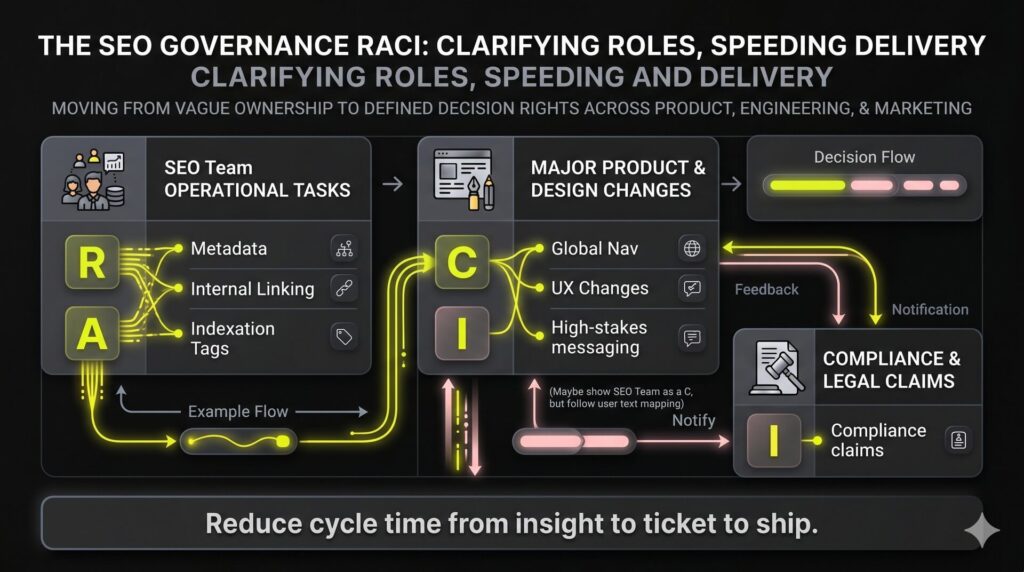
- A RACI governance model lets SEO ship metadata, internal linking, and indexation tags unilaterally while reserving navigation and compliance changes for collaborative review.
- Replace traffic reporting with organic SQLs, pipeline value, organic CAC, and content-influenced revenue, using W-shaped multi-touch attribution mapped into Salesforce or HubSpot.
- A single rogue noindex tag or template change can erase up to 40% of search equity overnight, so technical guardrails belong in PR reviews and QA, not post-launch audits.
1. Build an SEO Governance Model to End Pipeline Friction
Enterprise SaaS SEO stalls when ownership is vague. When a single title tag change requires a cross-functional committee, organic growth plateaus. Effective governance transforms SEO from a perpetual negotiation into a resilient operating system. It ensures organic requirements enter product and content workflows without friction.
Deploy a RACI framework across Product, Engineering, Design, and Legal. Specify decision rights: SEO should ship unilaterally on metadata, internal linking, and indexation tags. High-impact changes like global navigation, templates, or compliance-heavy messaging claims require collaborative review. Clear boundaries prevent SEO work from dying in backlogs.
Embed SEO into the product development lifecycle as a mandatory line item. This means including SEO in PRDs, design reviews, QA, and release checklists. Establish a defined escalation path for priority conflicts to resolve bottlenecks quickly. Positioning SEO as a release gatekeeper ensures it remains a core business requirement.
Deliver a one-page SEO governance charter and a monthly steering committee agenda to maintain alignment. Measure performance through operational metrics:
- Cycle time from insight to ticket to ship.
- Percentage of releases with formal SEO review.
- Ticket-to-shipment velocity across departments.
2. Treat Enterprise SEO as an Internal Sales Motion
Enterprise SaaS SEO fails when stakeholders aren’t bought in. Being technically correct is insufficient for progress. You must treat SEO as an internal sales motion by mapping influence versus interest to secure resources and clear backlogs.
Classify stakeholders into four categories:
- Exec Sponsors: Final budget and priority owners.
- Blockers: Security or legal teams that can halt progress.
- Implementers: Engineering and product teams executing tasks.
- Informed: Peripheral teams impacted by SEO changes.
Tailor your narrative to specific departmental drivers:
- CFO and CMO: Organic pipeline contribution and CAC reduction.
- Product: User adoption, activation metrics, and feature visibility.
- Engineering: Risk mitigation and clear, actionable technical specifications.
- Legal: Compliance, brand safety, and claim hygiene.
Establish a reporting cadence to prevent drift. Distribute a monthly executive 4-box summary covering wins, business impact, priorities, and blockers. Supplement this with biweekly working sessions with Engineering to maintain ticket velocity.
Create momentum with visible wins like fixing indexation leaks or shipping high-intent bottom-of-funnel pages. Publicize results internally with before-and-after screenshots. This creates durable buy-in, transforming SEO from an opaque cost center into a visible revenue engine.
3. Build Attribution That Maps Organic to CRM Pipeline
Executives ignore traffic is up reports because clicks do not fund growth. To secure headcount and engineering resources, transform SEO from a vanity metric into a revenue driver visible in Salesforce or HubSpot. Leadership funds what they can track to a closed-won opportunity.
Replace session reporting with enterprise metrics: Organic SQLs, pipeline value, organic CAC, and content-influenced revenue. In multi-stakeholder sales cycles, last-touch attribution is a liability that erases months of organic research. Use a W-shaped multi-touch model to credit SEO across the entire funnel, ensuring the board sees organic’s role in initial discovery and mid-funnel education.
Capture UTM parameters and organic referrers via hidden form fields mapped to CRM lead objects. Synchronize HubSpot and Salesforce campaigns to ensure organic touchpoints associate automatically with open opportunities. This connects SEO to the systems executives trust, preventing budget cuts and increasing implementation velocity.
Implementation Checklist:
- Standardize channel definitions and UTM discipline across all assets.
- Define lifecycle stages and SEO touchpoint rules for multi-contact opportunities.
- Audit CRM hidden fields to ensure source data persists through the funnel.
- Distribute a monthly board-ready report: pipeline influenced, forecast impact, and key blockers.
4. Prioritize Bottom-Funnel Demand for Faster Payback
Enterprise SEO programs often drown in TOFU content that generates impressions but zero sales calls. To maintain executive sponsorship, capture the small percentage of your Total Addressable Market (TAM) actively buying before expanding reach. Focusing investment on in-market buyers generates pipeline and shortens the SEO payback cycle.
Use a Money Keyword Matrix to identify and prioritize terms with high demo intent. Map your core offer against these specific columns to surface high-value gaps:
- Target industries and high-value vertical niches
- Direct competitors and alternative solutions
- Urgent Jobs-to-be-done (JTBD)
Prioritize page formats that resolve high-intent research queries:
- Competitor vs and Alternatives pages with honest positioning.
- Best [category] for [industry] pages targeting vertical use cases.
- Pricing, security, compliance, and implementation pages that remove buying friction.
To bypass slow reviews, align messaging with Legal and Product Marketing via pre-approved copy blocks. This governance allows you to ship high-stakes comparison content without triggering six-week review cycles.
Instrument every page for conversion. Each asset must provide a direct path to a demo or trial, supported by internal links to technical documentation and case studies. This revenue-first approach ensures enterprise SaaS SEO pays back fast enough to justify the investment.
5. Implement Technical Guardrails to Mitigate Invisible Losses
Enterprise sites rarely lose visibility gradually. A single rogue noindex tag or unchecked template change in production can erase 40% of search equity overnight. At this scale, technical SEO is high-stakes risk management that makes scaling safe.
Standardize architecture controls to prevent duplicate sprawl and index bloat. Define specific indexation rules and canonical policies by page type:
- Product and programmatic pages
- Help documentation and support
- Integrations and blogs
Strict faceted navigation policies ensure rapid scaling does not create crawl traps or thin content.
Prioritize rendering health for modern SaaS stacks to ensure discoverability for both Googlebot and AI crawlers. Move SEO from a post-launch audit to a pre-launch requirement. Embed mandatory checks into PR reviews and QA checklists to verify metadata and status codes before deployment. Ensuring critical sections remain discoverable protects organic revenue from technical debt.
Core Technical Deliverables:
- Page-Type Inventory: A master indexation map for every site sub-folder.
- Engineering Requirements: Templated SEO specs and entity schemas for all new components.
- Automated Monitoring: Real-time alerts for canonical shifts and indexation leaks.
These guardrails reduce technical risk and create an architecture that supports growth without constant firefighting.
6. Establish Content Governance to Maintain Velocity and Safety
Enterprise content velocity collapses when Subject Matter Experts (SMEs) and Legal become bottlenecks. Governance prevents quality and safety from eroding speed. A structured system transforms production into a predictable engine that protects brand equity while driving revenue through enterprise SaaS SEO. This framework ensures your brand remains the cited authority in both traditional search and AI-generated answers.
Standardize assets with briefs defining the ICP, search intent, POV, and specific proof points. Use a 30-minute SME interview workflow to extract technical authority before professional drafting and validation. Limit Legal and Product Marketing reviews to high-risk claims to prevent process gridlock. Every brief must include non-negotiable sections to ensure brand consistency across a multi-author system.
Focus QA on claim substantiation, security wording, and terminology consistency across complex product lines. In regulated industries, embed accessibility and compliance into the initial release process to avoid late-stage blockers. Maintain relevance with a structured refresh cadence: quarterly for BOFU assets and biannual for TOFU content.
Scale using these core governance outputs:
- Editorial standards documentation.
- Publishing checklists.
- Clear escalation rules for mandatory Legal review.
This approach converts content from a tactical bottleneck into a sustainable organic moat that compounds across the search landscape.
7. Scale Market Coverage via Programmatic SEO and Governance
Enterprise SaaS winners dominate the long tail by automating coverage for integrations and niche use cases. Manual content creation cannot match competitors who out-cover your footprint across thousands of queries. Programmatic SEO (pSEO) expands your organic revenue by predictably capturing high-intent demand. Deploy these page types to scale:
- Integration and partner hubs
- Industry solution pages
- Use-case libraries
- API and documentation hubs
High-density enterprise SaaS SEO requires programmatic systems that avoid thin content. Every page must deliver unique value to secure Google rankings and earn AI citations. Minimum standards must include specific setup steps, product screenshots, limitations, and technical FAQs. Strict uniqueness rules and shared modules prevent thin-content debt while protecting domain authority from index bloat.
Success requires cross-team coordination. Product teams ensure technical accuracy. SEO specialists own the semantic templates and internal linking architecture. Engineering teams manage the automated generation pipeline and data integrity.
Measure success by tracking indexation rates and conversion by page type. Prioritize pipeline influence and assisted conversions over vanity traffic volume. When governed by quality, programmatic systems transform into an automated net for capturing commercial demand. Don’t just rank. Be the answer.
8. Optimize Third-Party Footprints for AI Citations
Enterprise buyers shortlist on G2, Capterra, and TrustRadius before visiting your website. Neglecting these aggregators forfeits high-intent discovery at the source. Treat vendor profiles as secondary landing pages by optimizing positioning, outcome-driven screenshots, and technical proof of results.
These marketplaces function as the primary citation pool for generative engines. When a prospect asks Perplexity for the best enterprise CRM for healthcare, the LLM pulls data from these trusted third-party summaries. Implement a high-velocity review strategy to maintain recency and ensure your brand remains the top-cited entity for specific category queries.
Build authority through digital PR tied to original benchmarks and proprietary data reports. Coordinate with Product and Comms teams to publish annual stats that earn high-quality external links and mentions. This strategy cements your entity within the knowledge graph and secures your place in LLM training sets.
KPIs for External Visibility:
- Referral demo volume and assisted pipeline
- Share of voice in primary software directories
- AI citation frequency and visibility
By dominating the answer layer outside your domain, you ensure your brand is the default recommendation. Don’t just rank. Be the answer.
9. Secure the Answer Layer with Generative Engine Optimization (GEO)
Search is splitting. In complex B2B cycles, engines like ChatGPT and Perplexity act as automated researchers, shaping the vendor shortlist for enterprise SaaS decision-makers. Even with stable rankings, your brand becomes invisible if LLMs cannot synthesize your content. GEO ensures your brand remains the primary cited source in AI-assisted research.
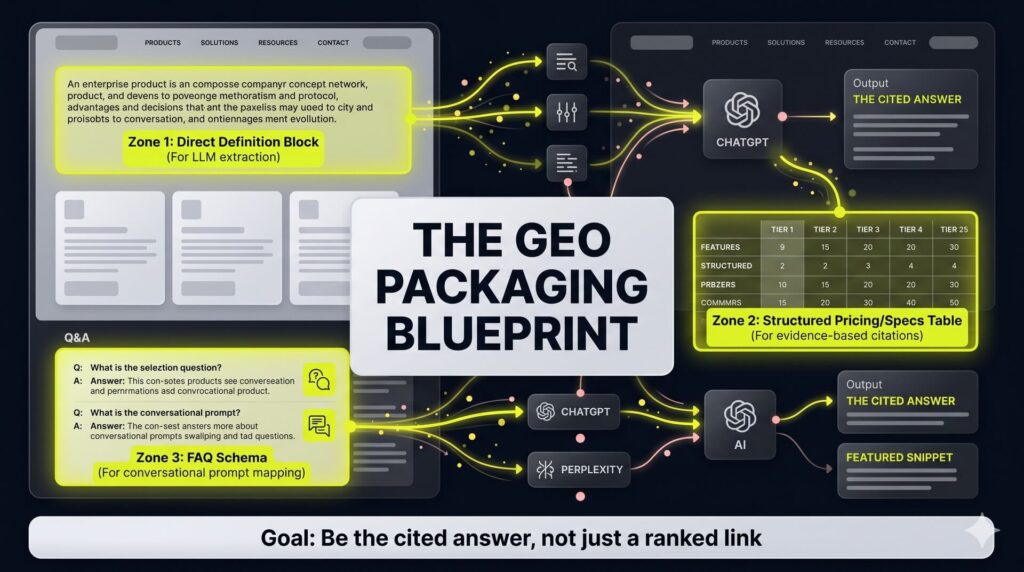
GEO is an authority and packaging problem, not a separate channel. Move beyond keyword density to entity-first positioning with clear statements of what your product is, which enterprise segment it serves, and your core differentiators. Format content for machine extraction using:
- Direct definitions and short takeaway blocks
- Structured data tables for technical specifications or pricing
- Organization, Service, and FAQ schema for consistent entity signals
Strengthen your off-site citation pool by earning mentions in authoritative B2B directories and publishing proprietary research to anchor your brand in the global knowledge graph. Internal governance must require every priority page to include a dedicated answer block, technical proof points, and specific entity declarations. For organizations needing strategic implementation, NUOPTIMA’s GEO services provide the framework to secure your place in the answer layer. Don’t just rank; be the answer.
90-Day Enterprise SaaS SEO Execution Roadmap
Enterprise SaaS SEO programs rarely fail due to a lack of ideas. They fail because of poor sequencing and stakeholder friction. Use this roadmap to convert strategy into a concrete operating cadence that aligns cross-functional teams and secures executive sponsorship through fast, measurable wins.
Days 1 to 14: Establish Your Operating Model
Initiate the governance and measurement frameworks required to support a scalable program.
1. Draft an SEO Governance Charter. Define a clear RACI model for your Product, Engineering, and Marketing teams to eliminate ownership confusion and streamline approvals.
2. Set your measurement baseline. Map organic touchpoints to CRM lead objects in HubSpot or Salesforce. You must track organic pipeline and revenue rather than just traffic volume to prove ROI.
3. Identify key stakeholders. Conduct interviews with internal Blockers and Implementers to identify resource gaps and secure early buy-in for technical changes.
Days 15 to 30: Foundation and Technical Triage
Stop invisible revenue leaks and formalize the SEO workflow within your existing technical infrastructure.
1. Deploy SEO checkpoints. Embed required SEO reviews into Jira workflows and product release cycles to prevent the launch of non-optimized code.
2. Audit UTM and CRM mappings. Verify that hidden form fields correctly persist source data through the full sales funnel for accurate conversion attribution.
3. Perform technical triage. Fix indexation leaks, crawl traps, and template-level issues. You will see immediate improvements in crawl efficiency and indexation speed.
Days 31 to 60: Capture High-Intent Revenue
Shift focus toward in-market buyers to demonstrate the program’s financial viability to leadership.
1. Build a Money Keyword Matrix. Prioritize Competitor vs and Alternative terms that drive high-intent demo requests from users ready to switch.
2. Ship BOFU pages. Launch the first wave of comparison and pricing support pages using pre-approved copy blocks to bypass Legal bottlenecks and speed up deployment.
3. Refresh directory profiles. Update G2 and Capterra profiles and launch a review velocity campaign. This feeds the AI citation pool and improves third-party brand authority.
Days 61 to 90: Scale Systems and AI Visibility
Move from manual execution to repeatable systems that support long-term growth and answer-layer dominance.
1. Launch programmatic templates. Deploy automated hubs for integrations and use cases to capture long-tail search volume at scale with minimal manual effort.
2. Formalize content governance. Standardize the SME interview workflow and establish a quarterly content refresh cadence to maintain topical authority and factual accuracy.
3. Implement GEO packaging standards. Roll out answer blocks and entity statements across all priority templates. These structural elements help secure mentions in generative search engines and AI overviews.
By the end of this 90-day cycle, your organization will have a repeatable quarterly planning process that connects search effort directly to pipeline contribution. For enterprise teams ready to dominate the answer layer with an AI-native partner, visit nuoptima.com and explore our specialized GEO services.
Where this fits in your MSP growth system
This is one piece of how NUOPTIMA makes MSPs and cybersecurity firms the provider buyers find on Google and in AI search. See how it connects to MSP SEO and GEO and AI-search, or get your free MSP lead forecast to see exactly where your firm shows up across ChatGPT, Gemini, and Perplexity today.