Employee stock ownership plan (ESOP) and employee ownership guide

20 ESOP and Employee Ownership Experts to Follow in 2026

Twenty named people who know this ground, employee stock ownership plans (ESOPs) and the routes around them: the owners who sold to their staff, the researchers with the data, the policy seats, the advisers who structure the deals, and the writers who put it all on paper.

20  people 5  lanes Verified 2 Sep 2026

How we verified this

Every claim in every entry was checked against a live source on 2 September 2026, usually the person's own bio page or the site of the organisation they work for. Where a figure comes from a secondary source, or from our own podcast recording, the entry says so in place. Where a number could not be confirmed at all, the entry says that instead of filling the gap.

This page is written for three readers. An owner who has been told to sell to the employees and wants to know who actually knows this ground. An adviser building a referral bench for the clients who ask about it. A journalist or researcher who needs named people rather than firm logos.

It is not a directory of every ESOP firm in the country, it is not advice on which route to take, and it is not for anyone who wants NUOPTIMA to pick their exit. The routes owners hear about, an ESOP, an employee ownership trust (EOT), a worker cooperative and a management buyout, are four different animals with four sets of rules, and weighing them up is work for the people below.

The list mixes five lanes on purpose. A route decision needs the operator who has already done it, the researcher with the data on what happens afterwards, the policy person who knows what is about to change, the adviser who structures and finances the deal, and the storyteller who wrote it down. Most employee ownership (EO) reading comes from one lane at a time, which is how an owner ends up with a firm opinion and no plan.

Where our money comes from

NUOPTIMA is a growth agency. We sell marketing, not exits, valuations or transactions, so nobody on this page competes with us and nobody paid to be here. We grow companies, and when owners ask about exits beyond a sale, these are the people we point to. One relationship is disclosed in place on entry 01.

Comparison

At a glance

Twenty people working in employee ownership, each checked against a live source on 2 September 2026
NameRoleOrganisationLaneBest known for
Eric RiegerFounder; writer and employee ownership advocateWEBIT ServicesOperatorTurned down private equity, sold WEBIT to its employees
Jack StackFounder, President and chief executive officer (CEO)SRC HoldingsOperatorThe 1983 employee buyout and open-book management
Corey RosenFounderNational Center for Employee Ownership (NCEO)ResearcherFounded the NCEO in 1981
Loren RodgersExecutive DirectorNCEOResearcherLeads the NCEO; in the field since 1995
Joseph BlasiDistinguished Professor; Director EmeritusRutgers School of Management and Labor Relations (SMLR)ResearcherCo-author, The Citizen's Share
Douglas KruseBeyster Distinguished Professor; Research DirectorRutgers SMLRResearcherCo-writes the ESOP research reviews with Joseph Blasi
Adria ScharfDirector, employee ownership instituteRutgers SMLRResearcherDirects the Curriculum Library for Employee Ownership (CLEO), 600+ teaching materials
Pete StavrosPartner, Co-Head of Global Private EquityKKRPolicyFounder and Chairman of Ownership Works
Jack MoriartyExecutive DirectorLafayette Square InstitutePolicyLead architect of the American Ownership and Resilience Act
Jim BonhamPresident and Chief Executive Officer (CEO)The ESOP AssociationPolicyTestified to Congress on ESOP oversight, July 2025
Hilary AbellChief, Division of Employee OwnershipUnited States Department of Labor (DOL)PolicyFirst chief of the federal employee ownership division
Alison LinganeFounderOwnership Capital LabPolicyCo-founded Project Equity; Heinz Award winner
Steve StorkanExecutive DirectorEmployee Ownership Expansion Network (EOX)PolicyBuilding state centers for employee ownership
Mary JosephsFounder and chief executiveVerit AdvisorsAdviserOver 300 ownership-transition deals for middle-market companies
Kelly FinnellChief executive and presidentEFS ESOP ConsultantsAdviserWrote The ESOP Coach; 300+ conference talks
Chris MichaelFounder; Rutgers professorEOT AdvisorsAdviserRoughly $750m transferred to over 3,000 workers
John MenkePresidentMenke & AssociatesAdviserFounded Menke & Associates in 1974
Darren GleemanFounder, managing partnerMBO VenturesAdviserESOPs for cannabis operators
Bret KeislingHostThe ESOP PodcastStorytellerAn interview archive numbered into the 280s
Bo BurlinghamAuthor and Forbes contributorForbesStorytellerAuthor of "Small Giants" and "Finish Big"

One pattern worth reading off the lane column: eleven of the twenty are either movement and policy people or practising deal advisers, so more than half this list works on the rules or the money rather than inside a company. Two are owners who have actually sold to their employees. That is the scarcest lane here, and it is the reason the page starts with one.

The people

The 20

Grouped by lane, numbered for navigation, every fact read off a live source on 2 September 2026.

Operators who did it

01

Eric Rieger

Founded an information technology services company in 1996 and sold it to his own staff instead of to private equity

Operator WEBIT Services Naperville, Illinois
Disclosure: Eric Rieger is a guest on our Play It Smart podcast (season 2, episode 11) and this page exists partly to give that conversation a home. He gets the same template, the same word count and the same honest limitation as everyone else.
Role
Founder, WEBIT Services, Inc.; writer and employee ownership advocate, in his own LinkedIn wording
Based in
Naperville, Illinois, where WEBIT Services is headquartered
Since
1996, the year he started WEBIT Services; the company has been employee-owned since 2022
Podcast or media
Play It Smart, season 2 episode 11, "Six Private Equity Offers a Week, and He Sold to His Staff Instead," published 31 August 2026, about 39 minutes. He also writes a blog called Cogs and Consciousness
Verified claims
WEBIT is "one of only 270 employee-owned companies in Illinois and just 6,900 nationwide," and "the only two-time recipient of the Better Business Bureau Torch Award for Ethics in its industry"

Rieger started WEBIT Services in Naperville in 1996. The company became employee-owned in 2022, a date CertifiedEO says it corroborated from Department of Labor Form 5500 filings. What makes him worth an hour is that he says the numbers out loud. On the episode he describes six years of research and about twenty minutes of signing, private equity arriving as handwritten letters to his home address, and six or seven offers in a single week once revenue crossed $5 million. He puts setup at about $70,000, administration at five to six thousand a year, and an annual valuation at $10,000 to $15,000.

On the episode he also describes the shape of the deal: 30% into the trust in 2022 on a seller note, which made him the bank rather than a lender, then the remaining 70% sold by merging into an employee-owned holding company. His own site puts the rarity plainly, calling WEBIT one of only 270 employee-owned companies in Illinois and 6,900 nationwide. WEBIT also appears on the 2019 Forbes Small Giants list at number 24 of 25. He says on the episode that he is writing a book about the route he took.

Best fityou run a profitable company, private equity keeps calling, and you want the costs and the sequence from an owner who has been through it once rather than from someone who sells the transaction.

Think twice ifyou need someone to run your deal. He is an advocate and author, not an adviser, trustee or valuation professional, and on the episode he names four conditions his own route needed: $5 million in revenue, twenty employees, taxes paid, no debt.
02

Jack Stack

Led the 1983 employee buyout that became SRC Holdings, and wrote "The Great Game of Business"

Operator SRC Holdings Springfield, Missouri
Role
Founder, President and chief executive officer (CEO) of SRC Holdings Corporation and The Great Game of Business, as greatgame.com words it
Based in
Springfield, Missouri, where SRC Holdings is headquartered
Since
1 February 1983, the date SRC's own history gives for the buyout of an International Harvester remanufacturing division
Books
"The Great Game of Business"; "A Stake in the Outcome," with Bo Burlingham; "Change The Game: Saving the American Dream by Closing the Gap Between The Haves And The Have-Nots," with Darren Dahl
Verified claims
greatgame.com puts SRC at "annual sales of more than $500 million and a workforce of over 2,000 employee-owners." Other pages in the group word the sales figure differently, so this entry quotes the one page his name links to
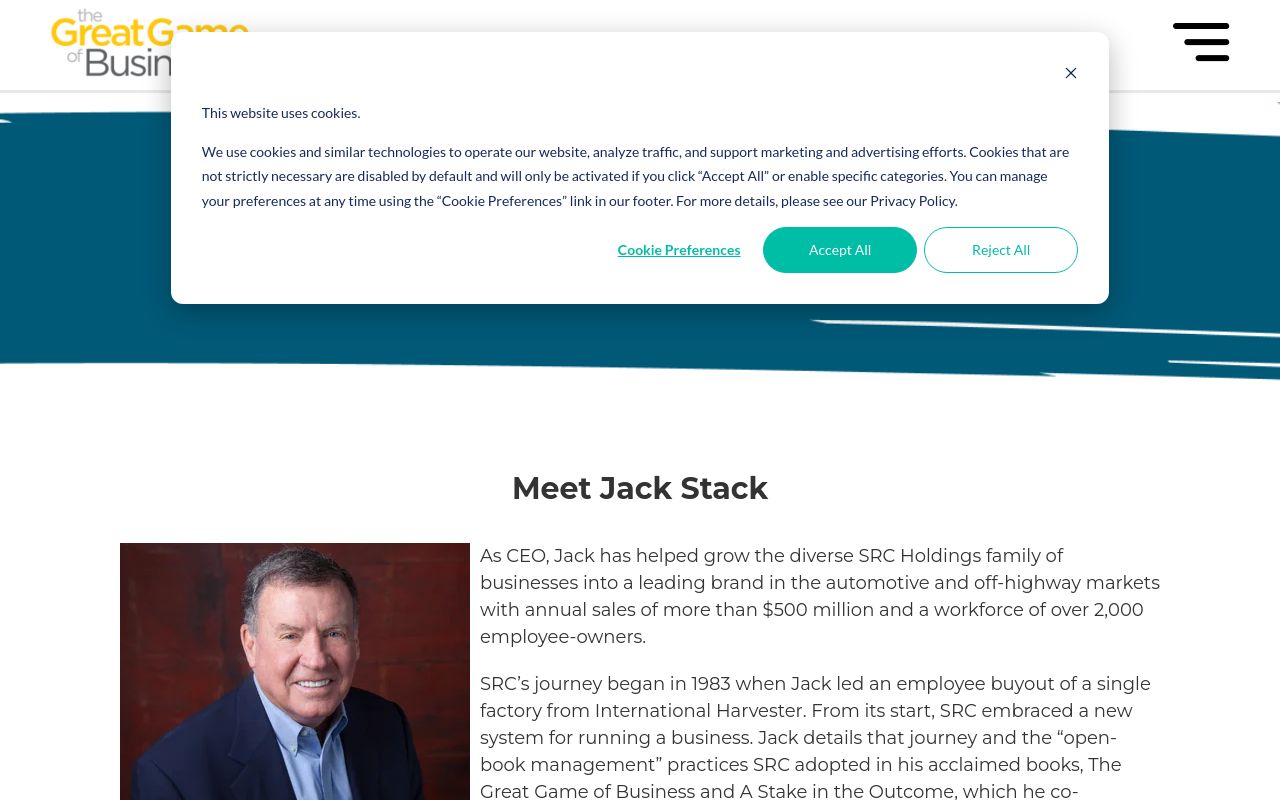
The Great Game of Business website, 'Meet Jack Stack' page, showing a cookie consent banner over a teal header, Jack Stack's headshot in a blazer against a brick wall, and body text describing him as CEO who grew SRC Holdings to more than $500 million in annual sales and over 2,000 employee-owners.
greatgame.com, captured 2 September 2026

The origin story on SRC's own about page is not a tidy one. In 1983 Stack and a group of managers scraped together $100,000 to buy a struggling International Harvester division and save the jobs in it, financed by an $8,900,000 loan at 18% interest against that equity, a deal the company still calls the worst loan in corporate American history. What they built to survive it is the open-book management method he has taught since: give people the financials, teach them to read them, and let them own the result. greatgame.com puts the company today at annual sales of more than $500 million and a workforce of over 2,000 employee-owners.

What makes him useful to an owner is that the method is written down. He wrote "The Great Game of Business," co-wrote "A Stake in the Outcome" with Bo Burlingham, entry 20, and co-wrote "Change The Game" with Darren Dahl. srcholdings.com counts 60 individual business spin-offs since 1983, so the model has been run more than once. His greatgame.com bio also has him as the first sitting CEO named to an Executive Fellowship at the Rutgers institute behind much of the research this page cites.

Best fityou want employees to own a share and also to understand the numbers behind it, and you would rather start with a management method than with a deal structure.

Think twice ifyour questions are legal or technical. SRC is a remanufacturing group and his published work is about open-book management, not ESOP structuring, valuation or trustee duties, which is the ground entries 14 to 18 cover.

Researchers

03

Corey Rosen

Founded the NCEO in 1981, after five years working on employee ownership legislation on Capitol Hill

Researcher National Center for Employee Ownership Oakland, California
Role
Founder, National Center for Employee Ownership
Based in
Oakland, California, the NCEO's headquarters city. Its own contact page does not state a city, so this comes from Wikipedia's entry on the organisation
Since
1981, the year he formed the NCEO
Books
"Ownership: Reinventing Companies, Capitalism, and Who Owns What" (2023, with John Case); "Equity" (Harvard Business School Press, 2005, with John Case and Martin Staubus)
Verified claims
No scale figures published on his NCEO bio, which counts his output as "dozens of books, articles and research papers"
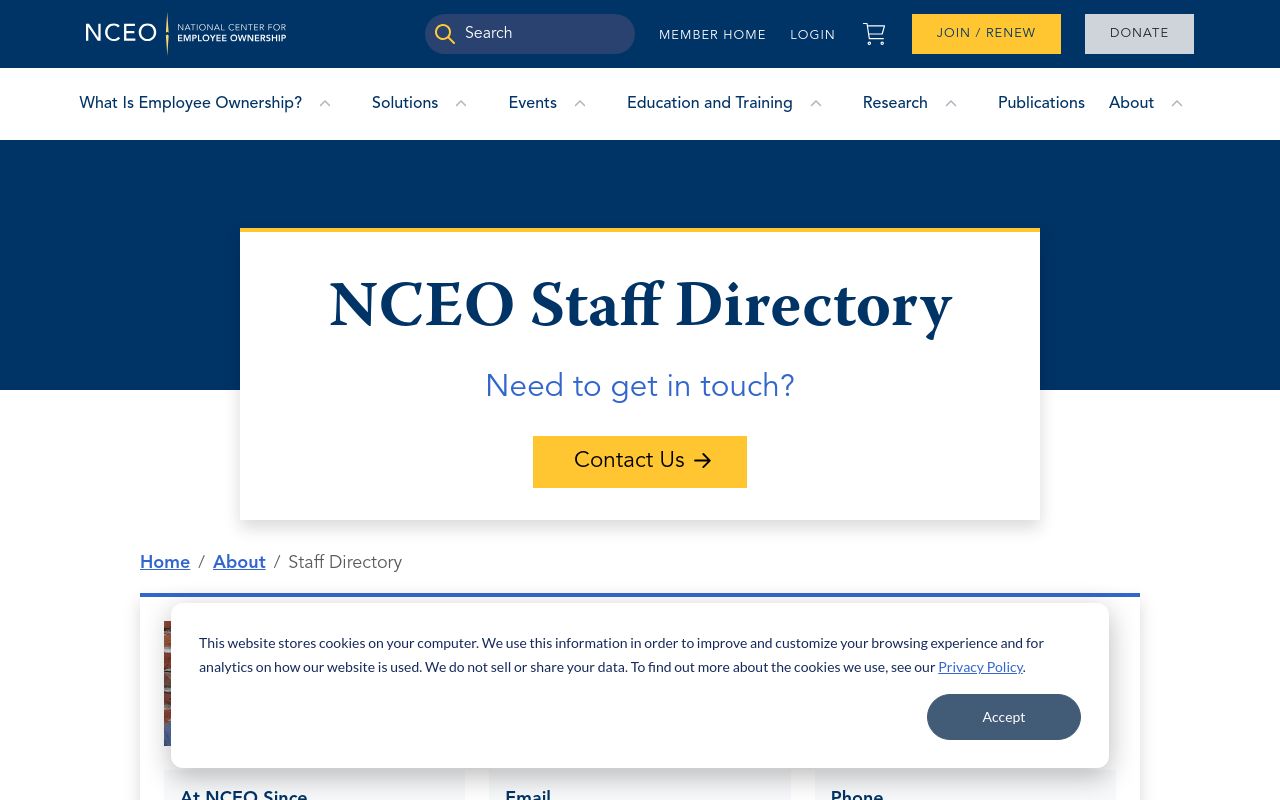
NCEO Staff Directory landing page on nceo.org, navy header with National Center for Employee Ownership logo, a white hero card reading NCEO Staff Directory over a Contact Us button, and the top of the directory listing below.
nceo.org, captured 2 September 2026

Rosen came into employee ownership through legislation rather than through a deal. He took a doctorate in political science at Cornell in 1973 and taught politics at Ripon College, then spent five years on Capitol Hill, where his NCEO bio says he helped initiate and draft the legislation on ESOPs and employee ownership. In 1981 he left and formed the NCEO. The same bio says he has been called the leading expert on employee ownership in the world, which reads as the organisation's standing description of its founder rather than a dated award or ranking.

What he offers a reader is the long view, mostly in writing. He co-authored "Equity" with John Case and Martin Staubus (Harvard Business School Press, 2005) and "Ownership: Reinventing Companies, Capitalism, and Who Owns What" with John Case in 2023. The NCEO page counts the rest of the output as dozens of books, articles and research papers rather than giving a number. He also sits on several ESOP company boards, so the arguments in the books have a boardroom test attached to them.

Best fityou want the case for employee ownership, and the history of how the rules came to exist, from the person who helped draft them, in books you can read before you speak to anyone.

Think twice ifyou want the organisation's day-to-day contact. His NCEO title is Founder, not an operating role; Loren Rodgers, entry 04, is the executive director.

04

Loren Rodgers

Runs the NCEO day to day, and has been working in employee ownership since 1995

Researcher National Center for Employee Ownership Oakland, California
Role
Executive Director, National Center for Employee Ownership
Based in
Oakland, California, the NCEO's headquarters city. Its own contact page does not state a city, so this comes from Wikipedia's entry on the organisation
Since
2011 as executive director; he joined the NCEO in 2005 as its research director
Verified claims
His NCEO bio says he "has worked with hundreds of companies and presented to tens of thousands of people" since 1995
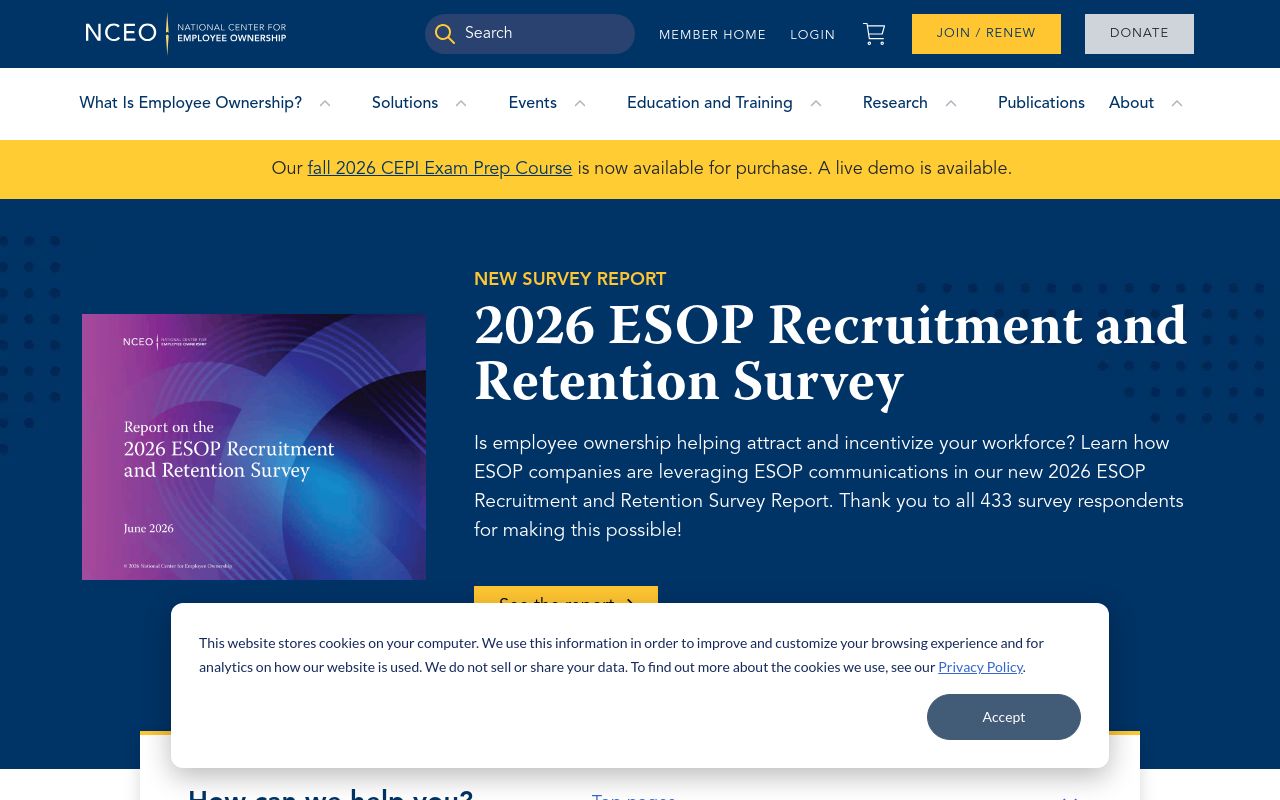
NCEO homepage at nceo.org, navy header with National Center for Employee Ownership logo and main nav, a yellow announcement bar for a fall 2026 exam preparation course, and a New Survey Report hero for the 2026 ESOP Recruitment and Retention Survey with its report cover thumbnail.
nceo.org, captured 2 September 2026

Rodgers entered the field in 1995 as a consultant, joined the NCEO in 2005 as its research director and became executive director in 2011. That makes him the person running the organisation Corey Rosen founded. His bio states the volume plainly: hundreds of companies worked with, tens of thousands of people presented to. He also holds a visiting executive fellow appointment at the Rutgers Institute for the Study of Employee Ownership and Profit Sharing, so the membership body and the academic side meet in one person.

His stated range is wider than transactions. The NCEO page lists corporate governance, employee motivation, communications and business literacy next to ESOP transactions and operations. That last item is the one owners tend to underestimate. An ESOP hands shares to people who may never have read a set of accounts, and what employees understand about the business is a separate problem from getting the deal closed. He holds a master's degree in public policy from the University of Michigan.

Best fityou want the membership body's own read on what happens after the deal closes, plus a route into the NCEO's research, training and member companies.

Think twice ifyou are outside the United States, or weighing an EOT rather than an ESOP. The NCEO is a United States membership nonprofit organised around a United States legal structure, so the direct fit narrows.

05

Joseph Blasi

Spent sixteen years directing the Rutgers institute that studies employee ownership, and is now its Director Emeritus

Researcher Rutgers SMLR Piscataway, New Jersey
Role
Distinguished Professor in Human Resource Management and in Labor Studies and Employment Relations, Rutgers SMLR; Director Emeritus, Institute for the Study of Employee Ownership and Profit Sharing
Based in
Piscataway, New Jersey (Janice H. Levin Building, 94 Rockafeller Road)
Since
Director Emeritus after sixteen years directing the institute, per the NCEO's announcement published 1 July 2025; no exact handover date is stated
Books
"The Citizen's Share: Reducing Inequality in the 21st Century" (Yale University Press, 2013, with Richard Freeman and Douglas Kruse)
Verified claims
None published on his Rutgers faculty page
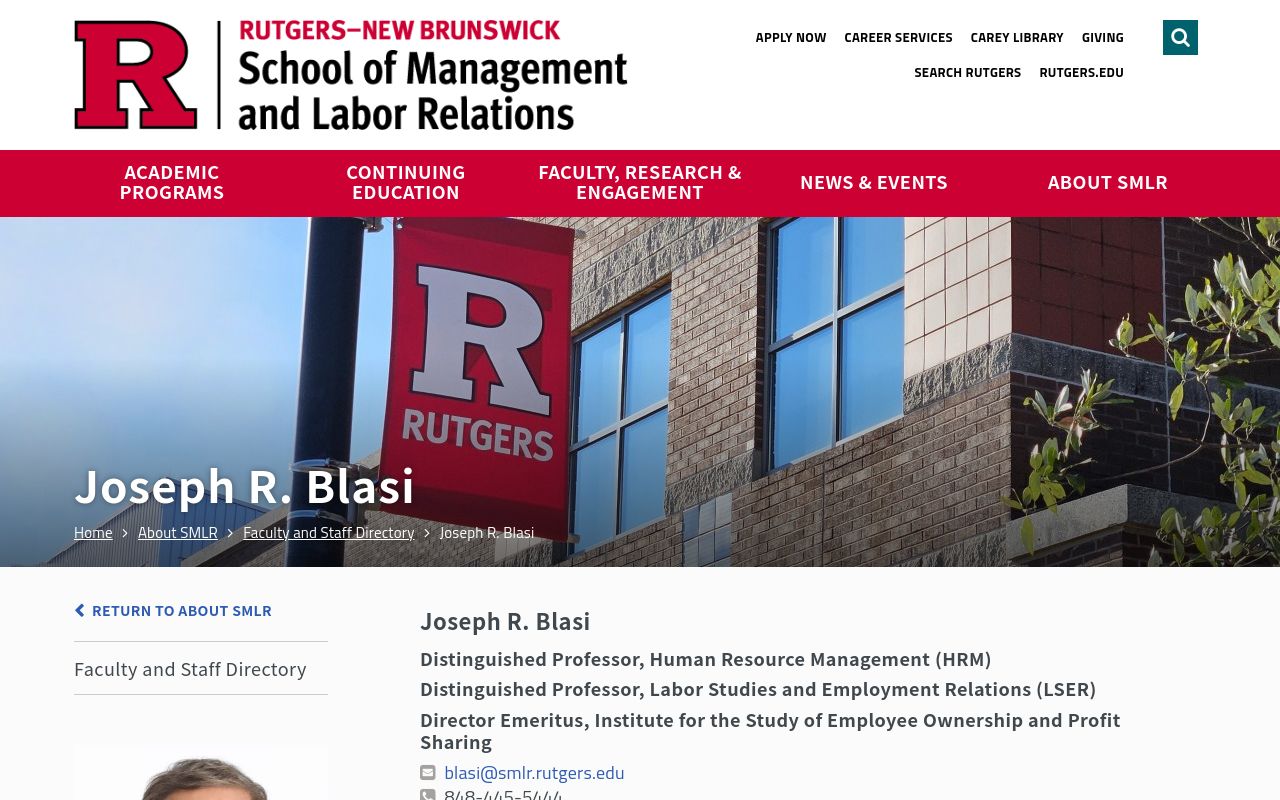
Joseph R. Blasi's Rutgers SMLR faculty profile page: red Rutgers-New Brunswick School of Management and Labor Relations header, a photo of the Rutgers building banner, his name as the page title, and his titles (Distinguished Professor HRM and LSER, Director Emeritus of the Institute for the Study of Employee Ownership and Profit Sharing) with email link visible.
smlr.rutgers.edu, captured 2 September 2026

Blasi holds Distinguished Professor rank twice over at Rutgers, in Human Resource Management and in Labor Studies and Employment Relations, and he is Director Emeritus of the Institute for the Study of Employee Ownership and Profit Sharing. The NCEO reported on 1 July 2025 that he had stepped down from the directorship after sixteen years and would carry on at Rutgers as a researcher and mentor. That announcement does not say exactly when the handover happened, and his faculty page does not date it either.

The work most owners will meet first is "The Citizen's Share: Reducing Inequality in the 21st Century", written with Richard Freeman and Douglas Kruse and published by Yale University Press in 2013. It builds the case for broad-based ownership out of American history and data rather than out of one company's story, which makes it a useful counterweight if everything you have read so far is founder testimony. His Rutgers page publishes no client count and no transaction record, because an academic seat does not produce those. It produces the evidence other people on this page quote.

Best fityou want the research and the history in book form, from someone with no transaction to sell you, before you start taking meetings.

Think twice ifyou want the institute's current leadership or its new work. Blasi is Director Emeritus; Adria Scharf, entry 07, has held the director's seat since 1 July 2026.

06

Douglas Kruse

The economist who runs the research side of the Rutgers employee ownership institute

Researcher Rutgers SMLR Piscataway, New Jersey
Role
J. Robert Beyster Distinguished Professor in Human Resource Management and in Labor Studies and Employment Relations, Rutgers SMLR; Research Director, Institute for the Study of Employee Ownership and Profit Sharing
Based in
Piscataway, New Jersey (Janice H. Levin Building, 94 Rockafeller Road)
Books
"The Citizen's Share: Reducing Inequality in the 21st Century" (Yale University Press, 2013, with Richard Freeman and Joseph Blasi)
Verified claims
None published on his Rutgers faculty page
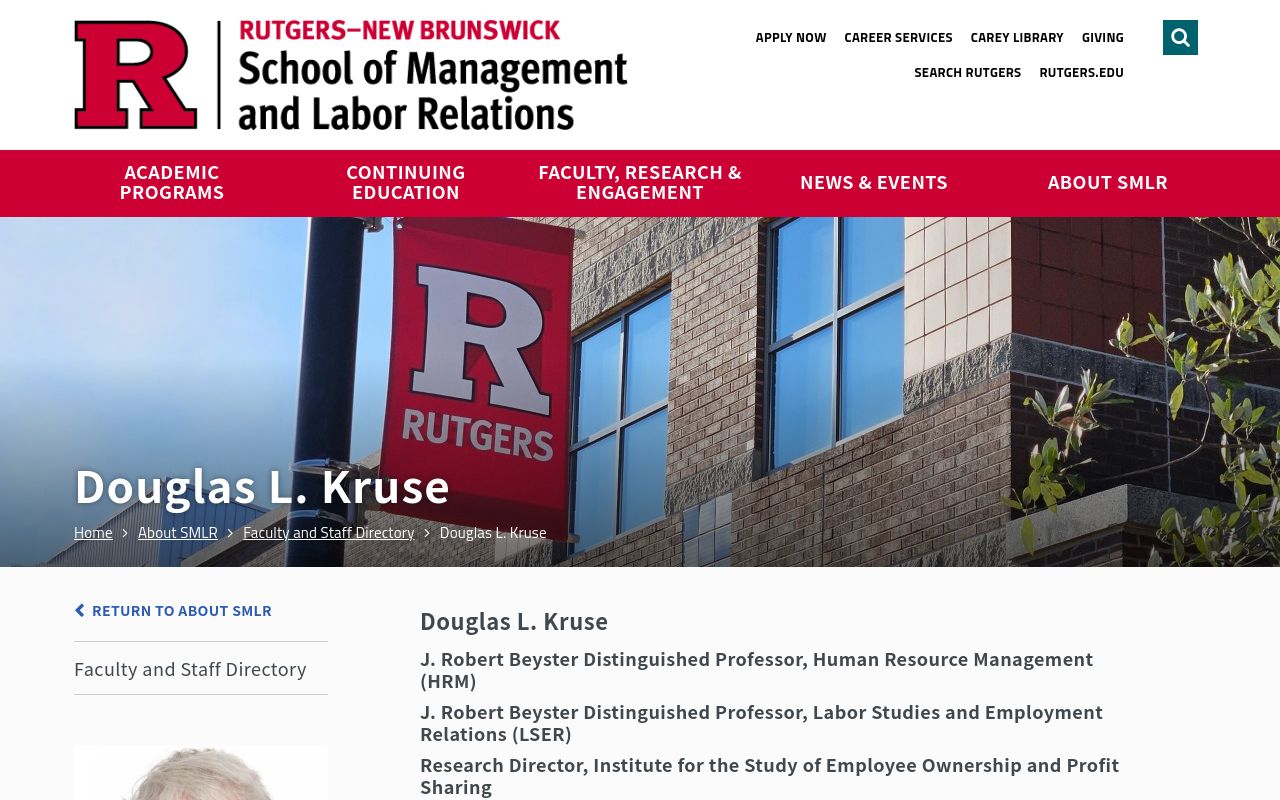
Douglas L. Kruse's Rutgers SMLR faculty profile page: red Rutgers-New Brunswick School of Management and Labor Relations header, a photo of the Rutgers building banner, his name as the page title, and his titles (J. Robert Beyster Distinguished Professor in HRM and LSER, Research Director of the Institute for the Study of Employee Ownership and Profit Sharing) visible below.
smlr.rutgers.edu, captured 2 September 2026

Kruse holds the J. Robert Beyster Distinguished Professorship at Rutgers in two departments at once, Human Resource Management and Labor Studies and Employment Relations, and his faculty page lists him as Research Director of the Institute for the Study of Employee Ownership and Profit Sharing. His Rutgers work also runs beyond ownership, since he co-directs the Program for Disability Research, so his output is not all about this field.

With Joseph Blasi he writes the recurring "Employee Ownership and ESOPs: What We Know from Recent Research" briefs, published through the Aspen Institute alongside the Rutgers employee ownership forum, with editions dated April 2024, April 2025 and May 2026. We verified those briefs by title, authors and year from the published files rather than by reading them line by line. If you want the state of the research in one short document instead of a sales deck, that is the series to start with. He co-authored "The Citizen's Share" with Blasi and Richard Freeman in 2013.

Best fityou want the evidence before the pitch: read the "What We Know from Recent Research" briefs he co-writes with Joseph Blasi, then decide who to call.

Think twice ifyou need a transaction structured and priced. His titles are professor and research director; valuation, plan design and trustee selection sit with the practising advisers in entries 14 onward.

07

Adria Scharf

Took over the Rutgers employee ownership institute in July 2026, and runs its teaching library

Researcher Rutgers SMLR Piscataway, New Jersey
Role
Director, Institute for the Study of Employee Ownership and Profit Sharing; Assistant Professor of Professional Practice in Human Resource Management, Rutgers SMLR
Based in
Piscataway, New Jersey (94 Rockafeller Road; her page gives the school address rather than a building)
Since
1 July 2026 as Director, succeeding Bill Castellano, per the NCEO's announcement of 14 August 2026; she joined the institute in 2019 as CLEO project director
Verified claims
CLEO's own site calls it "the largest online library for teaching materials on employee ownership" and counts "More than 600 teaching materials, including videos, cases, syllabi, teaching modules, and reading collections"
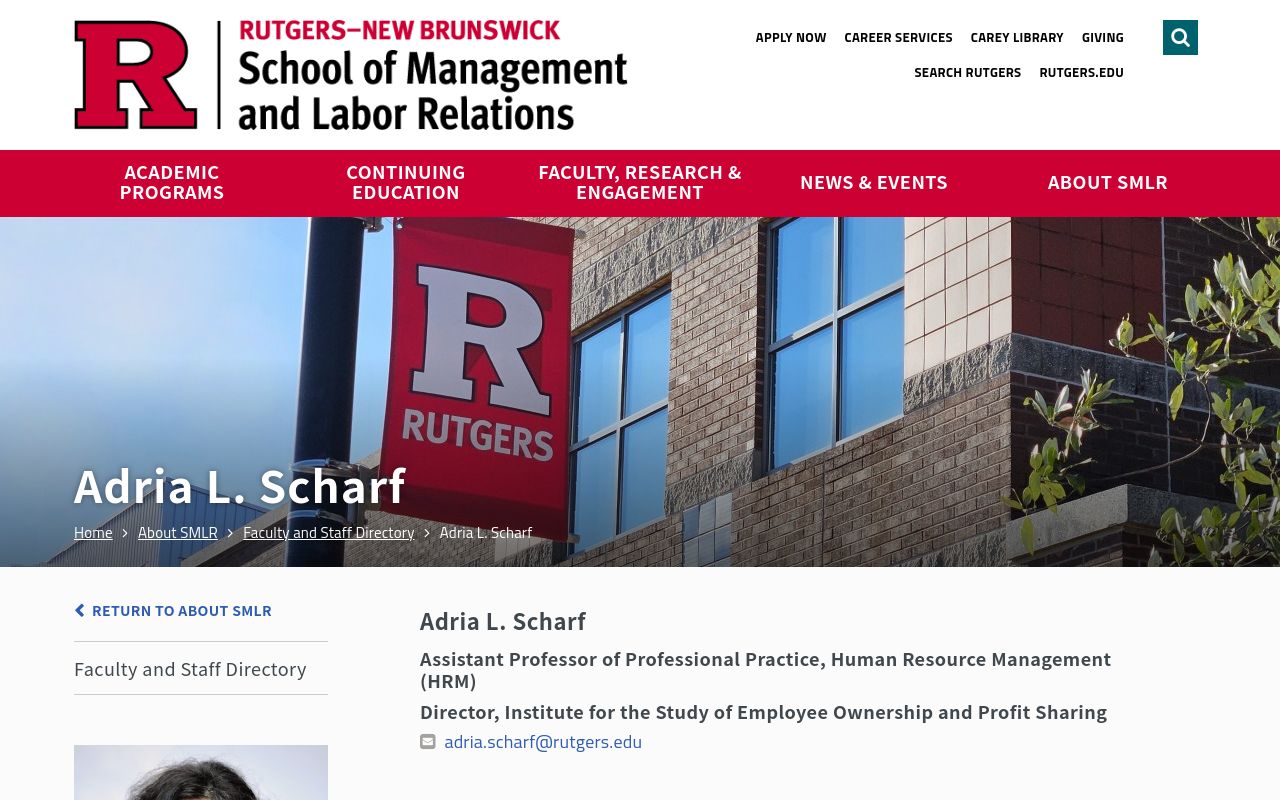
Adria L. Scharf's Rutgers SMLR faculty profile page: red Rutgers-New Brunswick School of Management and Labor Relations header, a photo of the Rutgers building banner, her name as the page title, and her titles (Assistant Professor of Professional Practice HRM, Director of the Institute for the Study of Employee Ownership and Profit Sharing) with email link visible.
smlr.rutgers.edu, captured 2 September 2026

Scharf is a sociologist, and her Rutgers page puts her work on organisations, work and ownership, with particular expertise in employee-owned business models. She joined the institute in 2019 to run CLEO and became its Director on 1 July 2026, succeeding Bill Castellano, per the NCEO's announcement in August 2026. The same announcement notes she was a keynote panelist at the NCEO's 2022 annual conference in Seattle, and that she recently launched a Research to Practice Hub connecting research on employee ownership outcomes to strategies companies and workers can act on.

CLEO is the practical thing to know here. Its own site describes it as the largest online library for teaching materials on employee ownership, and counts more than 600 items: videos, cases, syllabi, teaching modules and reading collections. Owners rarely need another opinion about employee ownership. What they need, usually at the point they have to explain the idea to a management team who did not ask for it, is teaching material that somebody else has already made. That is what she is in charge of.

Best fityou have to explain employee ownership to a management team, a board or a classroom, and you want material that already exists rather than slides you write yourself.

Think twice ifyour question is about the institute's direction over the long run. She became Director on 1 July 2026, so the published record to read her by is the CLEO work going back to 2019 rather than years in that seat.

Movement and policy

08

Pete Stavros

A private equity executive who also chairs two organisations set up to spread employee ownership

Policy KKR New York
Role
Partner, Co-Head of Global Private Equity, KKR. Also Founder and Chairman of Ownership Works and of Expanding ESOPs
Based in
New York. His KKR bio opens "Pete Stavros (New York) joined KKR in 2005"
Since
2005, the year he joined KKR. No founding year for Ownership Works is stated on either his KKR bio or the pages of Ownership Works we read
Podcast or media
A CBS News 60 Minutes segment, "Private equity's unlikely champion for giving workers a leg up with employee ownership", and a TED talk, "The secret ingredient of business success". Both are linked from his own KKR bio page
Verified claims
KKR's page, on its own portfolio: the model has been "successfully implemented at more than 80 KKR companies and has positively impacted more than 180,000 workers". Separately, Ownership Works states on its own site that it counts "192 Companies with shared ownership" across the sponsors it works with, and targets "$20 billion of wealth for workers by 2030"
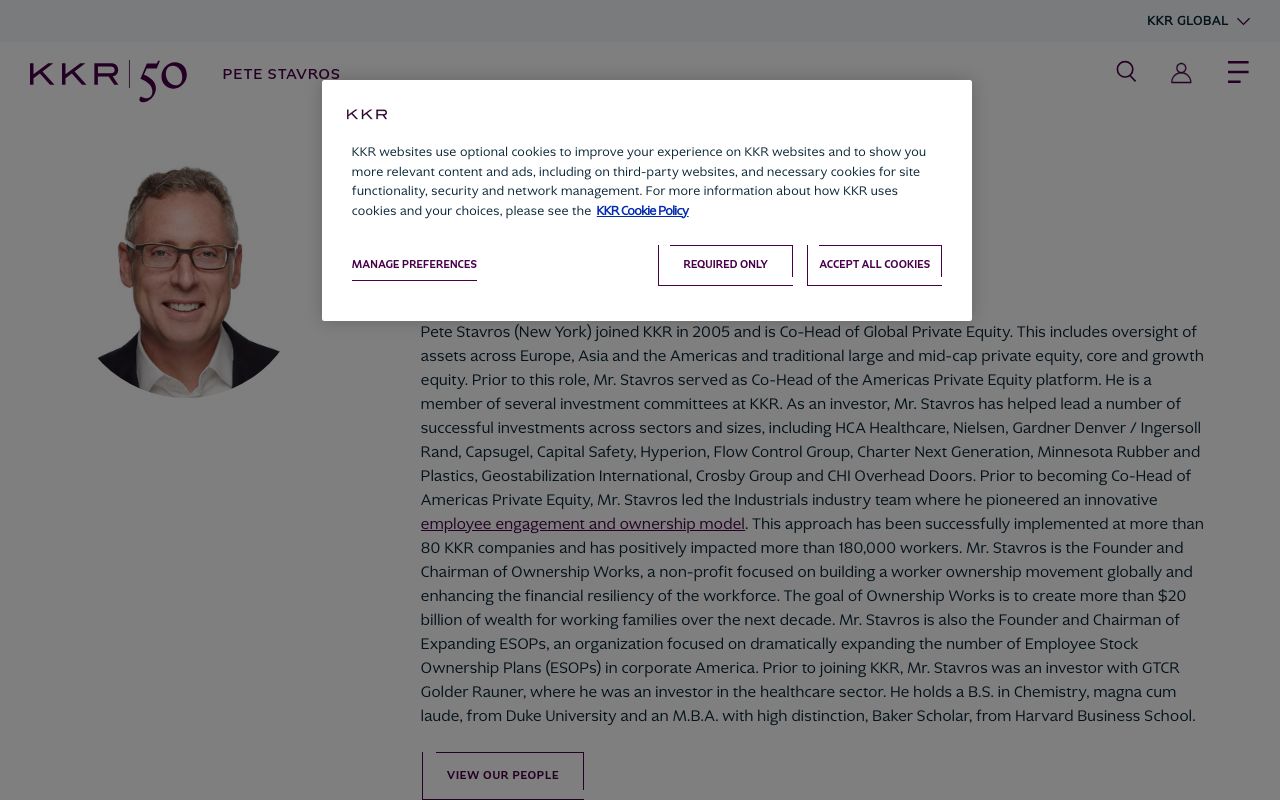
KKR staff bio page for Pete Stavros, showing his headshot, the KKR 50th-anniversary logo, and bio text describing him as Co-Head of Global Private Equity and Founder and Chairman of Ownership Works, with a cookie-consent banner overlaying the top of the page.
kkr.com, captured 2 September 2026

Stavros joined KKR in 2005 and led the firm's industrials team, where his bio says he "pioneered an innovative employee engagement and ownership model". He is now Partner and Co-Head of Global Private Equity. The same page puts the reach of that model at "more than 80 KKR companies" and "more than 180,000 workers". Those are KKR's own figures for KKR's own portfolio, and they are worth keeping apart from the movement-wide count below, which spans many sponsors rather than one firm.

Outside the day job he is "Founder and Chairman of Ownership Works, a non-profit focused on building a worker ownership movement globally", and founder and chairman of Expanding ESOPs, which his bio describes as working to expand the number of ESOPs in corporate America. Ownership Works publishes its own numbers: "192 Companies with shared ownership", 45 liquidity events "resulting in $2.2 billion in payouts to tens of thousands of workers", and a stated target of "$20 billion of wealth for workers by 2030". His KKR page links a CBS News 60 Minutes segment on the work and a TED talk.

Best fityou want to follow how broad-based employee equity is being built into companies owned by investment firms, argued by someone doing it from inside that industry.

Think twice ifyou are looking for someone to hire. His employee ownership work runs through KKR's own portfolio companies and through the two organisations he chairs, and his bio describes an investor role rather than an adviser taking on outside clients.

09

Jack Moriarty

A lead architect of the federal bills that would make employee ownership easier to finance

Policy Lafayette Square Institute
Role
Executive Director, Lafayette Square Institute
Based in
Not stated on his institute bio page
Podcast or media
Guest on The ESOP Podcast, episode "176: Ownership America with Jack Moriarty (Part 1)", recorded under an earlier title at Ownership America
Verified claims
His institute bio calls him "a lead architect of the bipartisan American Ownership and Resilience Act (AORA) legislation introduced in 2025 with the aim of crowding in private investment to create wealth for American workers and communities"
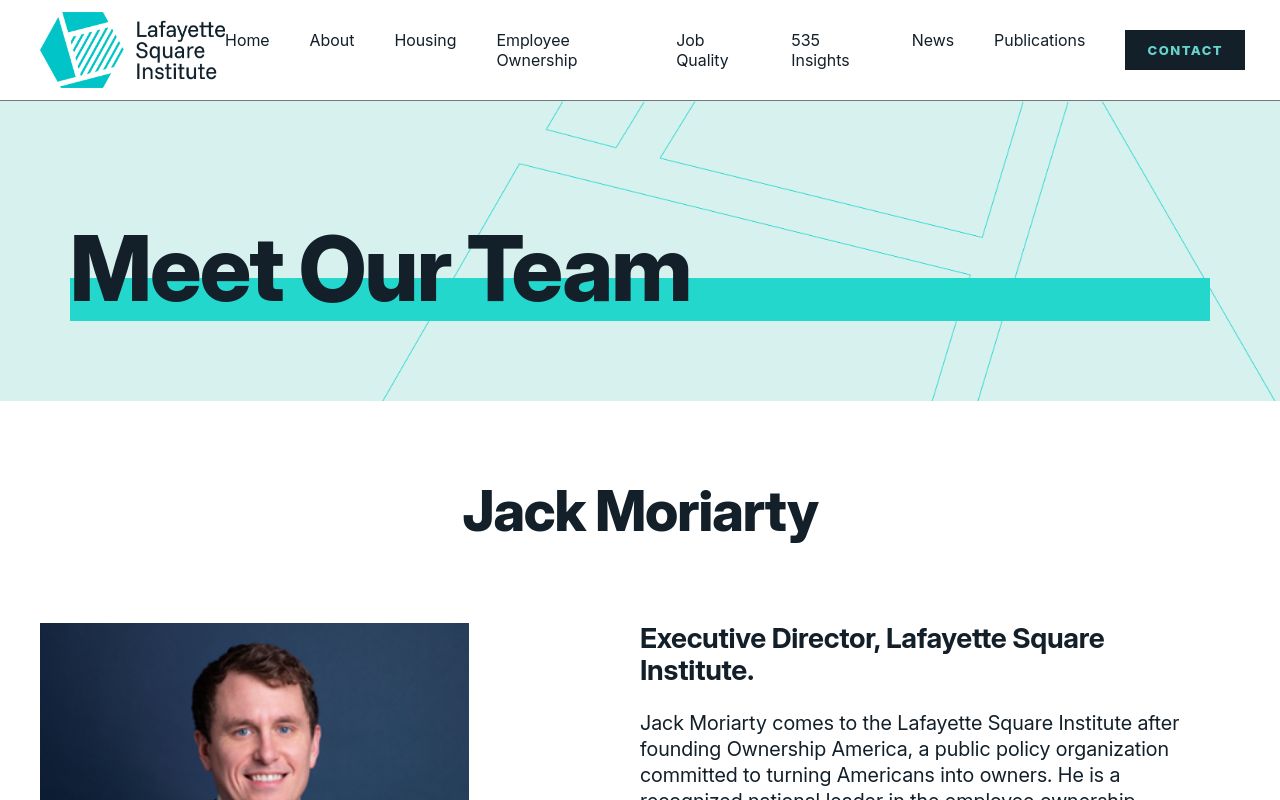
Lafayette Square Institute 'Meet Our Team' page, showing the site's teal-and-navy header navigation and the start of Jack Moriarty's bio, headshot, and title as Executive Director, Lafayette Square Institute.
lafayettesquareinstitute.org, captured 2 September 2026

Moriarty runs the Lafayette Square Institute, and his bio there describes him as "a lead architect of the bipartisan American Ownership and Resilience Act (AORA) legislation introduced in 2025". The same page says he came to the institute "after founding Ownership America, a public policy organization committed to turning Americans into owners". Ownership America no longer runs a site of its own, and the institute is where the work now sits.

The substance is about money rather than sentiment. Per the notes for his earlier ESOP Podcast appearance, Ownership America's marquee proposal, the Employee Equity Investment Act, would create federal loan guarantees for private investment funds that focus on forming ESOPs in mid-sized companies, modelled on the existing Small Business Investment Company program. AORA carries a similar idea into a bipartisan bill: use public guarantees to pull private capital toward deals that leave employees owning a share. His institute describes him as a lead architect of that bill, which makes his one of the policy seats to watch on how employee ownership gets financed.

Best fityou follow employee ownership policy and want to know which bills are live in Congress, what they would actually change about financing a sale, and who is shaping them.

Think twice ifyou have a transaction in front of you. His bio frames the work as public policy and advocacy through Congress and a nonprofit institute, not as advising an individual owner through a sale.

10

Jim Bonham

Runs the United States ESOP trade association and speaks for it in Washington

Policy The ESOP Association Washington, DC
Role
President & CEO, The ESOP Association. Also President of the Employee Ownership Foundation. The association's leadership page lists him as James Bonham
Based in
Washington, DC. The association's headquarters is at 200 Massachusetts Avenue NW, Suite 410
Since
1 March 2019, the date the association's own announcement gives for him taking the role
Podcast or media
Hosts "The Ownership Effect", with new episodes every two weeks
Verified claims
The association says it leads "19 state and regional chapters throughout the nation" and "attracts more than 23,000 people annually to its 19 chapter and five national meetings, including the Employee Owned Conference in Las Vegas, NV, which is the largest ESOP event in the world"
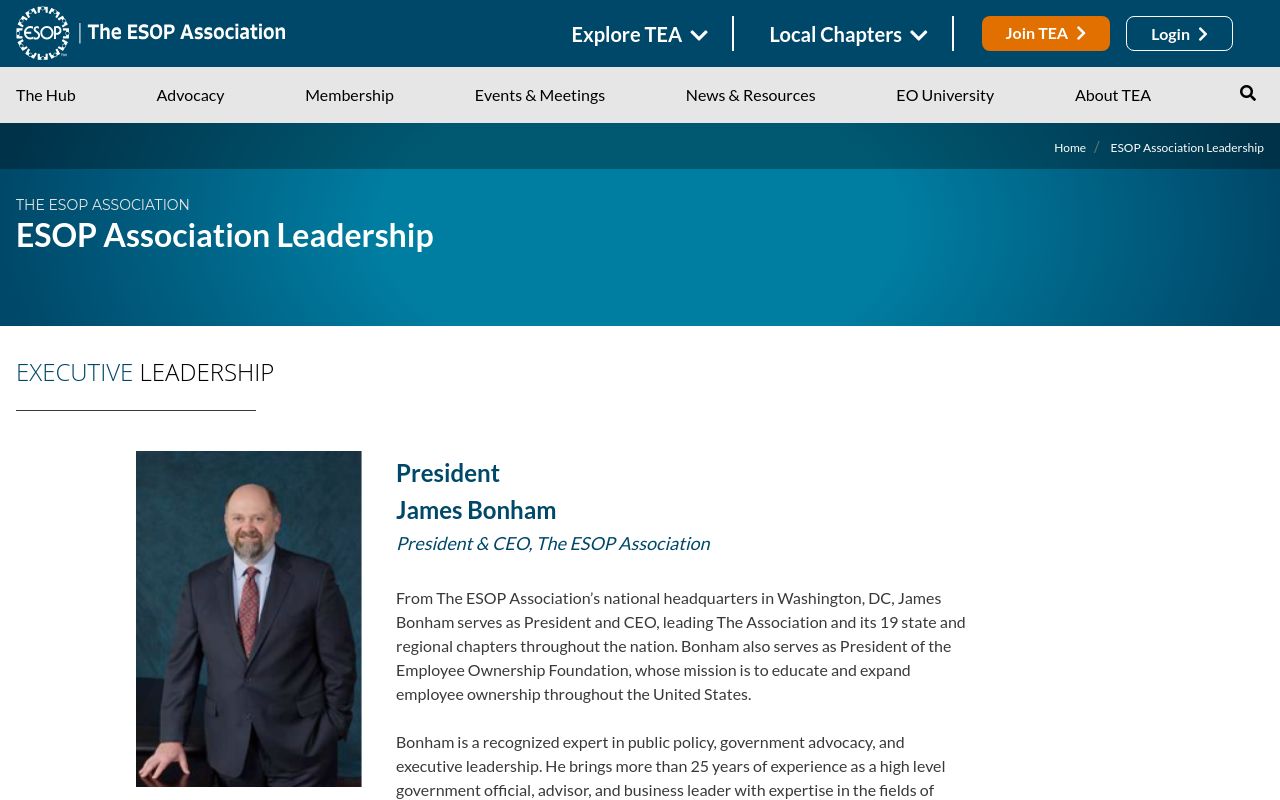
The ESOP Association's Leadership page, dark blue header with the association's ring logo, showing James Bonham's headshot and his title, President & CEO, The ESOP Association, alongside a paragraph of his bio.
esopassociation.org, captured 2 September 2026

Bonham took over The ESOP Association on 1 March 2019 and also serves as President of the Employee Ownership Foundation, "whose mission is to educate and expand employee ownership throughout the United States". His bio credits "more than 25 years of experience as a high level government official, advisor, and business leader" across taxes, labor, financial services, manufacturing, healthcare and government contracting. That background explains the shape of the job: he runs a membership body with 19 state and regional chapters, and he is the person who turns up when Congress asks about ESOPs.

He did exactly that on 22 July 2025, testifying at a House Education & Workforce subcommittee hearing titled "Restoring Trust: Enhancing Transparency and Oversight at EBSA", the Employee Benefits Security Administration, on the invitation of the committee chair, Representative Tim Walberg. Between hearings he hosts "The Ownership Effect", a show that lands every two weeks and runs "candid conversations with company founders, policymakers, and employees whose lives have been transformed by ownership". The association's own scale claim is about gatherings: more than 23,000 people a year across its meetings, and a Las Vegas conference it calls the largest ESOP event in the world.

Best fityou want the trade body's read on ESOP rules and federal oversight, and a chapter and conference network where you can meet owners who have already done it.

Think twice ifyou are comparing employee ownership bodies by size of membership. The association's published figures cover event attendance and chapter count, and we found no member-company total on its own site to compare against.

11

Hilary Abell

The first person to head the federal government's employee ownership division, after a decade building a conversion nonprofit

Policy United States Department of Labor
Role
First Chief of the Division of Employee Ownership, Employee Benefits Security Administration (EBSA), United States Department of Labor
Based in
Not stated on the DOL page that names her
Verified claims
dol.gov's own Employee Ownership Initiative page states that "EBSA's Office of Outreach, Education and Assistance welcomed Hilary Abell as its first Chief of the Division of Employee Ownership". The public route to that division is a general inbox published on the same page, [email protected]
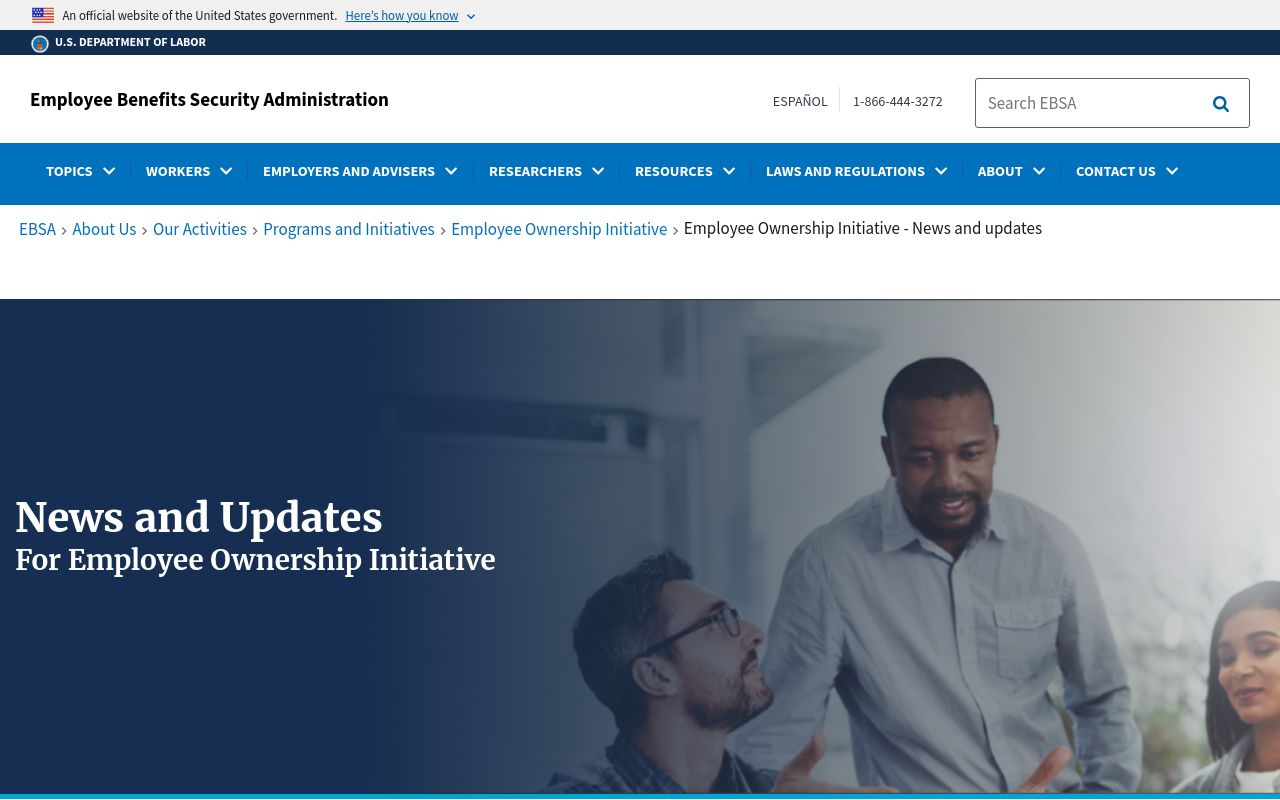
U.S. Department of Labor, Employee Benefits Security Administration website, News and Updates page for the Employee Ownership Initiative, showing the official DOL header with an American flag banner and a photo of colleagues in conversation.
dol.gov, captured 2 September 2026

The DOL names her directly on its own Employee Ownership Initiative page: "EBSA's Office of Outreach, Education and Assistance welcomed Hilary Abell as its first Chief of the Division of Employee Ownership." EBSA is the Employee Benefits Security Administration, the part of the department the division sits inside. Project Equity, announcing her move, put the same title in its own words as "Chief of the Employee Ownership Division at the U.S. Department of Labor".

She arrived with a decade behind her. Project Equity's own site says she and Alison Lingane, entry 12 here, "founded Project Equity more than 10 years ago" and dates it to 2014. The two of them jointly received the 27th Heinz Awards in the Economy category, cited "for their leadership in the movement to create better jobs and a fairer economy by advancing employee ownership". That combination is what makes the government seat worth watching: someone who spent years converting companies now sets the tone for how the federal side talks about it. The division's published output, rather than her personally, is the thing to follow.

Best fityou want the federal reading of employee ownership from the division created to promote it, and you are happy to work from what it publishes.

Think twice ifyou want a named adviser to take your call. She is a serving federal official, and the contact route her division publishes is a general inbox, [email protected], rather than a personal one.

12

Alison Lingane

Co-founded a national conversion nonprofit, and now works on how employee ownership deals get financed

Policy Ownership Capital Lab
Role
Founder, Ownership Capital Lab. Co-founder of Project Equity
Based in
Not stated on the Lab's site
Verified claims
The Lab's EO Fund Accelerator is "a tuition-free, nine-month program" running "September 2026 to May 2027" for an "inaugural 2026 to 2027 cohort" of "8 to 10 participating investment platforms". Project Equity's own site says she and Hilary Abell "founded Project Equity more than 10 years ago" and dates the founding to 2014
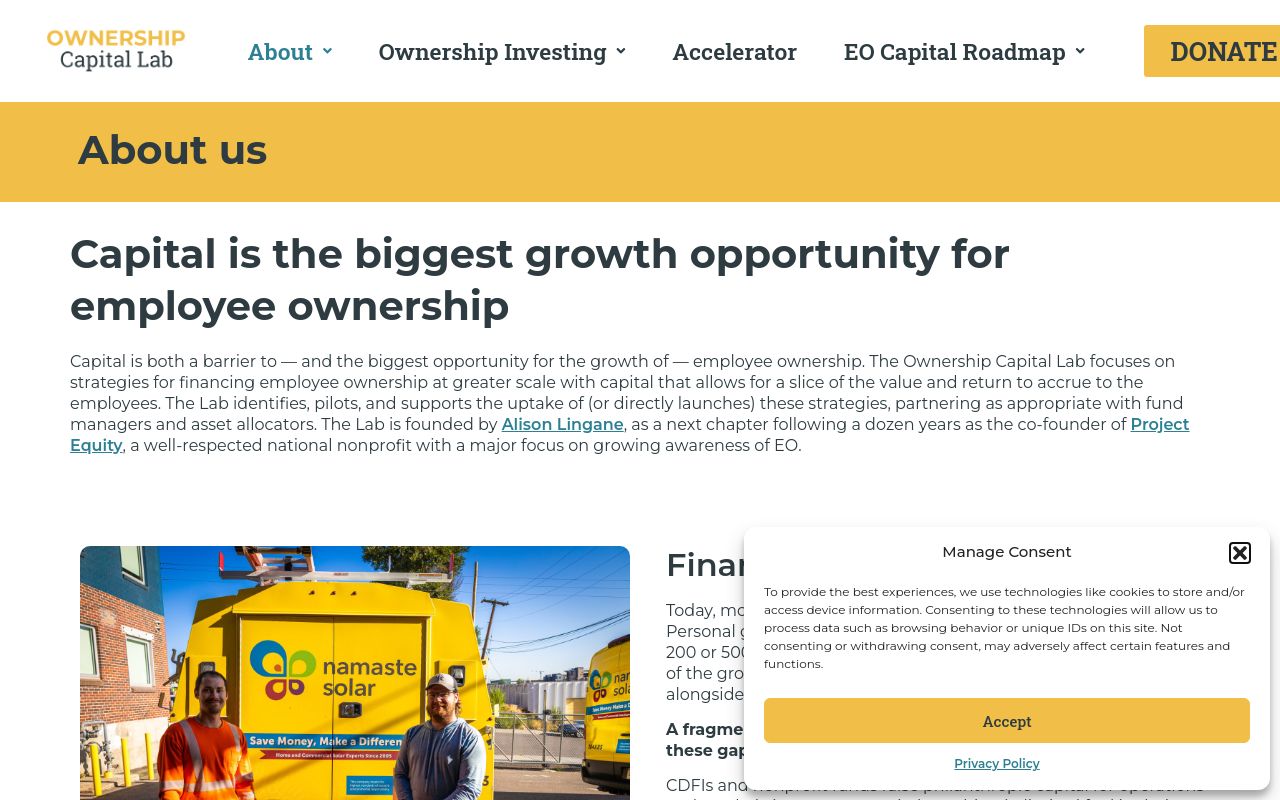
Ownership Capital Lab's About Us page, mustard-yellow header band reading 'About us' beneath the site's black-and-mustard logo, with body text describing the Lab and Alison Lingane as founder, a photo of two workers beside a Namaste Solar van, and a cookie-consent popup in the lower right.
ownershipcapitallab.capital, captured 2 September 2026

The Lab's about page introduces her plainly: "The Lab is founded by Alison Lingane, as a next chapter following a dozen years as the co-founder of Project Equity, a well-respected national nonprofit with a major focus on growing awareness of EO." Project Equity dates its own founding to 2014 and names her and Hilary Abell, entry 11 here, as the pair behind it. The two of them jointly received the 27th Heinz Awards in the Economy category for advancing employee ownership.

Her new work starts from a diagnosis about money: "Capital is both a barrier to, and the biggest opportunity for, the growth of employee ownership." The Lab's stated focus is "strategies for financing employee ownership at greater scale with capital that allows for a slice of the value and return to accrue to the employees." The first thing to come out of it is the EO Fund Accelerator, a tuition-free, nine-month program running September 2026 to May 2027 for an inaugural cohort of 8 to 10 investment platforms. Applications for that cohort have closed, and the site invites people to register interest in later ones.

Best fityou are building a fund, holding company or investment platform meant to finance employee ownership deals, and you want the person working on how that capital should be structured.

Think twice ifyou are an owner wanting help selling your own company. The Lab's flagship program is built for fund managers, holding companies, independent sponsors and other capital entrepreneurs, and its first cohort is already closed to applications.

13

Steve Storkan

Runs the network setting up state level centers for employee ownership, after 25 years administering ESOPs

Policy Employee Ownership Expansion Network Arlington, Virginia
Role
Executive Director, Employee Ownership Expansion Network (EOX)
Based in
EOX gives its address as 1405 S Fern Street, Box 534, Arlington, VA 22202. His own city is not stated on the site
Since
EOX was established in 2019, per a Project Equity article. The year he became Executive Director is not stated on the EOX site
Podcast or media
Listed as a guest on The ESOP Podcast, episode "91: Steve Storkan and the EOX - The States of EO"
Verified claims
EOX's own page says he "has been involved with employee stock ownership plans for over 25 years". That page shows state centers on an interactive map with no printed total, and the page listing them blocked our requests, so we state no current count

EOX's own page says Storkan "has been involved with employee stock ownership plans for over 25 years", and that he came to the job from "Director of ESOP Administration at Alerus Retirement and Benefits". That is the plan administration side of employee ownership, the ongoing annual work rather than the deal, which is a useful background for someone whose job is now explaining the structure to people who have never met one.

EOX describes what it does as building "a network of State Centers for Employee Ownership", and its site points visitors at an interactive map: "Click on any state in blue to be taken to that State Center's website." A Project Equity article records that EOX was established in 2019, and that the network's stated goal was to have centers "covering 70% of the country" by 2025. We could not confirm how many exist today. The EOX page that lists them blocked our requests twice, so the current total is not something this page can state.

Best fityou want to find the employee ownership center in your own state, or you want the person coordinating that network across the country.

Think twice ifyou want one national point of contact. EOX routes help through affiliated state level nonprofits rather than through Storkan directly, so a specific question usually goes to your state's center.

Deal advisers

14

Mary Josephs

Chicago investment banker whose firm counts more than 300 ownership-transition deals behind her

Adviser Verit Advisors Chicago, Illinois
Role
Founder and chief executive officer (CEO), Verit Advisors
Based in
Chicago, Illinois, the address Verit publishes on its own site
Podcast or media
Writes a Forbes column, linked from verit.com as "Mary Josephs Forbes Blog"
Verified claims
"more than 30 years of experience advising, structuring, and closing over 300 transactions for the ownership transition of middle-market companies"
Verit Advisors homepage, dark grey navigation bar with Overview, Services, Teams, Research, News, Transactions, Contact; hero image of a watercolour Brooklyn Bridge illustration in sage green behind the headline 'More Thoughtful. More Skilled.' and a short mission paragraph.
verit.com, captured 2 September 2026

Josephs founded Verit Advisors and runs it. Her bio credits her with "more than 30 years of experience advising, structuring, and closing over 300 transactions for the ownership transition of middle-market companies", and it places the origin of that record inside a bank: she "founded and built the ESOP group at Chicago's LaSalle National Bank into the nation's leading middle-market ESOP advisory team", in the site's own words. The work is described in transaction terms throughout, advising, structuring, closing, rather than as a planning exercise.

For an owner trying to picture what a partial ESOP looks like, she has written about one. On a verit.com post about Clif Bar's sale to Mondelez she says, "I was privileged to work with Clif Bar when they established a 20% ESOP plan in Spring 2010", a reminder that these deals do not have to be all or nothing. She holds a master's of business administration in finance from the University of Chicago Booth School of Business, sits on the ESOP Association's board of directors and chairs its advisory committee, and Mergers & Acquisition magazine named her one of the most influential women in mid-market mergers and acquisitions in 2017, 2018, 2019 and 2020.

Best fityou own a middle-market company, you want the ownership transition run and financed as a real transaction, and you want a banker who has closed hundreds of them.

Think twice ifyour company sits outside that band. Verit frames its practice around closely held middle-market businesses, and the engagement is full investment banking advisory rather than a first conversation about whether an ESOP suits a small owner-operator business.

15

Kelly Finnell

Author of The ESOP Coach, and by his firm's count a speaker at more than 300 conferences

Adviser EFS ESOP Consultants Memphis, Tennessee
Role
Chief executive officer (CEO) and president, EFS ESOP Consultants, worded on his bio as "CEO, President"
Based in
Memphis, Tennessee
Since
1981, the year Executive Financial Services was established. His own start date is not stated separately on the site
Books
"The ESOP Coach: Using ESOPs in Ownership Succession Planning", 2010. No publisher is named on execfin.com
Podcast or media
No show of his own. Guest appearances linked from execfin.com include the Becker Private Equity & Business Podcast and the Pull to Refresh Podcast
Verified claims
"more than 40 years helping business owners design and execute ESOPs"; "experience presenting at more than 300 conferences and meetings throughout the U.S. and abroad in London and Sydney"
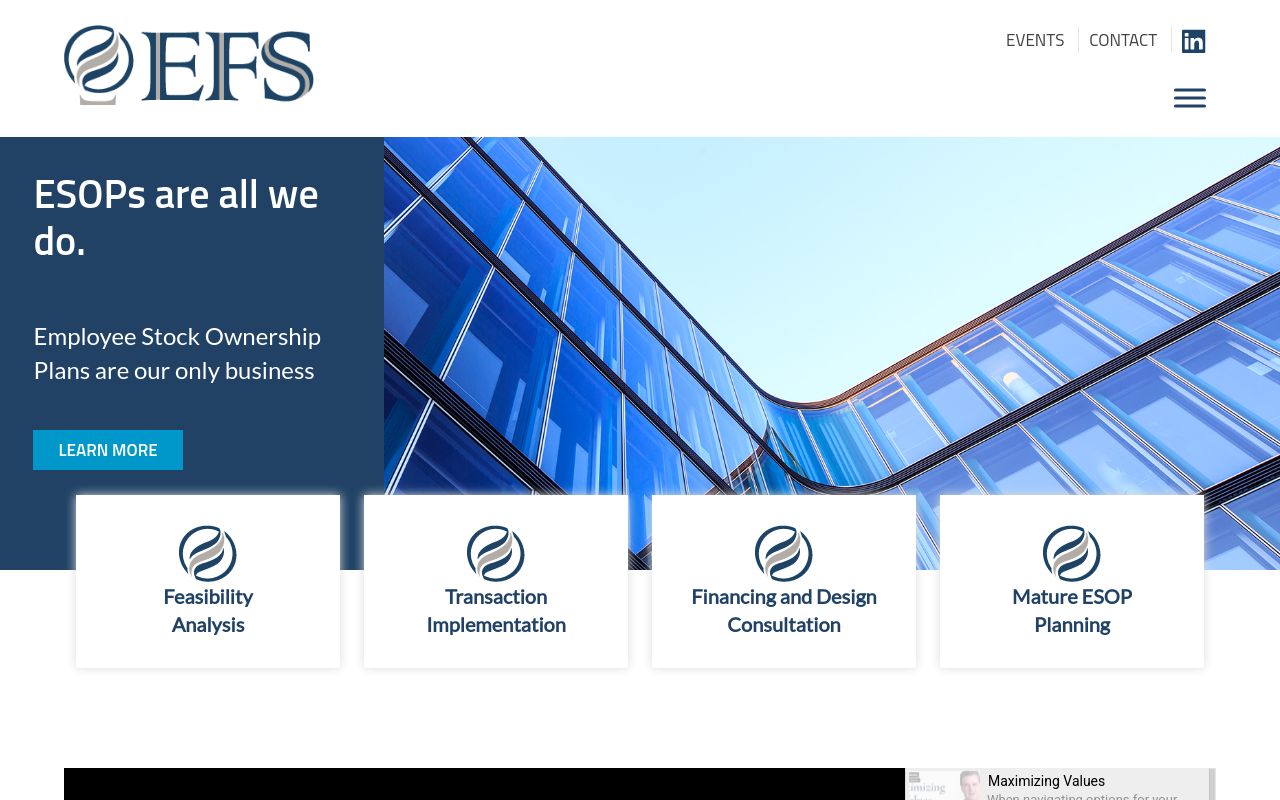
EFS ESOP Consultants homepage, navy blue hero panel reading 'ESOPs are all we do. Employee Stock Ownership Plans are our only business' with a Learn More button, beside a photo of a modern glass office building facade, and four service cards below: Feasibility Analysis, Transaction Implementation, Financing and Design Consultation, Mature ESOP Planning.
execfin.com, captured 2 September 2026

Finnell has spent "more than 40 years helping business owners design and execute ESOPs", by his firm's count, and a large part of that record is spoken rather than transacted: execfin.com credits him with "experience presenting at more than 300 conferences and meetings throughout the U.S. and abroad in London and Sydney". The firm's own history page describes what it does as "a very narrow focus on the use of ESOPs in Ownership Succession Planning". Its homepage puts it more bluntly: ESOPs are all we do.

The book is the easiest way in. "The ESOP Coach: Using ESOPs in Ownership Succession Planning" came out in 2010, and execfin.com says it has sold thousands of copies since. Behind him sits a firm established in Memphis in 1981, whose history page counts "100+ Transactions" and work "in 45 cities in 22 states". His bio lists him as an active member of the NCEO and The ESOP Association. The framing throughout is succession, an owner working out how to leave, rather than a sale process looking for the highest bidder.

Best fityou are an owner thinking about succession rather than a sale, and you want to read the book and hear the talk before you pay anyone a fee.

Think twice ifyou want your options weighed side by side. EFS states a very narrow focus on ESOPs in ownership succession planning, so a comparison against a trade sale or an outside buyer is not what the firm sells.

16

Chris Michael

Built his practice around one structure, the EOT, and says he introduced it to the United States

Adviser EOT Advisors New York, New York
Role
Founder, EOT Advisors; professor, Rutgers University
Based in
New York, New York, the address published for the affiliated law firm, EOT Law
Since
2015 for EOT Advisors, 2017 for the Rutgers role, per the timeline on his own site
Podcast or media
Guest on The ESOP Podcast, episode 151, "Chris Michael and EO Trusts", 19 May 2021
Verified claims
"has facilitated the transfer of roughly $750m in capital assets to over 3,000 workers in the course of more than 30 transactions"
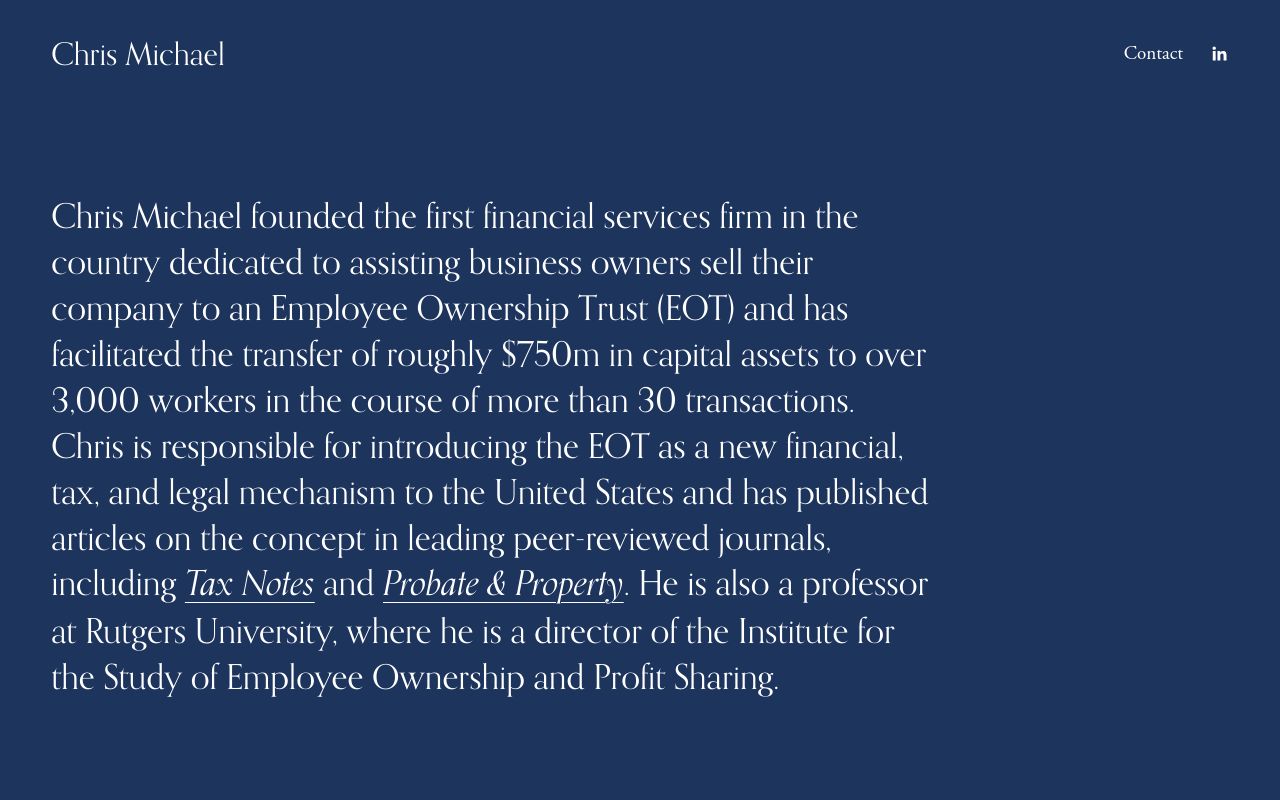
chrismichael.com homepage, dark navy background, white serif headline 'Chris Michael' top left with Contact and LinkedIn links top right, and a single paragraph bio below describing his EOT Advisors founding, transaction scale, and Rutgers University professorship.
chrismichael.com, captured 2 September 2026

Michael's site says he "founded the first financial services firm in the country dedicated to assisting business owners sell their company to an Employee Ownership Trust (EOT)", and that he is "responsible for introducing the EOT as a new financial, tax, and legal mechanism to the United States". Both are his own claims on his own site, and they are worth reading as such. The practice runs under two names that share his bio, his New York address and his phone number: EOT Advisors on the financial side and EOT Law on the legal side.

The numbers behind it are stated identically on both domains: he "has facilitated the transfer of roughly $750m in capital assets to over 3,000 workers in the course of more than 30 transactions". He has also argued the case in print, with articles on the concept in peer-reviewed journals including Tax Notes and Probate & Property. Since 2017 he has taught at Rutgers University, where he is a director of the Institute for the Study of Employee Ownership and Profit Sharing. For a longer version in his own voice, he talked the structure through on The ESOP Podcast in May 2021.

Best fityou have heard the EOT described as a lighter-touch alternative to an ESOP and you want it explained by someone who has published on it and closed more than 30 of these deals.

Think twice ifyou have already ruled the EOT out. EOT Law states its business as assisting owners "with the sale of their company to an Employee Ownership Trust", so a single structure is what both firms are built to deliver.

17

John Menke

Founded his ESOP firm in 1974 and is still listed as its president

Adviser Menke & Associates
Role
President, Menke & Associates, Inc., part of The Menke Group
Based in
Not stated on his bio page. The phone number published there is a San Francisco 415 number
Since
1974, the year he founded the firm
Books
His bio credits him with "a leading book on ESOPs" but does not name the title
Podcast or media
The firm publishes ESOP Radio, a company property rather than a show credited to him personally
Verified claims
The firm's own homepage claims: "Since 1974, Menke has structured over 4,000 ESOPs, the most by any single organization" and "AMERICA'S LARGEST & OLDEST ESOP ADVISOR"
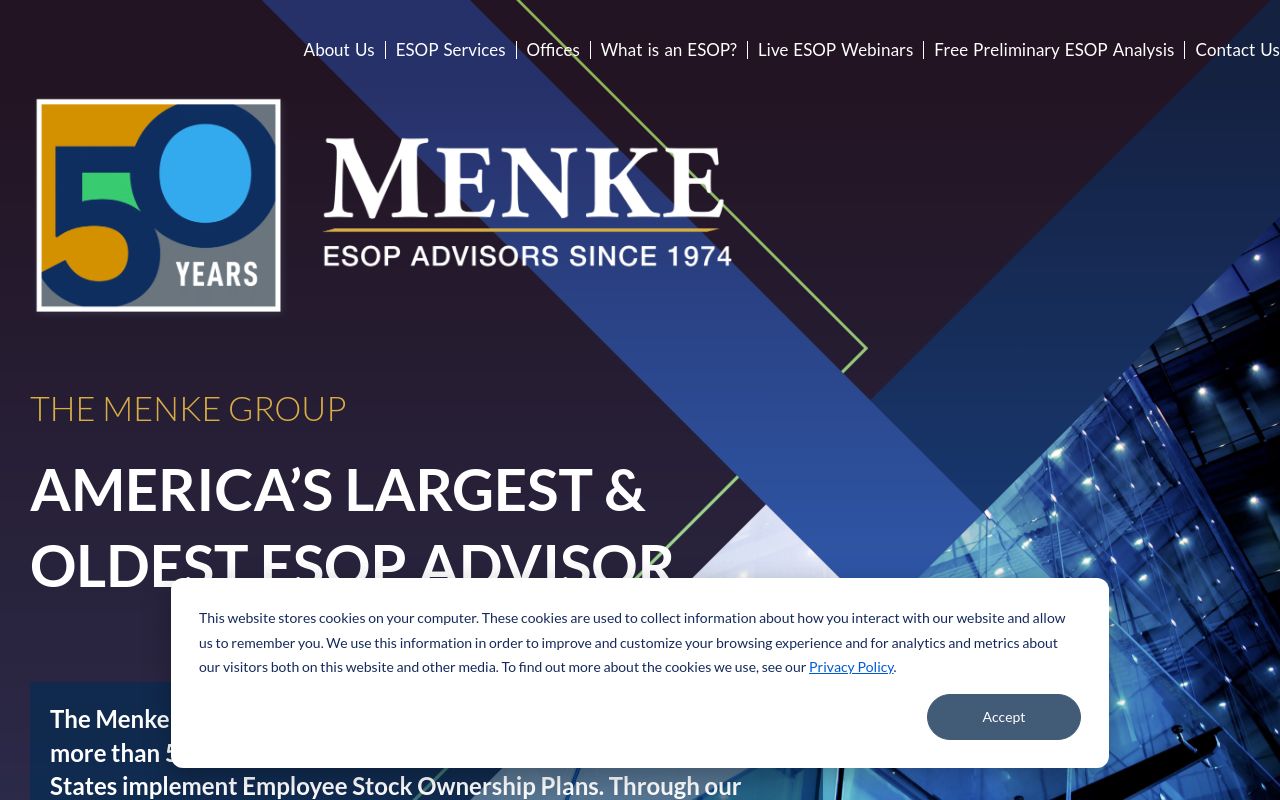
Menke.com homepage, dark navy hero banner with a gold '50 Years' anniversary badge and the Menke logo reading 'ESOP Advisors Since 1974,' headline 'THE MENKE GROUP / AMERICA'S LARGEST & OLDEST ESOP ADVISOR' over a photo of a glass office tower, with a cookie consent banner visible at the bottom of the frame.
menke.com, captured 2 September 2026

Menke founded Menke & Associates in 1974 and is listed today as its president, with his own email and phone number on the firm's advisory professionals page. Before that he was a senior tax attorney with the Law Offices of Louis O. Kelso, from 1972 to 1974. His bio also credits him with co-drafting "the original ESOP legislation which helped to spawn employee ownership in this country".

On volume, menke.com puts the firm's count at "over 4,000 ESOPs, the most by any single organization" since 1974, and calls the group "America's largest and oldest ESOP advisor". Both are stated at firm level, not attributed to him personally. Day to day the group is now led by Trevor Gilmore, promoted to chief executive officer (CEO) after Kyle Coltman retired, per a news post on the firm's site. Menke stays listed as president, a separate role from the one Gilmore now holds. Undergraduate degree at the University of Texas, law degree at Yale.

Best fityou have settled on an ESOP and want it designed, installed and administered by the firm that describes itself as America's oldest and largest ESOP advisor.

Think twice ifyou are still deciding. The firm sells structuring, legal work, valuation and administration to owners who have chosen an ESOP, so the comparison against other routes happens before you get here.

18

Darren Gleeman

Exit-planning adviser whose distinctive line is ESOPs for cannabis operators

Adviser MBO Ventures
Role
Founder, Managing Partner, MBO Ventures
Based in
Not stated on the firm's site
Podcast or media
Interviewed about ESOPs and business succession by Authority Magazine on Medium, byline Chad Silverstein
Verified claims
"He led the first fully ESOP-owned cannabis company in the country"; "Darren is a recognized expert in structuring ESOPs for cannabis operators"
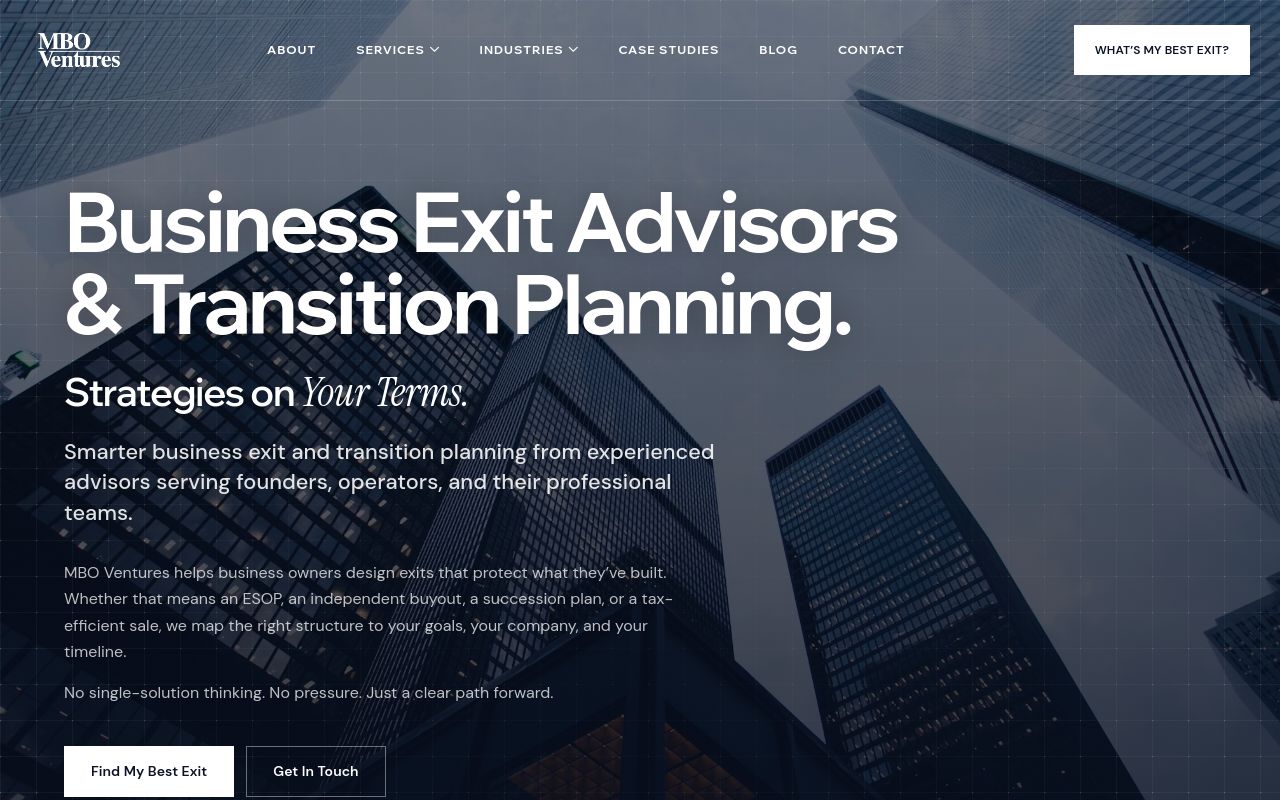
MBO Ventures homepage, dark navy navigation bar over a photo of glass office towers shot from street level, white headline 'Business Exit Advisors & Transition Planning. Strategies on Your Terms.' with a short intro paragraph and two buttons below it.
mboventures.com, captured 2 September 2026

MBO Ventures describes itself as "a business exit planning firm and investment partner" that designs transactions letting owners "sell a portion or all of their company", and Gleeman founded it. He came to the work from quantitative finance: the about page starts him at Wharton, with "hard work, modeling, and the scientific method", before the move into mid-market advisory. The site's own claim about him is specific: "He led the first fully ESOP-owned cannabis company in the country."

That is the distinctive part. mboventures.com calls him "a recognized expert in structuring ESOPs for cannabis operators" and puts the offer plainly: "If your company is plant-touching or adjacent, we can map a path that respects compliance and still delivers a fair deal." An Authority Magazine interview on Medium adds detail his own site does not carry, reporting that in 2023 he "received a patent pending for his ESOP methodology used in completing the cannabis industry's first ESOP, alleviating tax implications of 280E for a plant-touching multi-state operator, Theory Wellness", and that he took the Green Market Report 2024 Top Financial Advisor Award. No email is published on the site, so the way in is the contact form.

Best fityou run a cannabis business, plant-touching or adjacent, and you want to talk to someone whose firm has already closed an ESOP under those tax rules.

Think twice ifyou are outside that regulatory situation. The cannabis expertise is the firm's own stated specialism, and owners in other industries are not the audience that section is written for.

Storytellers

19

Bret Keisling

Built a long-running interview archive on employee ownership, plus a companion Mini-Cast and a summer school series

Storyteller The ESOP Podcast
Role
Host, The ESOP Podcast. The site calls him "the man behind The EO Podcast" and credits The Keisop Group in its footer
Based in
Not stated on their site
Podcast or media
The ESOP Podcast, also styled The EO Podcast across parts of the site, plus a companion Mini-Cast and a separately numbered ESOP Summer School series
Verified claims
No download or listener figures published on the site. The main feed's numbering reaches "283: Gina Schaefer on Business, Community & EO," dated May 28, 2024, and the summer school series reaches "ESOP Summer School 44," dated Aug 13, 2024
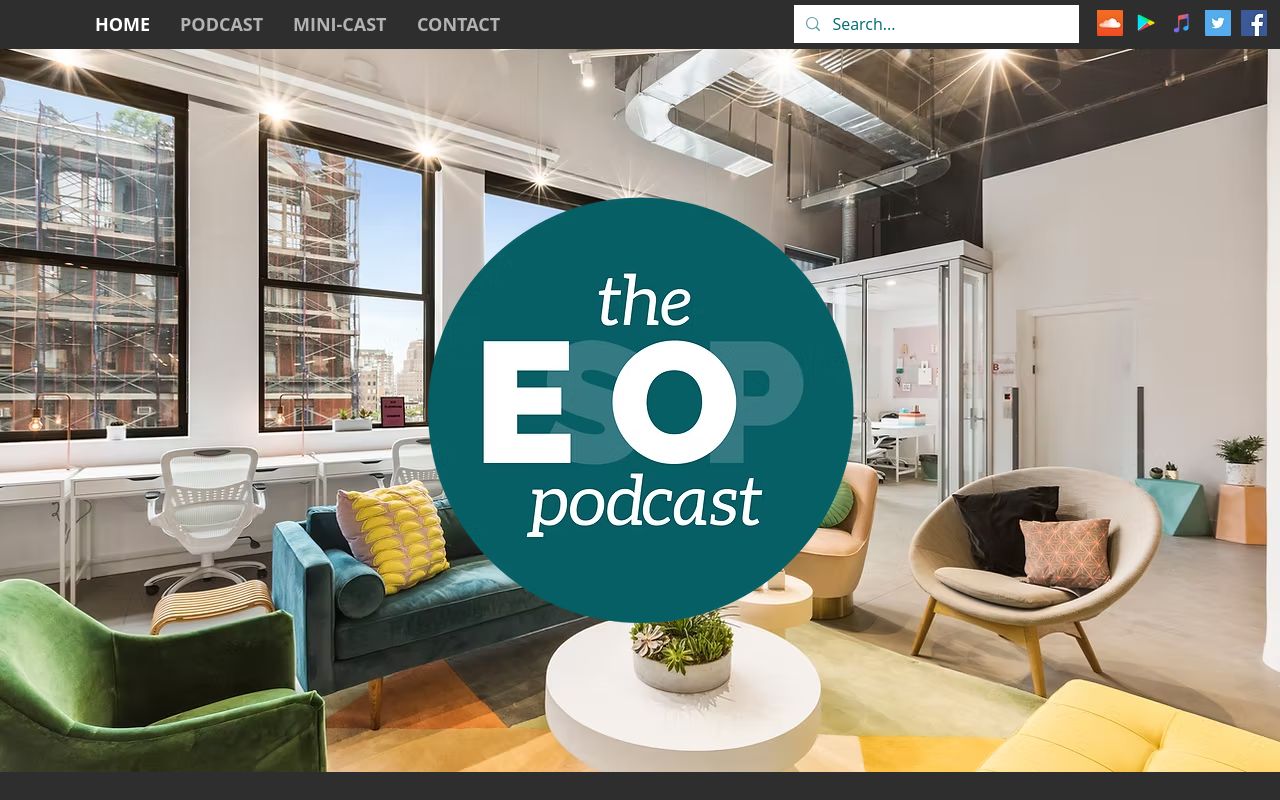
The ESOP Podcast homepage, dark navigation bar reading Home, Podcast, Mini-Cast, Contact with a search box and social icons, and a large teal circular logo reading 'the ESOP podcast' over a photo of a modern office lounge with colourful armchairs and a sofa.
theesoppodcast.com, captured 2 September 2026

The archive is the reason to bookmark him. The ESOP Podcast, which parts of the site brand as The EO Podcast, numbers its main feed into the 280s, and runs a separately numbered ESOP Summer School series alongside it that reaches 44. The homepage describes the show as inviting listeners from all over the world to hear insights from the best in the employee owned business, and the back catalogue is close to that: getting on for 300 numbered interviews, searchable, on a subject most owners run into once in a career.

One thing to be precise about, because it changes how you use the show rather than what it is worth. The most recent episode we could find dates from 2024: the site's own list stops in May 2024, Apple Podcasts shows nothing after 14 August 2024, and the underlying feed carries no item published after 1 December 2024. So the sensible way to treat this entry is as a library rather than a subscription, and to ask him where the show currently stands before planning around it.

Best fityou want to hear owners, advisers and employee-owners talk through this at interview length, on your own time, before you book a single call.

Think twice ifyou want a currently active show. The most recent episode we could find on the site, on Apple Podcasts and in the feed dates from 2024, so treat it as a back catalogue and confirm the position with him directly before pitching a guest slot.

20

Bo Burlingham

Wrote "Small Giants" and "Finish Big" after 33 years at Inc. magazine, and produces the annual Small Giants section for Forbes

Storyteller Forbes
Role
Contributor to Forbes, where his bio says he "produces the magazine's annual Small Giants section"; formerly of Inc. magazine
Based in
Not stated on his bio page
Books
"Small Giants: Companies That Choose to Be Great Instead of Big" (10th-anniversary edition, Portfolio, 2016); "Finish Big: How Great Entrepreneurs Exit Their Companies on Top" (2014); "The Great Game of Business" and "A Stake in the Outcome," both with Jack Stack; "The Knack," renamed "Street Smarts" in paperback, with Norm Brodsky
Verified claims
No figures published. His bio states he "worked for 33 years at Inc. magazine, as senior editor, executive editor, and editor at large," and that "the popularity of Small Giants led to the creation of the Small Giants Community"
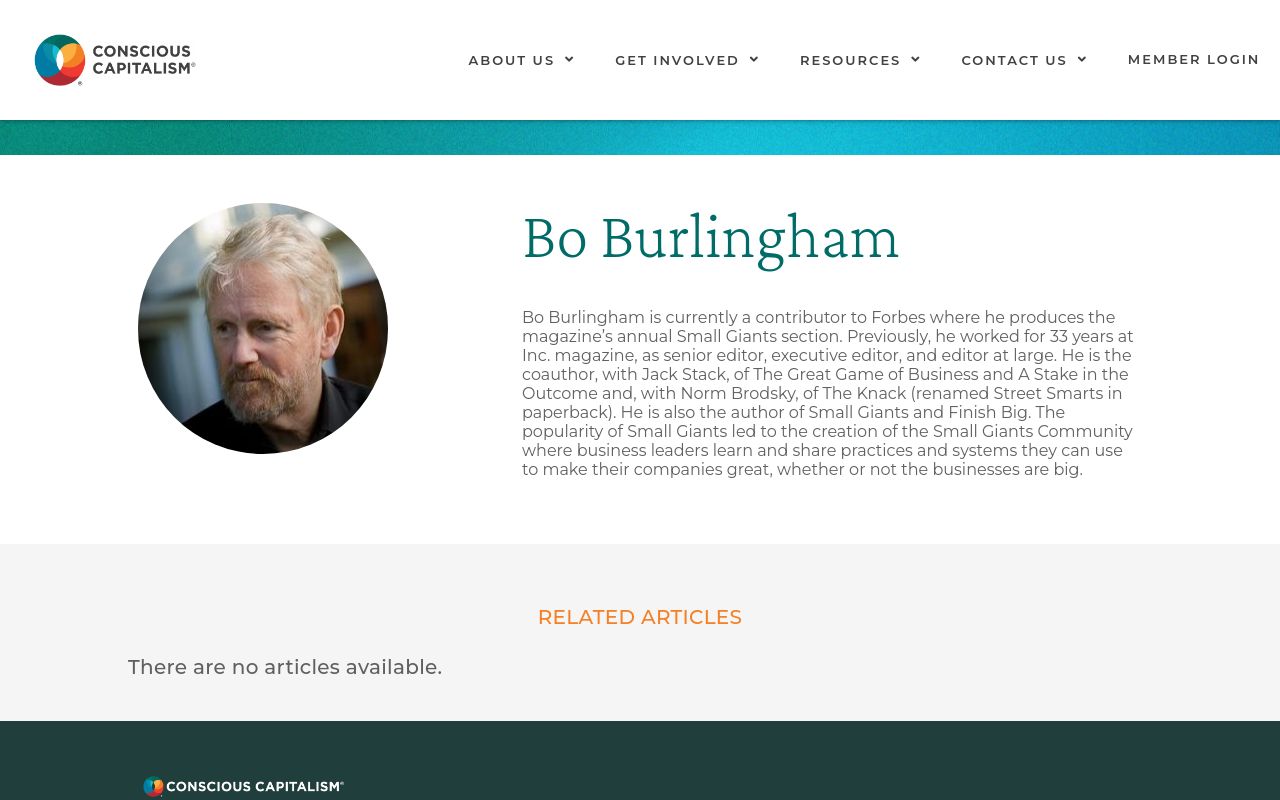
Conscious Capitalism website bio page for Bo Burlingham, showing a circular headshot of a grey-bearded man against a blurred background, his name in teal serif type, and a paragraph bio describing his 33 years at Inc. magazine and his books.
consciouscapitalism.org, captured 2 September 2026

Burlingham spent 33 years at Inc. magazine as senior editor, executive editor and editor at large, and the two books from that career are the ones owners get handed. "Small Giants: Companies That Choose to Be Great Instead of Big" is about companies that decided not to scale, and his bio says its popularity led to the creation of the Small Giants Community. "Finish Big: How Great Entrepreneurs Exit Their Companies on Top" is the one to read before an exit, and the subtitle is the whole argument. Neither book is an advice manual with a structure to sell. The authority is a reporter's, built over decades of writing about companies of this kind.

He now produces the annual Small Giants section for Forbes, per that same bio, which does not date when the relationship began. The 2019 edition of the list included WEBIT Services, entry 01, at number 24 of 25. His bio also credits him as co-author with Jack Stack, entry 02, of "The Great Game of Business" and "A Stake in the Outcome," and he co-wrote "The Knack" with Norm Brodsky. Read those credits together and the lineage on this page stops looking accidental.

Best fityou want to work out what a good ending looks like before you work out the mechanics, and you would rather read two books first than take a meeting.

Think twice ifyou want someone to structure the transaction. His bio lists editorial and authorial roles only, with no advisory, valuation or trustee credential, so the deal questions belong with entries 14 to 18.

Where to start

Who to read first, by question

Four questions owners actually arrive with, and the lane that answers each one.

01

Has anyone like me actually done this?

The operators and the storytellers. Eric Rieger gives the costs and the sequence from his own deal. Jack Stack has run an employee-owned company since 1983 and wrote the method down. Bo Burlingham spent a career reporting on owners who wanted a good ending.

02

What do the numbers say happens after?

The researchers. Douglas Kruse and Joseph Blasi co-write the recurring research briefs on what the evidence shows. Loren Rodgers runs the membership body that publishes the surveys behind a lot of it.

03

How does a transaction get structured and paid for?

The deal advisers. Mary Josephs runs these as investment banking for middle-market companies. Kelly Finnell frames the same work as succession planning. Chris Michael builds his around the employee ownership trust instead of the ESOP.

04

What is changing in the rules?

The policy seats. Jack Moriarty is a lead architect of the American Ownership and Resilience Act, the bill aimed at changing how these deals get financed. Jim Bonham speaks for the trade association in Washington. Hilary Abell heads the federal division created to promote employee ownership.

On the call

Questions to ask any adviser on the first call

  • Who do you represent in this transaction, me as the seller or the trust that buys the company?
  • How are you paid: a flat fee, a percentage of the deal, or something that only pays if it closes?
  • How many transactions like mine have you closed, and can I speak to two of those owners?
  • What happens to the repurchase obligation in five years and in ten, and who models it before I sign?
  • Who else has to be in the room: a trustee, an independent valuation firm, a lender, a lawyer on the other side?

The first question sets up the rest. The seller and the trust that buys the company each need their own advice, and the word adviser gets used by people sitting on opposite sides of that table.

Watch for

Red flags

  • An adviser who cannot say plainly which side of the table they sit on.
  • A pitch that leads with the tax treatment before anyone has made the business case.
  • A firm site with no named people on it. You are buying judgement, and judgement has a name.
  • A view on what your company is worth, offered before anyone has read your accounts.
Adjacent

Who this page deliberately leaves out

Firms and law practices. Several people here run one, and their firms are named inside their entries, but the unit on this page is a person. A directory of firms is a different page with different criteria, and merging the two produces a list where an institution with a marketing budget outranks a professor who has published for thirty years.

Worker cooperative and mutualism voices. A worker cooperative is owned and governed by its worker-members, one member one vote, and it has its own practitioners, organisers and writers. Two token entries would not represent that lane properly, so the widening is a job for a later version of this page rather than a footnote on this one.

Names on the bench. Other candidates were left out for scope or balance reasons: two strong legal voices from one firm ecosystem, where one entry was enough; a culture-side authority with a semi-retired title; and the worker cooperative and mutualism voices, which belong in a wider version of this page. None of that is a judgement on them, and they are not named here because a name without a full entry is unfair to the person. If you think someone belongs, the correction route in the method applies.

FAQ

Frequently asked questions

Who is on this list, and how were they chosen?

Twenty named people working in employee ownership, across five lanes: two operators who sold to their own employees, five researchers, six movement and policy people, five deal advisers and two storytellers. Every entry was checked against a live source on 2 September 2026, and each one carries a plain limitation as well as a best fit. Nobody applied and nobody paid.

Is this list ranked?

No. The numbers are navigational, so entries can point at each other and so you can send someone a link to one of them. Eric Rieger is 01 because he is a guest on our podcast and this page grew out of that conversation, which is an editorial call we disclose in the method and again on his entry. Everyone after that is grouped by lane.

What is the difference between an ESOP and an EOT?

An employee stock ownership plan holds shares in a trust for employees through a qualified retirement plan, so each employee has an account and a balance that pays out when they leave. An employee ownership trust holds the shares permanently on behalf of employees instead, with no individual accounts. Which one suits a particular company is a question for the advisers in entries 14 to 18.

Why is a growth agency publishing this?

We grow companies. When owners ask about exits beyond a sale, these are the people we point to, and until now we were sending those links one at a time. The page also gives our podcast conversation with Eric Rieger a permanent home. We do not sell exit advice, valuations or transactions, so this list is the whole of what we have to offer here.

How do I get an entry corrected or added?

Write to the author through the author page. Corrections come first: if a title, a date or a figure here is wrong or has moved on, say what the live source now says and we will fix it and date the change. Suggested additions get read the same way as the original research, against a live source, and most will land in a later version rather than the same week.

Are the people on this list paid to be here?

No. Nobody paid, nobody was offered anything, and there are no affiliate arrangements and no paid placements on this page. Every outbound link is a plain link. The one relationship we have is disclosed on entry 01: Eric Rieger recorded an episode of our podcast, which is why he is first and why we say so twice.

Method

How this list was built

  1. Live source verification. Every fact in every entry was read off a live source on 2 September 2026: the person's own bio page, the site of the organisation they work for, or the publication that carries their work. Where something could not be confirmed, the entry states the absence rather than filling it. Two entries carry a stated gap for that reason.
  2. Named individuals, never firms. Every entry is a person, and several of them run firms that would have been easier to write about. Institutions appear here through the people who run them, which is why the National Center for Employee Ownership (NCEO) shows up as Corey Rosen and Loren Rodgers rather than as a logo. A list of firms tells you where to send an email. A list of people tells you whose judgement you are buying, and who is likely to answer.
  3. Five lanes, defined. Operators who have sold a company to their own employees. Researchers who publish the data on what happens afterwards. Movement and policy people who run the member bodies, the federal division and the bills. Deal advisers who structure, value and finance the transactions. Storytellers who wrote the books and built the archives.
  4. Order. Eric Rieger is entry 01 because he is a guest on our Play It Smart podcast and this page grew out of that conversation. That is an editorial call, and it is disclosed here and again on his entry. NUOPTIMA hosts this page and publishes the podcast; it is a growth agency that sells marketing, not exits or transactions, and nobody paid to be listed. Everyone else is grouped by lane, in no order within the lane, and not ranked against each other.
  5. Balance. The list includes the private equity (PE) side of the ownership conversation on purpose. Plenty of writing in this field is built as a case against private equity, and a page that only carried that argument would be a worse map. The entries describe who is doing what, with their own words quoted, and leave the argument to the reader.
  6. What we could not check. We did not audit anyone's figures. Every scale claim, transaction count and dollar figure below is quoted the way the person's own site or their organisation words it, attributed in place, and none of it has been checked by us beyond that source.
  7. Corrections and additions. If something here is wrong, out of date, or missing a person who belongs, write to the author through the author page. Corrections get made and dated.

Numbering is navigational, not hierarchical

Entry 01 is not better than entry 20. The numbers exist so entries can refer to each other, and so you can send someone a link to one of them. Lane is the thing to read, not position: a researcher and a deal adviser are not competing for the same slot in your week.

Reference

Glossary

Every short form used on this page, in one place. Each one is also spelled out where it first appears above.

Short forms used on this page, with the plain meaning of each
Short formWhat it stands forIn plain terms
ESOPEmployee stock ownership planShares held in a trust for employees through a qualified retirement plan, so each employee has an account and a balance
EOTEmployee ownership trustA trust that holds the shares permanently on behalf of employees, with no individual employee accounts
EOEmployee ownershipThe general term, used as shorthand across this field and inside several organisation names
MBOManagement buyoutA sale to the company's existing managers rather than to its wider workforce or an outside buyer
PEPrivate equityThe investor buyers most owners meet first, and the alternative several people here were weighed against
NCEONational Center for Employee OwnershipThe membership nonprofit in entries 03 and 04
EOXEmployee Ownership Expansion NetworkThe network building state level centers, entry 13
DOLUnited States Department of LaborThe federal department that houses the employee ownership division in entry 11
EBSAEmployee Benefits Security AdministrationThe part of the Department of Labor that division sits inside
SMLRSchool of Management and Labor RelationsThe Rutgers school behind entries 05, 06 and 07
CLEOCurriculum Library for Employee OwnershipThe teaching library run from Rutgers, entry 07
AORAAmerican Ownership and Resilience ActThe bipartisan bill introduced in 2025, entry 09
CEOChief executive officerUsed in several people's own job titles below
HRMHuman resource managementOne of the two Rutgers departments the professors here hold rank in
LSERLabor studies and employment relationsThe second of the two Rutgers departments the professors here hold rank in

Short forms are expanded again on first use inside the entries, so a reader landing on one person from a search result does not have to come back up here.

Screenshots captured from each person's own bio page, organisation site or profile on 2 September 2026. Eighteen of the twenty entries carry one.

The episode behind entry 01: Six Private Equity Offers a Week, and He Sold to His Staff Instead, published 31 August 2026.

More from NUOPTIMA: the Play It Smart podcast.