Stop treating organic search like a mindless content production line. For SEO teams requiring repeatable systems, growth seo acts as an operating system of compounding loops that turn rankings into predictable pipelines. This guide delivers seven proven frameworks and a forecasting method to defend your organic growth strategy to leadership. Dominate the AI-search answer layer with revenue-first attribution and our scalable GEO services at nuoptima.com today.
Start by aligning the channel to one growth metric.
Key Takeaways
- Growth SEO is a revenue-first operating system of compounding loops, shifting focus from vanity traffic to a single north-star metric like organic pipeline value.
- Build a clean data foundation by consolidating GSC, GA4, and CRM into one source of truth and keeping 24 months of snapshots to forecast accurately.
- Forecast with controllable levers: model traffic from rank bands and CTR, conversions from organic CVR, and revenue from AOV or lead value, then present conservative, expected, and aggressive scenarios.
- The fastest near-term lever is refreshing pages ranking in positions 4 to 20, which already hold authority but need entity density and intent alignment to break into the top results.
- Scale safely with programmatic SEO governance (template excellence, QA sampling, gradual cohort releases) and engineer pages for GEO so LLMs cite your brand.
1. Pivot from Vanity Traffic to North-Star Revenue Metrics
If your SEO report highlights session growth while sales starves for leads, you are managing a vanity project. Growth SEO shifts focus from keyword-led outputs to loop-led outcomes: acquisition, activation, and monetization. Traditional agencies chase volume. Growth teams optimize for outcomes that are defensible to leadership.
Define your north-star metric by your business model. B2B organizations must track SQLs and organic pipeline value. B2C and e-commerce companies should prioritize revenue and contribution margin. To operationalize this, pick one primary metric and two guardrails:
- Total pipeline value generated
- Organic conversion rate (CVR)
- Assisted organic conversions
Map 3 to 5 bottom-of-funnel (BOFU) intends directly to revenue, specifically pricing, alternatives, integrations, and use-case pages through rigorous high-intent keyword prioritization. Review pipeline flow weekly to monitor velocity but analyze strategic attribution monthly.
The most common failure mode is reporting rankings without business impact. Fix this by tying every keyword and page to a specific SEO funnel stage. This prevents “SEO success” that looks good in dashboards but fails to move the needle on actual pipeline or profit.

2. Build a Clean Data Foundation for Forecastable Scale
Scaling a growth SEO strategy requires data leadership trusts. If inputs are messy, forecasts are fiction. Prioritize these minimum viable data points to define your baseline:
- GSC: Clicks, impressions, and position by query and page.
- GA4: Organic sessions and conversions.
- CRM: Lead value and close rates to anchor search data in revenue.
Consolidate these into a single SEO source of truth table. Maintain 24 months of snapshots to account for seasonality and isolate long-term trends. Segment the data by brand vs. non-brand, intent stage, and page type to identify exactly where revenue originates.
Bypass the 16-month GSC interface limit by using the GSC API and a warehouse pipeline. This lightweight ETL process ensures historical visibility and data integrity for year-over-year comparisons. Your dashboard must answer three questions: Where is growth originating, what is lagging, and what can we influence this quarter? This structure eliminates reporting chaos and enables repeatable ROI attribution.
3. Forecast Growth Using Controllable Revenue Levers
Leadership rejects generic growth percentages as guesswork. To secure a budget, you must demonstrate how to forecast seo growth using controllable levers. This turns abstract rankings into a defensible business case anchored in historical performance.
Categorize pages by intent and current rank bands: 1 to 3, 4 to 10, and 11 to 20. Use these variables to calculate projected impact:
- Traffic = Search Volume × CTR(position)
- Conversions = Traffic × Organic CVR
- Revenue = Conversions × AOV (or lead value × close rate)
This model enables scenario-based planning. If you move 20% of keywords from the 4 to 10 band into the top 3, you can quantify the exact pipeline lift. Present three scenarios to acknowledge market uncertainty:
- Conservative
- Expected
- Aggressive
Always calibrate by back-testing the model against the previous six months to adjust CTR and CVR assumptions. Final deliverables should include a one-page executive view and a detailed tab for controllable assumptions. This approach makes growth seo and organic revenue targets verifiable and investable.
4. Operationalize the Content Refresh Loop for Compounding Wins
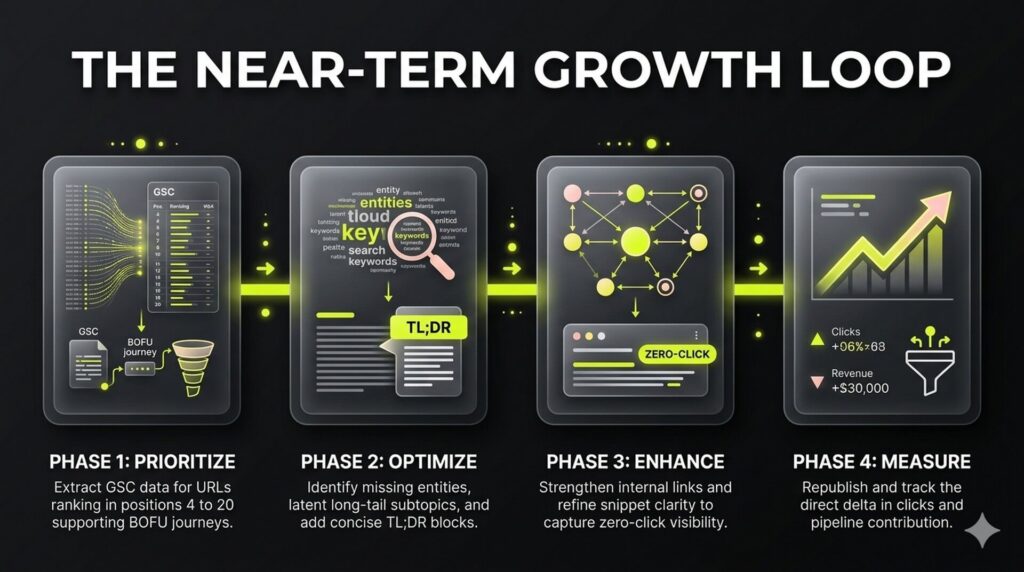
Your most immediate growth SEO lever is the “near-term growth bucket”: pages currently ranking in positions 4 to 20. These URLs possess meaningful impressions and authority but often lack the entity density required for ranking dominance. Systematically upgrading these assets produces faster, more reliable organic revenue than net-new content production.
Prioritize pages supporting Bottom-of-Funnel (BOFU) journeys or those with proven conversion rates. Execute a repeatable refresh sprint:
- Extract GSC query data to identify missing entities and latent long-tail subtopics.
- Add concise TL;DR blocks and update stale claims to sharpen intent matching.
- Strengthen internal links and refine snippet clarity to capture zero-click visibility.
- Republish and track the delta in clicks and pipeline contribution.
Avoid refreshing blindly. Tie every modification to specific query patterns in GSC and document “before and after” performance. This builds an internal playbook that transforms isolated updates into a compounding loop, securing your organic moat against shifting AI search signals.
5. Transition to Entity-Driven Information Architecture
High-ranking content often fails to earn AI citations because visibility now requires machine-level trust. At scale, the constraint is no longer content volume but entity understanding. Shift your strategy from isolated keyword lists to a formal information architecture.
Reframe topical authority as a structural challenge where clusters cover the entire decision journey. Define core entities (your product and category) and surround them with supporting entities:
- Industry standards and use cases
- Technical integrations
- Competitor comparisons
Every core entity needs a definitive anchor page supported by nodes that link back strategically to consolidate authority.
Engineer every page for GEO readiness. Use clear definitions, extractable answer blocks, and FAQ schema to help LLMs identify your brand as the definitive source. Apply a strict internal linking rule: every new page must earn a link from a hub and pass authority to a revenue page. Measure success through growth in non-brand impressions and top-10 keyword breadth.
6. Scale Safely with Programmatic SEO Governance Playbooks
Programmatic SEO (pSEO) is a high-velocity growth seo lever when targeting high-intent longtails with repeatable structures. Use it for integration pages, comparison templates, or “X for Y” solutions. Treat your pSEO engine as a product to avoid prioritizing URL volume over integrity.
Standardize your template anatomy to ensure every page provides distinct value:
- Unique value statement and intent match
- Specific examples and use cases
- Constraints or edge cases
- Direct next-step CTA
Maintain architectural integrity by keeping generated pages discoverable within two clicks of a hub page. This facilitates crawling and preserves link equity. Use non-negotiable QA guardrails before going live:
- Staging environment publishing
- Automated checks for template artifacts
- Human QA sampling
- Gradual cohort releases
Monitor success via indexation rates, the percentage of pages reaching the top 10, and conversions per cohort. Prune or redirect underperformers immediately. More URLs do not equal growth if quality or intent alignment degrades.
7. Convert Authority into Pipeline with Revenue-First Systems
Authority is the multiplier for competitive SERPs. However, visibility only yields growth SEO results when paired with high-conversion infrastructure. Use digital PR and credible mentions to satisfy both Google ranking factors and AI trust signals.
Transform content into a conversion engine with these repeatable upgrades:
- Above-the-fold CTAs and demo pathways
- Comparison tables and social proof blocks
- Internal links to pricing and BOFU pages
Establish instrumentation for revenue truth to prevent “traffic up, revenue flat” outcomes. Track organic-assisted conversions and lead quality rather than last-click metrics. The SEO lead must deliver a monthly reporting cadence covering forecast vs. actual wins and upcoming strategic bets.
If your team needs the execution capacity to dominate both Google and AI search, partner with nuoptima.com. Leverage our GEO services to ensure your brand becomes the definitive answer across the entire search layer.
If you need a partner to manage the complex intersection of SEO and GEO, explore our GEO services at nuoptima.com for strategic, AI-native execution.
Where this fits in your MSP growth system
This is one piece of how NUOPTIMA makes MSPs and cybersecurity firms the provider buyers find on Google and in AI search. See how it connects to MSP SEO and GEO and AI-search, or get your free MSP lead forecast to see exactly where your firm shows up across ChatGPT, Gemini, and Perplexity today.