Your organic traffic may flatten as AI answers absorb search demand, but your pipeline still requires market influence. Define a generative engine optimization strategy as SEO for AI-generated answers. It extends search fundamentals like crawlability and authority by adding requirements for extractability and entity clarity. This executive checklist ensures you get cited, stay represented accurately, and measure answer-engine ROI.
Start by understanding which engines you are optimizing for.
A generative engine optimization strategy is the plan you use to get your MSP cited inside AI-generated answers on engines like Perplexity, Google AI Overviews, and ChatGPT. It extends classic SEO by engineering your content for extractability and entity clarity so models quote you by name.
Key Takeaways
- A generative engine optimization strategy is SEO for AI-generated answers: it extends crawlability and authority by adding requirements for extractability and entity clarity so your MSP gets cited.
- Treat AI engines differently, not as a monolith: Perplexity rewards structured comparisons and tables, Google and Gemini prioritize entity signals and topical authority, and ChatGPT or SearchGPT optimize for clear quotable sections.
- Measure GEO with three KPI tiers: AI Share of Voice for money prompts, AI Referrals tracked via a GA4 channel group, and Assisted Pipeline connected to closed-won revenue.
- Structure content with an answer-first lead sentence under each H2 so it passes a copy-paste test and remains a complete answer without surrounding context.
- Identify 3 to 5 money prompts per engine and run a 30-day rollout across baseline, technical eligibility, citation-target page rebuilds, and a defend phase against brand misrepresentation.
How a GEO Strategy Differs From Traditional SEO
A generative engine optimization strategy keeps every SEO fundamental and adds a second job: making your content easy for a language model to lift and attribute. Traditional SEO works to rank a page so a person clicks through. GEO works to get your MSP named inside the answer itself, often with no click at all. The two are not rivals. GEO sits downstream of technical SEO and fails without it.
The practical differences show up in what you optimize for:
- Unit of success: SEO wins a ranking position. GEO wins a citation inside a Perplexity or ChatGPT answer, measured as AI Share of Voice rather than a blue-link spot.
- Content shape: SEO tolerates long narrative pages. GEO rewards atomic, answer-first passages that stay accurate when a model copies them out of context.
- Trust signal: SEO leans on backlinks. GEO leans on entity clarity, verifiable claims, and consistent brand mentions across LinkedIn, Google Business, and industry directories.
- Measurement: SEO counts sessions and rankings. GEO counts citations, AI referrals, and assisted pipeline, because most AI answers are zero-click.
For a full head-to-head on when to weight each discipline as a growing MSP in 2026, see our guide on MSP SEO vs GEO strategy. The rest of this page assumes you run both and focuses on the nine moves that earn the citation.
1. Differentiate by Engine: The Strategy of Citation
Why does your MSP dominate Perplexity but remain a ghost in SearchGPT? Many teams publish generic content and cannot explain inconsistent visibility. To win, stop treating AI as a monolith. Platform differentiation is your first strategic decision to bridge the Technical Authority Gap.
Each engine uses unique logic to source answers:
- Perplexity: Web-grounded and citation-forward. It rewards structured comparisons and sourceable formats like tables.
- Google/Gemini: Tightly coupled to the Google ecosystem. It prioritizes strong entity signals and topical authority.
- ChatGPT/SearchGPT: Focused on conversational UX. It optimizes for clarity and quotable sections for easy retrieval.
Identify 3 to 5 money prompts per engine covering categories, vendor comparisons, and regional service queries like best MSSP in London. Assign owners to monitor how these engines describe your brand authority. This prevents wasted effort by aligning GEO work with the specific prompts that influence your B2B pipeline.
The final output is a one-page Engine Coverage Plan. This document maps engines to specific prompt sets and high-intent target pages. This ensures your technical authority is engineered for the specific way each engine retrieves and presents information. This alignment transforms technical expertise into cited market leadership.
2. Build a GEO Measurement Framework to Track AI Influence
Traditional SEO metrics fail in the generative era because AI answers are often zero-click. If leadership relies solely on sessions, your generative engine optimization strategy will be deprioritized even when your brand is the primary authority cited by Perplexity or SearchGPT. To defend growth investment and prioritize technical fixes, you must transition to a measurement-first model.
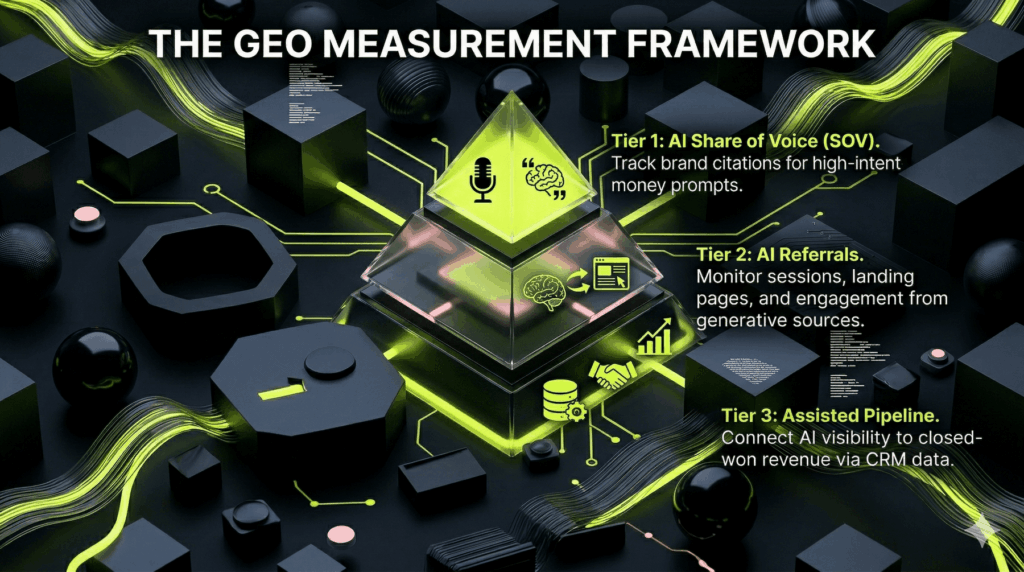
Architect your reporting around three tiers of KPIs:
- Tier 1: AI Share of Voice (SOV). Track brand citations for high-intent money prompts within primary LLM response blocks.
- Tier 2: AI Referrals. Monitor sessions, landing pages, and engagement rates specifically from generative engine sources.
- Tier 3: Assisted Pipeline. Connect AI visibility to closed-won revenue via CRM influence data and self-reported attribution.
Execute this by building an AI Tools channel group in GA4 using referrer regex to isolate traffic. While this undercounts total impact due to the clickless nature of LLMs, it establishes a defensible baseline for monthly reporting. Maintain an operational cadence of weekly SOV scans and monthly executive dashboards. This framework provides the investor-grade data required to move GEO from a vanity experiment to a core revenue driver for technical B2B firms.
3. Structure Content for Precision Extraction and LLM Citation
Generative engines prioritize atomic content units that deliver direct answers in the leading sentence to facilitate seamless extraction and citation. Traditional SEO ranking does not guarantee AI visibility if models cannot isolate specific insights from technical documentation. To bridge the Technical Authority Gap, content must be structured as self-contained units that retain full meaning when separated from the parent page.
Formatting for AI Retrieval
- Answer-First Lead: Define the concept or provide the solution in the very first sentence of the H2 or H3 section.
- Structured Support: Follow with 3 to 7 bullets or a small table to provide technical context or actionable steps.
- Standalone Quotables: Include specific definitions or thresholds that remain accurate when copy-pasted into an AI answer.
- Entity Specificity: Replace ambiguous pronouns like it or this with the specific entity, such as the NUOPTIMA GEO Framework.
Every H2 must pass a copy-paste test where the passage provides a complete answer without requiring surrounding context. This increases the probability that engines retrieve and reuse your content verbatim with attribution rather than paraphrasing competitors. This structure transforms technical expertise into durable organic equity for growth-focused MSPs.
4. Achieve Entity Clarity to Become the Default AI Recommendation
AI engines often understand technical concepts like Co-managed SOC but fail to link them to your brand. This Technical Authority Gap occurs when systems cannot disambiguate your firm from the broader topic. Without entity clarity, your company remains invisible during generative engine optimization strategy execution. Clear mapping prevents brand invisibility and ensures you are not confused with similarly named entities.
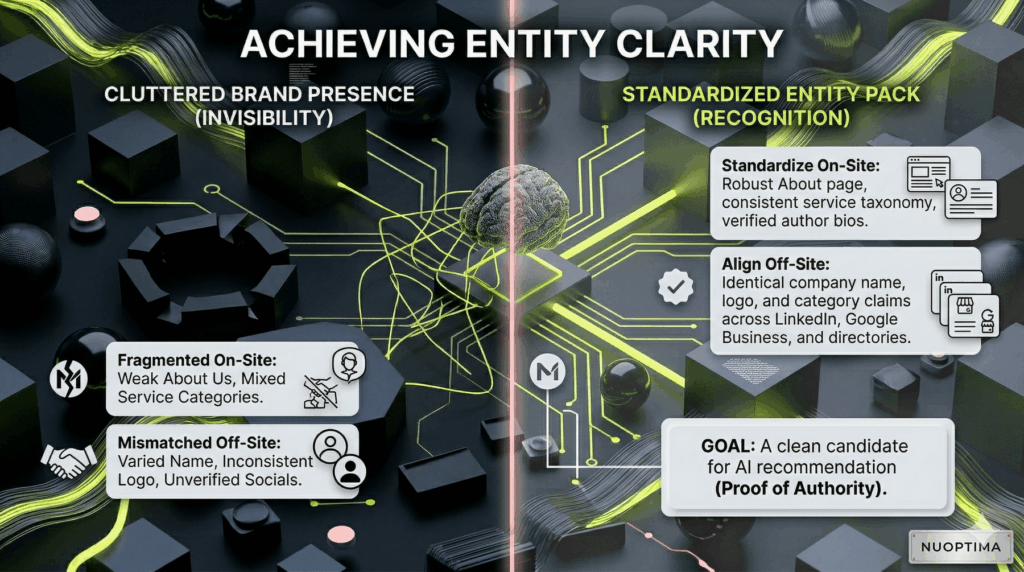
Build a minimum viable entity pack on your website to establish this connection:
- A robust About page stating your mission, geographic footprint, and industries served.
- Service pages using a consistent taxonomy and repeating the entity name naturally.
- Author pages for technical experts featuring stable bios and verified credentials.
- Consistent naming across these assets provides the Proof of Authority models need to cite you.
Off-site consistency is equally vital. Your company name, logo, and category claims must be identical across LinkedIn, Google Business, and industry directories. When your digital footprint aligns, your firm becomes a clean candidate for AI recommendation. When a CISO asks for the best cybersecurity partner for M&A readiness, the engine should name your firm with total confidence.
5. Prioritize Verifiability to Secure High-Value AI Citations
Answer engines frequently paraphrase MSP expertise without providing a backlink. This happens because most content lacks the evidentiary markers that LLMs require to justify a citation. To bridge the Technical Authority Gap, your generative engine optimization strategy must transition from generic thought leadership to a model of verifiable data.
Engines prioritize content that appears provable and low-risk to recommend. To become a primary source, pair every strategic claim with:
- Specific data points or statistics.
- Industry standards or definitions.
- Short methodology notes or timestamps.
For example, replace vague claims about fast support with specifics like our NOC maintains a 12-minute mean time to acknowledge for US mid-market firms as of Q3 2025. Place these references immediately following the claim instead of burying them in a footer. Use consistent units, dates, and geographic scopes to ensure data is easily extractable.
Build anchor assets such as proprietary benchmarks, calculators, or datasets that engines are forced to cite. Strictly avoid unverifiable superlatives like best or #1 unless you provide timestamped proof from a recognized third party. This approach builds Organic Equity by providing the verifiable substance that AI models need to credit your brand.
6. Deploy Technical Schema to Eliminate Brand Ambiguity
Generative engines often hallucinate brand facts or misattribute technical whitepapers when site data is unstructured. This entity fuzziness prevents AI models from citing your MSP as a definitive authority during the discovery phase. Schema markup provides a machine-readable commitment to facts, reducing ambiguity for LLM crawlers. It transforms your digital footprint into a structured layer of certainty.
Prioritize schema deployment by its impact on your Generative Engine Optimization strategy:
- Organization: Define your logo, sameAs profiles, and contact points to establish corporate identity.
- Article & BlogPosting: Lock in authorship and last modified dates to signal expertise.
- FAQ: Ensure authentic Q&A content is extracted cleanly without misinterpretation.
- LocalBusiness: Mandatory for capturing regional demand and territory-specific intent.
- Review & AggregateRating: Build trust through policy-compliant validation to increase conversion.
Treat schema as a strategic reinforcement tool that bridges the Technical Authority Gap. High-integrity data must exist in both the code and the prose to ensure machine parseability. Validate your implementation using Google’s Rich Results Test and ensure modified dates reflect genuine updates. This precision ensures your MSP remains the primary citation when high-intent decision-makers query AI for cybersecurity solutions.
7. Master Technical Accessibility to Ensure AI Indexing
Many MSPs invest in sophisticated prompts while their site content remains invisible to the engines they target. A generative engine optimization strategy fails when built on a broken technical foundation. If a crawler cannot access or parse your page, the entity clarity and formatting become irrelevant. GEO is fundamentally downstream of technical SEO.
Technical teams often hide high-value insights behind heavy JavaScript or block crawlers with misconfigured robots.txt files. To bridge the technical authority gap, your core content must exist in crawlable HTML. If your site uses complex frameworks, implement Server-Side Rendering (SSR) to ensure LLMs can read the full text immediately.
Execute these table-stakes checks to ensure your technical authority is retrievable:
- Audit meta robots tags and canonicals to prevent accidental noindex directives.
- Verify XML sitemaps accurately reflect your current architecture and service pages.
- Provide descriptive alt text for technical diagrams and full transcripts for video case studies.
- Avoid placing mission-critical data solely within images where models cannot parse it.
These technical requirements are the entry price for the AI era. By resolving these hurdles, you ensure your pages are eligible to be retrieved, quoted, and cited across Perplexity, SearchGPT, and other engines. This transforms your website from a static brochure into a cited source of truth for high-intent decision-makers.
8. Maintain Authority Through a Recurring GEO Refresh Playbook
Securing a citation in Perplexity today does not guarantee visibility tomorrow. Answer engines prioritize freshness because stale data increases hallucination risks for the model. If your technical documentation remains static, your authority effectively expires as newer, more relevant sources emerge.
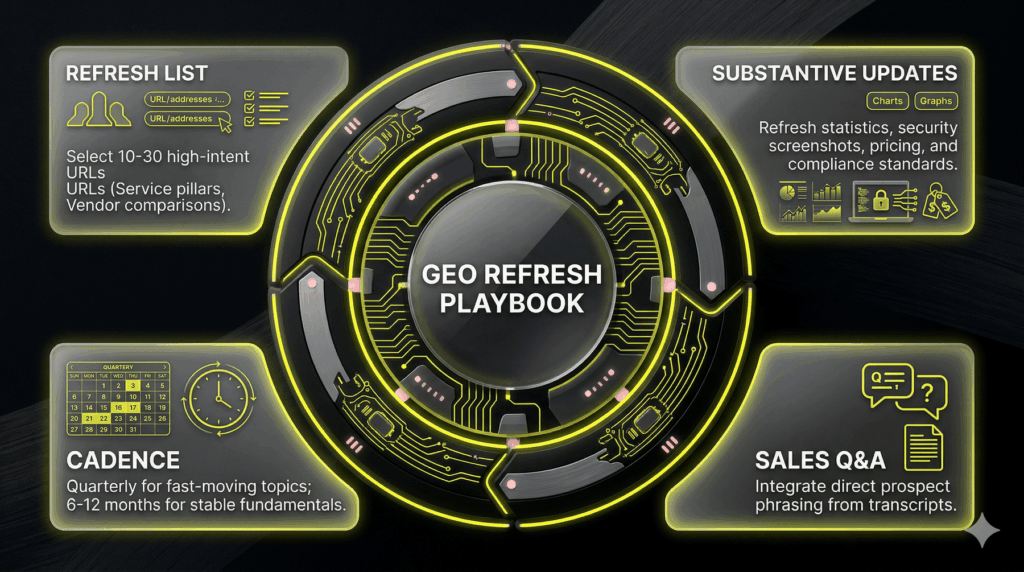
A successful generative engine optimization strategy treats content as a recurring operating system rather than a one-off project. Start by building a GEO Refresh List of 10 to 30 high-intent URLs. This list should include:
- Service pillar guides
- Vendor comparison pages
- Local industry landing pages
- Product-specific technical documentation
Your update playbook must prioritize substantive changes over vanity dates. Update performance statistics, refresh security dashboard screenshots, and adjust pricing or compliance standards to reflect current market realities. Integrate Q&A sections directly from sales transcripts to capture the specific phrasing prospects use in their prompts. Keep an internal changelog to document why changes were made and update the last updated timestamp only when content truly evolves.
Apply a quarterly cadence for fast-moving cybersecurity topics and a six to twelve month cycle for stable fundamentals. This systematic approach bridges the Technical Authority Gap. It protects your organic equity and ensures your content remains the primary citation source as industry standards shift.
9. Defend Brand Equity Against Generative Misrepresentation
When a $20M enterprise prospect asks Perplexity about your capabilities, receiving incorrect data is a direct revenue risk. Most competitors ignore the defensive side of a generative engine optimization strategy. For B2B firms, AI-driven misrepresentation can kill a deal before your sales team even engages.
To prevent engines from hallucinating capabilities, implement strict brand-voice controls:
- Publish a dedicated Positioning and Category section on all core service pages.
- Use consistent descriptors for industry, audience, and geography across your site and third-party profiles.
- Define What we do and What we don’t do boundaries to limit hallucinated services.
If inaccuracies persist, execute a negative GEO playbook. Document specific prompts and the source pages the engine cites. Fix these sources immediately, whether on your site or third-party platforms.
For common misconceptions, publish a corrective FAQ entry to provide a fresh, authoritative signal. Treat repeated misrepresentation as a reputation management issue that impacts your ultimate enterprise valuation. Accuracy is not a technical detail but a core component of market authority.
How to Operationalize a Generative Engine Optimization Strategy
Generative Engine Optimization (GEO) fails when marketing teams treat it as a series of random content tweaks. For a Head of Marketing, success requires moving beyond tactical experimentation into a controlled program with rigorous measurement. This guide provides an operational plan to bridge the Technical Authority Gap and drive predictable Revenue Outcomes.
Prerequisites: Setting the Operational Baseline
Establish your technical and analytical foundation before starting the 30-day rollout. These tasks ensure every subsequent action remains data-driven.
- Define Engine and Prompt Sets: Select your primary targets, such as Perplexity and SearchGPT. Identify your top 20 money prompts based on bottom-funnel intent (Item 1).
- Configure GA4 Tracking: Build a custom channel group using referrer regex to isolate traffic from AI sources. You will see these appearing as AI Referrals in your acquisition reports (Item 2).
- Establish Baseline SOV: Document your current AI Share of Voice for your primary prompts. This creates the before snapshot needed to justify the program spend.
Week 1: Baseline and Strategic Targeting
The first week focuses on moving from guesswork to a documented Money Prompt Map. This document serves as the strategic North Star for your generative engine optimization strategy.
- Build the Prompt Map: Categorize 10 to 25 specific prompts across targeted engines. Organize them by intent stages: Awareness, Consideration, and Decision.
- Run a Baseline SOV Scan: Manually test these prompts. Identify which competitors are currently cited, which pages the engines prefer, and which formats the models choose to display.
- Owner: SEO Manager or Content Lead.
- Deliverable: A finalized Prompt Map and a Baseline SOV Report identifying specific Authority Gaps.
Week 2: Fix Eligibility and Entity Clarity
Resolve the technical friction preventing AI models from trusting your brand. This phase makes your technical authority machine-readable.
- Execute Technical Hygiene: Audit robots.txt and server-side rendering. Ensure AI crawlers can access your core content without roadblocks (Item 7).
- Update the Entity Pack: Standardize the About page, author bios, and naming conventions across all digital touchpoints (Item 4).
- Deploy Priority Schema: Implement Organization, Article, and FAQ schema. This provides the structured proof of authority that LLMs require for high-confidence recommendations (Item 6).
- Owner: Technical SEO or Web Developer.
- Deliverable: A technical audit sign-off and a fully deployed schema architecture.
Week 3: Rebuild Citation-Target Pages
Transform your content into atomic units optimized for AI retrieval. Apply an extractability framework to your 3 to 5 most important service pages.
- Apply Answer-First Formatting: Restructure headers so the leading sentence provides a direct, standalone answer to your Money Prompts (Item 3).
- Integrate Verifiable Claims: Place specific data points, industry standards, or methodology notes immediately next to your primary claims (Item 5).
- Structure Data for Extraction: Use tables and quote blocks to make technical insights easy for a model to copy and paste with attribution.
- Owner: Senior Copywriter and Subject Matter Expert.
- Deliverable: 3 to 5 AI-Ready pillar pages optimized for citation.
Week 4: Refresh and Defend
Establish the long-term maintenance protocols required to protect your organic equity and enterprise valuation.
- Finalize the GEO Refresh List: Select 10 to 30 high-intent URLs. Set a recurring quarterly cadence for updates to ensure data freshness (Item 8).
- Launch the Negative GEO Workflow: Assign a technical owner to monitor for brand misrepresentation or hallucinations. Define an escalation path for corrections (Item 9).
- Owner: Marketing Operations.
- Deliverable: A documented GEO Maintenance Calendar and a Brand Defense Workflow.
Reporting Template and Revenue Alignment
Report on GEO performance using two distinct cadences to ensure continued leadership buy-in.
- Weekly Checkpoint: Track AI Share of Voice changes and total AI referral volume to detect immediate shifts in engine behavior.
- Monthly Dashboard: Summarize strategic wins, identify losses, and define the next set of prompts to target based on pipeline influence.
If you want NUOPTIMA to run this end-to-end for your MSP or Cybersecurity firm, explore our generative engine optimization (GEO) services.