Stop paying for an on page seo service that delivers metadata but ignores your pipeline. Most businesses fail to connect technical page-level optimizations to actual leads or AI engine citations. This guide helps you evaluate providers by linking specific deliverables to tangible ranking lift and conversion impact. NUOPTIMA is the AI-native SEO and GEO authority, engineering revenue-first page infrastructure to be the definitive answer. Use the criteria below to shortlist and pressure-test any provider.
Key Takeaways
- A strong on-page SEO service maps queries to URLs and search intents, not just metadata, so every page aligns with the SERP's dominant intent and avoids keyword cannibalization.
- Demand strategic content gap analysis: a before-and-after content brief detailing missing sections, entities, and proof points needed to outperform current leaders.
- Insist on AI-search extraction readiness with BLUF blocks, question-based headings, and entity-rich definitions, then run an LLM extraction test by asking ChatGPT to identify your USP.
- Require deep technical integration at the page level, including Core Web Vitals baselines per template and post-fix validation reports, since slow pages suppress form starts and demo bookings.
- Mandate outcome-based reporting tied to ranking lifts, conversion metrics, and AI visibility snapshots, with reviews at 30, 60, and 90 days, and treat task-only reports as a red flag.
An on-page SEO service optimizes page-level elements such as intent mapping, content, headings, internal links, schema, and technical health to connect search visibility directly to leads and conversions.
1. Prioritize Intent-Driven Keyword Mapping
Standard on page seo service providers often deliver meta-tag spreadsheets without explaining why specific pages exist. If a provider cannot map queries to URLs and search intents, you are buying cosmetic updates that fail to drive ranking movement. Documented mapping and structured entity SEO represent the true foundation of topical relevance. It prevents keyword cannibalization and ensures every page aligns with the SERP’s dominant intent.
Strategic mapping ensures content matches primary conversion actions like booking a demo rather than providing passive reading material. Verify a provider by requesting a sample mapping table and their decision rules for consolidating versus refreshing pages.
Request deliverables that include:
- Keyword sets per page and intent notes.
- Cannibalization flags.
- A prioritization list separating quick wins from rebuilds.

2. Demand Strategic Content Gap Analysis
Most agencies waste budgets swapping synonyms while ignoring why competitors actually rank. An effective on page seo service must identify specific content gaps rather than merely polishing existing text. Modern rankings favor the most useful resource. Depth and comprehensiveness signal topical authority to both Google and LLMs, driving visibility for competitive queries.
Comprehensive answers reduce user uncertainty and push prospects toward the next step. Verify a provider’s strategy by requesting a before-and-after content brief. This document should detail missing sections, entities, and proof points required to outperform current leaders.
Request these specific deliverables:
- Competitor gap breakdown (sections, entities, comparisons, and examples)
- Updated outlines for every page
- Rewrite notes tied to user intent
- Editorial QA process for accuracy and brand voice
3. Insist on AI-Search Extraction Readiness
Ranking #1 on Google no longer guarantees visibility in ChatGPT. Traditional SEO targets crawlers, but modern execution must prioritize LLM extractability. If an on page seo service treats Generative Engine Optimization (GEO) as an upsell, they are charging twice for the same architectural foundation.
Effective pages require explicit AI-readiness checks. This includes BLUF (Bottom Line Up Front) blocks, question-based headings, and entity-rich definitions. These structures increase the probability of being cited in AI Overviews and answer engines like Perplexity.
Verify maturity with an LLM extraction test. Paste your content into ChatGPT and ask it to identify your USP. If the model cannot attribute the source, your content infrastructure is broken. If AI visibility is a requirement, explore our engineering at nuoptima.com or https://nuoptima.com/generative-engine-optimization-geo-services.
4. Require Deep Technical Integration at the Page Level
Perfect copy cannot overcome a technical ceiling. If technical health is ignored, pages often plateau because of crawlability or indexation bottlenecks. A mature on page seo service integrates technical scope directly into page-level optimizations rather than treating it as a secondary IT task.
Technical stability also secures revenue. Slow speeds, layout shifts, and poor page speed for SEO terminate conversions before prospects read your headline. These bottlenecks directly suppress form starts and demo bookings. Verify providers by asking if they modify underlying templates or just surface-level copy. They must use GSC and Lighthouse to diagnose performance drains and optimize JS rendering for AI crawlers.
Deliverables to request:
- Core Web Vitals (CWV) baseline per template.
- Prioritized fix list with detailed implementation notes.
- Post-fix validation reports showing performance and indexation lifts.
5. Audit the Architecture of Main Service Pages
Most service pages are digital brochures that rank for nothing and convert no one. A revenue-first on page seo service uses repeatable architecture to transform search intent into pipeline. This is where visibility meets revenue.
High-performing pages utilize a problem-solution narrative to eliminate buyer uncertainty. Clear heading hierarchies help Google establish topical relevance while FAQs and friction-reduced CTAs drive conversions. Verify a provider by requesting a wireframe or redline example of their standard service page framework.
Effective pages must include:
- Single-service focus: Clear H1 and BLUF (outcome and audience).
- Process: Step-by-step delivery mechanics.
- Proof: Testimonials, trust signals, and case snapshots.
- Conversion: FAQ schema and strategic, friction-reduced CTAs.
6. Establish Strict Execution and QA Workflows
Most engagements fail during the handoff. Rankings respond to shipped code, not slide decks. If your on page seo service provides advice without an execution roadmap, you are paying for a backlog instead of organic revenue.
Force operational clarity through a documented audit, implementation, and QA cycle. Rigorous QA prevents broken layouts and mismatched CTAs that erode buyer trust and kill conversion rates. Verify a provider by requesting their implementation log format and a sample change ticket.
Request these deliverables to ensure deployment control:
- Implementation log identifying URL, specific change details, deployment date, and owner.
- Comprehensive CMS and developer requirement documentation.
- QA checklist covering mobile responsiveness, tracking, and schema validation.
- Rollback plan for high-risk technical changes.
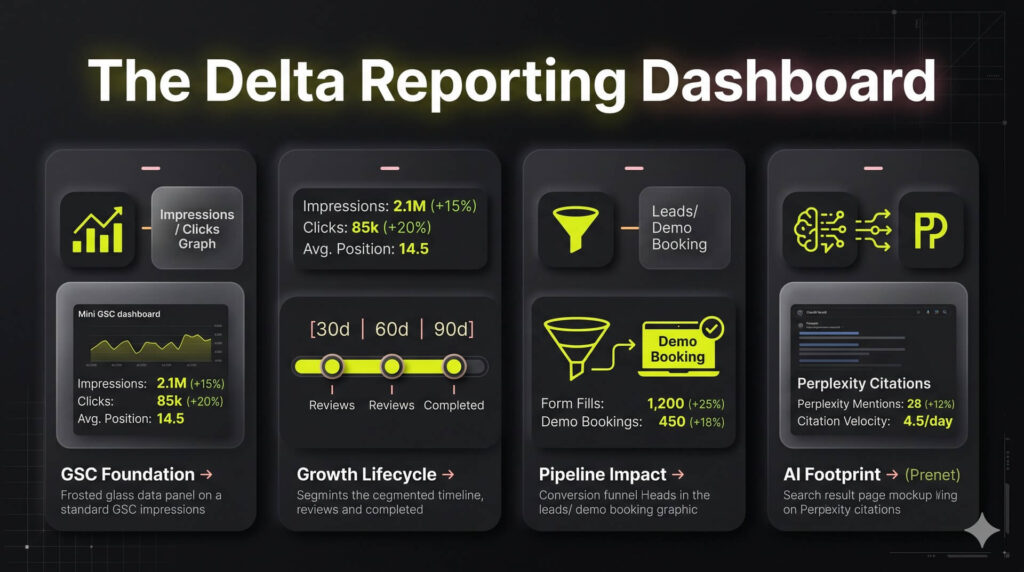
7. Mandate Outcome-Based Reporting and Measurement
Stop accepting reports that list tasks instead of revenue. A high-performance on page seo service must prove impact through delta-based measurement. If a provider cannot link optimizations to ranking lifts, you are paying for activity, not growth.
Require structured reporting that includes:
- Baseline GSC data (impressions, clicks, and query positions).
- Implementation timelines and post-optimization reviews (30/60/90 days).
- Conversion metrics like demo bookings or form fills.
- AI visibility snapshots monitoring citations in engines like Perplexity.
Verify potential partners by asking how they define a “win” and their protocol if metrics stall. Reporting that only lists completed tasks is a red flag. Authority partners prioritize visibility deltas and pipeline impact to ensure every change moves the needle.
| Criterion | What to ask for | Red flag |
|---|---|---|
| Intent mapping | Sample mapping table with keyword sets and intent notes per page | Meta-tag spreadsheets with no rationale for why pages exist |
| Content gap analysis | Before-and-after brief listing missing sections, entities, and proof points | Swapping synonyms while ignoring why competitors rank |
| AI-search readiness | BLUF blocks, question headings, and an LLM extraction test | Treating GEO as a separate upsell |
| Reporting | Ranking deltas, conversion metrics, and reviews at 30, 60, 90 days | Reports that list completed tasks instead of impact |
8. Align Pricing Models with Growth Constraints
Vague pricing disconnects investment from pipeline results. Select a model matching your scaling constraints to ensure accountability.
- Per-page: Ideal for high-value service pages requiring precise intent mapping.
- Retainer: Best for continuous iteration across large topic clusters.
A premium on page seo service includes:
- Intent mapping and content gap analysis
- Schema deployment and internal linking
- CWV optimization and implementation support
- QA and outcome reporting
Verify vendors by demanding an itemized per-page scope and clear out-of-scope boundaries to avoid under-scoped engagements. Ensure they commit to conversion instrumentation (events, forms, and call tracking) so improvements directly translate to measurable pipeline. Compare these standards against the AI-native frameworks at nuoptima.com.
FAQ
Your provider must deliver page-specific intent mapping and content gap improvements rather than generic metadata. Standard deliverables include optimized headings, internal linking, image optimization, and schema deployment. You should also receive a technical check for mobile responsiveness and a detailed implementation log. Reporting must cover baseline metrics and performance reviews at 30, 60, and 90 days to ensure changes move the needle on pipeline revenue.
You should see early signals like improved keyword impressions within a few weeks of implementation. However, clearer movement in rankings and traffic typically requires 30 to 90 days. This timeline depends on crawl frequency, niche competitiveness, and the scale of changes. Results are only attributable once changes are fully shipped and tracked. Emphasize shipping speed to shorten the feedback loop and allow for faster iterative improvements.
On-page SEO fixes intent mismatches and content gaps, but it is rarely enough in competitive SERPs. While on-page work establishes relevance and improves the user experience, authority remains a primary ranking factor. If your pages are relevant but underpowered compared to established competitors, you will likely need a strategic link building campaign. Use on-page work to maximize the value of your existing authority before investing in external acquisition.
On-page SEO focuses on page-level relevance and content structure. Technical SEO addresses site infrastructure, such as crawlability, indexation, and performance. You need both to achieve sustainable growth. A serious provider bundles necessary technical checks into their on-page service to ensure that backend bottlenecks do not prevent your content from ranking. This integrated approach ensures that your content infrastructure is sound before you scale production.
designed for machine extraction. Focus on these key elements: BLUF (Bottom Line Up Front) blocks. Extractable answers and entity declarations. Question-based headings and FAQ schema. LLM extraction testing to verify brand attribution.
Where this fits in your MSP growth system
This is one piece of how NUOPTIMA makes MSPs and cybersecurity firms the provider buyers find on Google and in AI search. See how it connects to MSP SEO and GEO and AI-search, or get your free MSP lead forecast to see exactly where your firm shows up across ChatGPT, Gemini, and Perplexity today.