Most SEOs chase 100/100 scores while organic revenue stagnates. The impact of how important is page speed for seo hinges on whether performance shifts user experience signals, competitive positioning, or operational crawl efficiency. Stop misallocating resources toward vanity metrics. We define Core Web Vitals thresholds, field data realities, and a 90-minute triage workflow to prioritize conversions. NUOPTIMA builds revenue-first technical architecture designed for both Google rankings and authoritative AI engine citations. Start with the ranking-factor reality.
Key Takeaways
- Core Web Vitals are confirmed ranking signals, but they function mainly as a tie-breaker when relevance and authority are equal, so speed cannot rescue weak content.
- The Good thresholds are LCP under 2.5s, INP under 200ms, and CLS under 0.1, and INP officially replaced FID in early 2024.
- The SEO benefit of speed is largely binary: the real ranking upside comes from moving pages out of Poor or Needs Improvement into Good, after which gains diminish.
- Field data from the Chrome User Experience Report, not Lighthouse lab scores, is the dataset Google's ranking systems actually use.
- Even when rankings stay flat, faster pages cut abandonment and lift organic conversion rate and revenue per session, so speed is a conversion engine.
1. Reframe Page Experience as a Strategic Tie-Breaker
Core Web Vitals are confirmed signals, but they primarily function as tie-breakers when relevance and authority are equal. Understanding how important page speed is for SEO requires recognizing this hierarchy. Speed cannot rescue irrelevant content or weak domain authority. Google prioritizes the definitive answer over the fastest one.
Over-investing in performance while neglecting intent alignment builds a high-speed road to nowhere. Deploy technical resources where they directly influence organic revenue. Focus speed optimization on pages where marginal gains decide competitive outcomes or secure primary AI citations, mirroring the optimization depth necessary when configuring content for a voice search SEO MSP campaign targeting conversational queries.
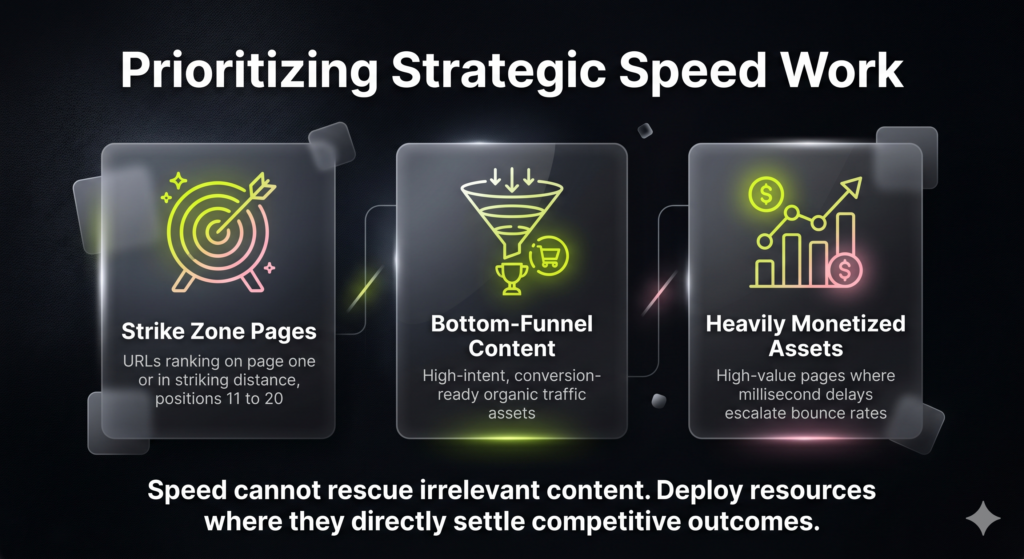
Prioritize performance work for:
- Pages already ranking on page one or in striking distance (positions 11 to 20).
- Bottom-funnel content with high-intent, conversion-ready organic traffic.
- Heavily monetized assets where millisecond delays directly increase bounce rates.
This prevents mis-prioritizing sprint capacity on projects that won’t shift rankings. Strategic speed work is the final nudge to overtake rivals in competitive SERPs.
2. Separate Diagnostic Lab Scores from Real-World Field Data
A 95 Lighthouse score is meaningless if your Search Console “Good URLs” report remains empty. This gap occurs because lab and field data serve different purposes. Field data from the Chrome User Experience Report (CrUX) captures the actual experience of your customers and is the primary dataset Google’s ranking systems use to evaluate Core Web Vitals.
Lab tools like Lighthouse offer reproducible experiments for debugging but cannot replicate diverse real-world devices or network conditions. Operationalize your measurement by reporting SEO impact using field buckets on high-value templates:
- Good
- Needs Improvement
- Poor
This methodology aligns stakeholder reporting with the performance signal Google observes at scale, standardizing analytics outputs much like an internal SEO reporting MSP dashboard designed for enterprise clarity. Use lab tools specifically to diagnose the technical “why” behind field failures. Focusing on real-user performance secures your brand’s authority across both traditional SERPs and generative engine citations where speed influences LLM retrieval and visibility.
3. Optimize for the Modern Core Web Vitals Trio
Most speed guides still cite First Input Delay (FID), despite it being officially replaced by Interaction to Next Paint (INP) in early 2024. Unlike FID, INP measures responsiveness across every interaction throughout a user’s entire session. To qualify for Google’s ranking signal, your pages must hit these “Good” thresholds:
- LCP (Largest Contentful Paint): Main content loads in < 2.5s.
- INP (Interaction to Next Paint): Responds to inputs in < 200ms.
- CLS (Cumulative Layout Shift): Visual stability score < 0.1.
The SEO benefit of speed is largely binary. Significant ranking upside occurs when moving pages from “Poor” or “Needs Improvement” to “Good.” Once you hit the “Good” threshold, chasing further millisecond gains yields diminishing returns. Focus resources on reaching these benchmarks rather than pursuing perfection, as the algorithm treats all “Good” pages as having satisfied the speed requirement.
4. Capture Revenue Gains Even When Rankings Stay Flat
Focusing on SERP positions ignores the primary driver of organic ROI: conversion. Slow pages trigger high abandonment and pogo-sticking, eroding the value of traffic you already own. Even without a ranking lift, performance bottlenecks create a leaky pipeline at the finish line. Speed is a conversion engine, not just a technical requirement.
To justify investment, shift leadership’s focus from visibility to pipeline impact. Track Core Web Vitals (CWV) field data against business outcomes for 10 high-revenue landing pages. Monitor three specific metrics:
- Organic conversion rate (CVR)
- Lead generation rate
- Revenue per session (RPS) Optimizations often yield measurable conversion uplifts even when rankings remain flat.
This framework prevents the narrative that performance work failed if rankings stayed stagnant. Technical architecture must do more than attract clicks. It must capture and convert them into revenue, reinforcing the mobile-first layouts optimized within a dedicated mobile SEO MSP strategy.
5. Address Server Latency to Unlock Crawl Throughput
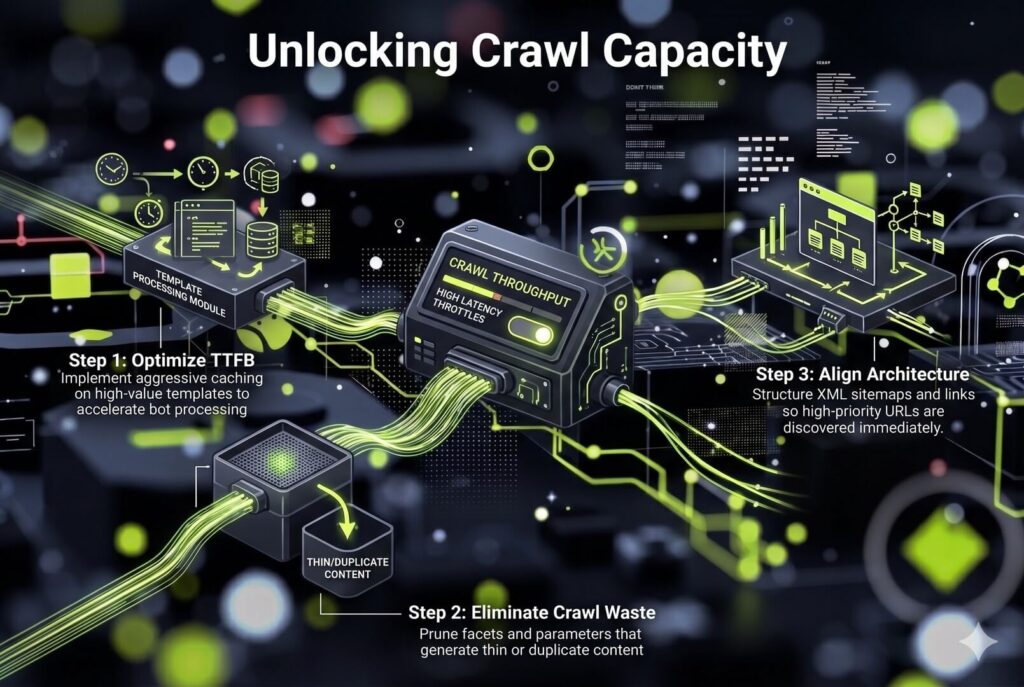
Slow discovery for new products or price updates signals infrastructure failure. High server latency forces bots to spend excessive time per URL, throttling crawl throughput. For enterprise marketplaces, this inefficiency delays indexation of new inventory and directly stalls organic revenue.
Technical SEOs must advocate for server-side optimizations that increase indexation velocity:
- Prioritize Time to First Byte (TTFB) and aggressive caching on high-value templates to accelerate bot processing and reduce server load.
- Eliminate crawl waste by pruning facets and parameters that generate thin or duplicate content, ensuring resources reach revenue-generating pages.
- Align XML sitemaps and internal link architecture so high-priority URLs are discovered immediately as performance gains free up crawl capacity.
Connecting performance to crawl efficiency is essential for large-site scalability. This technical architecture ensures your most valuable assets are primed for both traditional Google rankings and authoritative citation in generative engine answers.
6. Know When Performance Optimization Hits Diminishing Returns
Speed is a binary hurdle. Once you pass the “Good” threshold for Core Web Vitals, the ranking system has checked your box. Chasing micro-optimizations to move from a 92 to a 98 score is a strategic misallocation of engineering budget. Reliability is the signal; perfection is noise.
Speed shifts rankings in two instances: when your site sits in “Poor” status while competitors pass “Good,” or when two pages share identical relevance. In these scenarios, performance serves as the tie-breaker.
Conversely, speed yields zero ROI if you already pass CWV or if your content intent is weaker than the competition. A faster site cannot compensate for a lack of backlinks or topical authority. Prioritize fixing a broken user experience over chasing a 100/100 score. This heuristic stops teams from funding low-ROI work and refocuses effort on search dominance.
7. The 90-Minute Speed-to-Revenue Playbook
Execute this sprint to resolve performance bottlenecks and prove how important page speed is for the SEO pipeline.
Step 1: Pull Field Data (15 min)
Match Search Console’s “Poor” URLs against your top-converting landing pages. This prioritizes technical fixes by actual business value rather than abstract scores.
Step 2: Diagnose Priority URLs (30 min)
Run 3-5 high-value pages through PageSpeed Insights or WebPageTest. Identify the specific LCP element, long JS tasks causing INP risks, and primary CLS sources.
Step 3: Define Fixes by Bucket (30 min)
- LCP: Optimize hero image sizing, critical CSS, font loading, and CDN caching.
- INP: Defer third-party scripts, optimize handlers, and reduce JS execution time.
- CLS: Reserve dimensions for media blocks to stabilize above-the-fold content.
Step 4: Prevent Regression (15 min)
Establish a performance budget and Real User Monitoring (RUM) alerts to stop code bloat from eroding gains.
For end-to-end technical SEO and GEO readiness, visit nuoptima.com.
FAQ
Yes. Page speed is a confirmed ranking signal through Google’s Page Experience and Core Web Vitals frameworks. However, it functions primarily as a strategic tie-breaker. Speed cannot compensate for irrelevant content or poor domain authority. The most significant ranking lift occurs when moving a page from the Poor or Needs Improvement buckets into the Good category. Focus on performance to win close races against competitors with similar relevance and authority in high-value search results.
Chasing a perfect 100 score is a vanity exercise that frequently leads to diminishing returns. Lighthouse and PageSpeed Insights provide diagnostic lab data, but Google uses real-world field data from the Chrome User Experience Report to evaluate your rankings. Use lab scores to identify specific technical bottlenecks like render-blocking resources. Measure actual success by the percentage of user sessions that meet Good Core Web Vitals thresholds within the Google Search Console Core Web Vitals report.
Interaction to Next Paint officially replaced First Input Delay as a Core Web Vital ranking factor in early 2024. It measures how quickly a page responds to all user interactions throughout a session. To improve INP, focus on reducing main-thread blocking time. Common solutions include deferring non-critical JavaScript, auditing heavy third-party tags, and breaking up long tasks. This ensures the browser can respond immediately to user clicks, taps, and keyboard inputs on revenue-generating pages.
Performance optimization follows a threshold effect. Moving a Largest Contentful Paint score from 2.6 seconds to 2.4 seconds is highly meaningful because it shifts the URL from Needs Improvement to Good. However, shaving milliseconds off an already Good score rarely provides additional ranking upside. Prioritize reaching the Good threshold for LCP, INP, and CLS on your highest-revenue templates. Once you satisfy these benchmarks, redirect your technical resources toward increasing content authority or improving AI search visibility.
Reframe page speed as a conversion engine rather than a technical requirement. Report on the direct correlation between Core Web Vitals improvements and organic conversion rates or revenue per session. Fast sites reduce abandonment and build the necessary infrastructure for AI search citations. Position performance as a prerequisite for AI-search readiness.
For teams needing a strategic roadmap to dominate both Google and generative search, visit nuoptima.com to explore GEO services and expert technical execution.
Where this fits in your MSP growth system
This is one piece of how NUOPTIMA makes MSPs and cybersecurity firms the provider buyers find on Google and in AI search. See how it connects to MSP SEO and GEO and AI-search, or get your free MSP lead forecast to see exactly where your firm shows up across ChatGPT, Gemini, and Perplexity today.