Search is shifting from a directory of links to a definitive answer layer. As users migrate toward ChatGPT, Perplexity, and Google’s AI ecosystems, the fundamental AI driven search behavior has evolved. This change transforms B2B demand capture, dictating how brands win visibility and influence pipeline attribution. We have identified eight behavioral shifts and a tactical execution playbook to protect your organic revenue. Start with the change causing the largest pipeline blind spot: zero-click, which demands an immediate pivot to zero-click SEO for IT services.
Key Takeaways
- Search has flipped to answer-first, source-second: buyers accept or reject the AI answer before checking citations, so your point of view must be instantly extractable.
- B2B buyers now use constraint-heavy prompts (industry, size, budget, compliance), so content must cover specific criteria like SOC 2 for mid-market SaaS to be shortlisted.
- AI Overviews answer intent on-SERP, so measure brand recall, branded search lift, direct traffic, and demo requests citing ChatGPT or Perplexity rather than raw clicks.
- Win the evaluation phase with comparison-ready assets that expose ICP fit, pricing models, integrations, and proof metrics that AI engines can extract.
- Use a 3-layer measurement stack, visibility, consideration, and revenue, and treat a monthly set of money prompts like keywords.
AI-driven search behavior is the way buyers now research, compare, and shortlist using generative engines like ChatGPT, Perplexity, and Google AI Overviews, accepting AI answers before, or instead of, clicking source links.
1. The Inverse Evaluation Order: Answer First, Source Second
Search evaluation has flipped. Users accept or reject the AI-generated answer first, treating citations as secondary verification. This ai driven search behavior is native to Perplexity and Google AI Overviews. If your brand’s point of view is not easily extractable, you are absent from the buyer’s initial understanding.
To capture demand, your content must survive the instant extraction test. Failing this test makes your brand invisible in the answer layer, leading to invisible revenue loss. Update the first paragraph of every key page to serve the LLM by restructuring introductory text into scannable authority signals.
- Add answer blocks to the top of key pages: 1 to 3 sentences covering a definition, recommendation, and constraint.
- Include liftable proof through explicit claims with dates, scope, and methodology notes.
- Use specific statistics and proprietary data to anchor your expertise in AI citations.
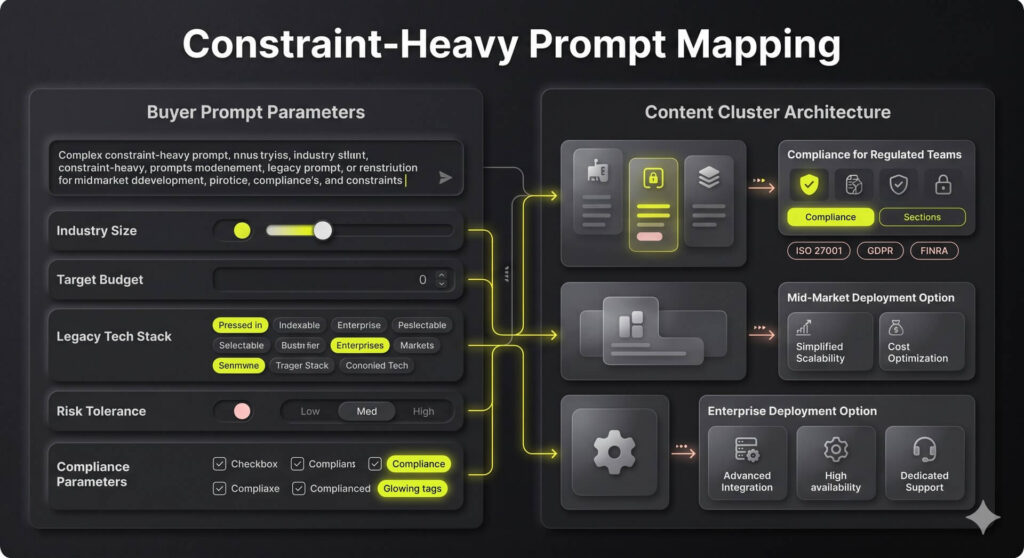
2. Prompt Complexity: From Keywords to Constraint-Heavy Queries
Keyword volume may remain steady, but lead quality often drops as AI driven search behavior shifts from short queries to constraint-heavy prompts. B2B buyers now outsource discovery to AI, providing specific parameters in a single interaction:
- Industry and company size
- Budget and tech stack
- Risk tolerance and compliance
To capture this organic revenue, your content must match the “shape” of these prompts. If service pages only highlight generic benefits, LLMs will bypass your brand when a user requests “SOC 2 compliant solutions for mid-market SaaS.” This makes your brand invisible during the AI-driven shortlisting phase.
Build “constraint coverage” into your architecture. Add sections like “Compliance for Regulated Teams” or “Mid-market vs. Enterprise Deployment.” Move from targeting isolated keywords to building prompt clusters that map problems to decision criteria and next steps. This closes the gap between legacy content and modern AI discovery.
3. Progressive Intent: Capturing the Multi-Turn AI Session
Buyers often identify a product’s weaknesses before visiting your website. This occurs because AI driven search behavior now centers on multi-turn refinement. Users conduct deep sessions where they iterate on prompts until they reach a final decision. They move rapidly through a logical sequence:
- “Show me the top options for B2B SEO.”
- “Tailor these choices to my $10M ARR SaaS company.”
- “List the risks and implementation tradeoffs for each.”
This behavior pulls mid-funnel evaluation directly into the discovery phase. Isolated content islands lose the narrative and allow AI engines to synthesize your differentiators without your input. You must build for progressive intent by anticipating the conversational path.
Include “Next Questions” modules addressing objections and decision checklists. Ensure internal linking mirrors the follow-up path:
- High-level topical overview
- Direct product comparisons
- Quantified proof and case studies
Stop publishing disconnected articles. Build conversational pathways that lead prospects directly to a strategy call.
4. The Consideration Shift: Influencing Without the Click
Traditional metrics classify declining click-through rates as failure. In reality, AI Overviews satisfy informational intent on-SERP, driving a fundamental “consideration shift” in AI driven search behavior. Users now research, compare, and narrow their shortlist without visiting your site.
To protect your pipeline, your content must influence buyers without a session. Prioritize brand recall and credibility signals over raw traffic. Optimize for citations with:
- Crisp, extractable definitions for industry terms
- Unique data points from internal research
- Quotable strategic frameworks that define your category
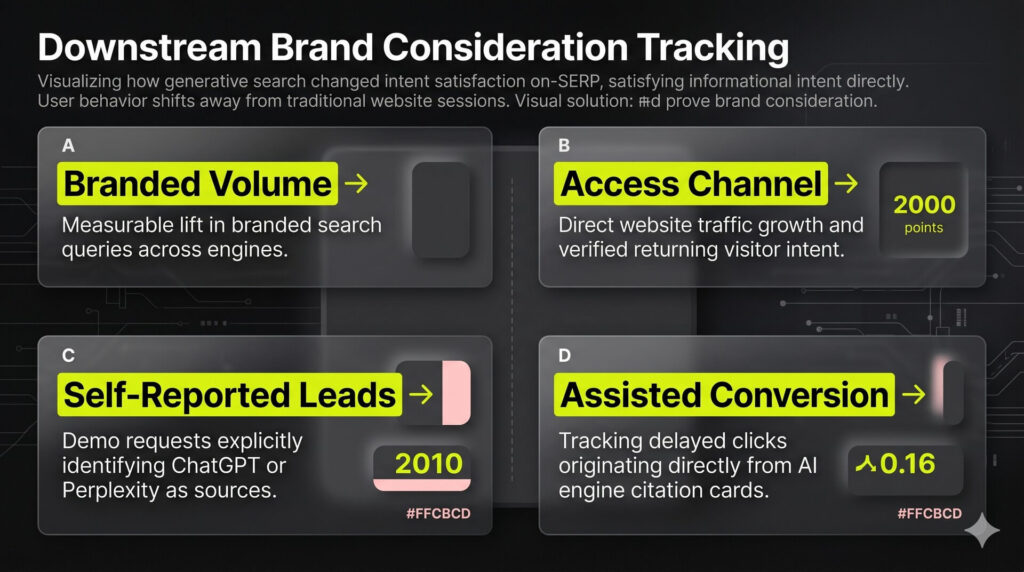
Leadership often misreads these behavioral shifts as SEO failure. Prevent premature budget cuts by tracking downstream signals proving brand consideration:
- Branded search volume lift
- Direct traffic growth
- Demo requests explicitly mentioning ChatGPT or Perplexity
- Assisted conversions and delayed clicks originating from AI engines
5. The Verification Chain: Optimizing for Dual-Surface Discovery
B2B buyers practice tool-chaining. They use LLMs for initial summaries and switch to Google or niche communities to verify facts. If ChatGPT cites your brand but the open web lacks supporting authority, the buyer journey stalls. This creates a pipeline leak where you earn citations but fail the trust test.
Modern optimization requires a dual-track strategy to capture this ai driven search behavior. AI-native engines like Perplexity prioritize entity clarity and third-party corroboration. Google’s AI layer rewards technical SEO fundamentals and structured, extractable answers. You must dominate both owned sites and the third-party surfaces that feed AI models.
Mapping this movement eliminates the false choice between SEO and GEO, while redefining how you balance content SEO vs technical SEO. Build a verification kit to convert citations into pipelines. High-intent assets need an authoritative infrastructure to confirm AI-generated claims:
- Documented proprietary methodologies.
- Transparent author credentials and expertise signals.
- Quantified case studies with verifiable data.
6. Trust Signals as Retrieval Signals: The New Verification Economy
High-quality content remains invisible without verified entity trust. AI driven search behavior forces users to rely on AI confidence and citations while cross-referencing claims with community consensus for high-stakes decisions. Brands lacking established trust are automatically excluded from AI-generated vendor shortlists and comparison prompts. Treat E-E-A-T and foundational SEO trust signals as technical retrieval signals rather than simple content guidelines to secure competitive advantage.
Strengthen on-site trust by packaging every asset with verified author credentials, expert bios, and primary source citations to reduce ambiguity. Expand off-site authority through consistent mentions on industry directories, podcasts, and partner surfaces that LLMs ingest to build Knowledge Graph connections and entity associations. This verifiable web of expertise builds the entity authority required to dominate the answer layer. Engineering for trust ensures your brand is frequently cited by AI systems and remains the definitive choice for human evaluators to capture high-intent pipeline.
7. Comparison-Ready Logic: Winning the Evaluation Phase Shortcut
Stable rankings fail if buyers bypass feature pages to prompt: “Compare [Your Brand] vs [Competitor] for my use case.” This AI driven search behavior compresses months of evaluation into seconds. Buyers now outsource shortlisting to AI rather than reading long-form whitepapers.
If differentiators are buried in vague copy, LLMs invent narratives from weak signals or omit your brand entirely. Protect your pipeline by publishing structured, “comparison-ready” assets. Use alternatives pages and decision-criteria checklists with explicit data points that AI engines can extract:
- Category and ICP fit
- Pricing models (including “custom” structures)
- Integrations, compliance data, and proof metrics
Brands lose market share when critical evaluation data sits behind “contact sales” walls that AI crawlers cannot parse. Mastering AI driven search behavior ensures you remain the definitive choice in every competitive comparison.
8. The 3-Layer Measurement Model for AI-First Search
Reporting based solely on organic sessions under-attributes search impact and misguides budget allocation. Predictable click paths are dissolving as AI driven search behavior moves off-site. Brand influence now occurs within LLM interfaces long before a user visits your domain.
To capture this value, deploy a 3-layer measurement stack:
- Visibility: Track AI citations, brand mentions, and impression share within AI features.
- Consideration: Monitor branded search volume, direct traffic, and returning visitor intent.
- Revenue: Measure assisted pipeline and self-reported attribution like “found you via ChatGPT.”
Treat prompts like keywords. Establish a monthly prompt set to audit how AI engines categorize your brand and competitors. Tracking these citations provides a defensible way to measure organic revenue in an era where the click is no longer the primary starting line.
How to Execute an AI-First Search Strategy for Modern Search Behavior
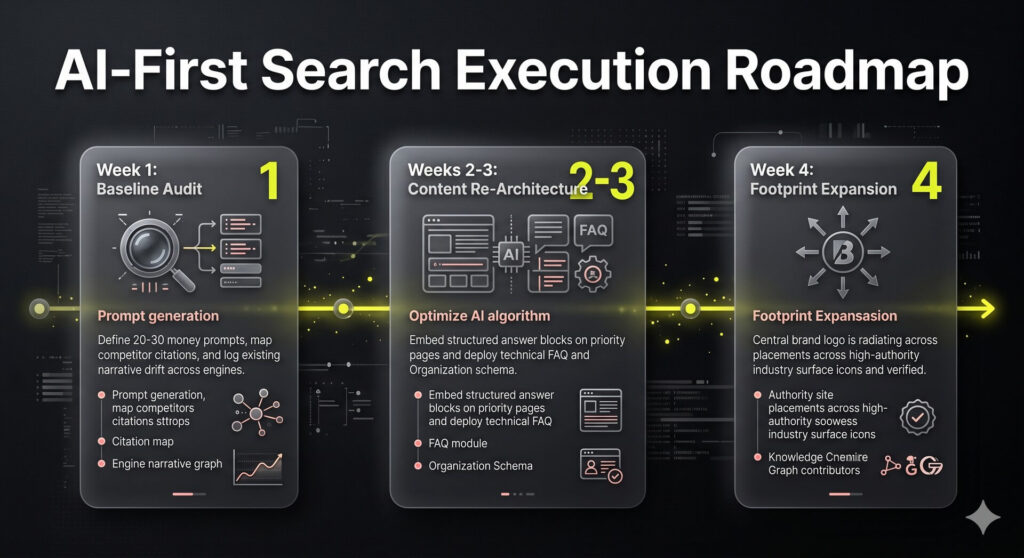
Step 1: Baseline Your AI Visibility (Week 1)
Audit your current presence in the generative answer layer to identify visibility gaps. Define 20-30 money prompts that represent your highest-value buyer queries. These prompts must cover category comparisons, complex use cases, and technical objections. Document which engines mention your brand, the specific competitors they cite, and the narratives they associate with your entity.
- Record engine mentions across ChatGPT, Perplexity, and Gemini.
- Map the source citations for every competitive query in your space.
- Identify narrative drift where AI summarizes your product features or pricing incorrectly.
- Outcome: You will establish a visibility benchmark to understand how current ai driven search behavior affects your brand authority.
Step 2: Re-Architect Content for Extraction and Trust (Weeks 2-3)
Update priority pages to satisfy the extraction requirements of Large Language Model (LLM) crawlers. Add structured answer blocks to the top of every high-value page. Integrate decision criteria, technical FAQs, and proof modules that verify your claims with data.
- Add two to three sentence answer blocks to the top of key service pages to anchor AI summaries.
- Standardize entity declarations across the site to ensure consistent positioning statements.
- Deploy FAQ and Organization schema to reinforce entity relationships and technical trust signals.
- Outcome: This architecture ensures AI engines view your content as a primary, trustworthy data source during synthesis and knowledge retrieval.
Step 3: Expand Your Citation Surface Area (Week 4)
AI engines cross-reference external sources to validate entity trust. Identify the niche directories, industry publications, and partner sites that AI engines repeatedly reference in your category.
- Prioritize high-authority surfaces for guest interviews, directory updates, and collaborative content.
- Publish corroborated proof off-site through partner content and expert roundups that LLMs ingest.
- Verify your brand entity across major Knowledge Graph contributors to increase citation probability.
- Outcome: Broadening your citation footprint creates the third-party corroboration required for AI engines to recommend your services to prospective buyers.
If you want a done-for-you program to dominate the answer layer, partner with the specialists at NUOPTIMA. Explore our Generative Engine Optimization services at nuoptima.com to secure your organic revenue today.
To build a comprehensive strategy that dominates the answer layer, partner with the specialists at NUOPTIMA and explore our Generative Engine Optimization services at nuoptima.com.
Where this fits in your MSP growth system
This is one piece of how NUOPTIMA makes MSPs and cybersecurity firms the provider buyers find on Google and in AI search. See how it connects to MSP SEO and GEO and AI-search, or get your free MSP lead forecast to see exactly where your firm shows up across ChatGPT, Gemini, and Perplexity today.