Search is splitting as buyers get answers without clicking. Visibility now lives in AI summaries and zero-click results. Your brand must evolve from a destination into the cited source.
To win, you must engineer pages for extractability. Mastering AI featured snippet optimization requires a structural playbook that aligns content for LLM ingestion.
This guide delivers eight patterns to refresh your existing pages. We start with the highest-leverage shift: question-first headings paired with concise answer blocks.
1. Structure Pages for Natural Language Answer Retrieval
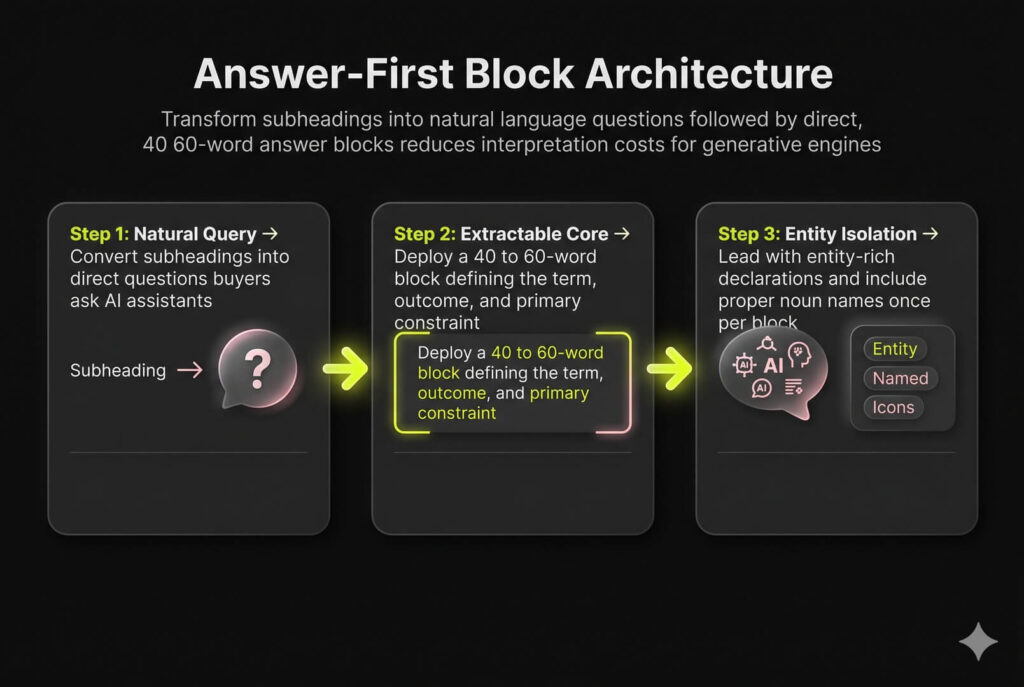
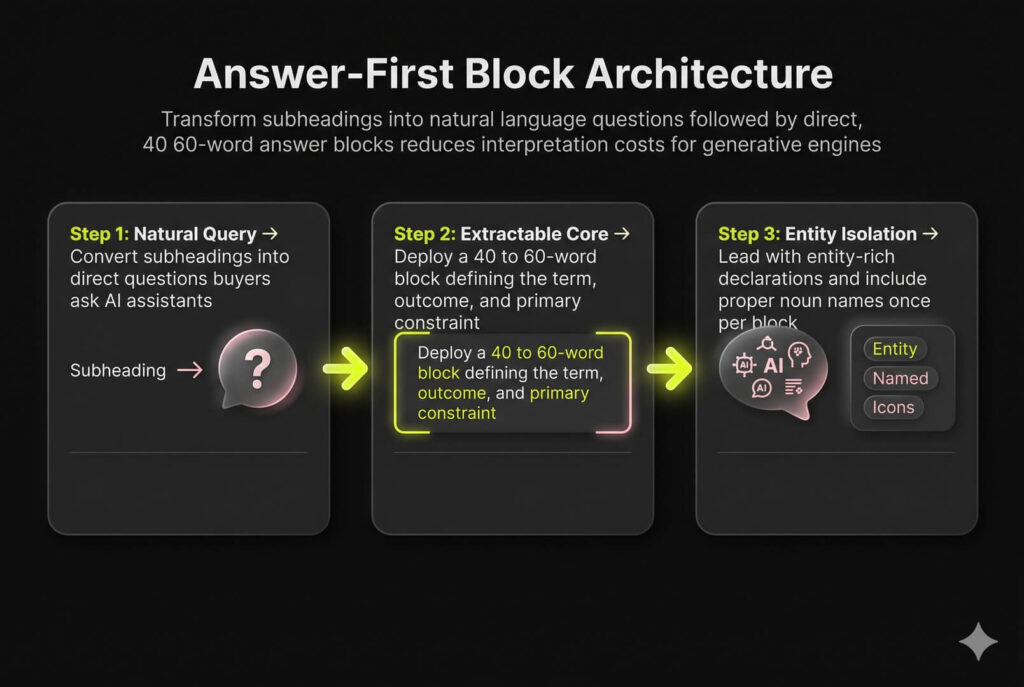
To master AI featured snippet optimization, transform subheadings into natural language questions buyers ask AI assistants. Follow each H2 with a direct 40 to 60 word answer that defines the term, states the desired outcome, and identifies the primary constraint. This format provides clear, extractable data points that LLMs index without manual interpretation, ensuring your brand becomes the primary citation in zero-click environments.
Structuring content this way reduces interpretation costs for generative engines. Mirroring the prompts marketing leaders use in tools like Perplexity makes your content the path of least resistance for algorithms. This tactical clarity protects organic revenue and pipeline as search traffic transitions toward AI-generated recommendations, showcasing why modern brands rely on zero-click SEO for IT services.
Implementation requires strict technical standards:
- Ensure answer blocks remain valid and contextually complete if read alone.
- Lead with entity-rich declarations instead of ambiguous pronouns like “it” or “this.”
- Include the primary entity name once per block to reinforce authority.
- Eliminate long brand stories or introductory “throat-clearing” that bury extractable answers.
2. Convert Ambiguous Prose into Structured Data Blocks
Generative engines prioritize low interpretation cost over nuanced prose. When attributes are buried in dense paragraphs, models must guess your intent, often skipping your content for simpler sources. To dominate AI featured snippet optimization, you must convert ambiguous text into structured blocks that map to common answer formats.
Reformat definitions, requirements, and checklists into these extraction-friendly categories:
- Bullets: Use for criteria and key takeaways.
- Tables: Use for feature comparisons and “best for” recommendations.
- Numbered Steps: Use for sequential processes.
Implementation requires explicit labels like “Pros:”, “Cons:”, or “Criteria:”. These markers make extraction unambiguous for LLM crawlers. Never provide a list without a lead-in sentence explaining what the data represents.
Machines cannot reliably infer intent from orphaned bullets. This structural shift ensures your page provides the definitive answer for complex comparison queries. By removing extraction friction, you unlock information previously trapped in paragraphs and transform legacy prose into a citation engine that protects your organic revenue and authority.
3. Define Explicit Entity Boundaries to Eliminate Topic Blending
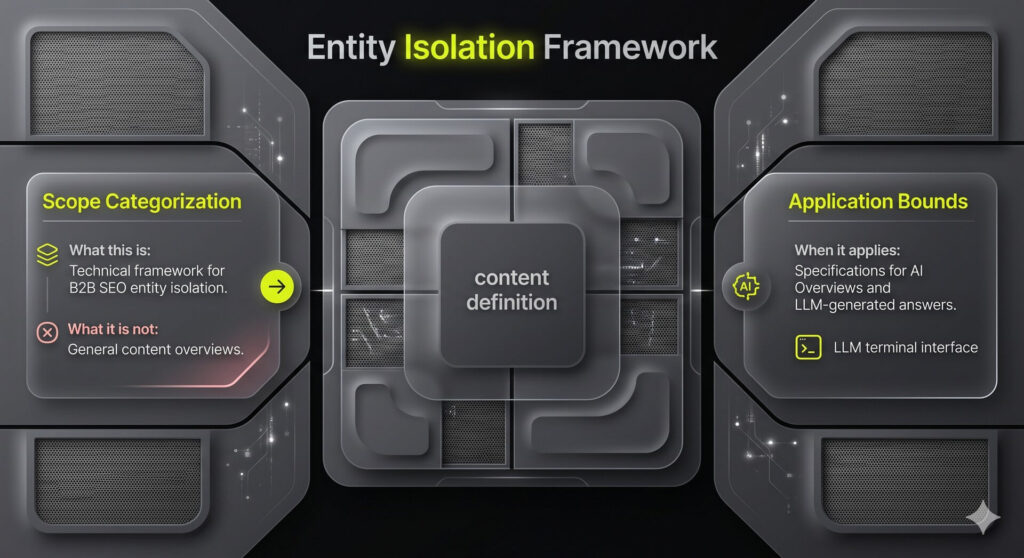
Why does an AI engine cite competitors for definitions you wrote? Semantic bleed occurs when content lacks hard boundaries, causing LLMs to blend your expertise into generic summaries. To master AI featured snippet optimization, you must explicitly define entities, scope, and constraints to prevent retrieval misclassification.
Add a scoped clarification block near your primary definitions:
- What this is: Technical framework for B2B SEO entity isolation.
- What it is not: General content overviews or broad industry commentary.
- When it applies: Specifications for AI Overviews and LLM-generated answers.
Ambiguity kills extractability. Precise entity boundaries powered by semantic SEO improve retrieval matching and eliminate competing interpretations. Use proper nouns and category-specific language like “B2B SEO,” “AI Overviews,” and “LLM-generated answers” to reinforce authority and improve matching precision.
Mixing definitions for Google Featured Snippets and AI Overviews is a common failure. If you do not isolate these entities, AI systems merge the data and you lose citation eligibility. Engineered clarity ensures the model recognizes your brand as the definitive knowledge source for that specific entity.
4. Capture Conversational Follow-up Prompts for AI Featured Snippet Optimization
Ranking for head queries is insufficient if you vanish during follow-up prompts. AI featured snippet optimization requires extractable Q&A units mirroring real-world queries to provide the granular data LLMs required for secondary citations.
Can I use the same FAQ schema for Google and Perplexity?
Yes. FAQPage JSON-LD works for both engines. Schema must match visible page text exactly to maintain citation eligibility and technical trust.
Does adding FAQs increase my GEO citation probability?
It depends. LLMs prioritize content resolving specific entity gaps. Structure answers as “extractable units” that retain authority and context when isolated from the main text.
Should I hide the FAQ schema to save space?
No. Mismatched content and schema is a primary failure mode. Hidden text undermines trust and disqualifies your site from AI-generated summaries.
Do LLMs favor long-form answers?
No. Generative engines prioritize concise, declarative blocks. Lead with a definitive statement to ensure your content is parsed effectively for the primary answer layer.
Why mirror real prompts instead of marketing questions?
Abstract questions rarely trigger citations. Mirroring natural-language prompts ensures your content aligns with how users actually query AI assistants during the research phase.
5. Implement Entity-Specific Schema to Remove Machine Guesswork
AI models struggle with specific context. Leaving a machine to guess if your page is a technical guide or a service offer creates a strategic blind spot. Implement JSON-LD that explicitly defines your page’s function to ensure accurate indexing and eligibility for citations.
Deploy standard Schema.org types to clarify relationships:
- Article and ItemList: Content depth and logical structure
- Organization and Person: Brand authority and author credentials
- Service: Commercial offers and specific B2B value
- HowTo and FAQPage: Actionable steps and direct extraction points
This precision is vital for AI featured snippet optimization because structured data reduces the computational cost of extraction for generative engines. Markup must match visible content exactly. Discrepancies cause LLMs to distrust your metadata, leading them to misread your page and ignore your citations.
Avoid over-markup by tagging every possible schema type on a single page. Instead, anchor content with expert author credentials and validate all code with testing tools before shipping. This technical clarity ensures your brand remains the cited, definitive answer, protecting organic revenue and pipeline in an AI-first search landscape.
6. Engineer Dual-Layer Content for Snippets and AI Synthesis
Ranking in the top ten is irrelevant if an AI summary ignores your insights. To win at AI featured snippet optimization, deploy two distinct content layers on every high-value page. This structure satisfies both the legacy snippet algorithm and the modern retrieval-augmented generation (RAG) processes used by LLMs.
Layer one is a concise 40 to 60 word answer block built as a snippet candidate. Layer two provides supporting evidence blocks including criteria lists, comparison tables, and specific examples. These blocks offer the grounding AI needs to synthesize a comprehensive summary.
Traditional SEO secures an index spot, while GEO increases the probability your page becomes the selected source inside AI-generated answers. Use consistent labels like “Definition,” “Steps,” “Examples,” or “Limitations” to guide the crawler.
Focusing solely on short snippets is a common failure. Without supporting evidence, AI engines cite competitors whose content offers richer grounding for the response. This dual-layer approach ensures you are both rankable and citable, protecting brand authority in the answer layer.
7. Build Unique Citable Assets for AI Featured Snippet Optimization
LLMs prioritize verifiable data over popularity. Describing a result as “significant” is noise. Providing a “42% increase” is a definitive citation trigger. To dominate AI featured snippet optimization, you must embed at least one unique citable asset on every high-value page. This ensures your brand becomes the definitive source for AI-generated answers.
- Original mini-studies or benchmarks
- Comparison matrices
- Definitions with measurable thresholds
Place your primary number or finding in a standalone sentence near the top of the relevant section. Briefly define your methodology in one supporting sentence to establish technical trust for the crawler.
Maintaining citation probability for your evergreen SEO content requires active data freshness. Include a visible “Last updated” timestamp and refresh volatile stats every 60 to 90 days. Stale data signals low authority and forces AI models to seek newer sources.
To move beyond isolated edits to a full GEO system, view NUOPTIMA’s GEO offering at nuoptima.com and our specialized Generative Engine Optimization service page.
8. Establish an Operational Loop to Measure and Refine Visibility
One-off edits fail because LLM retrieval weights shift constantly. Success requires an operational loop that treats AI featured snippet optimization as a continuous cycle rather than a static task. This process prevents authority decay and ensures your brand remains the primary cited source for generative engines.
Track performance across three KPI layers:
- Traditional SEO: Monitor top-10 rankings to maintain baseline organic visibility.
- SERP Features: Track ownership of Featured Snippets and People Also Ask (PAA) boxes.
- AI Visibility: Measure citations and brand mentions within AI Overviews and answer engines.
Operationalize this by maintaining 10 to 30 high-intent prompts for monthly checks. Classify queries by intent to prioritize content block updates and log which specific segments are extracted. Use Google Search Console and existing rank trackers to monitor visibility trendlines rather than seeking perfect attribution. For a managed reporting and execution loop, leverage NUOPTIMA’s GEO services.
Managing AI featured snippet optimization manually is unsustainable for growth-stage B2B firms. To build a defensive moat, explore NUOPTIMA at nuoptima.com or visit our GEO service page to start building your citation-native strategy today.
Where this fits in your MSP growth system
This is one piece of how NUOPTIMA makes MSPs and cybersecurity firms the provider buyers find on Google and in AI search. See how it connects to GEO and AI-search and answer engine optimization, or get your free MSP lead forecast to see exactly where your firm shows up across ChatGPT, Gemini, and Perplexity today.