B2B search distribution has split. Traditional SEO captures clicks, but AI visibility optimization secures selection and synthesis inside generative answers. You do not just need to rank. You must be the authoritative source an LLM extracts and cites. This checklist provides eight actions spanning on-site structure, entity trust signals, off-site corroboration, and citation tracking to dominate the answer layer. This shift moves your strategy from vanity impressions to verifiable search authority. If you want this executed end-to-end across all dimensions of conversational SEO, explore NUOPTIMA’s GEO services.
A GEO strategy is a deliberate plan to make your brand the source AI engines select and cite inside generative answers, spanning on-site structure, entity trust signals, off-site corroboration, and citation tracking. It differs from an SEO strategy, which optimizes for clicks and rankings. GEO optimizes for selection and synthesis: being the authority an LLM extracts, not just a blue link it lists.
Key Takeaways
- A GEO strategy makes your brand the source AI engines select and cite inside generative answers, optimizing for selection and synthesis rather than the clicks and rankings of classic SEO.
- Start with a measurement baseline: build a query set of 20 to 50 high-intent prompts and test them monthly across ChatGPT, Perplexity, and Gemini to map day-zero visibility.
- Engineer content for extraction with declarative claims, entity-rich subheaders, and comparison tables, since precise definitions earn the highest citation frequency.
- AI engines cite brands corroborated across multiple trusted domains, so audit the sources models already cite and earn placements through PR, guest contributions, and curated lists.
- Track executive-grade metrics (AI share-of-voice, citation rate, sentiment) from real UI outputs, and grant crawlers like GPTBot and ClaudeBot access so content can be retrieved.
Why it matters for MSPs and cybersecurity firms
- AI answers compress a shortlist to a few named vendors, so visibility there decides who even gets considered.
- For firms that live on referrals, an LLM citation is the closest thing to a referral that scales.
- It converts vanity impressions into verifiable authority, which matters across long B2B decision cycles.
We start every engagement with a measurement baseline (the actual prompts, the current citations) because executives do not fix what they cannot see. That baseline-first method drove Cortavo to $1M+ in MQL pipeline and $210K+ in contracted value by December 2025, and $403,330 in contracted sales value at a 4.6x return by month twelve, and it runs through our GEO services.
1. Establish a Repeatable Measurement Baseline
Executives do not fix what they cannot measure. You cannot defend a budget for a channel you cannot track. Your first priority is establishing a hard baseline across generative surfaces to tie every future optimization to pipeline impact. This shifts GEO from a speculative experiment into a defensible, outcome-driven growth channel.
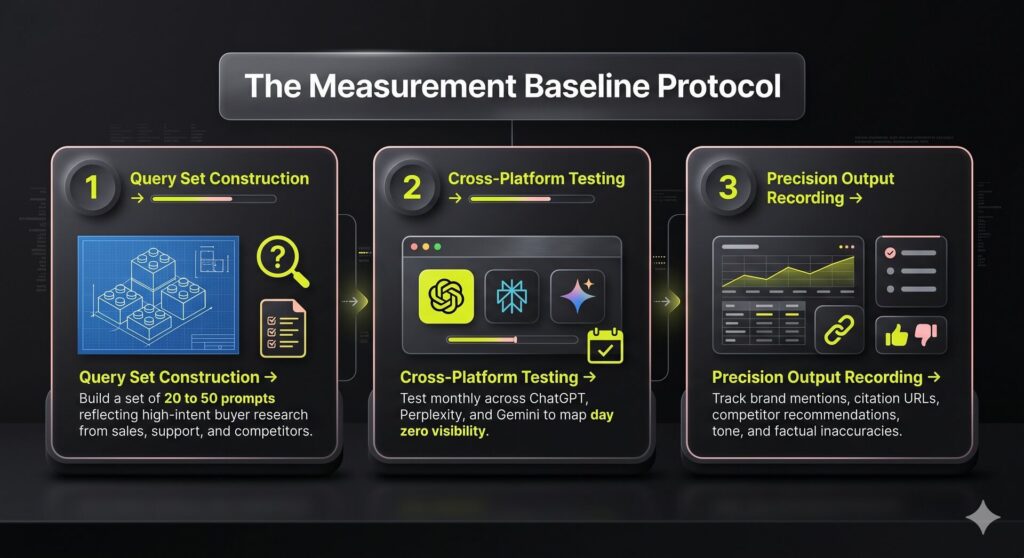
Build a query set of 20 to 50 prompts that reflect high-intent buyer research. Pull data from sales calls, demo objections, support tickets, and competitor pages. Include category terms, “best vs” comparisons, integration use-cases, and specific vendor recommendation prompts. Test these monthly across ChatGPT, Perplexity, and Gemini to map your day zero visibility.
Record outputs with analyst-level precision to identify competitive gaps. Track brand mentions, specific citation URLs, and which competitors the models recommend in your place. Document tone, sentiment, and any factual inaccuracies generated about your service. This creates a monthly scoreboard to prioritize technical actions and attribute citation growth to bottom-line results.
2. Engineer Content for High-Fidelity Extraction
High-fidelity content is information engineered for immediate retrieval and citation by Large Language Models. To optimize for AI visibility optimization, your pages must use declarative language, entity-rich headers, and structured data powered by semantic SEO. This structure ensures retrieval systems lift your brand’s claims without ambiguity, transforming raw text into authoritative source material for AI-generated answers.
Master Information Architecture
LLMs prioritize content they can extract cleanly. To maximize visibility, deploy these structural pillars:
- Declarative Claims: State “Our platform reduces churn by 20%” rather than using hedged language.
- Entity-Rich Subheaders: Include the brand name and topic in every H3 to preserve context during retrieval.
- Logical Data Formatting: Present comparisons in tables to simplify RAG synthesis.
| Content Format | Retrieval Value | Impact on GEO |
| Precise Definitions | Highest | Increases citation frequency |
| Bulleted Lists | High | Improves summary accuracy |
| Vague Prose | Low | Reduces engine trust |
Quick FAQ
How does extraction impact GEO?
Clean structure lowers the computational cost for LLMs to verify and cite your brand.
What makes a claim extraction-ready?
It must meet three criteria:
- Specific data or metrics.
- Direct, non-hedged phrasing.
- Zero reliance on external context.
3. Solidify Entity Trust and Knowledge Graph Signals
AI engines often attribute expert insights to competitors with clearer digital footprints. This occurs when your brand entity is “fuzzy” to the model. If a generative engine cannot verify your identity, it will not risk citing you as a primary authority. This “invisible brand” problem prevents effective ai visibility optimization even when your content is superior.
Strengthen core entity pages to bridge this attribution gap. Your About page needs:
- Crisp category statements (e.g., “AI-native SEO authority”)
- Verifiable proof including client logos or awards
- Clear mission and service descriptions
Author pages must detail specific roles, credentials, and publications to transform anonymous writers into recognized experts.
Create consistent “SameAs” signals by aligning brand descriptions across LinkedIn, Crunchbase, and partner directories. Use structured data to reinforce these relationships. Deploy Organization, Person, and Article schema to link creators directly to your brand.
Synchronized entity authority makes your brand the safer choice for AI attribution. By clarifying your identity, you ensure models know exactly whom to cite when generating answers.
4. Close the Retrieval Gap with Granular Follow-Up Pages
You can rank for broad category terms but remain invisible once a buyer asks a specific follow-up. This retrieval gap occurs because RAG systems prioritize document specificity over general domain authority. If your site lacks the exact page answering a niche integration or industry use case, AI engines will cite a competitor to fill the void regardless of your homepage power.
To master AI visibility optimization, map the follow-up questions your ICP asks after their initial discovery:
- Integrations: “Does X work with Y?”
- Use cases: “How do we deploy X in regulated industries?”
- Comparisons: “X vs Y”
Turn support knowledge into organic assets by moving help documentation into an indexable subdirectory. Create one dedicated page for every high-intent question and interlink these narrow assets from your main pillar. Maintain a tight cluster with consistent terminology and a single source-of-truth definition to reinforce entity authority. This architecture ensures your B2B content SEO assets become the default citation for narrow, high-buy-intent prompts, capturing buyers when they are closest to a final decision. This eliminates the risk of being ignored for specific technical queries that drive late-stage pipelines.
5. Build Digital Consensus Through Off-Site Corroboration
AI engines prioritize brands validated across multiple trusted domains. If your brand presence is limited to your own site, it lacks the corroboration required for high-trust citations. Digital consensus expands the pool of independent documents that verify your claims. This strategy solves the gap where competitors earn citations despite having weaker technical infrastructure.
Begin by auditing the sources AI models currently cite for your category. Identify the publishers, directories, and news sites appearing in generative answers. These established domains are the primary seed sources you must influence. Positioning your brand on these platforms ensures you enter the model’s existing retrieval pool.
Run a PR plan focused on expert commentary, guest contributions, and inclusion in curated lists. Supplement this with multi-format assets like YouTube explainers for category-level questions. Participate in Reddit and industry forums by solving specific user problems rather than promoting products.
This multi-source approach creates a network of independent documents that validate your expertise. By saturating external domains with consistent information, you make it easy for models to recommend and cite you. This moves your brand from invisible to authoritative within the answer layer for AI visibility optimization.
6. Maintain Recency with Systematic Refresh Cycles
AI engines often cite thin, newer guides over legacy masterpieces because retrieval systems use recency as a proxy for accuracy. If content remains stagnant, it becomes invisible to models searching for the latest pricing or market benchmarks. This weighting ensures users receive current information but penalizes authoritative assets that lack recent updates.
High-impact AI visibility optimization requires treating core assets like software products rather than static posts. Prioritize refresh cycles for pages that act as citation magnets:
- Category definitions and industry guides.
- Pricing benchmarks and cost comparisons.
- Proprietary data and best practice frameworks.
Adopt a product-led refresh strategy to signal quality to LLM crawlers.
- Add a “What’s New” changelog to document specific improvements.
- Replace outdated screenshots and verify data-driven claims against current conditions.
- Update dateModified schema and resubmit URLs via sitemaps to trigger re-crawling.
Systematic cycles ensure your brand remains the definitive source for AI synthesis. This prevents high-value pages from prematurely aging out of citation pools when generative engines weigh recency over historical authority.

7. Bulletproof Your Infrastructure for Reliable Retrieval
Authoritative insights are worthless if an LLM crawler hits a noindex tag or broken link. Invisibility is the ultimate tax on content investment. To ensure retrieval, you must secure these technical non-negotiables:
- Correct canonicals to prevent duplicate content confusion.
- Clean internal linking to guide bots toward high-value assets.
- Fast, lightweight templates to prevent crawler timeouts during ingestion.
Rendering choices determine your extractability. AI engines prefer server-rendered or hybrid configurations for editorial pages to avoid JavaScript processing delays. Keep critical definitions and data tables in raw HTML rather than embedded images. AI systems cannot cite information they cannot programmatically parse.
Audit robots.txt and bot directives to grant access to legitimate crawlers like GPTBot and ClaudeBot. Aggressive firewalls often inadvertently exclude brands from the RAG pipelines fueling modern buyer research. This infrastructure eliminates the silent failure mode where high-quality content is ignored due to architectural barriers. Reliable retrieval is the non-negotiable prerequisite for AI visibility optimization and sustainable search dominance.
8. Quantify Performance with Executive-Grade Metrics
Marketing budgets cannot survive on ChatGPT screenshots or brand “vibes.” Scaling AI visibility optimization requires a measurement layer that mirrors performance marketing reporting. This transforms GEO from a technical experiment into a managed growth channel with predictable revenue outcomes.
Focus reporting on three executive-grade metrics:
- AI Share-of-Voice: Brand appearance frequency across a curated prompt set versus competitors.
- Citation Rate: How often you are a listed, linked source rather than a passing mention.
- Sentiment and Positioning: How models frame your solution relative to peers during the research phase.
Capture data from real UI outputs rather than relying solely on API proxies. This ensures high fidelity by documenting the exact citations and links users see. Run controlled experiments by splitting prompts into control and test groups. Ship one technical or content change at a time to measure the resulting citation delta. This scientific loop turns AI visibility into a measurable acquisition channel rather than a guessing game.
The 90-Day Execution Plan for AI Visibility Optimization
This plan converts ai visibility optimization into a funded, repeatable sequence. Build a compounding authority moat to secure your position in the generative answer layer using this 90-day framework designed for speed-to-signal and measurable pipeline impact.
Weeks 1 to 2: Baseline and Triage
- Run a comprehensive citation and sentiment audit to establish baseline visibility metrics across all major LLMs.
- Identify the top 10 high-intent prompts most closely tied to your sales pipeline to focus optimization on revenue-generating queries.
- Fix factual inaccuracies and positioning gaps on priority landing pages to ensure immediate accuracy for model training.
- Map competitor mentions in ChatGPT and Perplexity to pinpoint specific citation gaps your brand must fill to capture market share.
Weeks 3 to 6: On-Site Citation Engineering
- Upgrade 5 to 10 priority pages using answer-first architecture and structured data blocks to facilitate efficient LLM ingestion.
- Deploy entity upgrades, including advanced Schema markup and authoritative author profile pages, to solidify your presence in the global knowledge graph.
- Audit technical assets to ensure LLM crawlers access content without JavaScript hurdles or robots.txt restrictions.
Weeks 7 to 10: Coverage Expansion and Corroboration
- Publish longtail fan-out pages to address niche integration queries and specific use-case prompts that drive bottom-funnel traffic.
- Launch targeted PR and guest placements to secure the third-party corroboration required for high-trust AI citations.
- Secure features on two high-signal industry lists that generative engines prioritize as authoritative seed sources for recommendations.
Weeks 11 to 13: Refresh and Measurement Loop
- Establish a refresh cadence for winning assets to maintain the recency signals that generative models favor.
- Implement a tracking dashboard to measure AI share-of-voice and citation growth compared to your primary competitors.
- Launch a monthly experiment cycle to refine content structures based on shifting model response patterns.
Contact NUOPTIMA for professional GEO services to execute this plan and scale your organic revenue.
FAQ
Traditional SEO is not dead, but it has evolved into a foundation for broader discovery. Generative Engine Optimization acts as an overlay on top of classic search fundamentals. AI browsing and retrieval systems still rely on crawlability and high rankings to identify which sources to synthesize. You are not abandoning the basics. You are optimizing for a new outcome: being the cited answer rather than just a blue link.
Training data influences an LLM’s general knowledge based on historical information ingested during its last major update. Real-time citations occur through Retrieval-Augmented Generation (RAG) or live web browsing. You can improve citations faster by deploying structured, retrievable pages and securing off-site corroboration. This ensures your brand is selected when the model searches the live web for the most current and relevant answer.
No single tag or schema type guarantees a citation. While Schema supports extractability and clarity, AI engines prioritize relevance, credibility, and how well the content answers the specific prompt. Use structured data to help the model parse your data, but focus on building entity authority. Citations depend on the engine trusting your brand enough to represent it as a primary source.
Fast wins are possible within weeks by targeting niche longtail prompts or securing mentions on third-party sites that AI engines already trust. Durable, category-level visibility typically requires several months of consistent optimization. This timeframe allows for entity authority and topical coverage to compound across the knowledge graph, making your brand the default source for broader, high-competition queries.
Avoid vanity metrics by tracking a fixed set of high-intent prompts across platforms like ChatGPT, Perplexity, and Gemini. Use UI-faithful capture to document exactly how your brand is cited and measure your Share of Voice. Tie these visibility shifts to pipeline data by annotating when citation changes correlate with leads. This scientific approach ensures your ai visibility optimization efforts drive measurable revenue growth.
For expert implementation of these strategies, visit nuoptima.com or explore our dedicated GEO services page.
Where this fits in your MSP growth system
This is one piece of how NUOPTIMA makes MSPs and cybersecurity firms the provider buyers find on Google and in AI search. See how it connects to GEO and AI-search and answer engine optimization, or get your free MSP lead forecast to see exactly where your firm shows up across ChatGPT, Gemini, and Perplexity today.