Writing naturally is not a strategy. Conversational seo is the evolution from keyword matching to answer selection, where AI systems decompose queries to retrieve and cite the most extractable response. The objective is no longer just ranking; it is becoming the definitive cited authority in the answer layer. This checklist covers seven tactics for query design, structure, and trust signals to win citations. Start with the query patterns AI-driven search is actually responding to.
Key Takeaways
- Conversational SEO is the shift from keyword matching to answer selection, where AI systems decompose queries to retrieve and cite the most extractable response.
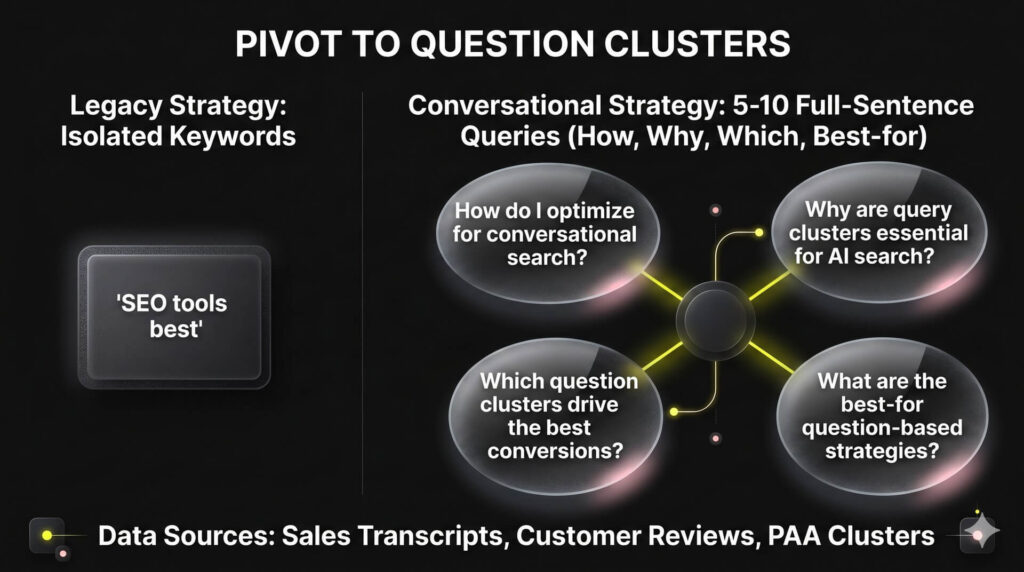
- Replace isolated keyword phrases with question clusters: convert each topic into 5 to 10 full-sentence queries using "how," "why," "which," or "best-for" variations.
- Use an answer-first, inverted pyramid structure: frame each H2 as the literal question, then give a direct two-sentence answer, supporting bullets, and a proof or trust signal.
- Mine real buyer language from sales transcripts, support tickets, chat logs, customer reviews, and "People also ask" clusters to engineer content for AI retrieval.
- Measure citations, not just clicks: track Share of Answers, Branded Lift, and Lead Quality, since a traffic dip can mask lead growth as AI summaries filter casual browsers.
1. Pivot from Keyword Lists to Question Clusters
Traditional keyword targeting misses the mark in conversational SEO. AI engines decompose prompts into intent-based sub-questions. Without specific anchors for these sub-queries, you lose citations to competitors who answer the nuance. Content must mirror the multi-layered way users prompt LLMs.
Replace isolated phrases with question clusters. Convert each target topic into 5 to 10 full-sentence queries using “how,” “why,” “which,” or “best-for” variations. Include follow-up constraints like budget, industry, timeframe, or “for B2B” to capture bottom-funnel intent, applying principles akin to zero-click SEO for IT services where specific constraints dictate clarity.
Mine these queries from existing data:
- Sales transcripts, support tickets, and chat logs
- Customer reviews and testimonial wording
- “People also ask” (PAA) clusters
Provide this query map to writers as a structural heading hierarchy rather than a list of terms. This repeatable process ensures your content is engineered for AI retrieval and directly addresses the questions driving B2B purchase decisions. This transition turns organic content into a defensive moat against competitors who still rely on legacy keyword strategies.
2. Optimize for Extraction with Answer-First Formatting
Traditional ranking no longer guarantees visibility if your answer is buried under introductory context. Conversational SEO requires an inverted pyramid structure where the most extractable information sits at the top of every section. This is a structural mandate to ensure AI systems can parse and cite your content.
To capture the answer layer, frame each H2 as the literal question your buyer asks. The first three sentences must provide a direct, plain-language solution without throat-clearing. Use structured evidence to support the claim:
- Define specific steps, criteria, or definitions in 2 to 3 bullets.
- Include one “edge case” line to address nuance and build trust.
- Present data or facts in clear, quotable language.
Writers should follow this micro-template:
- Question-based heading
- Two-sentence direct answer
- Supporting bullets
- Proof or trust signal
This turns every section into a citation-ready unit. By prioritizing extraction over narrative flow, you position your brand as the definitive source for both human readers and generative engines.
3. Apply the Answer-Led Rewrite Pattern
“Write naturally” is common advice that often produces unrankable fluff. Most writers confuse conversational with casual, sacrificing the technical precision AI engines require for citations. To dominate the answer layer, you must replace abstract, third-person keyword stuffing with an operational rewrite pattern.
The transformation replaces keyword-dense descriptions with direct, second-person address and specific criteria.
The 4-Step Rewrite Checklist:
- Query-Lead: Replace generic introductions with the literal question the reader asked.
- Answer-First: Move the conclusion to the top as a direct, two-sentence answer.
- Contextual Qualifiers: Insert concrete constraints like target industry, budget, or timeframe to ground the advice.
- Proof Signals: Add one unique signal, such as a proprietary data point or a documented process step.
This system turns passive text into an extractable asset. Leading with the direct answer builds immediate buyer trust and ensures AI engines cite your brand as the definitive authority.
4. Anchor Conversational Authority with Concrete Trust Signals
Conversational content often fails by building rapport without establishing authority. If your tone is friendly but lacks proof, readers view it as anecdotal rather than expert advice. To convert sophisticated marketing teams, ground your conversational SEO in credibility artifacts that verify your brand as a cited source.
Replace vague claims with process evidence and specific data points:
- Include first-hand observations from internal testing or client workflows.
- Use quantified outcomes with industry context, such as “this architecture reduced CAC by 15% in four months.”
- Integrate short review fragments or methodology summaries to provide immediate social proof.
Maintain a natural rhythm by using plain language and specific nouns rather than academic jargon. Avoid superlatives like “leading” or “best” unless you substantiate them with third-party data. These trust signals do more than drive traffic. They improve lead quality by signaling maturity to buyers who prioritize expertise over marketing fluff.
5. Build Agent-Legible Content Through On-Page Semantics
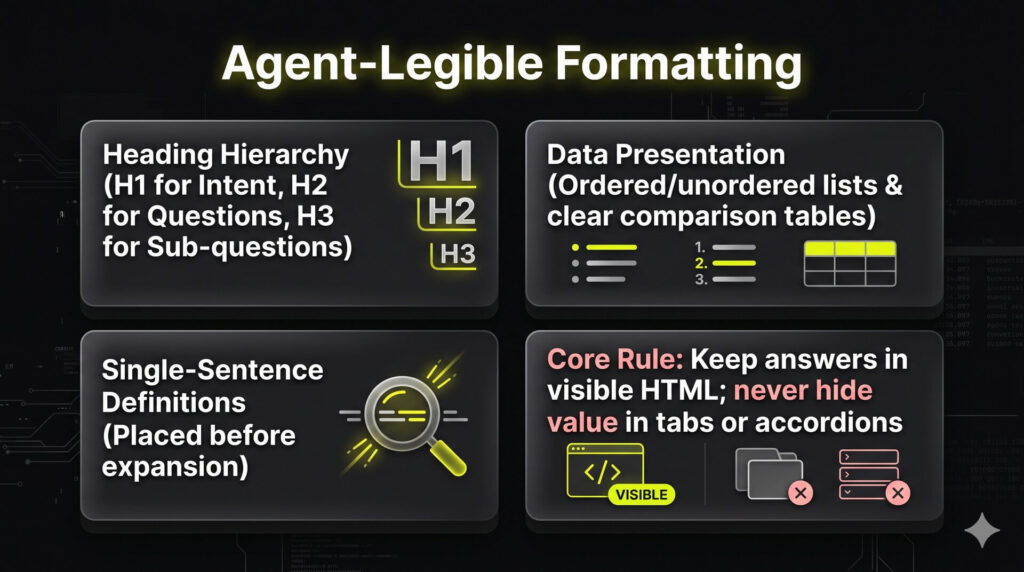
Technical teams often over-invest in hidden metadata while leaving visible page structures chaotic. AI agents cannot reliably extract or cite your expertise if the HTML is structurally messy. This checklist ensures your pages function as high-confidence extraction points for conversational SEO:
- Heading Hierarchy: One H1 defines intent. Format H2s as literal questions and H3s as supporting sub-questions.
- Lists: Use ordered lists for sequential steps and unordered lists for selection criteria.
- Tables: Present multi-variable comparisons in tables rather than dense paragraphs.
- Definitions: Lead with a single-sentence definition before expanding.
- Visibility: Keep core answers in visible HTML. Never hide primary value in tabs or accordions.
Use schema to reinforce these signals rather than replacing them. This precision makes content blocks agent-legible and easier for engines to extract. It ensures your answers are ready to be summarized and cited without requiring a full website rebuild.
6. Extract High-Signal Data for SEO Conversational Marketing
Content teams often guess buyer needs while revenue teams hold the literal transcripts. Support tickets, sales demos, and chat logs are the highest-signal datasets for conversational seo. These interactions capture the exact natural language queries buyers use when prompting generative engines.
To master seo conversational marketing, extract recurring questions from:
- Sales calls and demos
- Support tickets and onboarding sessions
- Live chat logs
Transform each query into a focused article or page section using the Q → Direct Answer → Proof pattern. This structure ensures content matches the specific syntax LLMs prioritize for citations.
Maintain entity authority by consolidating near-duplicate questions to prevent thin pages, which serves as a core pillar of modern entity SEO execution. Every asset must include a next-step CTA, such as a template, checklist, or strategy consultation, aligned with the buyer’s immediate intent. This workflow transforms raw sales data into conversion-ready content that AI engines preferentially surface as the definitive answer.
7. Shift Measurement from Clicks to Conversational Citations
Legacy click-through rates cannot justify a conversational SEO budget. When AI engines satisfy queries directly, traditional sessions never register. A 15% traffic dip may mask lead growth because AI summaries filter out casual browsers while surfacing your brand to high-intent buyers. Clicks are now a proxy; citations are the primary objective.
Track these three metrics to map conversational SEO to pipeline impact:
- Share of Answers: The frequency of brand citations in AI responses for priority queries.
- Branded Lift: Growth in direct traffic and branded search volume following content deployment.
- Lead Quality: MQL-to-SQL conversion rates and sales cycle length from organic sources.
Maintain a disciplined operating cadence to ensure long-term visibility. Perform monthly testing across AI surfaces to log which pages are referenced and how citations appear. Every quarter, refresh high-authority pages with new proof points, updated technical data, and structured answers to maintain entity relevance.
Secure your brand’s position in the answer layer with NUOPTIMA’s specialized GEO services at nuoptima.com.
FAQ
Voice search is a delivery mechanism, but conversational SEO is a strategy for AI-driven query interpretation. It focuses on how LLMs decompose prompts and synthesize answers. To win, you must optimize for full-sentence questions and extractable answer blocks that function across all devices, from mobile screens to voice assistants. Focus on how users prompt systems rather than just how they speak.
No, provided you maintain clarity and topical authority. Modern search engines prioritize intent match over formal prose. Conversational SEO actually improves rankings by answering specific user queries directly. Ensure every article remains credible by using precise definitions, sourced claims, and first-hand experience rather than generic casual language. See Section 4 above for more on trust signals.
Focus on second-person address and specific nouns. Avoid generic filler intros. Use an answer-first structure where the direct solution appears immediately under the heading. By including real-world examples and proprietary data, you distinguish your content from the repetitive patterns typical of standard LLM output. This approach builds human trust while satisfying AI extraction requirements.
Yes. Traditional SEO provides the authority signals that AI engines use to determine source reliability. While conversational formatting makes your content easy to extract, backlinks and citations verify its trustworthiness. You must pair on-page extractability with off-site signals like authoritative mentions and reviews to ensure AI models select your brand as the definitive answer.
Audit one revenue-critical page and rewrite its H2 headings as direct questions. Place a two-sentence answer block immediately below each heading and add a supporting trust signal.
To scale this across your site, develop a full GEO roadmap with specialists. Visit nuoptima.com to explore our GEO services and transition your content into the AI answer layer.
Where this fits in your MSP growth system
This is one piece of how NUOPTIMA makes MSPs and cybersecurity firms the provider buyers find on Google and in AI search. See how it connects to GEO and AI-search and answer engine optimization, or get your free MSP lead forecast to see exactly where your firm shows up across ChatGPT, Gemini, and Perplexity today.