
You do not win premium pricing by matching cheap seat prices. You win by being the MSP buyers and AI shortlists cite.
While low-cost, no-contract competitors (often running break-fix or stripped-scope models at around $30 per user) cause anxiety, price matching destroys your gross margin. Resolving this requires a system for how to price MSP services using a margin-first pricing breakdown, structured packaging, and a transition workflow that preserves client retention. Start by defining your floor price, because everything else is purely negotiation theater.
Key Takeaways
- Calculating a true floor price from fully burdened labor and direct tool COGS, then dividing by your margin complement, is the only way to set a non-negotiable per-user minimum that prevents busy but unprofitable contracts.
- Target a 55% to 65% gross margin on managed services; anything below that threshold means your pricing is subsidizing client complexity rather than pricing it correctly.
- A three-tier packaging ladder with standardized inclusions, exclusions, and environment readiness standards eliminates custom quoting and protects gross margin at every deal stage.
- Per-user pricing is the default risk-allocation model; switch to a hybrid with explicit site minimums and server fees the moment a prospect introduces high-complexity or shared-device infrastructure.
MSP pricing is the structured process by which a managed service provider calculates a non-negotiable floor price from fully burdened labor and tool costs, selects a risk-appropriate pricing unit, and packages services into standardized tiers to protect gross margin and support predictable recurring revenue.
MSP Pricing vs MSRP: Clear Up the Acronym First
Two different things share the letters "MSP," and search results in 2026 still blur them. When you plan how to price MSP services, MSP means managed service provider: a company that delivers ongoing IT support, security, and cloud management for a recurring monthly fee. MSRP means manufacturer's suggested retail price: the sticker figure a vendor like Dell or Microsoft recommends for a physical product or license. They are not related, and confusing them leads buyers to expect a single published number for managed IT.
Managed service pricing is not a suggested retail figure. It is a calculated output of your delivery costs, risk model, and packaging discipline, which is why two providers can quote the same environment at very different rates. Here is how the terms differ in practice:
- MSP pricing: A recurring per-user or per-device rate you build from fully burdened labor, tool COGS, and a target gross margin. It reflects service scope, not a product's shelf price.
- MSRP: A one-time list price a manufacturer publishes for hardware or software. Your MSP may resell products near MSRP, but that markup is separate from your managed services margin.
- Why buyers conflate them: Prospects want a clean sticker number, so they treat managed IT like a boxed product. Your job is to reframe pricing around outcomes and scope, using the floor-price math below.
Mature, security-led providers typically land in the $150 to $300 per-user range, but that band is an output of the calculation, never a suggested retail price you copy from a competitor. The rest of this guide shows how to build that number from your own delivery reality.
1. Calculate Your True Floor Price (Not Market Rate)
Pricing based on market averages is how MSPs quietly starve. You must calculate a hard floor based on delivery reality to prevent busy, unprofitable contracts.
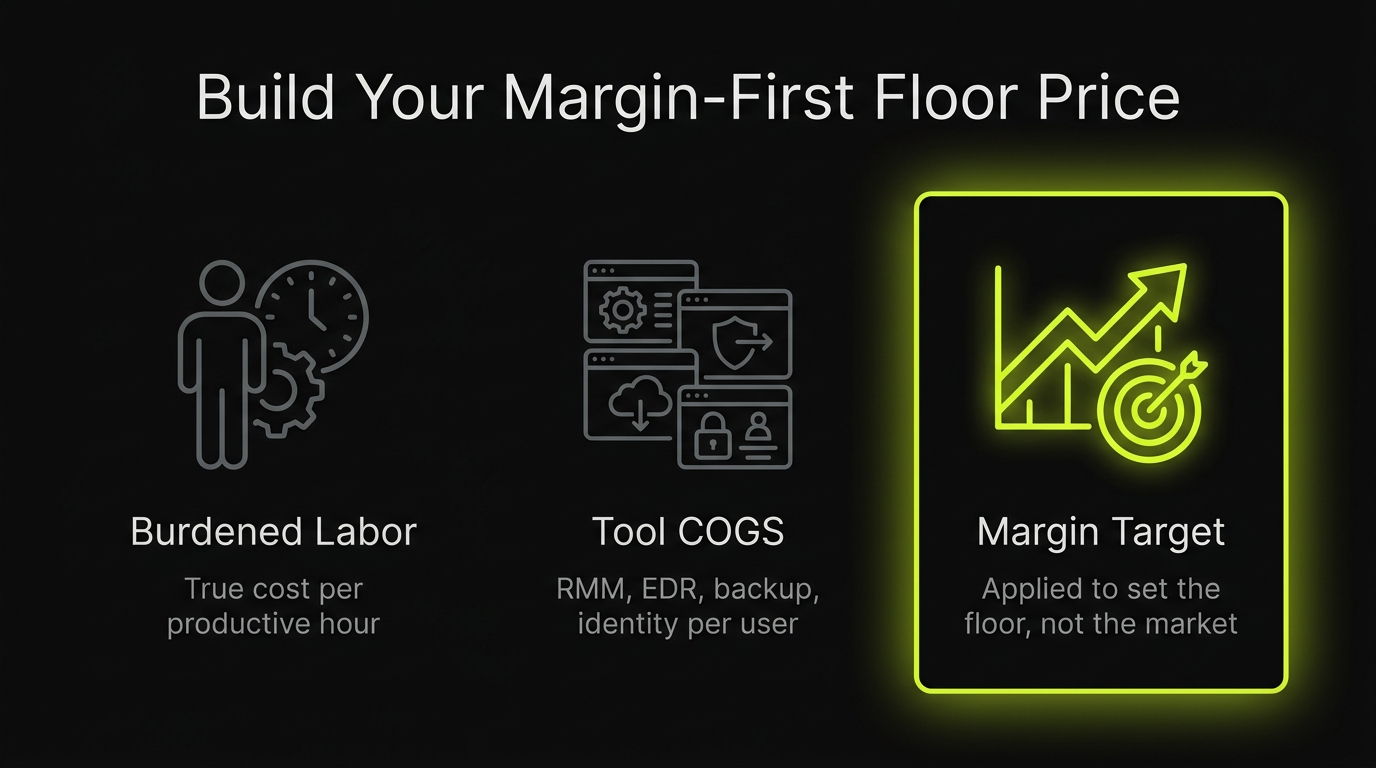
First, calculate fully burdened labor for direct delivery technicians:
- Salary, taxes, and benefits
- 401(k) match and workers' comp
- Prorated PTO and holidays
Divide this total by 1,760 productive hours (not the calendar 2,080) to find your hourly cost.
Next, determine monthly support hours per user based on environment:
- Simple: 0.25 hours
- Normal: 0.5 hours
- Messy: 1.2 hours
Multiply these hours by your hourly rate, then add direct tool COGS per user, specifically RMM, EDR, backup, email security, and identity.
Apply your margin target with this formula:
Floor Price = (Direct COGS + Labor Cost per User) ÷ (1 - Target Gross Margin)
If your target is 60%, divide costs by 0.4. This is your absolute floor. If a prospect rejects it, adjust scope, exclusions, or user minimums instead of discounting.
2. Solve the Credibility Gap to Defend Premium Rates
Low-cost competitors run a stripped scope, a cheaper cost structure, or target buyers who ignore compliance. If you compete on their terms, you default to commodity pricing. Treat price pressure as a demand and credibility gap, not a margin problem.
Solve this by establishing a positioning checklist:
- Who you serve: Your target vertical, size band, and compliance intensity.
- What you protect: Business outcomes like uptime, risk reduction, and audit readiness.
- What you can prove: Verified case studies, certifications, and third-party mentions.
If Google and AI tools do not recommend you for "best MSP for manufacturing in Chicago," you will fight on price. You must build shortlist visibility, not vanity traffic. Pick one defendable niche like healthcare or legal, and align packages to it. Premium pricing is only "risky" to your operations partner when your proof and demand engine are weak.
3. Choose a Pricing Model that Allocates Risk Correctly
Your pricing unit is a risk-allocation decision. Underwriting a client's operational complexity for free is the fastest way to kill your gross margin. Choose a pricing unit that aligns directly with your tooling and the client’s actual infrastructure.
- Per-User: Identity-driven bundles that simplify quoting. Use this as your default.
- Per-Device: Best when endpoints map to management effort. Use this for shift work or shared-device environments where per-user structures undercharge.
- Per-Site and Minimums: Flat fees that protect your margin against multi-location coordination and travel costs.
- Hybrid: A per-user base plus flat fees for servers, sites, and compliance management.
Low-cost competitors often hide their real margins behind cheap sticker prices, clawing back profit later through aggressive out-of-scope exclusions. To protect your contract profitability, default to per-user packaging. Switch to a hybrid model with explicit site minimums and server fees the moment a prospect introduces high-complexity infrastructure.
4. Standardize Your Offering with a Three-Tier Packaging Ladder
Custom quotes create unpredictable delivery costs and erratic gross margins. To protect profitability, stop selling custom "IT support" and move to a productized packaging ladder with controlled scope.
Build three standardized tiers:
- Base: The minimum tool and security stack you are willing to support long-term.
- Mid: Adds proactive features that reduce ticket volume and risk.
- Top: Adds premium response times, strategic outcomes, and advanced security.
Protect your gross margin by establishing a minimum monthly commitment (MRR floor), explicit inclusions and exclusions, and strict "environment readiness" standards for hardware and operating systems.
Keep these base packages clean by shifting variable costs to paid add-ons:
- Servers and onsite support
- After-hours coverage
- Compliance reporting and vCIO cadences
This ladder simplifies your packaging system, letting you sell up without inventing a custom scope for every client.
5. Prevent Margin Bleed with an Itemized Security Ladder
Many MSPs quietly lose margin by throwing cybersecurity into a flat seat price. This turns a premium promise into a commodity math trap where licensing and labor costs quickly eat your profits.
To protect your margin, structure security into a three-tier ladder:
- Base: Baseline essential controls you can deliver consistently, like MFA.
- Pro: Managed detection components and active reporting.
- Advanced: Full MDR or SOC coverage with defined response expectations.
Maintain strict pricing discipline by separating vendor license COGS from your operational labor. Apply your gross margin target to this combined security COGS, rather than passing tools through at cost.
Finally, clarify contract terms. Define whether "24/7" means monitoring or actual remediation, and specify client obligations. This disciplined packaging protects your premium tier and supports $200 to $400 plus pricing bands for mature, security-led managed services.
6. Enforce Strict Profit Guardrails on All-You-Can-Eat Contracts
A single hyper-needy user can devour dozens of helpdesk hours on unsupported home devices, destroying your contract's unit economics. Selling an All-You-Can-Eat (AYCE) agreement without strict operational constraints is not a pricing model. It is an unlimited liability.
To protect your gross margin, your contracts must enforce clear profit guardrails:
- Standardization: Mandate approved hardware, active patching compliance, and a supported apps list.
- Usage and Scope: Include excess usage clauses and exclude project work, onboarding, or major infrastructure changes.
- Access Rules: Apply flat site minimums and premium after-hours rates.
Position tiered managed support as the standard default. Treat AYCE as a premium tier available only to clients who agree to complete standardization. This preserves the predictable simplicity buyers value while preventing difficult accounts from consuming technician capacity and collapsing your gross margin.
7. Protect Margins Upfront with Contractual Indexing and Scope Controls
The easiest price increase is the one your client agreed to upfront. Over a multi-year partnership, vendor stack costs, labor, and security obligations inflate. If you do not automate price adjustments, inflation quietly erodes your gross margins. Automating this is a critical step in a durable MSP pricing system.
Your master services agreement must include two mechanisms:
- An automatic annual uplift tied to the Consumer Price Index (CPI) or a fixed 3% to 5% range.
- Scope-change triggers that force an immediate re-rate, such as new office locations, M&A activity, compliance changes, or major application stack adjustments.
When the anniversary arrives, send a brief, factual notice: "To continue delivering the agreed security and operational outcomes, your pricing adjusts to [new rate] on [date]."
This proactive contractual mechanism protects your margins. It removes the need for annual, awkward rate renegotiations led by the founder.
8. Run a De-Risked Transition Playbook for Legacy Clients
Delaying rate corrections out of churn fear guarantees shrinking gross margins. De-risk the transition by leading with operational facts rather than apologies.
First, run client-level COGS against current MRR to classify accounts as healthy, borderline, or unprofitable. Present legacy contracts with a three-option choice architecture:
- Option A: Keep current scope with a phased price increase.
- Option B: Move to a modern per-user package and stack.
- Option C: Transition to month-to-month at the new rate with restricted scope.
Send an advance notice detailing the effective date and coverage improvements. Schedule an account review call immediately; never negotiate pricing over email. This repeatable playbook transitions legacy per-device contracts to per-user models without triggering mass cancellations.
How to Run an MSP Pricing and Visibility Alignment Session
Pricing changes stick when operations, sales, and positioning agree. Gather these prerequisites first: burdened technician costs, stack costs, top client ticket trends, and current packages. This session defines how to price MSP services with operational discipline.
Step 1: Compute Your Unit Floor Prices (20 min)
- Apply your burdened labor formula to establish true hourly delivery costs.
- Add direct tool COGS to set non-negotiable per-user floor minimums. This establishes a baseline gross margin.
Step 2: Structure Your Package and Security Tiers (20 min)
- Align services into a three-tier packaging ladder.
- Separate baseline security from advanced MDR tooling. This prevents underpricing complex cybersecurity work.
Step 3: Write Your AYCE Profit Guardrails (15 min)
- Write five non-negotiable operational rules for All-You-Can-Eat contracts.
- Define hardware standards to ensure legacy equipment does not cause ticket bloat.
Step 4: Standardize Contractual Uplift Triggers (15 min)
- Insert automatic annual price adjustments of 3% to 5% into agreements.
- Define triggers for immediate re-rating, such as user growth. This prevents scope creep.
Step 5: Run Your Shortlist Visibility Checkpoint (20 min)
- Test 10 commercial queries in Google and ChatGPT.
- Score where you appear, which competitors show up, and what proof is missing. This reveals if your pricing is backed by authority.
If visibility is weak, buyers will keep attacking your rates. Book a margin and package review at nuoptima.com to find where your pricing structure is leaking profit. If comparing growth partners, review our list of the best MSP marketing agencies.