Your organic pipeline must now compound across Google and generative answer engines while headcount remains frozen. Deciding between in-house SEO vs AI tools or an agency partner is a strategic operating-model choice across cost, control, and scalability.
Most winners in the 2026 search landscape run a hybrid model to maximize efficiency. This practical framework provides nine decision factors and a simple scorecard to choose your model this quarter. We begin with total cost of ownership.
Key Takeaways
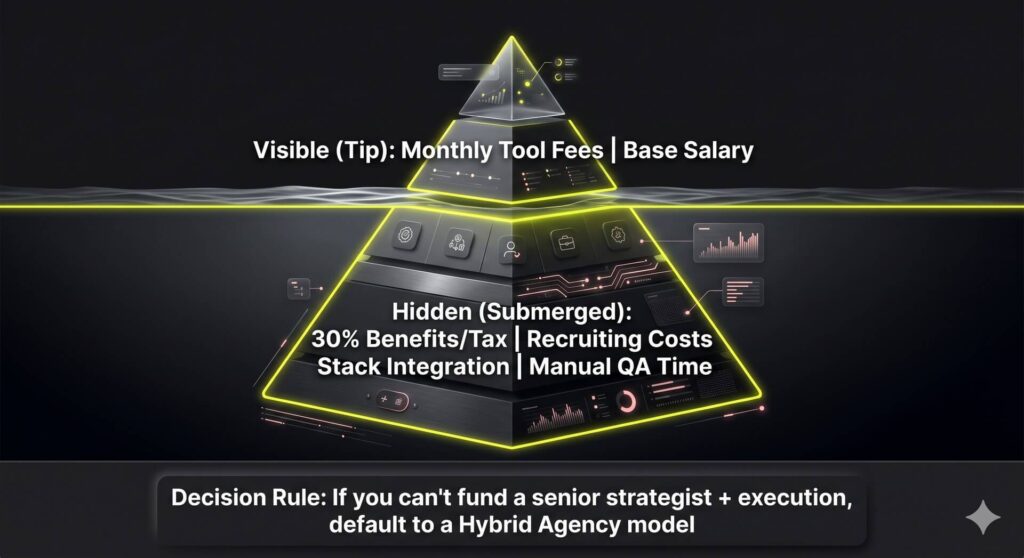
- Comparing a $200/month AI tool to a $100,000 salary is a category error; true in-house cost includes salary, benefits (often 30 percent overhead), recruiting, ramp-up, and management time.
- Most winners in 2026 run a hybrid model where AI handles 60 to 80 percent of execution while humans own strategy, quality assurance, and originality.
- The fastest responsible path to revenue is a 90-day hybrid sprint: a fractional lead architects strategy while an internal champion manages an AI stack for volume.
- AI tools are fast at detecting technical issues but fail at safe implementation, so never use a tool-only approach for high-risk work like migrations or crawl controls.
- Choose your operating model by your single biggest constraint (budget, speed, risk, or scale), then score nine factors out of 18 to map to in-house, agency, or hybrid.
1. Calculate the Total Cost of Ownership (TCO)
Comparing a $200/month AI tool to a $100,000 salary is a category error. True in-house TCO includes salary, benefits (often 30% overhead), recruiting, ramp-up, and management time. While AI tools offer low sticker prices, stack integration and manual QA drive costs higher than expected. Agencies bundle specialist labor and premium tools into one predictable, visible line item.
Apply this decision rule: if you cannot fund one senior strategist plus execution capacity, default to a hybrid model. This involves a fractional lead or agency paired with specific AI tools. Junior hires using software alone often produce high-volume, low-authority content that fails to rank in Google or earn citations in generative engines. This model prioritizes pipeline revenue over vanity metrics.
2. Evaluate Your Strategic Control and Governance
Control is the most underpriced variable in search. It comprises prioritization power, decision speed, and brand governance. View SEO as a series of strategic tradeoffs rather than a simple checklist.
Choose your operational model based on these requirements:
- In-house: Best for tight alignment with product roadmaps, sales feedback, and regulatory compliance.
- Agencies: Provide repeatable processes but risk context gaps without a decisive internal owner.
- AI Tools: Deliver speed with zero default governance. Impose constraints via templates and manual QA.
Unreviewed AI output creates a specific risk. Generic claims and inconsistent terminology dilute your positioning and make the brand invisible to generative answer engines. Strong governance prevents the loss of strategic focus when you outsource or automate.
3. Account for Three Operational Clocks to Accelerate Impact
Publishing volume is a vanity metric if execution remains incompetent. Reaching impact requires synchronizing three ‘clocks’: hiring, onboarding, and implementation.
Choosing in-house SEO vs AI tools requires balancing these timelines:
- In-house: Slow start during recruitment but offers high compounding once embedded.
- Agencies: Fastest kickoff, provided they have CMS access and high decision velocity.
- AI tools: Instant output but demands rigorous prompt systems to avoid expensive rework.
The fastest responsible path to revenue is a 90-day hybrid sprint. Deploy a fractional lead to architect the strategy while an internal champion manages an AI stack for volume. This model bypasses hiring lags and builds the authority required for Google rankings and AI engine citations.
4. Build a Scalable Hybrid Operating Model
Manual scaling creates headcount bottlenecks that erode margins. Pure software reliance produces generic content that search engines ignore. The high-performance model for in-house SEO vs AI tools is a hybrid system where AI handles 60% to 80% of execution while humans own strategy, QA, and originality.
Each model faces specific scaling constraints:
- In-house: Scalable via internal systems but bottlenecked by headcount.
- Agency: Scalable via specialist benches but bottlenecked by budget and prioritization.
- AI Tools: Scalable via instant drafts but bottlenecked by subject-matter review and QA.
Build a workflow that treats content as search infrastructure:
- Knowledge base ingestion
- AI drafting
- Human expert review
- Publication and measurement
- Data refresh
This governance ensures scale without triggering quality, trust, or brand authority issues.
5. Navigate the Technical Ceiling and Accountability Gap
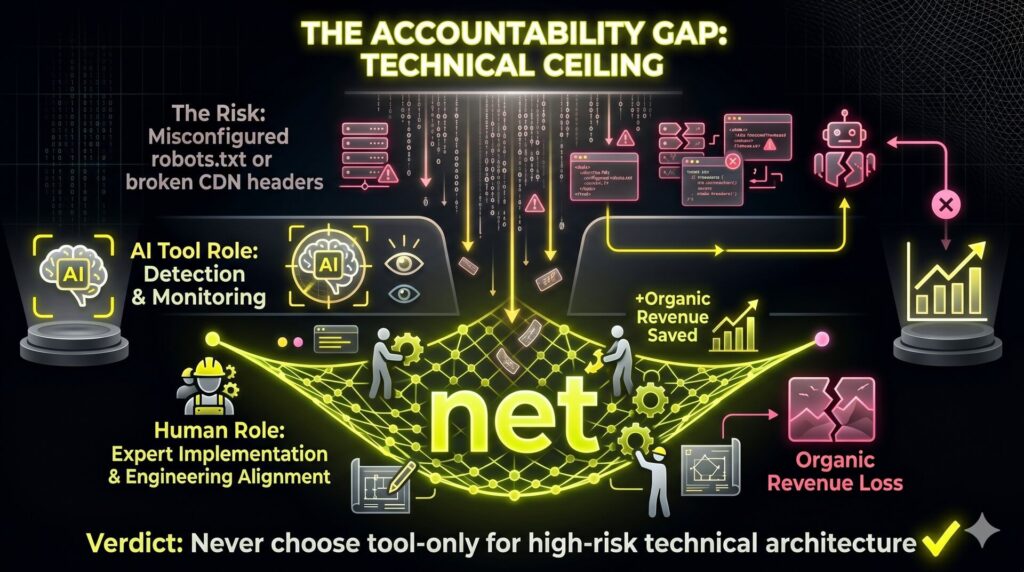
A misconfigured robots.txt or broken CDN header wipes out organic revenue in hours. These self-inflicted catastrophes create a technical ceiling involving migrations, JavaScript rendering, and crawl controls. If your architecture blocks LLM bots from indexing your site, your brand remains invisible.
The accountability gap between in-house SEO vs AI tools emerges when indexation breaks.
- In-house: Best for blocking bad deployments when embedded with engineering.
- Agencies: Provide specialist depth but need an internal implementation pathway.
- AI tools: Fast at detection but fail at safe, nuanced implementation.
Continuous monitoring beats one-off audits by catching disasters before rankings drop. Never choose a tool-only approach for high-risk technical work that requires expert accountability.
6. Bridge the Authority Gap to Earn Citations
AI accelerates research, but authority is earned through brand mentions and third-party validation. These are the primary citation signals software cannot simulate. For B2B leaders, the decision to scale authority depends on internal leverage.
- In-house: Best for teams with existing PR muscle or a founder network that secures interviews and features.
- Agency: Ideal for building repeatable digital PR systems and specialized outreach that require high-scale execution.
- AI Tools: Useful for prospecting and drafting personalization, but they cannot replace the relationships required to close high-authority placements.
Executive Takeaway: If link acquisition constrains growth, tools alone fail. Scaling human capacity is required to protect reputation and secure the citations that drive AI search visibility. Automated outreach without human oversight risks damaging the entity authority your strategy requires.
7. Measure Impact Across the Dual-Surface Search Landscape
Traditional SEO dashboards miss the generative engines where buyers research and compare solutions. Transition to a dual-surface KPI set that tracks Google performance alongside answer engine visibility.
In-house teams can link organic activity to CRM pipeline if analytics and CRM are integrated. Agencies provide structured reports but often prioritize vanity traffic. AI tools automate reporting but cannot prioritize strategic KPIs.
Adopt a three-tiered framework for performance accountability:
- Business: Organic pipeline, CAC payback, and qualified leads.
- Search: Non-brand share of voice and landing page conversions.
- AI Visibility: Citation frequency and brand mentions across ChatGPT and Perplexity.
This framework evaluates in-house talent, agencies, and AI tools based on revenue outcomes and AI-search dominance.
8. Mitigate Risk by Enforcing Editorial Discipline
Scaling content without discipline is a critical brand risk. Generic content is invisible in a 2026 search environment where LLMs provide baseline answers. To earn AI citations and outrank competitors, your strategy must prioritize original experience and expert ownership over automated repetition.
Structure your model around specialized contributions:
- In-house: Best for capturing domain expertise, product truth, and customer language.
- Agency: Best for specialist editorial standards and expert-led processes.
- AI Tools: Best for structure and drafting. Must be constrained and heavily edited.
Maintain authority and long-term visibility with this QA checklist:
- Fact-check claims against primary sources.
- Include unique internal data or specific examples.
- Require expert review for technical accuracy.
- Ensure citation hygiene and on-brand language.
9. Prioritize GEO Readiness as a Selection Criterion
Search is splitting. By 2026, visibility requires ranking in Google and appearing in generative answers like ChatGPT or Perplexity. This makes Generative Engine Optimization (GEO) a mandatory selection criterion rather than an experimental add-on.
When comparing in-house SEO vs AI tools, your operating model must bridge this gap:
- In-house: Works if you possess senior talent to manage technical entity architecture and content systems.
- Agency: Strongest when executing structured content and authority building together to capture citation opportunities.
- AI tools: Helpful for drafting but insufficient to build the trust signals LLMs require for citation consistency.
If AI discovery influences your pipeline, GEO cannot be a side project. It is the primary filter for choosing a model that ensures your brand remains the cited, trusted source as buyer research shifts from traditional SERPs into AI-generated summaries.
How to Choose Your SEO and GEO Operating Model
Identify your primary bottleneck before selecting an operating model. Every organization faces one dominant constraint that dictates the choice between in-house SEO vs AI tools and external partners.
Step 1: Define Your Constraint
Select the single constraint that most accurately describes your current situation:
- Budget: You require the lowest possible cash outlay.
- Speed: You need results faster than a six month hiring cycle allows.
- Risk: Technical compliance or brand reputation stakes are high.
- Scale: You must increase output by 10x without increasing headcount.
Step 2: Operational Scorecard
Score your organization on a scale of 0 to 2 for each factor. Use 0 for low or unavailable, 1 for moderate, and 2 for high or fully resourced.
1. Control requirements for brand and legal.
2. Technical complexity of your site architecture.
3. Availability of internal Subject Matter Experts (SMEs).
4. Need for digital PR and high authority link building.
5. Reporting maturity and pipeline attribution capability.
6. Urgency for AI search and GEO visibility.
7. Execution bandwidth of your current marketing team.
8. Feasibility of hiring senior SEO talent in your region.
9. Tooling tolerance and ability to manage a complex stack.
Step 3: Map the Score to Your Model
Calculate your total points out of 18 to determine your path forward:
- Mostly 0s or 1s: Use an agency-led model with a light internal champion.
- High control + high tech + SMEs available: Build an in-house lead model with specialist contractor support.
- High scale + moderate risk: Deploy a hybrid model using a senior strategy owner, AI tools, and editorial QA.
Step 4: Recommended Models by Company Stage
Align your search strategy with your current business maturity:
- Founder-led SMB: Utilize a fractional strategist plus AI-assisted content. Engage an agency for focused authority and link building bursts.
- Growth-stage Team: Hire an in-house SEO lead to own strategy. Support them with an agency bench and a managed tool stack.
- Enterprise: Establish an internal Center of Excellence. Use specialist agencies for niche technical projects and maintain strict governance.
Step 5: Next Steps for AI Visibility
If you require visibility in AI search alongside Google performance, partner with specialists in the answer layer. Visit nuoptima.com to explore our Generative Engine Optimization (GEO) services. This is the direct path to becoming the cited authority in your category.
Maintain one hard stance: AI is leverage, but humans own accountability. Tools produce drafts while leaders produce revenue.
FAQ
No. While AI tools excel at repetitive execution and drafting, they cannot own high-level strategy, task prioritization, or technical risk management. AI lacks the original subject matter expertise and product truth required to rank in a competitive search landscape. The most effective model uses AI to automate execution while keeping a human hire accountable for strategic direction and final quality assurance.
There is significant overlap because authority signals remain critical, but the specific targets have changed. Traditional link building focuses on domain authority for Google rankings. Generative Engine Optimization (GEO) focuses on the sources AI models retrieve and cite. Success requires entity clarity, structured data, and ensuring your brand is referenced in the specific datasets that LLMs prioritize when generating answers.
Yes. You must shift your measurement beyond simple click-through rates to include brand mentions and assisted conversions. While AI summaries may capture some traffic, being the cited source builds massive branded demand and trust. High-intent buyers still click through to verify details or complete transactions. If you are not cited in the AI response, you lose that conversion opportunity entirely.
Appoint one internal or fractional owner to maintain accountability. Implement technical monitoring to ensure AI bots can crawl your site. Use AI tools for content drafts and keyword clustering, but enforce a strict human review checklist for every publication.
Where this fits in your MSP growth system
This is one piece of how NUOPTIMA makes MSPs and cybersecurity firms the provider buyers find on Google and in AI search. See how it connects to MSP SEO and GEO and AI-search, or get your free MSP lead forecast to see exactly where your firm shows up across ChatGPT, Gemini, and Perplexity today.