
Picture a buying committee at a 200-seat law firm. Before anyone emails a vendor, the IT director has already read three competitor sites, run a ChatGPT prompt asking for MSP recommendations in their city, and skimmed two AI-generated shortlists. If your firm does not appear in those answers, you are not in the conversation.
That is why your MSP blog cannot be a pageview hobby. It must be buyer-education infrastructure engineered for AI citation and sales enablement, not volume.
Real authority requires technical accuracy, where human subject matter experts own the claims and AI merely supports the drafts. This eight-part strategy is your new operating system.
Key Takeaways
- Measure pipeline outcomes, not pageviews: track query-level presence, citation quality, and sales usage to avoid wasted spend on content no buyer reads.
- Own a defensible wedge (vertical, geography, or risk theme) so search engines and AI models can categorize and cite your firm consistently.
- Use a three-tier production system (internal SME, writer/strategist, AI) with a claim log to produce practitioner-grade content that algorithms trust and buyers forward.
- Build reusable decision-support artifacts (selection guides, comparisons, financial guides, roadmaps) that sales reps send mid-deal rather than generic commentary that no one shares.
An MSP blog for AI shortlists is a structured content program that positions a managed service provider to appear in AI-generated vendor recommendations by publishing technically accurate, wedge-focused, machine-readable content that buyers and AI models can cite as credible proof of expertise.
1. Shift Your Metrics From Vanity Traffic to Pipeline Outcomes
If you measure the wrong output, you will buy the wrong content. The discipline you bring to managed IT rarely exists in your marketing, leading to the "four posts per month" volume trap. Publishing for volume is an expensive anti-goal if it never gets read by a decision-maker or used in a deal.
Your objective must be simple: "When a buyer asks X, we appear, and sales can send proof that answers Y."
To stop wasted spend on busywork that fails to improve shortlist visibility, the owner and ops partner should monthly review a one-page scorecard focusing on three metrics:
- Query-level presence: Do you appear in Google and AI answers (yes/no and position)?
- Citation quality: Are you cited for the correct geography, niche, and technical claims?
- Sales usage: Which posts do reps forward mid-deal?
Stop chasing vanity traffic. Focus on assets that secure shortlists and close deals.
2. Focus on a Defensible Wedge to Secure AI Citations
If your content tries to speak to everyone, search engines and AI models will ignore you. Generalist content is impossible for algorithms to categorize and easy for buyers to forget.
To build pipeline authority, focus on one defensible wedge:
- Vertical: Healthcare, legal, finance, manufacturing, or professional services.
- Geography: Your actual local service radius, not a vague nationwide claim.
- Risk theme: Ransomware readiness, compliance posture, or downtime prevention.
Next, draft a clear entity statement for consistent repetition across your site: "We support legal firms in Greater Atlanta, guaranteeing zero billable hour losses with a SOC 2 posture."
Apply this rule: if a post does not reinforce this wedge, do not publish it. This prevents a random-topic site and turns your content into a coherent body of evidence. This makes your firm easier to cite and easier to buy.
3. Run a Three-Tier Production System to Protect Technical Accuracy
You likely believe external marketing agencies cannot write your technical content without making you look foolish to a skeptical IT decision-maker. You are right, unless you run a system that strictly divides labor by competence.
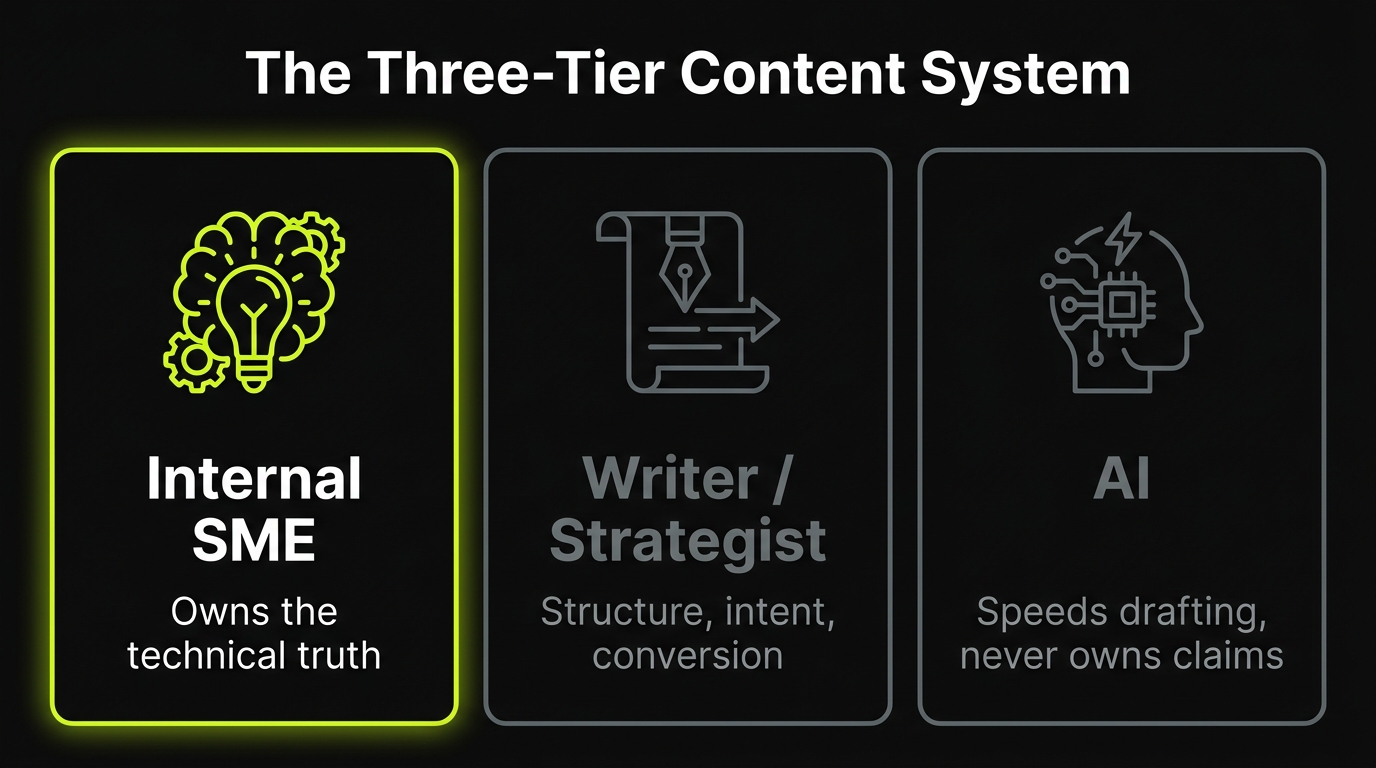
To scale your content program safely, implement three non-negotiable roles:
- Internal SME: Owns the technical truth, approves claims, and adds real-world service nuance.
- Writer/Strategist: Structure, search intent, readability, and conversion design.
- AI: Speeds up execution by summarizing notes, generating checklists, and drafting outlines.
Next, enforce a "claim log" inside every document. Every technical claim must link to a verified source, configuration screenshot, or internal reference.
Before publishing, pass every post through two quality gates:
1. Would your best systems engineer sign their name under this?
2. Does this help your sales team resolve an active prospect objection?
This rigor produces practitioner-grade content that is safe for search engines to cite, eliminating low-trust, error-prone outsourced copy while keeping production timelines realistic for an owner-led MSP.
4. Build Reusable Content Artifacts Instead of Generic Commentary
Most MSP blogs fail because they publish generic commentary. No owner forwards "Top 7 Cybersecurity Tips" to their CFO. Real citation value and sales velocity come from reusable decision-support assets that solve concrete business dilemmas.
To secure shortlist visibility, prioritize high-intent formats that buyers bookmark and forward:
- The Selection Guide: "How to choose an MSP for [vertical] in [city]" outlining localized pitfalls.
- The Comparison: "Co-managed IT vs fully managed: what breaks in real life" utilizing a clear decision tree.
- The Financial Guide: "MSP pricing model explained for CFOs" detailing inclusions and scaling costs.
- The Roadmap: "Security roadmap for a 50 to 200 seat [vertical] firm" presenting a phased plan.
- The Incident FAQ: "What happens in the first 24 hours of a breach" for process clarity.
Every post must include clear definitions, objective decision criteria, and one proof asset you can substantiate. This builds a high-value sales enablement toolkit instead of a graveyard of forgettable content.
5. Structure Your Pages for Direct AI and Machine Extraction
AI engines require structured data to recommend your firm. To secure citations, every page must make it easy for Google and LLMs to extract who you are, what you do, and why you are credible.
Start each page with a direct, two-sentence summary designed for AI engines to lift into answers. This makes your content mechanically easier for algorithms to cite and trust.
Next, embed clear proof blocks that machines cannot misinterpret. Use simple tables or bullets to list:
- Active certifications
- Geographic areas served
- Vertical industry specializations
- Contractual response-time promises
Maintain strict terminology consistency across your site. Use the exact same service names and geographic labels on every page.
Finally, build a strict hub-and-spoke structure. Link every supporting post back to its primary service hub page. This reduces ambiguity for prospects and ensures higher extractability for AI.
6. Package Your MSP Blog Content Into an Educational Newsletter
Blogging alone is a slow path to growth. To convert your content into repeated buyer touches and client retention education, package your articles into a recurring newsletter. This is not a generic marketing blast. It is a referral acceleration engine designed to keep your technical expertise top-of-mind for busy decision-makers.
A monthly cadence is sufficient if you maintain absolute consistency. Structure every email using a repeatable, four-part template:
- One current threat lesson (e.g., a recent phishing vector)
- One operational business insight
- What your technical team is doing to address it
- A direct call to action linking back to a pillar post
For rough planning benchmarks on a clean, client-only list (not a guarantee, and increasingly distorted by Apple Mail Privacy Protection):
- Rough open rate range: 35% to 42%
- Top-quartile rough open rate: 42% to 50%
- Target click-to-open rate (CTOR): 14% to 17%
Because Apple Mail Privacy Protection inflates open rates, track CTOR as your true engagement metric. This approach transforms your writing from an inactive pile of URLs into an active follow-up system that secures renewals and drives predictable referrals.
7. Establish an Uncompromised Tooling Stack for Your Content Distribution
You do not need a bloated marketing suite to distribute your content. Technical owners need a clean distribution engine, not a vendor gallery.
Evaluate platforms using this requirements checklist:
- Hygiene and segmentation: Separate active clients, past prospects, and referral partners.
- Automation basics: Run a simple welcome sequence and a cold subscriber re-engagement loop.
- Reliable reporting: Track CTR and CTOR, not inflated Apple Mail opens.
- Data ownership: Verify immediate, clean CSV exportability.
Start testing cadence with general ESPs. Transition to advanced automation tools only when managing multiple segments and active sequences. Avoid MSP-specific platforms that lock you into generic, syndicated content.
The non-negotiable rule is that you must own your audience data and your editorial calendar. Use these criteria to draft a one-page tooling decision document for ops and finance review.
Set a Publishing Cadence and Mine Topics Buyers Actually Search
Consistency beats volume, and cadence should follow your SME review capacity, not a content-mill quota. One wedge-specific post a month that your best engineer will sign beats four thin posts nobody forwards. Pick a rhythm you can hold for a year, publish on the same schedule every time, and let compounding do the work. A monthly pillar plus a lighter supporting piece is a realistic floor for an owner-led MSP in 2026.
Feed that calendar from the questions real buyers ask, not from a topic generator:
- Mine sales and support calls: Every objection a CFO raises and every question a prospect repeats on a discovery call is a post title. Your team hears the exact phrasing buyers later type into ChatGPT.
- Pull long-tail queries: Start from your MSP keyword research shortlist and the People Also Ask box on your core service terms, then write the page that answers the question outright.
- Watch r/msp and vertical forums: When practitioners ask what makes a good MSP for a law firm or how co-managed IT actually works, that is a selection guide waiting to be published.
Keep every topic tied to your wedge. A stray post on a niche you do not serve dilutes the entity signal that gets you cited. For the wider planning layer that sits above the blog, see our MSP content strategy and RevOps playbook.
How to Launch a Controlled 90-Day MSP Blog Experiment
Most marketing initiatives fail because owners commit to six months of unstructured writing, see zero leads, and stop. This 90-day plan serves as a controlled, low-risk experiment designed to satisfy the cautious finance partner. Validate your demand engine with clear milestones and measurable outputs before scaling spend.
Weeks 1 to 2: Establish Your Technical Foundation
- Pick a specific authority wedge and write a one-sentence entity statement using the guidelines from Section 2 to eliminate positioning confusion.
- Build a scorecard by baseline-testing 10 commercial queries across ChatGPT, Gemini, Perplexity, and Google Search. Document competitor presence in these results.
- Draft the SME review workflow and claim log template to guarantee technical accuracy from day one.
Weeks 3 to 6: Publish High-Intent Citation Pillars
- Publish two critical pillar posts: a localized selection guide and an objective pricing or CFO explainer.
- Create two sales-ready one-pagers derived directly from these pillars so your sales reps can forward them to resolve active mid-deal objections.
Weeks 7 to 10: Activate Your Distribution Loops
- Launch a monthly client-only newsletter using a structured, four-part template.
- Add a shorter, highly shareable referral partner variant of the newsletter to accelerate warm introductions.
Weeks 11 to 13: Measure and Audit Sales Impact
- Re-run the 10-query visibility test in Google and generative AI tools to audit baseline shortlist improvements and track citation share.
- Review internal sales usage to identify which assets are being forwarded and why they influence deals.
To verify your current starting point, partner with nuoptima.com for a content and AI-citation audit, and read our deep-dive MSP Content Marketing Growth Guide to scale your compounding demand engine.