
Most MSP social media strategies waste time on vanity posts. Your social presence exists to validate technical authority, secure referrals, and build findable proof for buyers and AI. Focus on LinkedIn personal profiles, not dead company pages. When skeptical CFOs look you up, invisibility kills deals.
This LinkedIn-first authority system takes hours a month, not days. For broader pipeline growth, see how the best MSP marketing agencies scale at NUOPTIMA.
Key Takeaways
- LinkedIn personal profiles outperform company pages for MSP authority because buyers trust real people, not logos. Prioritize founder and technical-lead profiles.
- Structure every post as a three-part case note (Situation, Action, Result) to give buyers and AI models quotable, vertical-specific proof of competence.
- An organic authority foundation must convert warm referrals before you invest in paid LinkedIn ads. Scaling a leaky profile burns capital.
- Opinionated content on tradeoffs (what you refuse to do, why) filters out bad-fit prospects and raises your close rate on inbound referrals.
- Your best content is already in your tickets, Slack channels, and client calls. Capture one real technical artifact per week rather than outsourcing generic templates.
MSP social media is a LinkedIn-first authority system that uses structured case notes, founder-led profiles, and opinionated technical content to validate credibility with buyers and AI search models, not to generate direct leads.
Which Platforms an MSP Should Actually Use
You do not need to be on every network; you need to be findable where B2B buyers check credibility. For an MSP that means LinkedIn first, with a small supporting role for a few others. Spreading thin across five platforms produces neglected profiles that hurt the credibility check more than help it. Pick the shortest list you can post to consistently.
Here is how the main platforms rank for a managed service provider in 2026:
- LinkedIn (primary): Where CFOs, COOs, and vertical decision-makers vet providers before a referral call. This is where founder profiles, case notes, and selection advice belong. If you only run one channel, run this one.
- YouTube (supporting): The home for the Loom walkthroughs and incident lessons from Section 4. It doubles as a proof library you can link from LinkedIn and cite in proposals. The same footage is the creative for YouTube ads for MSPs when you want it in front of buyers who have not found the channel.
- Facebook (local only): Useful for MSPs serving a tight geographic market, community groups, and recruiting. Not a B2B authority channel; treat it as local presence, not pipeline.
- X and Instagram (optional): Rarely worth a dedicated effort for a mid-market MSP. Repurpose a clip here only if it costs you no extra time.
Match content to the channel: publish the structured case note or opinion post natively on LinkedIn, host the long video on YouTube, and reserve the company page for distribution and recruiting. One consistent channel beats four abandoned ones every time.
1. Optimize Your Founder Profile for the 10-Second Credibility Check
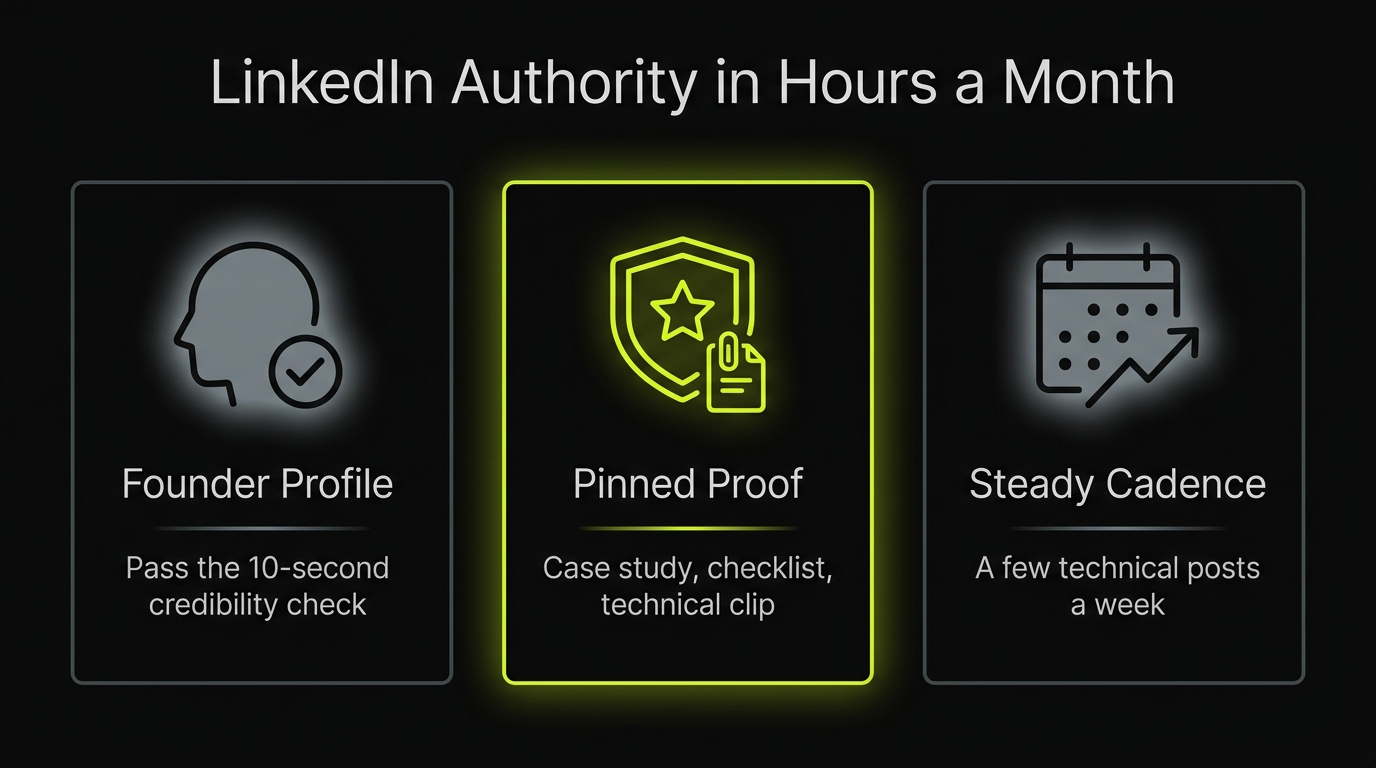
Most founders post generic content and wonder why nothing happens. Fix this by treating your personal profile as a controlled outbound and credibility layer, not standard content marketing. When a referred prospect looks you up, your founder profile must confirm you are a credible specialist in 10 seconds.
Set up your profile operationally. Your headline and about section must explicitly state your target ICP, geographic focus, and an auditable proof anchor rather than marketing hype. In your featured section, pin two or three specific proof assets:
- A localized case study with clear metrics
- A practical security and compliance checklist
- A video clip from a technical IT presentation
Next, run an active social selling workflow for 15 to 25 minutes, twice a week. Comment on posts where buyers like CFOs, COOs, and vertical associations gather, and send five targeted connection requests weekly with a one-line relevance hook. Measure success by qualified conversations and direct replies, not vanity likes. This system earns referrals and AI-citable mentions because both buyers and AI models quote real people with verifiable proof.
2. Publish Structured Case Notes Instead of Motivational Advice
Stop posting generic business inspiration that makes your technical team cringe. Your prospects do not look to their IT provider for motivational takes. They look for proof of technical competence.
Reframe your social posts as structured, mini case notes that let buyers benchmark your operations without sounding like a hype marketer. Use this repeatable three-part format:
- Situation: State the vertical, size, and risk context, such as a 200-seat law firm facing critical ransomware exposure.
- Action: Detail the exact operational control, process change, onboarding sequence, or incident response runbook you deployed.
- Result: Provide a measurable decision outcome, like a 40% reduction in exposure or passing an audit checkpoint.
Avoid credibility killers like vague superlatives, tool-name flexing without outcomes, and templated graphics that look like every other provider. Close with a soft, diagnostic call to action: "DM me and I will share the checklist."
This approach protects your reputation with skeptical CFOs and provides structured claims for search engines. Clear, vertical-specific evidence increases your shortlist visibility when buyers ask Google or AI models who to trust.
3. Build an Authentic Capture Loop to Eliminate Template Fatigue
Most MSPs struggle with template fatigue, posting generic stock graphics that make their firm look interchangeable. Your actual technical authority is already produced daily; it is simply trapped in internal tickets, Slack channels, and client calls. To build a high-converting authority stream, you must capture this real-world competence.
Establish a weekly capture loop assigned to a founder, vCIO, or lead engineer. Each week, document one technical artifact:
- Sanitized network diagrams or architecture mockups
- War-room whiteboards during incident resolution
- Clean server rack before-and-after photos
- Excerpts from an onboarding checklist
Pair the visual with a two-sentence narrative explaining the specific problem solved and the business decision it enabled. Keep this process compliant by making digital redaction an automatic habit. Never publish credentials, client-identifying data, or sensitive configurations.
Distribute the credit by tagging the team members who did the work. This builds individual employee authority while sending a clear recruiting signal to prospective talent. The outcome is an authentic content stream that signals deep operational competence, creating a proof engine that outsourced template vendors cannot replicate.
4. Turn 8-Minute Loom Videos into High-Yield Social Assets
Many owners stall on video because they think it requires a production crew and hours of editing. In reality, video compresses trust faster than text because a buyer can hear your technical competence. You do not need polished production, just a simple workflow to turn one recording into multiple authority assets.
Record a five-to-eight-minute Loom video on a single topic:
- A recent client incident lesson
- A specific technical checklist walkthrough
- An onboarding mistake your team fixed
Use a transcript-first tool like Descript to cut that recording into three short clips and add captions.
Publish the clips using a specific distribution order:
1. Post the clip on your personal LinkedIn profile first to lead with a founder voice.
2. Repost to your company page the next day as a distribution step, not the primary channel.
Ensure every clip follows three rules:
- Make one technical claim
- Share one concrete example
- Avoid fearmongering
For this LinkedIn authority strategy, ignore vanity view counts. Your target metrics are saves, direct messages, and comments asking for the featured asset. These signals indicate actual pipeline intent.
5. Express Hard Opinions and Clear Tradeoffs to Stand Out
Posting generic security tips signals that you are an interchangeable provider, pushing your firm directly into margin-eroding price wars. Bland content makes you look identical to every local competitor. To build true technical authority on LinkedIn, you must sound like an expert specialist.
First, speak consistently to one high-value vertical like healthcare, legal, or manufacturing. Second, take an open stand on operational tradeoffs. Explain why you refuse custom stack sprawl or why you mandate standardized onboarding. This directness shows the operational conviction sophisticated buyers respect.
You do not need to post daily to build authority. Instead, deploy two high-yield content formats:
- Selection advice: Teach prospects the exact technical questions they must ask an MSP before signing a contract to expose weak providers.
- Failure analysis: Share anonymized breakdowns of actual security incidents, what went wrong, and how your team adapted.
This clear, opinionated positioning protects your gross margins and filters your pipeline. Unqualified prospects filter themselves out, while ideal buyers self-qualify before the first sales call. This directly increases your close rate and generates higher-quality referrals because partners know exactly what you stand for.
6. Run a Controlled Escalation Path Before Scaling Paid Spend
Before scaling your social spend, run this strict diagnostic: if your profile and authority posts cannot convert warm referral checks, do not buy paid traffic. Scaling a leaky profile burns capital that should fund pipeline.
Once your organic foundation converts, deploy two risk-controlled escalation options to manufacture qualified sales conversations:
- Trigger-based LinkedIn ads: Target specific buying events, such as SOC 2 compliance readiness, running LinkedIn ads for MSPs around a single high-value diagnostic checklist.
- Founder-led sequences: Run account-based outreach combining direct LinkedIn touches and highly personalized emails that mirror the founder’s consultative POV, measured strictly on qualified meetings.
Control financial risk by prioritizing strict ICP list quality over broad distribution. Measure your campaigns strictly by cost per sales conversation or cost per qualified meeting, never by vanity metrics like impressions or clicks.
To connect this outbound motion to a compounding demand engine, integrate it with SEO and AI search visibility. Review our evaluation of the best MSP marketing agencies to see how we build true technical authority.