Stop optimizing for blue links. In generative search, visibility is binary: you are either the cited source or you are invisible. Success in Perplexity SEO requires shifting from ranking pages to becoming the most extractable, trustworthy answer for a prompt. You will learn the mechanics of source selection and ten tactics to increase citation likelihood through formatting and authority. Start by mapping what the engine already trusts for your prompts.
Key Takeaways
- In Perplexity, visibility is binary: you are either the cited source or you are invisible, so the goal shifts from ranking pages to becoming the most extractable answer for a prompt.
- Perplexity ranks passages, not full pages, so a fragment-first architecture of question-based H3s with self-contained 50 to 150 word answers raises selection odds.
- Lead every section with an answer capsule: a 2 to 3 sentence block placing the direct answer in the first 50 words using specific data instead of vague adjectives.
- Proprietary data creates a defensible moat, since Perplexity cannot substitute your brand when you own the only existing data point for a query.
- Freshness is a machine-detectable signal, so a visible "Last updated" date plus a quarterly refresh cadence protects citations from being swapped for a competitor's newer source.
Perplexity SEO is the practice of optimizing content to become the most extractable, trustworthy, and citable answer for a prompt in Perplexity's generative search, rather than ranking a page in traditional results.
1. Reverse-Engineer Your Target Prompt Clusters
You cannot optimize for what you cannot see. Treating Perplexity as a black box wastes budget. To dominate Perplexity SEO, treat its citations as a transparent SERP to be reverse-engineered.
Pick 20 to 50 prompts spanning commercial and informational intent. For each query, record:
- Cited domains and URL types.
- Content fragments extracted.
- Source recency and authority signals.
This identifies exactly what the engine considers authoritative for your niche. Spot repeatable selection patterns that signal authority to the LLM:
- BLUF structure: Direct answers positioned in the first 100 words.
- Data tables: Heavy reliance on structured tables for best or vs comparison queries.
- Aggregator dominance: Third-party lists and directories appearing as primary sources.
- Recency cues: Freshness acting as a decisive signal in technical or high-growth sectors.
Mapping these signals creates a repeatable baseline. You can then engineer the specific content architecture Perplexity is already programmed to trust and cite. This provides a clear target: the exact sources and formats already winning the prompts your buyers care about.
2. Deploy Answer Capsules for Extraction Readiness
Perplexity ignores narrative buildup to prioritize the most efficient answer for the user. To dominate Perplexity SEO, every section must lead with an answer capsule. This 2 to 3 sentence block directly resolves the query with a definition, quantitative benchmark, or step summary. Leading with this capsule ensures your passage is selected for the final generative response.
Implementation requires removing introductory fluff and adding crisp nouns, numbers, and technical constraints. LLMs prioritize source selection based on information density. To earn a citation, follow these standards:
- Place the direct answer in the first 50 words.
- Use specific data points instead of vague adjectives.
- Frame insights as constrained, quotable data blocks.
Precision provides the engine with a quotable fact it can justify. For instance, state that B2B organic search delivers 250 percent higher ROI than paid search over 18 months. This ensures your brand becomes the primary recommendation. Competitors who bury the lead remain invisible in the answer layer.
3. Structure Your Content for Fragment Extraction
Perplexity ranks passages rather than full pages. Traditional B2B content often fails because key insights remain buried within long-form narrative. If an answer requires extensive scrolling, the engine prioritizes a competitor who provides a concise, extractable block.
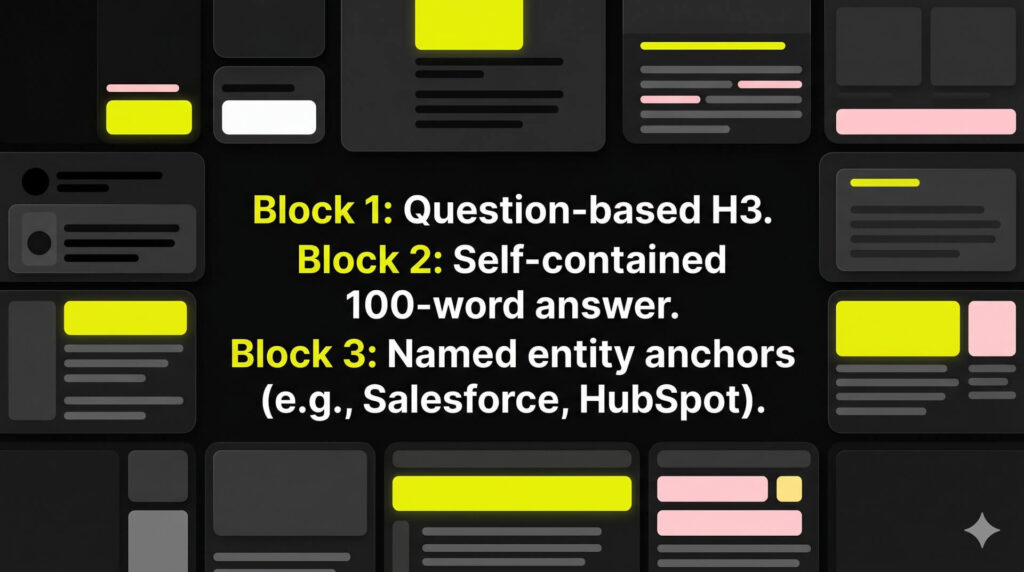
Adopt a fragment-first architecture to dominate Perplexity SEO. Structure sections around question-based H3s followed by self-contained answers of 50 to 150 words. Each module must function as a standalone resource to ensure the engine can synthesize your data without broader context. Ensure every section includes:
- Defined acronyms like Generative Engine Optimization (GEO).
- Named entities such as HubSpot or Salesforce to anchor the topic.
- Concrete benchmarks, like the 2% to 5% B2B SEO conversion rate standard.
This modularity increases the probability of selection at the passage level. Providing direct, factual statements satisfies the engine’s requirement for high information density. This approach ensures your brand remains the cited authority even when the full page is not the primary search result.
4. Signal Editorial Accountability through Trust Signals
Perplexity prioritizes sources that signal editorial accountability through visible rigor. Content must be more than correct; it must look safe to cite. The engine favors pages with transparent authorship, precise definitions, and clear methodologies.
Establish accountability by including visible author and editor profiles. When presenting proprietary data or specific guidance, include a short methodology note explaining sources and timeframes. This provides the engine with the metadata required to justify a citation and improves Perplexity SEO outcomes.
Maintain aggressive source hygiene to create a citation loop. Link to primary official sources and reputable industry references to anchor claims. Keep statements falsifiable by using specific technical constraints rather than vague superlatives:
- The best
- The fastest
- Market leading
This technical credibility ensures Perplexity selects your content over less transparent competitors. It reduces the risk that the engine skips your page because it cannot safely attribute key statements to your brand.
5. Prevent Source-Substitution with Proprietary Data
Perplexity synthesizes answers from multiple domains to provide context. However, it cannot substitute your brand if you own the only existing data point. Proprietary data creates a defensible moat in Perplexity SEO by prioritizing unique insight over mere domain authority. This strategy ensures you remain the mandatory source against well-known domains by controlling the primary data and the subsequent citation.
High-value, must-cite material includes:
- Original benchmarks and industry mini-studies.
- Internal telemetry or real-time pricing snapshots.
- Structured checklists with clear, quantifiable scoring criteria.
Make your data citable by stating your methodology in one line and placing core numbers directly in-text. Summarize every finding in a tight, declarative sentence that functions as a liftable quote. For example: Our analysis of 50 SaaS portals found that GEO-optimized pages see a 400% spike in AI citations. This precision makes your brand the mandatory answer for the engine layer, preventing competitors from substituting your insight.
6. Use Comparison Tables to Win Decision Queries
B2B brands lose citations when critical data remains trapped in dense paragraphs. For commercial queries like best X, X vs Y, pricing, features, or requirements, Perplexity requires structured proof to justify recommendations. Narrative-heavy layouts lead to hallucination or force the engine to prioritize competitors with cleaner data structures.
Include a comparison table near the top of every high-intent page. Tables convert narrative explanations into extractable evidence that AI engines cite with high confidence. This architecture transforms your content from an explanation into evidence for commercial-intent prompts. Follow these citation-ready standards:
- Place evaluation criteria in the left column.
- Keep cell content to short, factual fragments.
- Avoid complex sentences inside the grid.
Place a one-sentence takeaway directly under the table. This defines the decision rule the engine should extract, such as: Platform A is the most cost-effective choice for teams requiring native CRM integration. This pre-packaged conclusion maximizes your Perplexity SEO authority for complex decision queries.

7. Signal Recency Through Machine-Readable Freshness
Perplexity is aggressively recency-sensitive. If a competitor refreshed their data three weeks ago and yours is six months old, the engine will swap your citation for theirs. In Perplexity SEO, freshness is a machine-detectable signal. It proves your content remains the safest, most accurate source for the AI to cite.
Make freshness legible by displaying a clear Last updated date near the top of every page. Update this timestamp only when you materially refresh facts, tools, or screenshots. This metadata signals to AI crawlers that your information reflects current market reality.
Establish a maintenance loop for high-value assets. Place core service and strategy pages on a quarterly calendar for mandatory updates. During these refreshes, prioritize the following:
- Benchmarks and performance data
- Tool features and interface screenshots
- Competitor pricing or product changes
This protects your authority against citation decay and ensures your brand remains in the answer layer. By treating content as live search infrastructure rather than a static archive, you maintain entity authority and prevent competitors from capturing your citation share.
8. Dominate the Referral Layer Through Aggregator Presence
Perplexity prioritizes the recommendation layer over deep onsite content. If your brand is absent from the third-party surfaces the engine trusts, you remain invisible in AI-generated answers. Successful perplexity SEO requires appearing in the aggregators and communities the engine uses as unbiased validators to verify brand claims. This strategy breaks the pattern where high-quality brand sites are ignored because they lack external corroboration.
Visibility follows intent across three primary external surfaces:
- Commercial: Secure placements on curated listicles, review platforms, and directories like G2 or Clutch to win best of queries.
- Technical: Optimize GitHub documentation and README files to capture technical and developer-focused prompts.
- Community: Participate in relevant Reddit threads discussing specific troubleshooting, comparisons, or industry trends.
Enter these layers by contributing high-value data points and neutral comparisons that LLMs can easily extract as evidence. Avoid shallow promotions that signal low entity authority. Maintain identical brand and entity naming across every external profile. Consistent alignment ensures Perplexity correctly links fragmented mentions back to your primary search infrastructure, compounding your visibility across the entire answer layer.
9. Ensure Technical Retrieval for AI Bots
Visibility is the prerequisite for citation. Restrictive access controls act as silent killers for Perplexity SEO growth. Even high-value content fails if PerplexityBot cannot fetch your page during its retrieval phase. Treat access control as a foundational GEO priority rather than a technical footnote.
Audit your robots.txt to ensure the PerplexityBot user-agent has full access. If using a Web Application Firewall (WAF), whitelist Perplexity’s published IP ranges to prevent request-time blocks. Technical hurdles create silent failure modes where your strategic insights remain invisible to generative engines.
Prioritize retrieval speed and structural clarity to facilitate seamless extraction. Use server-rendered HTML for all critical content blocks to avoid data loss from fragile JavaScript-only rendering.
Maintain crawl-ready infrastructure:
- Keep XML sitemaps clean with accurate lastmod tags to signal content recency.
- Optimize page load speeds to minimize crawler timeouts during real-time retrieval.
- Ensure key content is unmasked by paywalls or intrusive interstitials.
Effortless parsing allows your brand to transition from a technical ghost to a cited authority.
10. Measure Performance Through Citation Share and Downstream Attribution
Traditional rank tracking fails in generative search because it measures blue links while buyers consume synthesized answers. To master Perplexity SEO, shift from keyword rankings to prompt-level visibility. This ensures you measure the specific touchpoints influencing the B2B decision cycle rather than vanity impressions.
Monitor these three metrics weekly to maintain authority:
- Citation Presence: Verify if your brand appears in the primary generated response.
- Citation Share: Calculate the percentage of source slots you own for high-intent prompts compared to competitors.
- Source Position: Determine if you are the top-cited source or buried in the Show More long-tail list.
Deploy AI-specific tooling such as Semrush’s AI Visibility Toolkit, GrowByData, or Finseo to track your entity footprint across topic clusters. To connect visibility to revenue, segment GA4 referral traffic specifically for `perplexity.ai` sessions and conversions. This turns Perplexity from an unmeasurable trend into a managed acquisition channel with clear feedback loops and pipeline attribution.
Where this fits in your MSP growth system
This is one piece of how NUOPTIMA makes MSPs and cybersecurity firms the provider buyers find on Google and in AI search. See how it connects to GEO and AI-search and answer engine optimization, or get your free MSP lead forecast to see exactly where your firm shows up across ChatGPT, Gemini, and Perplexity today.