Your rank tracker is lying. Search personalization ensures the average rank is a ghost metric no actual user sees. This variable breaks traditional tracking and reshapes how AI selects answers based on session history. NUOPTIMA, the AI-native SEO and GEO authority, helps you Be The Answer by redefining visibility. This guide provides a tactical breakdown of personalization inputs and how to test visibility cleanly. We start with precise definitions.
Key Takeaways
- Search personalization makes average rank a ghost metric, since results shift by user identity, history, session, and location rather than a single fixed position.
- Disambiguate four concepts: personalization (user profile), localization (IP and coordinates), contextualization (device and query rewriting), and on-site search personalization.
- Five controllable layers govern a clean audit: identity, history, short-term session, location, and device, each with a specific neutralization step.
- Incognito mode is not a full shield, because Google still uses your IP for localization and tracks query chains within the active window.
- Win by maximizing eligibility across organic ranks, AI citations, and entity panels through entity clarity, original proof, extractable answers, and topic clusters.
Search personalization is the tailoring of search results and AI answers to an individual based on their identity, search history, session behavior, and location.
1. Defining the Four Pillars of Search Variation
Static ranking reports often mask underlying performance volatility. Most SEOs misattribute rank drops to algorithm updates when results are actually shifting based on user-specific signals. This shift marks the transition from keyword-matching to true search personalization, where the “answer” evolves based on the searcher’s unique profile and intent history.
To measure visibility accurately, you must disambiguate four distinct concepts:
- Personalization: Driven by individual user profiles, Google account data, and historical session behavior.
- Localization: Determined by device IP, precise physical coordinates, and geographic intent signals.
- Contextualization: Influenced by hardware device type, browser language settings, and real-time query rewriting.
- On-site Search Personalization: First-party behavioral tracking within closed ecosystems like Amazon, LinkedIn, or B2B SaaS marketplaces.
For a B2B Marketing Leader, “ranking #3” is a distribution across contexts rather than a single fixed coordinate. For example, a prospect who recently engaged with your technical whitepaper may see your brand cited in a Perplexity or Gemini summary, while a cold searcher sees a generic list of competitors.
We categorize these variations into three taxonomy pillars: account-based, session-based, and location-based personalization. This precise model, coupled with advanced automation SEO diagnostics, prevents incorrect conclusions about ranking drops by identifying which signal triggered the volatility. By isolating these variables, you stop chasing ghost metrics and begin measuring conversion-ready organic authority.
2. The Five Controllable Layers of Personalization
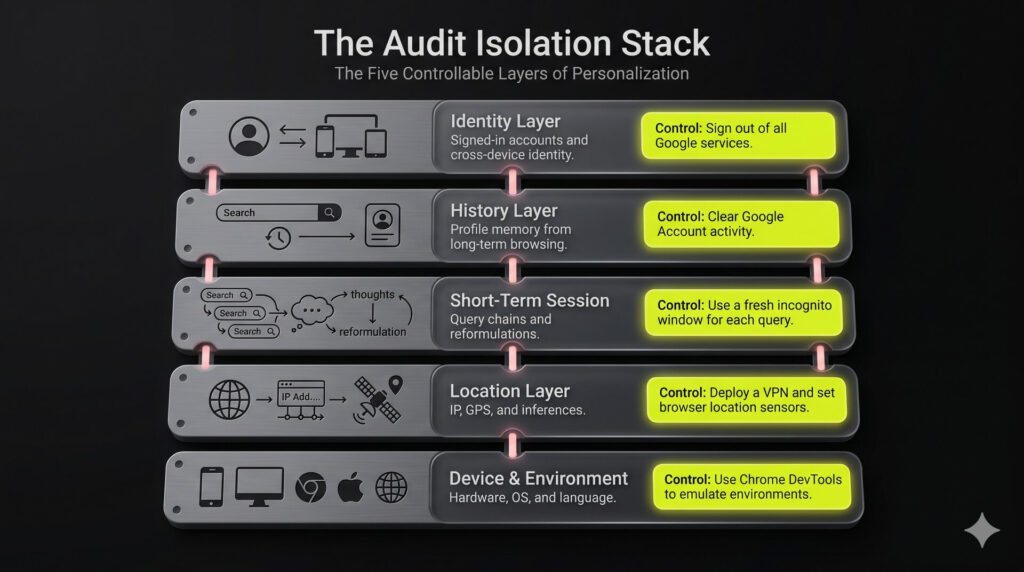
SEO and GEO experiments require a clean baseline. You cannot trust visibility audits performed on a “dirty” browser carrying personal search bias. To isolate causes rather than debating “Google being weird,” you must control these five layers:
- Identity Layer: Signed-in accounts and cross-device identity. Control: Sign out of all Google services.
- History Layer: Profile memory from long-term browsing and app activity. Control: Clear Google Account activity.
- Short-Term Session: Query chains, dwell time, and reformulations within a single window. Control: Use a fresh incognito window for each query.
- Location Layer: IP, GPS, and “near me” inferences. Control: Deploy a VPN and set browser location sensors to the target locale.
- Device & Environment: Hardware, OS, and language settings. Control: Use Chrome DevTools to emulate specific mobile or desktop environments.
These layers dictate the visibility surface, altering SERP features, local packs, search suggestions, and AI summary citations. Note that incognito mode is not a total shield. Even anonymous sessions leak context via IP-based locale and real-time session behavior patterns alter the active ranking layer, dictating how nodes enter the engine’s primary indexing playbook. Mastering these variables transforms a vague concept into a concrete inventory for SEO audits.
3. Beyond Link Reordering: The Synthesis Shift
Search personalization in 2026 has evolved from reordering links to dictating the architecture of the answer itself. It determines:
- Which SERP modules appear, such as AI Overviews, PAA variants, or local packs.
- Which specific sources the engine selects for synthesis and citation.
- Which entities or brands receive implicit recommendation in the generated response.
This shift creates rapid reinforcement loops based on prior satisfaction. When users fulfill intent through your domain, engines develop a brand bias that prioritizes your site for subsequent query chains. For advanced SEOs, engagement is no longer a universal signal; it is a personalized trust proxy. Intent alignment and topical authority now function as the primary filters for source selection within generative layers.
Traditional rank tracking often underpredicts losses because it ignores how personalization shifts citation selection. To dominate, you must optimize for coverage across multiple personas rather than a single canonical SERP. This requires being the cited authority for the CMO while remaining the deep technical resource for the practitioner. Align your content infrastructure with specific E-E-A-T proxies that AI engines use to verify source credibility during the synthesis process.
Diagnostic question: Is your brand losing global visibility, or only failing in specific user contexts and personas?
4. How to Neutralize Personalization for Clean SEO Audits
Valid SEO audits require distinguishing between removable account-based personalization and permanent location or session context. Because perfect neutrality is impossible, prioritize repeatability to ensure consistent technical verification. Use these configurations to minimize profile-driven search personalization:
Google Optimization
- Sign out or use a dedicated “clean” Chrome profile with no search history.
- Pause “Web & App Activity” in your Google Account Data & Privacy settings.
- Append &pws=0 to the search URL to disable profile-based ranking adjustments.
- Select “Try without personalization” when prompted within the SERP.
Bing and DuckDuckGo
For Bing, sign out and clear your history via the Microsoft Privacy Dashboard. DuckDuckGo provides an excellent baseline because it lacks profile-driven personalization by design, though it still utilizes query and location data.
Mobile Verification
On Android, toggle off “Search Personalization” within the Google app’s Privacy & Safety settings. On iOS, manage settings across both the Google app and your centralized account activity controls. Aim for consistent audit conditions rather than seeking a universal “true” rank.
5. Designing a Rigorous SERP Divergence Experiment
Personalization creates volatility across identity, history, and location. Use a four-condition control group to isolate which variable triggers result shifts in both Google SERPs and generative AI summaries. This framework moves beyond anecdotal evidence by quantifying the delta between specific user layers.
- A) Identity: Signed-in, normal browsing with a real user profile.
- B) Filtered Activity: Same account with Web and App Activity paused.
- C) Baseline: Signed-out incognito session with a clean browser profile.
- D) Geo-Control: Signed-out session using a VPN endpoint.
For every query, capture top organic results, SERP features, and cited domains within AI answer layers. Verify whether your brand entity appears in the synthesis. Interpret data as an overlap percentage or “delta” rather than simple rank movement.
Maintain a fixed query set on a recurring schedule to track GEO authority across personas. Continuous monitoring identifies whether shifts are localized to intent packs or informational summaries. This rigorous design prevents flawed SEO conclusions by making personalization measurable and repeatable across controlled environments.
6. Maximizing Eligible Surfaces: Strategies for Generalizable Authority
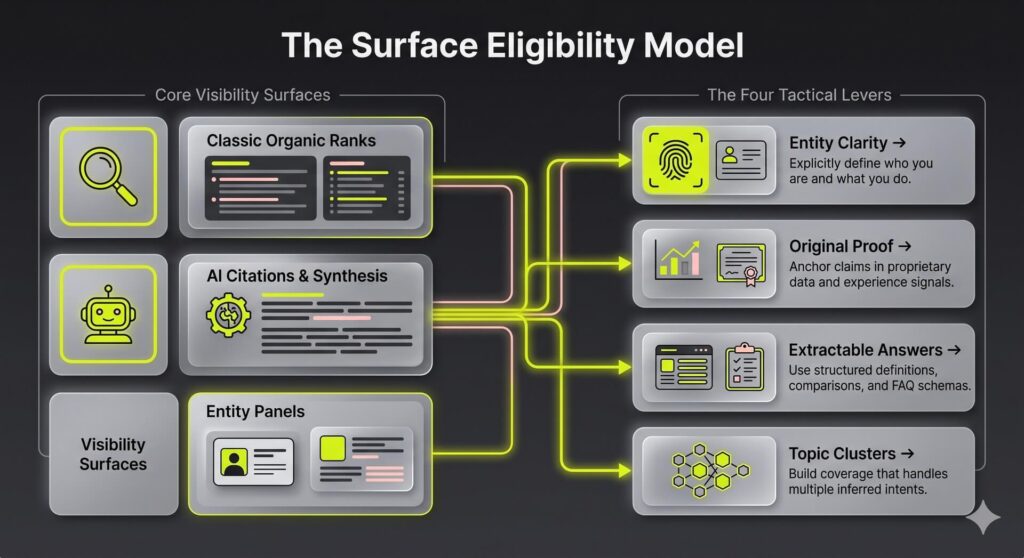
Universal ranking is obsolete in the era of search personalization. Brands must pivot from chasing “Position 1” to maximizing eligibility across three core surfaces: classic organic ranks, AI citations, and entity panels. Ensure your content is the definitive candidate for LLM synthesis regardless of user history.
Generalizable authority relies on four tactical levers:
- Entity Clarity: Explicitly define who you are and what you do.
- Original Proof: Anchor claims in proprietary data and experience signals.
- Extractable Answers: Use structured definitions, comparisons, and FAQ schemas.
- Topic Clusters: Build coverage that handles multiple inferred intents.
Avoid engagement hacks targeting biased users. These tactics fail to scale across diverse search contexts. Apply a citation-first audit: “If an AI system had to cite one paragraph from this asset, which would it be?”
Personalization accelerates winner-take-most dynamics. Being the cited source compounds pipeline by establishing your brand as the answer layer. High eligibility is the only sustainable moat against fluctuating user bias.
7. Reclaiming the Narrative: Legible Reporting for Leadership
Search personalization makes “average rank” a ghost metric. Global averages mask risk while competitors capture your high-value segments. To regain strategic control, replace legacy KPIs with reporting primitives that align search visibility with pipeline outcomes.
Stop reporting site-wide averages. Track these primitives instead:
- Segmented visibility: By location, device, and persona to identify exactly where the funnel is leaking.
- Answer engine presence: Track share-of-answer and citation frequency in AI layers like Perplexity and Gemini.
- Branded vs. non-branded drift: A drop in non-branded visibility signals a loss of top-funnel reach, as brand bias often masks personalization decay.
Communicate this shift to leadership using this template: “We are stable overall, but losing in new-user contexts, which predicts pipeline decline.”
To become the cited answer, you need an AI-native strategy. Explore NUOPTIMA’s GEO services to dominate the answer layer and secure your organic pipeline.

How to Execute a Personalization-Proof Search Audit
Search personalization makes audits non-reproducible without standardized conditions. Standardizing variables allows you to measure true visibility instead of search noise. Use this playbook to stabilize data and turn observations into prioritized SEO and GEO actions.
Audit Prerequisites
- Clean browser profile: Use a dedicated instance with no history or active accounts.
- Infrastructure: Secure VPN endpoints, a fixed query set, and a logging sheet to track variables.
Execution Workflow
- Define query cohorts by informational, commercial, and local intent.
- Run baseline queries in a signed-out, clean profile to find neutral SERPs.
- Run signed-in queries to estimate returning user bias and brand affinity.
- Pause account activity and rerun tests to isolate specific session history.
- Cycle through VPN variants to map regional visibility shifts across target markets.
- Record SERP features and AI citations for every individual search run.
- Convert findings into actions including content gaps, entity clarity, structured answers, and internal linking.
The final output is a visibility distribution and citation gap list that feeds your GEO roadmap.
Where this fits in your MSP growth system
This is one piece of how NUOPTIMA makes MSPs and cybersecurity firms the provider buyers find on Google and in AI search. See how it connects to MSP SEO and GEO and AI-search, or get your free MSP lead forecast to see exactly where your firm shows up across ChatGPT, Gemini, and Perplexity today.