SEO teams face an impossible mandate: ship more content, technical fixes, and reporting while AI search shifts demand toward citation-worthy authority. Most treat automation seo as a tool pile. We frame it as an operating system for total search dominance.
Automation SEO means using scripts, models, and pipelines to run the repeatable parts of SEO (research, internal linking, schema, reporting, refreshes) so human effort concentrates on judgment and original insight. Done right it raises throughput without flooding your site with generic prose. The goal is information gain at scale, not more thin pages competing for the same answer.
Key Takeaways
- Automation SEO means using scripts, models, and pipelines to run the repeatable parts of SEO (research, internal linking, schema, reporting, refreshes) so humans focus on judgment and original insight.
- The core rule is to automate the inputs (data, structure, monitoring) but never the opinion, keeping a human QA checkpoint for high-stakes claims.
- Semantic clustering before production assigns one canonical URL per intent cluster to prevent keyword cannibalization as you scale publishing.
- Vector-driven internal linking and continuous technical monitoring (indexation, Core Web Vitals, template issues) protect and consolidate entity authority with auto-generated tickets.
- The compounding layer of research automation feeding human-reviewed content helped produce roughly 11.6x organic growth for Eden Data in six months.
Why it matters for MSPs and cybersecurity firms
- Most MSPs run a one-person or zero-person marketing function, so manual SEO simply never ships.
- AI engines cite specific, verifiable claims, not volume, which is exactly what a one-person team struggles to produce consistently.
- Automating the grunt work frees your technical experts to supply the accurate detail that makes content citation-worthy.
Our rule: automate the inputs (data, structure, monitoring), never the opinion. The compounding layer that produced ~11.6x organic growth for Eden Data in six months is research automation feeding human-reviewed content, which anchors our wider MSP content engine.
These five AI-native plays increase throughput without sacrificing quality, keeping your strategy human while citations scale. We begin with the automation that creates compounding advantage through information gain rather than volume.
1. Automating Research Gaps to Secure AI Citations
Most automation fails because it scales generic prose instead of unique insights. To dominate rankings and secure AI citations, you must automate research discovery to produce citation-worthy deltas. This turns your content pipeline into a quality multiplier that makes unique value and information gain the default output for every page.
A strategic automated workflow follows three steps:
- Trigger: A target keyword enters the content backlog.
- Extraction: A script via no-code (Make) or code (Python) scrapes SERP pages to map existing entities and data points.
- Synthesis: An LLM identifies gaps and generates an outline detailing the “must-add” angles competitors missed.
Enforce a strict “information gain” guardrail for every output to avoid lookalike content. Each article must provide proprietary frameworks, specific examples, or new data to satisfy Generative Engine Optimization (GEO). Answer engines reward clean, extractable fact patterns and prioritize content that offers a distinct, verifiable delta from their existing training sets.
For example, if competitors targeting “B2B SEO pricing” only list retainers, your gap analysis would trigger three angles: invisible search costs, GEO-readiness audits, and revenue-based models. Include a human QA checkpoint for high-stakes claims to maintain authority. This prevents automated content from becoming generic noise and ensures factual deltas are cited.
2. Orchestrating Semantic Clusters to Prevent Keyword Cannibalization
Internal competition dilutes authority and stalls rankings. Scale publishing safely by deploying a pragmatic control system that clusters intent before production. This ensures every content hour builds domain authority rather than cannibalizing existing assets.
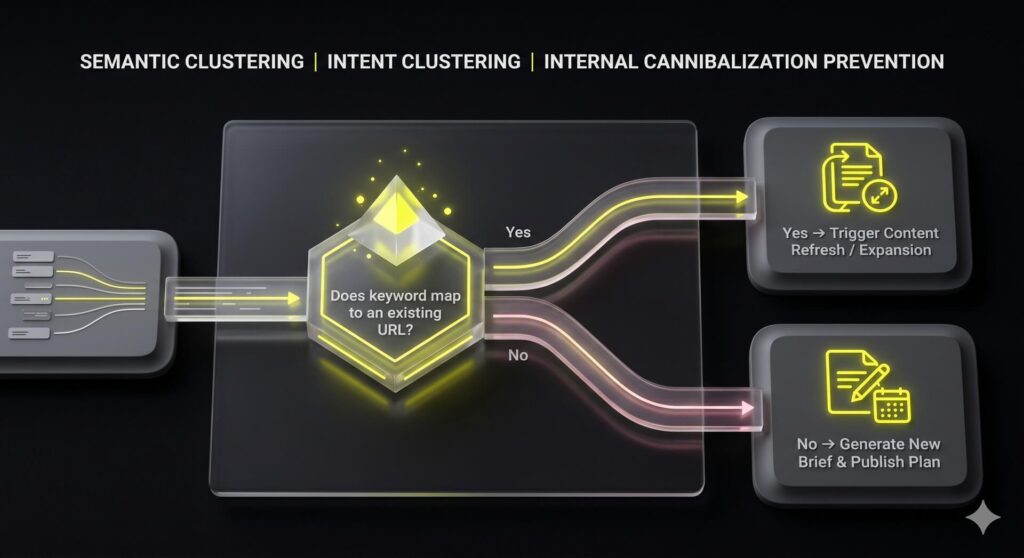
The automation SEO workflow processes keyword exports through semantic clustering using embeddings or tool-based grouping. This identifies intent patterns rather than syntax and assigns one canonical target per cluster to prevent internal duplication.
Decision Logic:
- If keyword maps to an existing URL: Trigger a content refresh or expansion.
- If cluster is vacant: Generate a new brief and publish plan.
The automation produces a Jira or Sheet export with these fields:
- Cluster name
- Primary keyword
- Existing URL
- Action (Refresh/New)
- Priority
Governance Assign one architect to approve all mappings to maintain entity integrity and prevent overlap. Control velocity with a ramp-up period to measure search response and iterate before full-scale acceleration.
Micro-Template: Cluster Spec
- Cluster Identity: Core semantic topic.
- Search Intent: Buyer journey stage.
- Primary Keyword: Optimization anchor.
- Target URL: Canonical destination.
- Action Logic: Refresh or New Build.
3. Scaling Authority via Vector-Driven Internal Linking
Manual internal linking is a scalability bottleneck that results in missed authority and orphaned pages. We treat internal links as a compounding lever, using a systematic retrieval and placement engine to eliminate the manual grind. This ensures fast discovery and implementation of high-impact links without the risks of spammy auto-insertion.
The process crawls your site and chunks long-form content into semantic units, converting them into embeddings for a vector database. The system then retrieves the top related source candidates for any target URL. An LLM analyzes context to propose exact anchors and sentence placements.
The engine returns structured JSON for human review in spreadsheets or pull requests:
- source_url
- target_url
- anchor
- sentence
Approved changes are applied programmatically via CMS batch updates. This eliminates manual editing while maintaining total editorial control and avoiding low-quality link patterns. Built-in governance prevents poor automation by capping link density, diversifying anchors, and blocking circular references.
For example, a “GEO services” target page can receive automated suggestions from blog posts discussing AI search trends. This site architecture consolidates entity authority. It ensures key assets are easily retrievable for generative answer engines, improving visibility in AI-generated answers.
4. Building a Continuous Technical SEO Monitoring System
Marketing leaders don’t need 100-page audits that collect dust; they need an operational system that converts technical issues into prioritized work. Traditional audits are static snapshots. To dominate Google and AI search, you must shift to a real-time defense system that protects organic revenue and entity authority.
Automate these three critical monitoring categories:
- Indexation Anomalies: Sudden drops in indexed pages or spikes in noindex and canonical changes.
- Performance Regressions: Core Web Vitals dips that threaten rankings and user experience.
- Template SEO Issues: Heading architecture, title tags, and canonical errors detected via scheduled crawls.
The Automation Workflow:
- Trigger: A scheduled crawl or API threshold breach identifies an issue.
- Report: The system generates a concise incident report with affected URLs and severity.
- Action: Auto-create Jira or Asana tickets with priority, recommended fixes, and reproduction steps.
- Notify: Tag the owner in a dedicated Slack channel for immediate remediation.
Set strict thresholds to reduce alert fatigue and use weekly digests for low-priority items. Ensure your system validates JavaScript rendering, as AI crawlers require fully rendered content to extract your entity data.
Auto-Ticket Checklist:
- Full list of affected URLs
- Visual evidence (screenshot or code snippet)
- Business severity level
- Assigned owner and deadline
5. Transforming Reporting into a Strategic Decision System
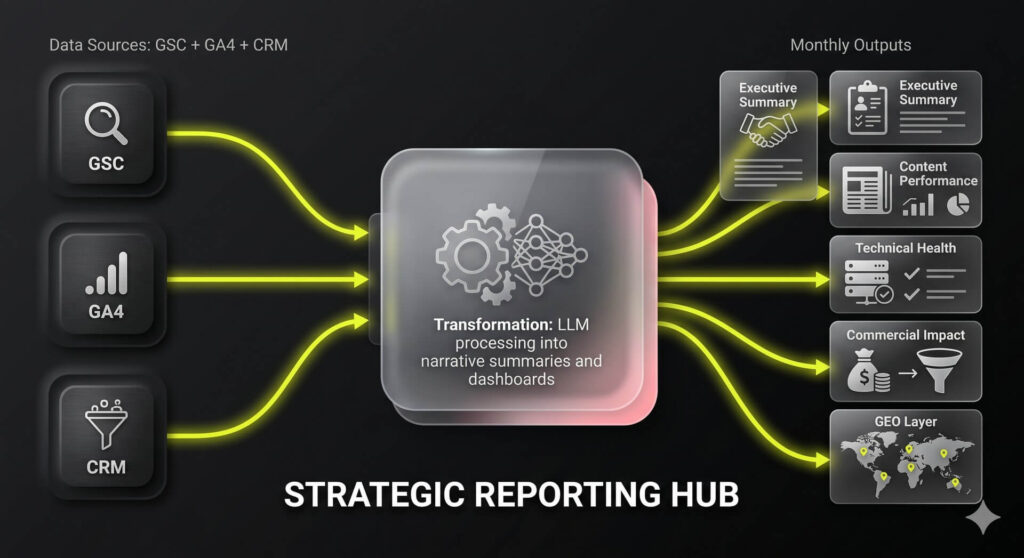
Automation transforms reporting from a passive scoreboard into a strategic decision system. By syncing GSC and GA4 with your CRM, you pivot from tracking clicks to measuring organic revenue and pipeline. This alignment proves commercial impact and secures budget for automation seo in AI-driven search environments.
Automate these monthly outputs:
- Executive Summary: Narrative wins, losses, and strategic next actions.
- Content Performance: Automated identification of pages to refresh or consolidate.
- Technical Health: Real-time logs of incidents and time-to-fix metrics.
- Commercial Impact: Leads and pipeline influenced by organic search.
- GEO Layer: Brand mentions in AI answers, prompt sets, and visibility deltas.
Workflow logic follows a sequence: pull data (GSC, GA4, CRM), transform it via LLM into narrative summaries, and publish to dashboards. The system should auto-generate a list of the top 10 high-impact tasks with assigned owners and expected impact.
Build vs. Buy
Standard dashboard tools work for basic tracking. Custom ETL scripts and proprietary GEO measurement require a dedicated solution.
For teams seeking expert automation and a GEO measurement layer, nuoptima.com builds the strategic infrastructure to own the answer layer.
How to Implement an Automation SEO Framework in 30 Days
Automation without orchestration scales mistakes at the speed of computation. Automating a flawed strategy simply accelerates your exit from search results. Use this 30-day implementation sequence to automate data collection and execution first while keeping human approvals where risk is highest.
Prerequisites for Strategic Scale
Define your KPI stack before launching scripts. This list must include pipeline revenue, lead volume, and AI visibility goals such as citation counts and brand mentions. Map your current workflow to identify exactly where work enters the system, who provides approval, and where final execution occurs. You will gain a clear blueprint of your human-to-machine handoff points.
Week 1: Instrumentation and Backlog Hygiene
Standardize your URL inventory and content map to create a single source of truth. Build a cluster schema in Sheets or Jira that defines your topical boundaries and entity relationships. Establish hard rules for refresh versus new page actions. You will end this week with a prioritized backlog where every keyword is assigned to a specific cluster and target URL.
Week 2: Context Layer and Content QA
Automate competitor data extraction to build automated gap briefs. Ensure these briefs identify the unique information gain required to secure AI citations in generative engines. Implement a required QA gate that checks for factual accuracy, internal link health, and keyword cannibalization. This step ensures that your automation seo efforts prioritize quality over raw volume.
Week 3: Internal Linking and On-Page at Scale
Launch an embeddings-based suggestion engine to find authority-building opportunities across your site. Review these suggestions in batches and use programmatic implementation for all approved links. This process consolidates your entity authority across primary pillars without the manual editing grind. You will see a more resilient internal link architecture that supports both Google and LLM discovery.
Week 4: Technical Monitoring and Executive Reporting
Deploy defensive automation to protect your gains. Configure monitoring systems to generate Jira tickets automatically for indexation anomalies or performance regressions. Launch a weekly executive summary that translates technical work into pipeline impact and strategic next actions. This converts complex technical data into clear business outcomes for leadership.
Governance Rules
Maintain human-in-the-loop approvals for all high-value revenue pages to manage risk. Ramp your publishing velocity over 90 days rather than spiking overnight to avoid quality flags. Always use a staging-first approach for every sitewide technical or internal linking change.
If you want an AI-native SEO and GEO partner to implement this system for your brand, visit nuoptima.com and explore our GEO services page.
For teams aiming to achieve “be the answer” outcomes through advanced automation, visit nuoptima.com or explore our specialized GEO services to start your strategy.
Where this fits in your MSP growth system
This is one piece of how NUOPTIMA makes MSPs and cybersecurity firms the provider buyers find on Google and in AI search. See how it connects to MSP SEO and GEO and AI-search, or get your free MSP lead forecast to see exactly where your firm shows up across ChatGPT, Gemini, and Perplexity today.