Stop losing crawl budgets to index bloat. Start treating site architecture seo as the blueprint for how URLs, templates, and internal links express hierarchy. Complex sites fail when technical waste hides high-value pages from AI answer engines. Use these six moves to improve indexation throughput and clarify entity relationships. Validate your progress with log files or GSC. Partner with NUOPTIMA, the AI-native SEO authority, for GEO services to dominate the generative search layer.
Key Takeaways
- Site architecture is the URL hierarchy, internal linking, and templates that determine how search engines and AI engines discover, crawl, and interpret your domain.
- Set a hard boundary across three URL tiers: indexable (high-intent revenue pages), discoverable (noindex, follow support pages), and blocked (search results, session IDs) to stop crawl waste.
- Govern faceted navigation by tier: make high-value combinations indexable with self-referencing canonicals, set medium filters to noindex/follow, and block low-value parameters.
- Engineer internal links with a donor-acceptor model, sending authority from high-traffic donor pages to priority acceptor pages, and keep XML sitemaps to canonical URLs only.
- Build a retrieval surface for generative engines with authoritative hubs, crawlable HTML breadcrumbs, BreadcrumbList and FAQ schema, and clear entity relationships to earn AI citations.
1. Define a Hard Boundary Between Discovery and Indexation
Large sites often fail because they treat every generated URL as an indexation candidate. This dilutes domain authority and creates crawl waste, forcing Googlebot to spend its budget on low-value parameters instead of conversion-ready pages. This hard boundary between crawlable and indexable URLs is fundamental to site architecture seo.
Enforce a classification system across three distinct tiers:
- Indexable: High-intent URLs with specific ranking and revenue KPIs.
- Discoverable: URLs supporting internal linking using noindex, follow directives.
- Blocked: Technical dead ends like internal search results or session IDs.
Implementation requires an inventory of URL patterns via crawl logs to assign business intent per path. Deploy a strategy that aligns your technical directives:
- Inventory: Catalog top patterns and parameters to identify crawl traps.
- Intent: Assign a KPI to every pattern (rank, support, or suppress).
- Directives: Enforce the boundary via canonical tags, meta robots, and robots.txt.
Validate progress through Google Search Console Crawl Stats and Index Coverage reports, ensuring XML sitemaps only include canonical, indexable URLs to provide clean signals. Example: index category pages while blocking filters and canonicalizing tracking parameters. Monitor crawl frequency for revenue-driving clusters, an operational principle that mirrors how modern tech firms build the digital frameworks that remote IT support leads trust during procurement. This precision forces Google and generative engines to focus on your highest-value assets, accelerating brand citations in AI-generated answers like Perplexity.
2. Operationalize Facet Governance to Prevent Crawl Traps
Faceted navigation triggers a combinatorial explosion of URLs. Millions of near-duplicate pages consume crawl budgets and dilute category authority. Dominant site architecture seo requires a governance model that separates revenue-driving pages from technical noise.
Classify facet patterns into three tiers based on intent and demand:
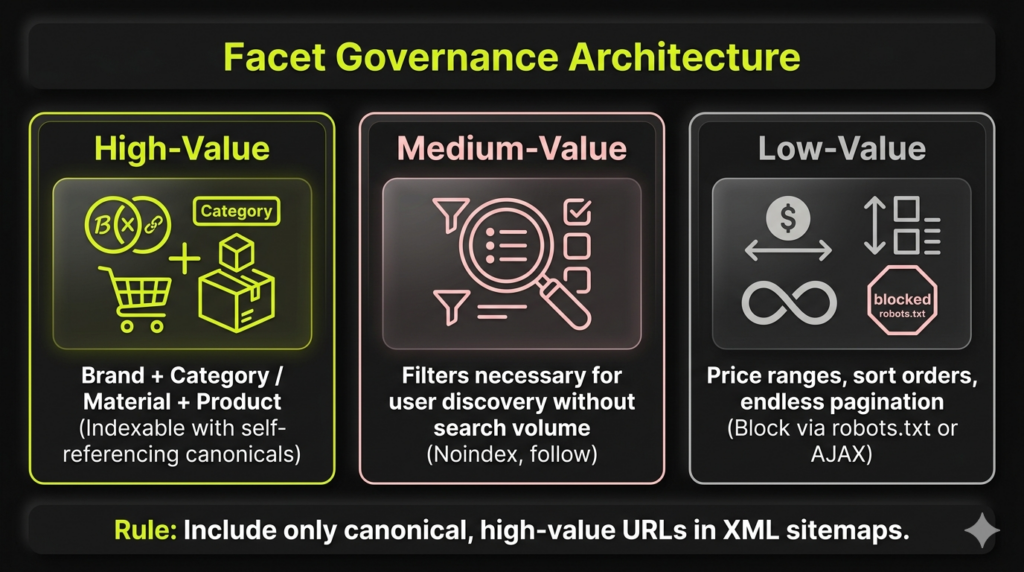
- High-Value: High-intent combinations like Brand + Category or Material + Product. These must be indexable with self-referencing canonicals to capture search volume.
- Medium-Value: Filters necessary for user discovery that lack search volume. Use noindex, follow to allow link equity to flow without bloating the index.
- Low-Value: Parameters like price range, sort order, or endless pagination variants. Block these via robots.txt or render them using AJAX to prevent crawlers from entering traps.
Include only canonical, high-value URLs in your XML sitemaps. Clear indexation signals are essential for LLM citation and AI-search visibility, especially when buyers audit documentation to evaluate IT help desk support services compliance standards.
Validate your governance by monitoring Google Search Console for a downward trend in “Excluded” parameter URLs. Check server log files to ensure crawl frequency shifts toward your money pages. When facet architecture is lean, generative engines can more easily map product entities and cite your brand in AI-generated answers.
3. Map Intent Hierarchy to Nested Folder Patterns
Unclear topical ownership forces search engines to guess which URL satisfies intent. Without a defined hierarchy, feature pages and blog articles compete for the same queries. This fragmentation triggers internal cannibalization and dilutes authority across both Google and generative AI engines.
Transition to a nested folder pattern that reflects parent-child intent. Establish category hubs as canonical parents and place subtopics in consistent subfolders. For example, a B2B SaaS brand should use /solutions/ as the pillar and /solutions/lead-generation/ for child pages. Explicit folder structures allow crawlers to map relationships and entity associations without processing redundant internal links.
Avoid generating multiple pages where only the keyword modifier changes if the underlying intent remains identical. Consolidate near-duplicates to concentrate authority into a single knowledge graph entity. Every hub page must include:
- A concise topic summary
- A navigational module
- “Best next page” internal links to guide users and LLM crawlers.
Validate the architecture by running a cannibalization check in Google Search Console. If multiple URLs map to the same query, consolidate or re-nest the content immediately. Ensure every child page has an unambiguous parent and every hub has comprehensive child coverage. This structural precision builds the entity authority required to become the cited answer in generative search results.
4. Engineer Internal Linking via Donor-Acceptor Models
Stop letting high-value clusters sit orphaned while Google discovers deep pages months late. Ad-hoc strategies fail at scale because they are unpredictable and untestable. Move toward an engineered internal link dataset that maps donor URLs to acceptor URLs. This transforms linking into a scalable system that powers your site architecture seo.
Crawl your site to identify orphaned pages and those with an average depth greater than five. Define donors as high-authority pages with traffic and acceptors as priority pages needing discovery. For a SaaS docs site, a high-traffic “Quickstart Guide” (donor) should link to a specific “Advanced API Authentication” page (acceptor) to pass authority, mimicking the structural link flow found in an enterprise network support services MSP guide configuration.
Implementation Workflow:
- Identification: Use crawl logs to find isolated nodes and deep URLs.
- Mapping: Generate candidate links using a defined dataset (donor URL, anchor, and acceptor URL) based on semantic similarity.
- Deployment: Store these relationships in a central database and deploy via UI templates for stability.
- Governance: Cap contextual links per page to preserve equity and avoid sitewide footer spam.
Monitor average crawl depth and indexation speed for acceptor cohorts. Track impression lift in GSC to confirm authority flow. This systematic approach ensures your site architecture supports both Google discovery and the entity extraction required for citations in AI search engines like Perplexity.
5. Reinforce Hierarchy with Persistent Breadcrumb Navigation
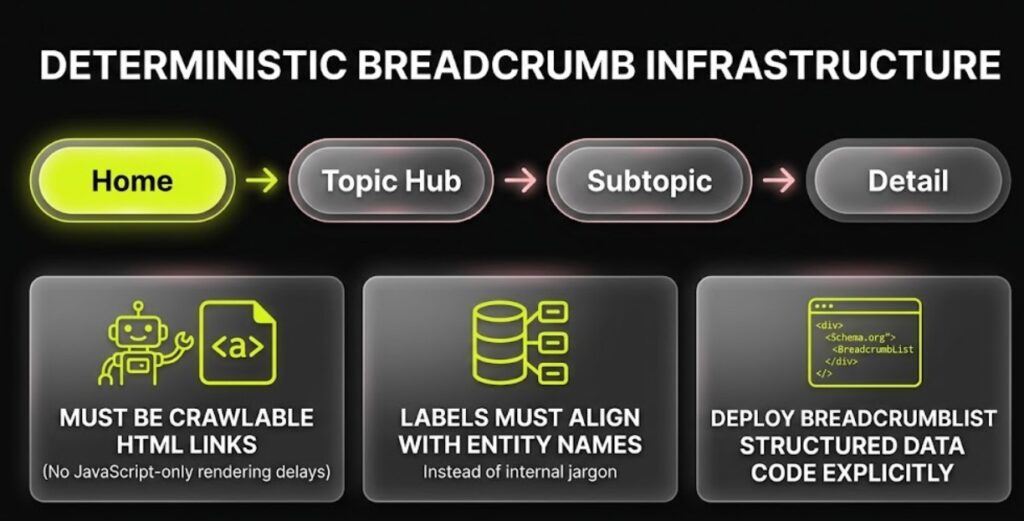
Enterprise sites with massive organic footprints rely on deterministic crawl paths to guide search engines through complex structures. Breadcrumbs and global navigation provide “always-on” internal linking infrastructure that defines site hierarchy. Every URL must maintain a consistent upward path to a parent hub to solve weak parent-child reinforcement. This structure creates a predictable route for bots to distribute authority and index deep content, directly improving site architecture seo for large-scale B2B sites.
Implementation requires a strict hierarchical pattern: Home > Topic Hub > Subtopic > Detail. Breadcrumbs must be crawlable HTML links rather than JavaScript-only elements to ensure immediate discovery and prevent rendering-based crawl delays. Align breadcrumb labels with entity names instead of internal jargon. This helps LLMs and generative engines associate your pages with specific knowledge graph nodes, increasing citation potential in AI-generated answers.
Deploy BreadcrumbList structured data to explicitly define these relationships in the code. Navigation must link exclusively to canonical URLs, never low-value parameter or filter states. Validate the architecture by crawling the site to identify breadcrumb loops or inconsistent parent assignments.
For mobile-first designs, verify that hidden navigation menus still expose the underlying HTML links to crawlers. Consistent hierarchy signals make the site legible to both Google and AI engines, turning site architecture into a defensible authority moat. This ensures authority distributes predictably, improving indexing efficiency for deep content.
6. Build a Retrieval Surface for Generative Search Engines
Why is your brand missing from AI summaries even when you rank on page one? Traditional site architecture SEO focuses on Googlebot discovery, but modern architecture must build a retrieval surface for generative engines. Systems like Perplexity and Gemini summarize, cite, and recommend rather than just ranking URLs. Without clear entity relationships, AI engines cannot extract the canonical truth needed to credit your brand as the authoritative source.
To dominate the generative search layer, optimize your site structure for extraction:
- Build authoritative hubs: Consolidate definitions and comparisons into “best answer” sections that serve as primary data sources.
- Eliminate redundancy: Remove near-duplicate variants that dilute topical authority and confuse LLM retrieval systems.
- Prioritize accessibility: Ensure critical content is accessible to AI crawlers by removing blocked rendering on key pages.
- Strengthen internal linking: Create explicit “aboutness” signals that connect specific entities to their attributes and use cases.
- Deploy FAQ blocks: Use FAQ schema on core pages to match user intent and facilitate citation extraction for answer engines.
Validate your architecture by spot-checking AI responses for citation patterns. Trace these mentions back to specific URLs to identify which structures drive citations and which are ignored.
NUOPTIMA helps brands bridge the gap between Google rankings and AI visibility. Partner with our GEO services to ensure your brand becomes the definitive answer in every generative search experience.
If you need expert implementation, NUOPTIMA provides specialized GEO services to ensure your brand becomes the definitive answer in generative search results. Contact us for an SEO strategy to build a retrieval-ready content infrastructure.
Where this fits in your MSP growth system
This is one piece of how NUOPTIMA makes MSPs and cybersecurity firms the provider buyers find on Google and in AI search. See how it connects to MSP SEO and GEO and AI-search, or get your free MSP lead forecast to see exactly where your firm shows up across ChatGPT, Gemini, and Perplexity today.