Rankings dipped and pipeline stalled, yet your cloud migration firm holds years of backlink equity. You do not need a new content program. You need a revenue recovery lever. A strategic content refresh seo system diagnoses decay and prioritizes high-impact winners to make pages citation-ready for Google and AI engines. This is not a cosmetic date change. It aligns intent, CTR, and conversion to prove impact fast, mirroring the rigorous systems used when navigating the SEO agency vs freelancer dilemma to secure dedicated growth engineering. We start with diagnosis to avoid wasting resources.
Key Takeaways
- A content refresh is a revenue recovery lever, not a cosmetic date change, that diagnoses decay and prioritizes high-impact pages to make them citation-ready for Google and AI engines.
- Use Google Search Console to isolate the failure mode: CTR decay (rewrite meta titles), ranking decay (fill intent gaps and links), or demand shift (repoint to new queries).
- Prioritize striking-distance pages ranking between positions 3 and 20, since they already hold search equity and offer the fastest path into the click zone.
- Calibrate cadence to real change velocity: quarterly reviews for core service pages, monthly checks for transactional pages, and refresh 5 to 10 pages monthly so wins are attributable.
- Scale with AI only under one rule, AI drafts and humans publish, grounding the AI in a proprietary knowledge pack so refreshes add net-new value instead of eroding entity authority.
Content refresh SEO is a system that diagnoses content decay and updates high-impact existing pages to realign intent, CTR, and conversion, recovering rankings for both Google and AI search.
1. Diagnose the Failure Mode with GSC Data
Most teams waste effort on their content refresh SEO because they confuse CTR collapse or demand shifts with “outdated” content. Use Google Search Console to compare the last 28 days against the previous period or year, reviewing impressions, clicks, and average position to isolate the failure mode.
- CTR Decay (Stable rank, lower CTR): Fix by rewriting meta titles and tightening the above-the-fold answer to reclaim the click.
- Ranking Decay (Sliding position): Resolve this by filling intent gaps, refreshing entities, and improving internal link density.
- Demand Shift (Falling impressions): Don’t polish the old intent. Repoint the page toward emerging search angles and new queries.
Organize these refreshes into cohorts to track organic revenue impact and prevent wasted resources on pages that simply lack demand.
2. Prioritize Striking Distance Pages for Immediate Pipeline
Content refreshes fail when you optimize pages with zero search equity. Target “striking distance” assets ranking between positions 3 and 20 to move into the click zone quickly. These assets represent your highest probability for disproportionate revenue gains because they already possess search equity but lack the precision to capture top spots.
Filter Google Search Console performance data for the last 28 days to isolate these opportunities. Map content directly to queries surfaced in your report to ensure edits address proven intent. Use these tactical actions:
- Move primary answers higher to reduce “scroll to value.”
- Add snippet-ready definitions, steps, and comparison tables.
- Include sections for high-intent modifiers like “cost,” “AWS/Azure,” or “migration partner.”
Request re-indexing and monitor position, CTR, and conversions for 4 to 12 weeks to validate revenue impact.
3. Calibrate Refresh Cadence to Real-World Change Velocity
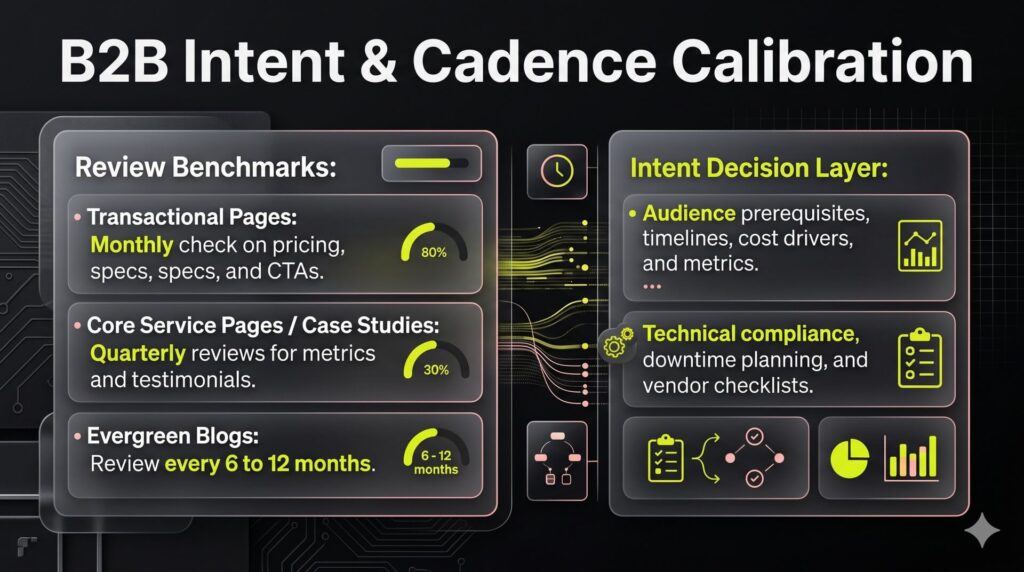
Generic advice to update every six months ignores the real-world change velocity of B2B offers. High-performance content refresh seo aligns cadence with what Google and AI engines require for accuracy. Stale data erodes entity authority and prevents your brand from earning LLM citations.
Use these benchmarks to maintain accuracy:
- Core service pages: Quarterly light reviews; full refresh annually.
- Case studies: Update metrics and testimonials quarterly to maintain social proof.
- Transactional pages: Check pricing, specs, and assessment CTAs monthly.
- Evergreen blog posts: Review every 6 to 12 months only when decay signals appear.
Operationalize by refreshing 5 to 10 pages monthly so wins are attributable. Prioritize assets closest to revenue to ensure every update compounds your organic pipeline growth.
4. Realign Content with Evolving B2B Buying Intent
Rankings often drop because a query’s “job to be done” shifted from education to evaluation. Identify intent shifts by monitoring SERP composition. If impressions remain but clicks crater, Google likely prefers service pages over blogs. Your content refresh SEO strategy must pivot to meet this new intent.
Integrate a decision layer to address risk mitigation. Include:
- Target audience, prerequisites, and timelines
- Cost drivers and success metrics
- Vendor evaluation checklists and RFP questions
For cloud migration content, detailed platform variants like AWS, Azure, or GCP. Include security compliance, downtime planning, and migration phases. Swap generic links for intent-aligned CTAs like a migration roadmap or readiness audit.
Conversion rate is the primary KPI. Prove execution capability rather than just explaining a process.
5. Engineer for the Answer Layer and AI Citations
To recover clicks in 2026-style SERPs, you must win the answer layer. Your content refresh seo should prioritize featured snippets and AI Overview citations. Rewrite the above-the-fold section to include a direct definition, outcome, and target audience, followed by a procedural steps list.
Insert extractable blocks to improve LLM-friendly ingestion:
- Comparison tables for approaches, timelines, and risks.
- Bulleted lists of common pitfalls.
- Glossaries for key entities like rehosting or landing zones.
Include 4 to 6 FAQs pulled from sales calls to capture natural language intent. Finally, deploy FAQ, Organization, and Service schema to ensure claims match on-page content. Mastering these entity configurations is essential if you want to learn how to rank in ChatGPT search as a reliable baseline. This architecture makes your brand the definitive source of truth for both Google and generative engines.
6. Prevent Self-Cannibalization with a Consolidation Map
High-authority refreshes can accidentally outrank newer, lead-driving pages, cannibalizing authority and stalling pipelines. Use Google Search Console to identify pages with unstable, alternating positions for the same query set.
Choose a canonical winner based on:
- Strongest backlink equity
- Clearest intent alignment
- Highest conversion rate
Resolve the conflict through one of two consolidation paths:
- Merge content into the winner and 301 redirect the secondary page.
- Reposition the loser to a distinct intent, such as a technical how-to instead of a service overview.
Update navigation and internal links to route authority to the winner. Monitor GSC query overlap for two to six weeks to ensure rankings stabilize and the organic pipeline recovers.
7. Scale Content Refreshes with AI Without Sacrificing Authority
Bulk AI rewriting triggers ranking collapses because generic rewording erodes entity authority. Balancing execution speed against human editorial oversight is a central challenge when choosing between in-house SEO vs AI tools for operational workflows. To scale velocity without losing E-E-A-T, follow one rule: AI drafts, humans publish. Ground your AI in a “knowledge pack” of proprietary data to ensure factual depth.
This grounding base should include:
- Service definitions and pricing logic.
- Case study metrics and sales call snippets.
- Verified testimonials and brand differentiators.
Use AI to map intent gaps and striking-distance queries. Draft new sections providing net-new value, such as decision criteria, migration metrics, or technical proof points. Final human QA must verify factual accuracy, compliance, and brand voice. Without unique insights, your content offers nothing for AI engines to cite.
8. Protect Search Equity with Content Guardrails
You lose rankings fastest by “improving” a page and deleting the elements that earned its authority. Before editing, snapshot the following:
- Title tags and H1/H2 structure.
- Top-ranking queries and internal link patterns.
- Conversion CTA placement.
Never casually change URL slugs, primary intent, or backlink-earning sections like stats and definitions. Avoid over-optimizing headings or removing “boring” explanatory content that matches user intent. These elements provide the semantic anchors required for LLM citations and generative visibility.
Manage risk by refreshing content in cohorts rather than site-wide. Maintain strict version history and set a 2 to 4 week review window. If pipeline metrics slip, execute a rollback plan to restore the version search engines and AI engines already trusted.
How to Build a High-Performance Content Refresh Workflow
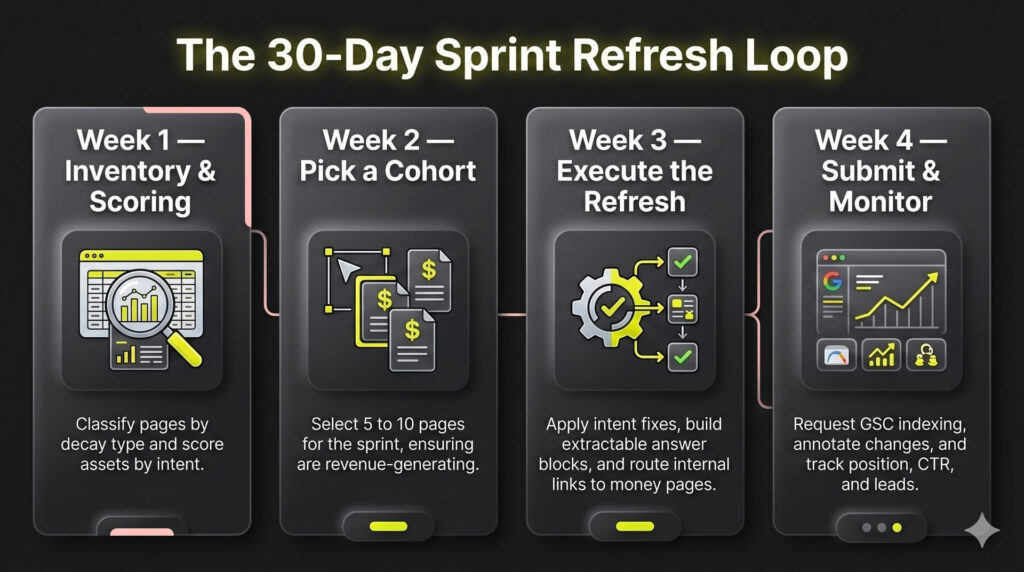
List posts inspire action, but workflows ship results. To move beyond static tactics, implement a minimum viable content refresh seo system. This repeatable 30-day loop transforms your blog into an operating system designed to compound rankings and AI-citation readiness.
Prerequisites
Before starting the sprint, complete these data-gathering steps:
- Pull Google Search Console data and top landing pages from analytics.
- Identify money pages, specifically service pages, case studies, and comparison guides.
The 30-Day Refresh Loop
- Week 1, Inventory and Scoring: Classify pages by decay type, such as CTR collapse, ranking slides, or demand shifts. Score each asset by intent to determine if it serves informational “how-to” needs or transactional service requirements.
- Week 2, Pick a Cohort: Select 5 to 10 pages for the sprint. Include at least two revenue-generating pages to ensure the work impacts your pipeline.
- Week 3, Execute the Refresh: Apply intent shift fixes and answer-layer upgrades. Tighten definitions and insert extractable blocks for AI engine citations. Update internal link density by routing authority from high-traffic posts to money pages.
- Week 4, Submit and Monitor: Request indexing in Google Search Console. Annotate all changes in your analytics platform to track CTR, position, and leads.
Maintain a measurable refresh log to prove which specific edits recover rankings. To operationalize this system across SEO and AI answer engines, partner with the specialists at nuoptima.com for generative engine optimization services.
For a GEO-ready refresh program, consult nuoptima.com for specialized generative engine optimization services.
Where this fits in your MSP growth system
This is one piece of how NUOPTIMA makes MSPs and cybersecurity firms the provider buyers find on Google and in AI search. See how it connects to MSP content marketing and MSP SEO, or get your free MSP lead forecast to see exactly where your firm shows up across ChatGPT, Gemini, and Perplexity today.