Selecting an SEO agency vs freelancer based on a price quote is a strategic mistake. You are choosing between a multi-specialist delivery system and a single operator. NUOPTIMA provides the specialist depth required to secure revenue and AI citations for 70+ global brands. This guide provides six criteria to map your growth stage to the right model, plus a scorecard and contract checklist. Start with your growth stage because it dictates every search outcome.
Key Takeaways
- A freelancer buys speed-to-learning for tactical wins like audits and on-page cleanups, while an agency buys compounding capability for parallel technical, content, and authority workstreams.
- Complexity is about dependencies, not page count: a 50-page migration can be riskier than a 1,000-page content refresh, and high-stakes migrations favor an agency's redundancy and QA.
- By 2026, visibility requires winning both Google rankings and AI citations (GEO), so map your internal gaps before choosing between specialist depth and an agency's synchronized execution.
- Mandate total account ownership from day one (GA4, Search Console, CMS, ad platforms) plus a 30-day handover clause to prevent vendor lock-in.
- Use the 90-day test: if one pair of hands can fix a specific bottleneck, hire a freelancer; if you need a scalable system to dominate search, pick an agency.
1. Define Your Outcome: Channel Viability vs. Compounding Revenue
Most B2B leaders fail their first SEO hire by confusing labor cost with outcome value. Choosing between an SEO agency vs freelancer requires forcing clarity: are you proving channel viability or scaling a proven revenue engine?
The Freelancer: Speed-to-Learning
A freelancer buys you speed-to-learning. This model is ideal for validating ROI before committing a significant budget. Use it for focused, tactical wins:
- Technical audits and roadmaps.
- On-page cleanups and content sprints.
- Local SEO fundamentals for niche providers.
This provides the agility to test what resonates without structural overhead.
The Agency: Compounding Growth
An agency buys you compounding capability. This is the choice when SEO is a critical growth lever tied to quarterly pipeline goals and multi-stakeholder expectations. Agencies execute parallel workstreams that freelancers cannot sustain:
- Technical architecture and content infrastructure.
- Entity authority and Generative Engine Optimization (GEO).
- Scaled CRO for SaaS or enterprise eCommerce platforms.
The 90-Day Decision Checkpoint
Write a one-sentence success definition: In 90 days, we need X (leads, demo requests, or AI citations). If X requires a single pair of hands to fix a specific bottleneck, hire a freelancer. If X requires a scalable system to dominate the search landscape, pick an agency.
2. Assess Project Complexity: Technical Dependencies and Risk Management
Losing years of organic authority during a botched site migration is an executive nightmare. Leaders often mistake site size for complexity. A 50-page migration is more dangerous than a 1,000-page content refresh due to irreversible technical dependencies. The choice between an agency and a freelancer is an exercise in risk management.
Agencies win when complexity creates multiple failure modes. This model provides the redundancy and rigorous QA required for high-stakes workstreams:
- Site migrations and international SEO architecture.
- JavaScript rendering and technical debt remediation.
- Analytics attribution rebuilds and cross-functional developer coordination.
When you hire an agency, you invest in documented processes that account for vacations and illness. If a migration triggers a ranking drop, a team provides the accountability a single operator cannot sustain.
Freelancers excel when a project is bounded and specable. They are ideal for:
- Defined audit deliverables.
- Keyword maps and template-specific optimizations.
- Coaching in-house teams through implementation.
If the scope has a clear finish line and low systemic risk, a specialist provides efficiency without agency overhead.
The Risk Checkpoint
Ask yourself: If this goes wrong, what is the cost to our organic revenue? If the revenue loss is meaningful, prioritize a model with built-in safety nets. Complexity is about dependencies, not page count.
3. Skill Breadth vs. Specialist Depth: Navigating the 2026 Search Reality
In 2026, organic visibility is no longer a linear race for keywords. Success requires dominating both Google rankings and AI-generated citations (GEO). This shift makes the generalist vs. specialist trade-off critical for your revenue pipeline.
Agency Advantage: Synchronized Execution
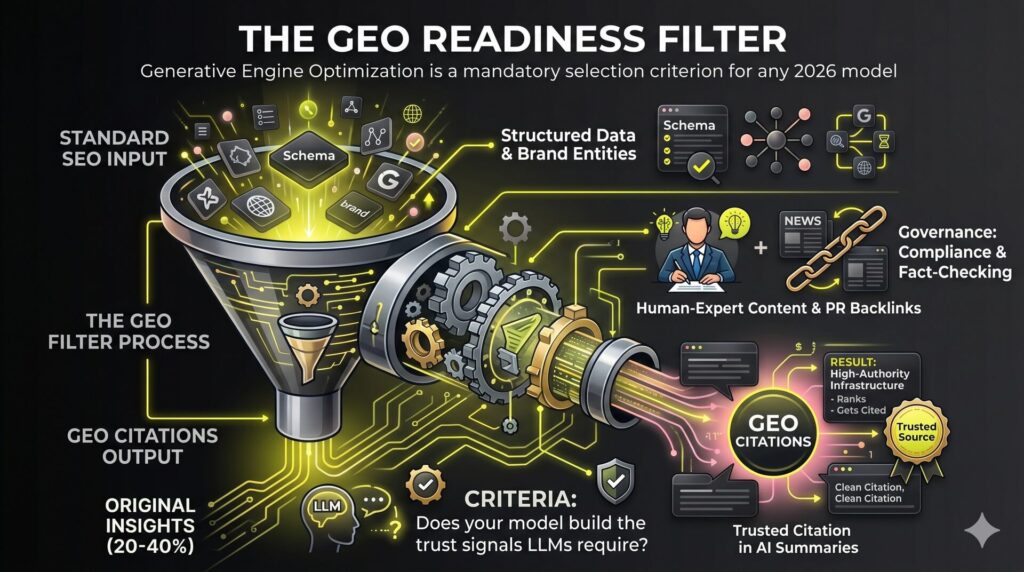
Agencies provide a synchronized delivery system for these complex, multi-surface strategies. This model is essential when your program requires technical SEO, entity architecture, and citation-ready content to work in unison. Built-in handoffs ensure your schema, internal linking, and authority signals align to make your brand a trusted source for LLMs like ChatGPT. Use an agency to build a complete search infrastructure from scratch.
Freelancer Advantage: Surgical Precision
Freelancers offer elite depth in a single slice of the organic strategy. This is the optimal choice for companies with robust in-house teams facing a specific bottleneck. An expert can plug into your existing system to solve technical audits for AI-crawlers or specialized link-building. You gain senior-level execution without paying for a full agency stack you do not need.
Decision Checkpoint: Capability Inventory
Perform a capability inventory to choose your model. Map your current internal resources:
- Technical development and site architecture
- Content production and SEO writing
- Data and revenue attribution analytics
- Digital PR and authority building
Hire the model that closes your specific gaps to avoid redundant costs. Sustainable dominance requires a full engine, not just a collection of parts.
4. Continuity and Parallel Execution: Solving Capacity Bottlenecks
Search growth often stalls not from lack of insight, but from lack of bandwidth. In the SEO agency vs freelancer debate, the primary agency advantage is redundancy. An agency executes technical, content, and authority workstreams in parallel. While one specialist optimizes site architecture for AI crawlers, another produces citation-ready content and a third builds entity authority. This concurrency ensures consistent velocity and prevents your roadmap from stalling due to a single person’s schedule.
Modern freelancers offer high leverage by using AI to accelerate research and drafting. This is ideal for lean teams requiring a senior expert for strategy and prioritization. However, output speed is not the same as execution depth. Freelancers remain linear engines; they become the bottleneck when delivery requires simultaneous QA, strategic pivot points, and high-volume technical deployment. Even with AI scaling their production, a solo operator cannot be in three places at once.
The Capacity Checkpoint
To determine the right model, audit your monthly demand across these specific workstreams:
- Technical: Number of schema deployments and crawl budget fixes.
- Content: Volume of revenue-driven briefs and AI-native articles.
- Authority: Number of high-impact backlinks and entity citations required.
If hitting your revenue timeline requires these streams to move at once, a freelancer is a bottleneck. AI makes a specialist faster, but it cannot replace a team’s parallel capacity. Match your choice to the concurrency your growth targets demand to avoid stalled roadmaps and inconsistent output.
5. Risk Management and the Hybrid Path to Ownership
The SEO agency vs freelancer decision hinges on your internal reporting requirements. Agencies are built for structured cadences and stakeholder-ready reporting necessary for board-level visibility. Freelancers prioritize direct senior access and rapid, daily iteration cycles. Alignment here prevents the operational friction that leads to expensive partner churn.
Prevent vendor lock-in by mandating total account ownership from day one. Your contract must guarantee 100% control of:
- GA4 and Search Console accounts
- CMS and ad platform credentials
- Internal documentation and API keys
Include a 30-day handover clause to ensure search equity remains a balance-sheet asset rather than a provider-held liability.
Security hygiene is now a core SEO requirement. Confirm your partner utilizes 2FA, password managers, and least-privilege access to protect your data infrastructure. Verify they carry professional liability and indemnity insurance to cover compliance failures or data breaches. These safeguards protect your brand’s entity authority in increasingly regulated search environments.
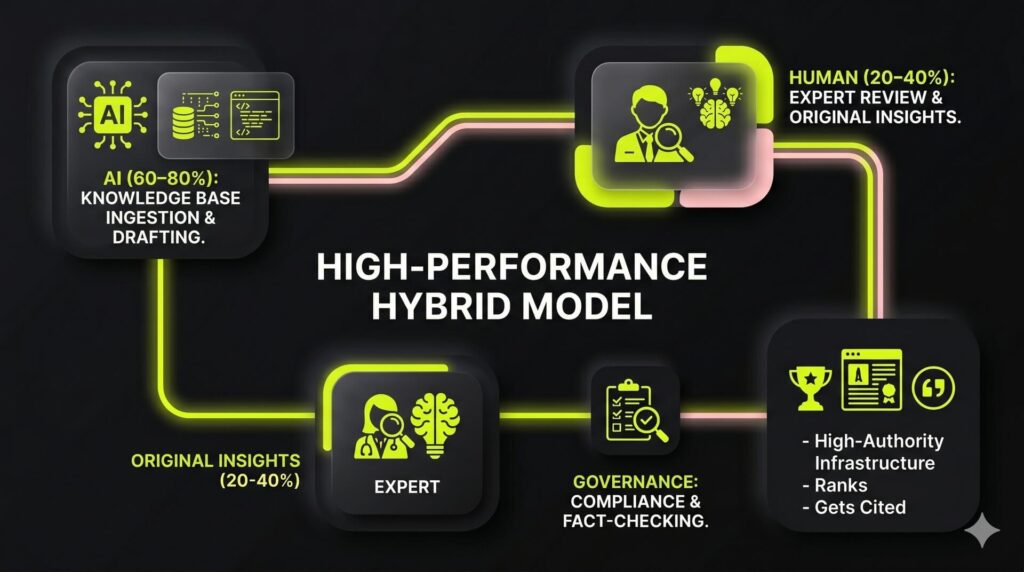
For growth-stage brands, the hybrid model often delivers the highest ROI. Use a fractional SEO or GEO lead to drive strategy and high-level QA. Outsource execution to specialized freelancers or white-label agency teams for cost-effective scaling. This approach maintains strategic control while optimizing for organic visibility across both Google and generative engine answer layers.
Your 4-Step Selection and Execution Roadmap
Step 1: Define your job to be done
Document your specific requirements before interviewing any partner. Write down outcome targets like pipeline contribution, leads, or revenue. Set a strict timeline of 90 or 180 days for initial results. Explicitly list internal constraints such as developer bandwidth, content team capacity, and approval hierarchies. This ensures the partner aligns with your operational reality and prevents future scope creep.
Step 2: Score the provider on 6 criteria
Evaluate candidates on a scale of 0 to 3 across these essential points:
1. Growth stage fit: Does their model match your current revenue?
2. Complexity risk: Can they manage your technical dependencies and site architecture?
3. Specialist depth: Do they have a proven GEO and AI-search framework?
4. Capacity and continuity: Does work stop if one person is unavailable?
5. Reporting needs: Are metrics tied to pipeline impact?
6. Compliance maturity: Do they meet your insurance and security standards?
A score below 10 suggests a freelancer is sufficient. A score over 15 necessitates the infrastructure of an agency.
Step 3: Deploy the vetting script
Use these specific questions on every sales call to surface capability gaps:
- Who specifically performs the daily execution on our account?
- Show month-one deliverables for a similar client.
- What weekly hours do you require from our internal dev and content teams?
- How do you measure organic pipeline impact?
- What is your GEO approach and how do you track brand citations in LLM engines?
Step 4: Scale with integrated SEO and GEO
If you require Google rankings and AI visibility engineered together, choose a specialist partner. For teams that need search dominance and answer layer visibility, visit nuoptima.com or explore the NUOPTIMA GEO service page to book a strategy session focused on building a sustainable organic revenue moat.
FAQ
Freelancers often charge $75 to $200 per hour, while agencies start around $3,000 monthly. Prioritize scope over rates. If your growth requires technical SEO, content, and GEO concurrently, managing several individual freelancers often costs more than a single integrated agency team. Focus on the total cost of ownership rather than isolated hourly fees.
Use a freelancer to prove channel viability on a lean budget. This testing phase validates that organic search drives revenue for your specific niche. Once you confirm ROI, graduate to an agency to scale your content systems and technical infrastructure. Always require detailed handover documentation from day one to protect your strategy during the transition.
Your organization must own GA4, Search Console, CMS, ad accounts, and domains. Never let a provider host content on their proprietary platforms. Demand a full inventory of admin logins during onboarding to ensure your data and site access remain internal assets. This prevents vendor lock-in and protects your long-term search equity.
If your buyers use AI assistants like ChatGPT or Perplexity to compare vendors, you need GEO. Traditional SEO is the foundation for rankings, but GEO signals ensure you are cited in AI-generated answers.
Hybrid models succeed when a single owner, like a fractional lead, manages priorities and quality assurance. Clear, written responsibilities prevent operational chaos and duplicated effort. This structure allows you to combine agency infrastructure for core growth with niche freelancer expertise for specialized, one-off technical projects.
Where this fits in your MSP growth system
This is one piece of how NUOPTIMA makes MSPs and cybersecurity firms the provider buyers find on Google and in AI search. See how it connects to MSP SEO and GEO and AI-search, or get your free MSP lead forecast to see exactly where your firm shows up across ChatGPT, Gemini, and Perplexity today.