Publishing elite content is worthless if Google never sees it. You must master indexing in seo to convert invisible pages into a consistent organic revenue engine.
Your assets must move through crawling, rendering, and indexing before they can rank or earn AI citations. This GSC-driven playbook identifies why content remains invisible and ensures your architecture is engineered for AI-search readiness. We eliminate the technical friction blocking your pipeline to drive growth.
Key Takeaways
- Search is a four-stage chain: crawling (Googlebot fetches the URL), rendering (executing HTML/JS), indexing (storing the page), and ranking (ordering it for a query), and you cannot fix a ranking problem with crawling tactics.
- "Discovered, currently not indexed" is a crawl-priority problem solved by stronger internal linking and sitemap hygiene, while "Crawled, currently not indexed" is a value problem solved by adding distinct content.
- Google Search Console is the source of truth: use the URL Inspection tool for single-page diagnostics and the Page Indexing report for directory-wide friction, and account for reporting lags.
- Google uses your site's mobile version for indexing, so any headers, links, schema, or media present on desktop but missing on mobile are treated as non-existent.
- Index bloat from internal search results, faceted navigation, thin tag pages, and paginated variants wastes crawl budget, so prune with noindex or robots.txt to concentrate authority on revenue pages.
Indexing in SEO is the stage where Google selects and stores a crawled, rendered page in its database so the page becomes eligible to rank in search results and earn AI citations.
1. The Search Pipeline: Distinguishing Crawling, Indexing, and Ranking
A “successfully crawled” URL that fails to generate leads is a symptom of pipeline confusion. To build a sustainable search moat, you must treat the process as a four-stage chain rather than a single event.
- Crawling: Googlebot fetches the URL.
- Rendering: Google executes HTML/JS to interpret the page output.
- Indexing: Google selects and stores the page in its database for retrieval.
- Ranking: Google orders indexed pages for a specific query.
Mapping GSC statuses to these stages prevents wasting resources. You cannot solve a ranking deficit with crawling tactics. A page might be indexed but fail to rank because rendering errors created mobile parity issues. Isolating the failure point ensures technical resources drive actual pipeline growth, adhering to the deep technical architecture tenets found in our managed IT services SEO guide.
2. Beyond Rendering: Solving ‘Crawled but Not Indexed’ Through Value
Fetching and rendering are only the first hurdles in the indexation process. Google declines indexing for pages that lack distinct utility or present near-duplicate intent. In modern indexing in seo, the engine acts as a value filter, discarding thin content regardless of technical health.
To move a page from “crawled” to “indexed,” execute these high-impact checks:
- Unique Purpose: Every URL must justify its existence compared to your existing assets.
- Intent Differentiation: Use specific titles to prevent being flagged as a duplicate of your own content.
- Internal Link Architecture: Eliminate orphaned pages; Google ignores content that lacks internal authority signals.
Performance is a critical proxy for quality. Slow load times and poor UX reduce crawl efficiency and weaken authority signals. This prevents your brand from reaching the answer layer where search engines and LLMs synthesize information. Optimization is no longer about forcing indexation; it is about proving relevance.
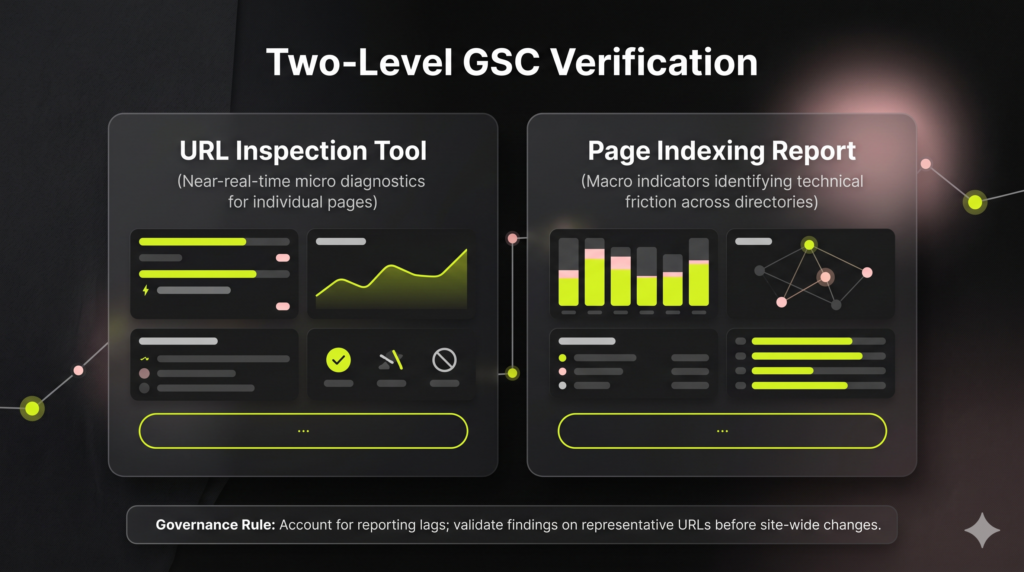
3. Two-Level Verification: Using GSC as Your Source of Truth
Google Search Console is the source of truth for indexing in seo. Distinguish between micro and macro data to avoid misinterpretation. Use the URL Inspection tool for near-real-time diagnostics on individual pages. The Page Indexing report identifies technical friction across entire directories.
Account for reporting lags when interpreting GSC data. Never pivot strategy based on same-day data swings. Validate findings on representative URLs before executing site-wide changes. This prevents wasting resources on phantom issues.
| URL | GSC Status | Suspected Stage | Next Action |
| /demo | Crawled, not indexed | Indexing | Add unique entity data |
| /pricing | Discovered, not indexed | Crawling | Increase internal link depth |
| /service-a | Indexed | Ranking | Optimize for AI citations |
4. Solving ‘Discovered, currently not indexed’ with Crawl Prioritization
This status indicates a crawl prioritization problem rather than a broken page. Googlebot has added the URL to its queue but lacks the incentive to fetch it. This is a clear signal that your discovery architecture fails to communicate page value to the engine.
Execute these high-leverage fixes to move URLs into the crawl queue:
- Strengthen internal linking: Link from indexed, high-authority hubs directly to these invisible assets.
- Audit sitemap hygiene: Include only canonical, index-worthy URLs with accurate lastmod tags.
- Reduce programmatic noise: Avoid flooding Google with low-value pages that dilute crawl budget.
Reserve the Request Indexing tool for high-priority pages after fixes are live. Scalable indexing in seo requires demonstrating site-wide quality signals that pull pages into the crawl queue rather than relying on manual submissions.
5. Remediating ‘Crawled, currently not indexed’ with Content Integrity
Google fetched the URL but declined to index it because the content lacks sufficient utility. This status indicates thin content, duplicate signals, or intent overlap. Googlebot sees the page but determines it does not improve the search index. To master indexing in SEO, convert these rejected pages into distinct assets.
- Increase Distinct Value: Add proprietary data, original insights, or clearer definitions to differentiate the page from competitors.
- Consolidate Duplicates: Merge near-identical pages into one pillar. Use canonical tags to manage faceted or parameter duplicates.
- Improve Snippet Signals: Rewrite titles and H1s to be meaningfully different from your other pages and competing results.
Request indexing for priority URLs after deployment. Monitor pattern changes across templates to ensure your content is engineered for retrieval.
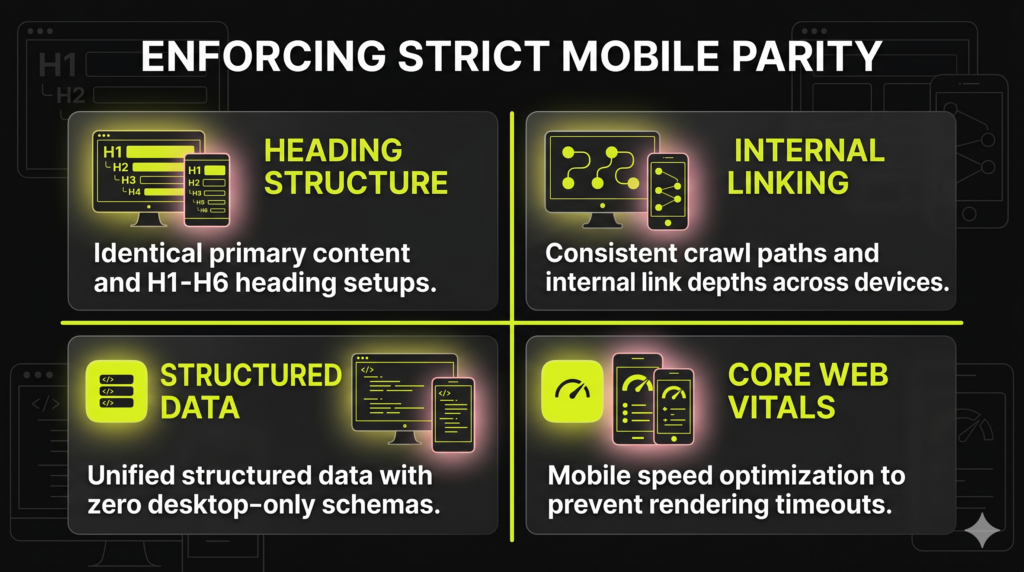
6. Enforcing Mobile Parity: The Foundation of Modern Indexing
Google primarily uses your site’s mobile version for indexing in seo. If headers or links exist on desktop but are hidden on mobile, Googlebot treats that content as non-existent. This parity gap creates “invisible content” that fails to rank or appear in AI-search citations.
Maintain strict parity to protect your index coverage:
- Identical primary content and H1-H6 heading structures.
- Consistent internal links and site-wide crawl paths.
- Unified structured data (no desktop-only schema).
- Indexable media accessible on all devices.
Mobile speed is a technical crawl constraint. Slow performance reduces crawling efficiency and weakens user signals. Fix Core Web Vitals on mobile first to ensure your site architecture is fully indexed.
7. Strategic Exclusion: Managing Index Bloat to Protect Authority
Most indexing failures are self-inflicted. Index bloat occurs when low-value URLs exhaust crawl capacity, diluting entity authority. This programmatic noise forces search engines to waste resources on thin content rather than revenue-driving pages.
Apply these decision rules to maintain control:
- noindex: Use when Google must crawl the page to understand site relationships but should not surface it in search results.
- robots.txt: Use to block entire directories, such as staging environments, where discovery is unnecessary.
Prioritize pruning these high-bloat targets:
- Internal search results
- Faceted navigation
- Thin tag pages
- Paginated variants
Eliminating bloat maximizes crawl efficiency for indexing in SEO. This ensures Googlebot prioritizes the high-authority assets that drive pipeline revenue and earn AI citations, anchoring the web infrastructure that remote IT support leads trust when vetting technical vendors. Concentrating crawl budget on conversion-ready pages shortens the path from discovery to revenue.
How to Build a Scalable Framework for Indexing in SEO
Follow this operational process to move your pages through the search pipeline and into the answer layer. This workflow ensures technical fixes translate directly into visibility for high-volume content hubs and e-commerce sites.
Step 1: Verify the Exact State via URL Inspection
Open Google Search Console and paste your priority URL into the URL Inspection tool. Confirm if the page is currently live on Google. Check the selected canonical and the last crawl timestamp. If the server returns errors or the robots.txt file blocks the bot, you are facing a crawling issue rather than an indexing refusal. The outcome is you identifying whether the failure occurs at the fetch, render, or selection stage.
Step 2: Classify the Issue by Pipeline Stage
Group your invisible URLs by their status in Google Search Console to apply the correct fix.
- Discovered, currently not indexed: Increase internal link depth and sitemap hygiene to raise crawl priority.
- Crawled, currently not indexed: Enhance content uniqueness and entity signals to pass Google’s value filter.
- Duplicate / alternate canonical: Fix inconsistent internal linking to ensure Google respects your chosen canonical. The outcome is you generating a prioritized remediation list based on specific friction points.
Step 3: Clear Primary Technical Blockers
Audit the site for “silent” inhibitors. Remove accidental noindex directives in the HTML or X-Robots-Tag settings in the HTTP header. Resolve redirect chains and eliminate soft 404 patterns that drain crawl budgets. Verify that the robots.txt file does not unintentionally shield high-value directories from Googlebot. The outcome is you providing an unobstructed path for search engines to fetch and render your content.
Step 4: Engineer Index-Worthy Content and UX
Maintain mobile parity by ensuring your mobile version contains the same primary content and structured data as the desktop version. Add original data, FAQ schemas, or proprietary insights to differentiate the page from competitors. Optimize Core Web Vitals to allow Googlebot to render the page efficiently without timing out. The outcome is that the page justifies its presence in the index and prepares for AI-search citations.
Step 5: Execute Intelligent Re-Submission
Submit an updated XML sitemap to signal fresh content across the directory. Use the “Request Indexing” tool only for your top 5% revenue-driving URLs to avoid hitting request limits. For scale, connect your sitemap to a Google Search Console API report to monitor indexing in seo failures across thousands of pages in real time. The outcome is you verifying the transition from “Not Indexed” to “Indexed” for your most valuable assets.
To build a sustainable indexing and AI-search visibility system for your brand, talk to the experts at NUOPTIMA. We specialize in high-performance GEO services that turn invisible pages into citation-worthy answers.
If you want a done-with-you roadmap for indexing and generative search visibility, contact the experts at nuoptima.com to learn more about our GEO services.
Where this fits in your MSP growth system
This is one piece of how NUOPTIMA makes MSPs and cybersecurity firms the provider buyers find on Google and in AI search. See how it connects to MSP SEO and GEO and AI-search, or get your free MSP lead forecast to see exactly where your firm shows up across ChatGPT, Gemini, and Perplexity today.