
You do not need more cold dialing to grow. If you are referral-led and skeptical of marketing, selling managed IT services becomes easier when prospects self-qualify through search and proof assets. You simply need a demand engine that drives warm inbound, plus a close process your team can run. Here are 9 practical moves to build shortlist visibility and a 90-day loop to operationalize it.
Key Takeaways
- Generalist MSPs lose on price. Claiming a vertical or risk specialty (healthcare, SOC 2, manufacturing) makes you findable on search and AI shortlists and removes the commodity dynamic.
- Content built as pre-sales infrastructure, such as shortlist pages, pricing guides, and proof packs, self-qualifies prospects before they call, which shortens discovery and raises close rates.
- Co-managed IT and diagnostic assessments are your entry moves for accounts that resist full outsourcing. They create a 30-to-90-day proof window that converts into long-term SLAs.
- A 90-day operating loop with five tracked pipeline metrics (visibility, qualified meetings, close rate, time to close, gross-profit payback) turns marketing from a guess into a controlled experiment.
Selling managed IT services is the process by which a managed service provider generates, qualifies, and closes contracts for ongoing IT support by positioning its expertise, building trust through proof assets, and converting search-driven inbound interest into recurring-revenue agreements.
1. Claim a Positioning Wedge to Escape the Generic Price Trap
Marketing as a generalist MSP forces you into margin-killing price wars and long sales cycles. If your website claims to support everyone, you remain invisible on search engines and AI shortlists because you look interchangeable.
To stand out, claim a sharp positioning wedge. Choose a vertical like healthcare or manufacturing, or a risk-focused specialty like SOC 2 readiness.
Execute this strategy this week:
- Write your ICP: "We help [industry] firms with [size] users reduce [risk] with [service model]."
- List 10 high-intent search queries, such as "[vertical] MSP" and "co-managed IT [vertical]."
This positioning eliminates the commodity dynamic that makes your services feel interchangeable to buyers.
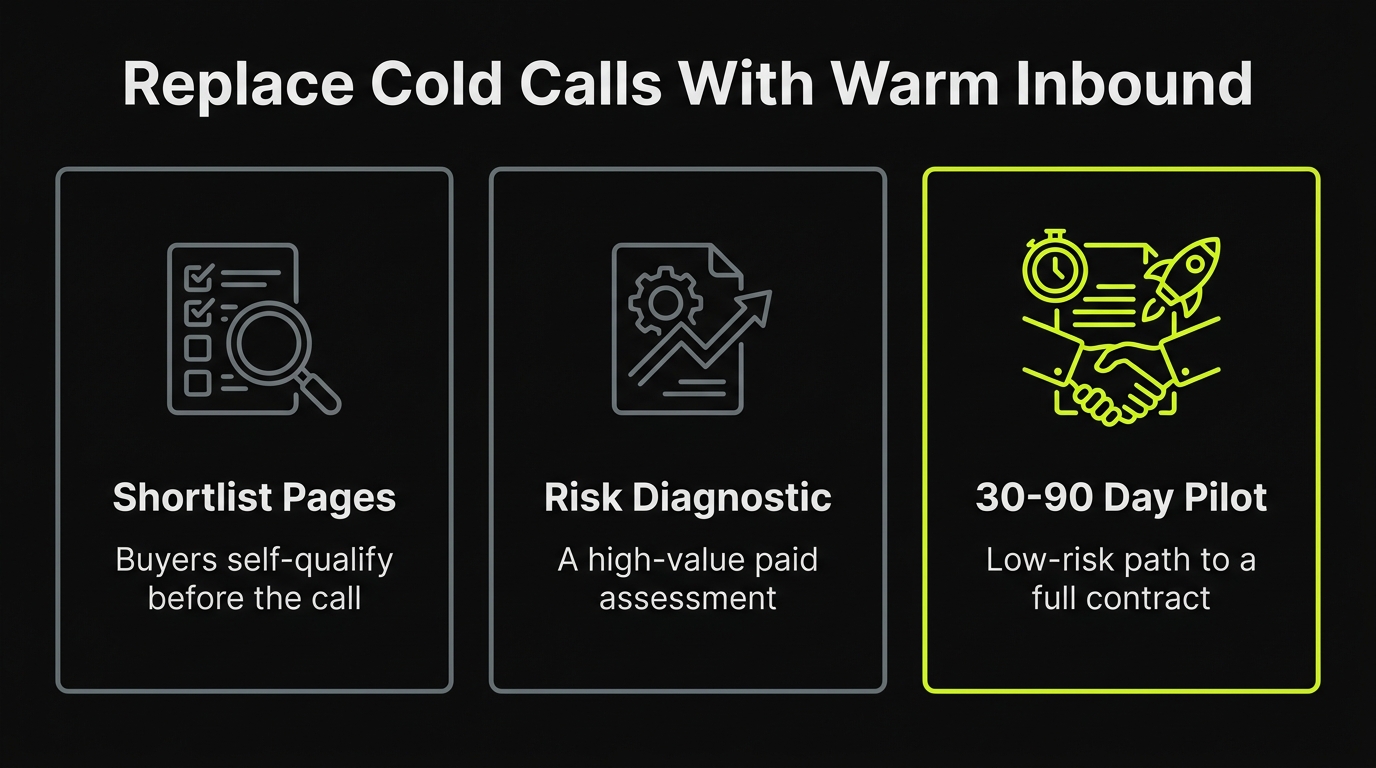
2. Turn Content into Pre-Sales Infrastructure to Answer Buyer Questions Early
Prospects search Google and AI models before contacting you, arriving with skepticism. Replace generic blogging with pre-sales infrastructure. Publish three pages to build trust fast:
- Regional Vertical Hubs: "Managed IT Services for [Vertical] in [Region]" to prove localized authority.
- Co-Managed IT Pages: "Co-Managed IT for [Vertical] Teams" to reassure internal tech departments.
- Pricing Guides: "Pricing and What’s Included" detailing cost ranges and drivers for the CFO.
Anchor these with response times, SLAs, and case snippets. Replace "book a call" with a soft, diagnostic CTA like "Request a visibility teardown." This drives warm inbound and cuts "convince me" discovery time.
3. Package a High-Value Diagnostic to Stop Giving Away Free Consulting
Jumping straight from a discovery call to a proposal kills your margins. You need a high-value meeting hook that beats cold calling without giving away free engineering. Offer a 60- to 90-minute strategic assessment. Deliverables are strictly defined: a summary of their top 10 operational risks, supporting evidence, and a prioritized roadmap.
To prevent this from turning into unpaid consulting, gather screenshots and facts during the diagnostic but never remediate. In the readout, split findings into three clear columns:
- Included in managed IT services
- Paid project work
- Client-owned tasks
Close the assessment by proposing a 30- to 90-day stabilization plan to resolve urgent risks. This project demonstrates immediate value and rolls directly into a long-term SLA.
4. Pitch Co-Managed IT to Convert Internal IT Objections
Hearing "we already have an IT guy" makes outreach feel dead on arrival. Co-managed IT bypasses this barrier, winning accounts that are not fully outsourceable while reducing internal resistance.
Position your firm to support their team by owning difficult, time-consuming lanes:
- After-hours P1 support
- Patch posture and backup verification
- 24/7 security monitoring and EDR tuning
- Short-term project spikes
The win condition is trust. Secure boundaries with a signed responsibility matrix. This RACI-style document maps IT domains directly to ownership and escalation columns.
To close, offer a 30- to 90-day pilot on one lane. Once you prove competence, expanding the scope is straightforward.
5. Build a Three-Page Proof Pack to Prevent "Think About It" Deal Stalls
Deals stall because "we need to think about it" actually means "we cannot justify the risk." CFOs evaluating managed IT services prioritize downside control over technical features.
Replace generic follow-up emails with a three-page proof pack sent immediately after your discovery call. Create three single-page PDFs:
- Onboarding Plan: Your first 30 days are mapped with clear milestones.
- Security Baseline: The exact checklist you standardize on day one.
- Case Snapshots: Industry-specific references proving your regional track record.
Define three measurable outcomes in plain language: a 99% patch compliance target, a 15-minute response speed, and a 5-day ticket aging ceiling. This de-risks the transition and gives cautious buyers a defendable reason to choose you.
6. Buy Search Intent as a Bridge While Organic Channels Compound
If you want to build your pipeline without the cold-calling grind, buy search intent instead of chasing cold attention.
The play is simple. Target bottom-funnel search terms like "managed IT services [city]" or "[vertical] MSP," then route those clicks to dedicated shortlist pages. This paid traffic acts as a targeted bridge while your organic SEO and AI visibility compound.
Set strict operational guardrails. Only run ads if you have conversion assets like a Risk Snapshot CTA, a proof pack, and clear positioning. Measure success by cost per qualified meeting, not raw clicks.
Retarget unconverted visitors with a proof message combining a case snippet with an assessment offer. This generates warm conversations without paying for unconvertible traffic.
7. Use a 7-Question Discovery Checklist to Eliminate Scope Creep
Unstructured discovery drags out sales cycles and invites scope creep. Protect your delivery capacity and margins by treating qualification like an operational audit.
Ask these seven questions:
- Trigger: Why are you looking to switch right now?
- Current Model: Internal IT, an incumbent MSP, or a hybrid setup?
- Risk: What did the last incident cost in downtime and compliance?
- Environment: What is the headcount, locations, and critical app stack?
- Expectations: What are the requirements for SLAs and after-hours support?
- Decision: Who signs the contract, and who can block it?
- Next Step: When can we schedule the Risk Snapshot readout?
Never close with "I will follow up." Secure a scheduled calendar invite before hanging up.
8. Track 5 Pipeline Metrics to Treat Marketing as a Controlled Experiment
Claiming "marketing does not work" usually means you are measuring the wrong variables. Bring the same operational discipline you apply to managed IT to your demand generation.
Track these five metrics weekly to build a forecastable pipeline and prevent wasting a year on unmeasured content:
- Shortlist visibility: Your presence in Google and AI answers for 10 target queries.
- Qualified meetings: Sales-ready inbound meetings booked monthly.
- Close rate: Percentage of qualified meetings that sign.
- Median time to close: Pipeline speed from first touch to signature.
- Gross-profit payback: Months of client gross profit required to recover spend.
Review these metrics in 30-day sprints. If visibility rises but meetings do not, stop publishing. Fix your CTAs and proof assets first to capture existing traffic.
9. Build a Vertical Authority Hub to Validate and Multiply Referrals
Referrals are a powerful growth engine, but they are rationed. When they slow down, you lack a secondary pipeline. Worse, referred prospects who search for you will bounce if they find a thin, generic website.
Solve this by building a vertical authority hub. This regional or industry page links directly to:
- Shortlist comparison assets
- A three-page proof pack and Risk Snapshot
- Three to five deep articles answering your buyer's most expensive questions
This structure helps prospects self-educate and aligns internal stakeholders before the first call. Discovery becomes a validation session instead of a sales pitch.
To build compounding demand, partner with NUOPTIMA (nuoptima.com) for a non-pushy SEO and AI visibility diagnostic.
How to Sell Managed IT Services: The 90-Day Operational Roadmap
To grow your contract base, you do not need a massive, expensive marketing department. You need a structured, 90-day operating cadence that coordinates search visibility with a repeatable close motion. This roadmap operationalizes that process, delivering milestones your finance partner can verify and accept.
Before launching this loop, complete the prerequisites. You must finish Item 2 (niche specialization) and Item 3 (shortlist pages) first so your inbound traffic lands on high-converting destinations.
The 6-Step 90-Day Loop
- Week 1: Build a 10-query visibility scorecard tracking your presence across Google and key AI search engines, then log your baseline position.
- Weeks 2 to 3: Publish the three shortlist pages alongside one proof pack asset to capture high-intent comparison queries.
- Weeks 3 to 6: Publish three buyer-education pieces that remove sales friction by addressing pricing, co-managed boundaries, and your onboarding plan.
- Weeks 4 to 8: Launch paid demand capture campaigns targeting only your highest-intent search terms to accelerate inbound volume.
- Weeks 6 to 10: Run the Risk Snapshot diagnostic as your default conversion event across all digital assets.
- Weeks 10 to 12: Standardize your sales handoff by deploying a structured discovery script, a clear responsibility matrix, and a 30 to 90-day pilot contract option.
The Strict "Continue or Cut" Rule
Measure this sequence like any technical deployment. If your Google and AI visibility scores rise but your meeting count remains flat, pause. Do not write more content. Optimize your conversion assets, landing page speeds, and call-to-action placement before scaling your budget.
If you are currently comparing potential growth partners, read our review of the best MSP marketing agencies to evaluate different service models. To speed up your close motion, visit NUOPTIMA at nuoptima.com for a non-pushy SEO and AI visibility diagnostic tailored to your sales process.