If organic traffic climbs while your pipeline remains flat, your strategy is failing. A professional SEO audit SaaS must act as a revenue diagnostic rather than a vanity checklist. This framework identifies indexing leaks, messaging gaps, and intent mismatches that block trials and demos. SaaS growth requires navigating JS frameworks and PLG complexities while optimizing for the emerging AI-search layer. You must first define the revenue event your SEO needs to drive.
Key Takeaways
- A SaaS SEO audit should be a revenue diagnostic, not a vanity checklist: anchor every technical check to your GTM motion (PLG or SLG) and your money-pages (pricing, demo, trial, comparisons).
- Treat indexing as a revenue gate. If Google cannot crawl your pricing, demo, or trial pages, your organic pipeline is stalled, so fix noindex tags, robots.txt blocks, and canonical errors first.
- Prioritize fixes with an attribution stack (GSC, GA4, CRM) and a score of (Impact x Reach x Confidence) divided by Effort, so high-value work beats low-value metadata edits.
- Require SSR, SSG, or ISR for marketing pages; pure client-side rendering can hide your best content from search engines and LLMs.
- Add citation readiness for AI search: extractable answer blocks, entity clarity, and Organization, SoftwareApplication, and FAQ schema, plus access for AI crawlers like GPTBot.
A SaaS SEO audit is a revenue-first diagnostic that finds the indexing leaks, rendering failures, intent mismatches, and trust gaps blocking organic trials, demos, and pipeline.
1. Define Your GTM Track: Aligning the Audit with Revenue Models
Technical audits fail to move MRR when SEO tactics decouple from GTM strategy. A generic SEO audit SaaS treats every URL as equal, ignoring that your revenue model dictates which pages are load-bearing. You must anchor every technical check to the SaaS revenue motion.
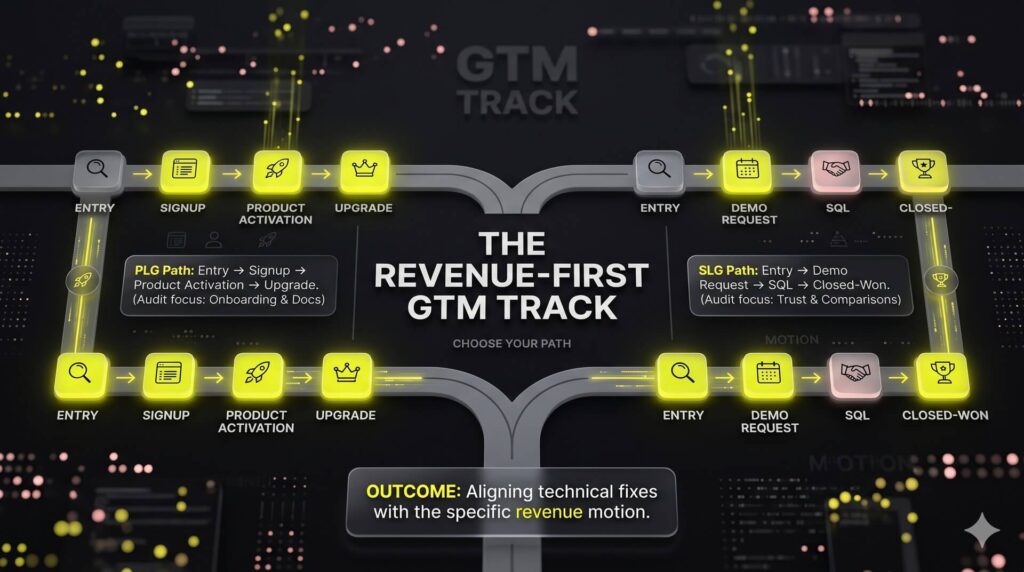
Select your track before crawling. Product-Led Growth (PLG) minimizes time-to-value by prioritizing signups, activation, and upgrade paths. Sales-Led Growth (SLG) maximizes MQL quality by stacking trust signals, social proof, and direct demo request flows.
Inventory your money-pages:
- Pricing, Demo, and Trial
- Integrations and Docs Hub
- Use-cases, Comparisons, and Alternatives
A broken canonical on a pricing page is not a technical bug; it is a revenue outage.
Produce a one-page audit brief defining the GTM model, target personas, and primary conversion events. This framework prevents the common mistake of fixing low-impact technical debt or informational pages first. By anchoring the audit to the revenue motion, you ensure every optimization directly supports pipeline growth. This turns the audit from a list of technical chores into a strategic roadmap for organic revenue.
2. Set Your Attribution Stack: Prioritize Fixes by Revenue Impact
Don’t waste engineering resources on metadata fixes for pages that ignore your pipeline. Most audits fail because they lack a truth layer connecting clicks to cash. You cannot prioritize technical debt without visibility into the full lead journey.
Set a minimum viable attribution stack to ensure your SEO audit SaaS focuses on commercial impact. Integrate Google Search Console for query intent, GA4 for landing page performance, and your CRM for lead-to-customer mapping. This converts vanity metrics into a verifiable pipeline forecast.
Track metrics specific to your business motion:
- PLG: Organic entry → signup → product activation → upgrade.
- SLG: Organic entry → demo request → SQL → closed-won.
Construct a Revenue Leak Table listing top landing pages, conversion rates, and next-step drop-off points. This establishes baseline metrics to prioritize fixes by revenue potential instead of opinions. Stop optimizing for rankings. Plug leaks in the revenue engine.
3. Indexing & Crawlability: Secure Your Revenue Gate
Treat indexing as a revenue gate. If Google cannot crawl your pricing, demo, or trial pages, your organic pipeline is stalled. Use Google Search Console Coverage reports to verify these high-intent URLs are fully indexed. Commercial visibility is non-negotiable for SaaS growth.
Eliminate technical red flags that deindex money pages. Audit for accidental `noindex` tags and robots.txt rules blocking conversion paths. Canonical templates must point to definitive HTTPS versions to prevent authority dilution through duplicate variants or parameter bloat.
Follow this fix sequence: unblock the crawl, correct canonical logic, then resubmit for validation in GSC.
Indexing Fix Pack: Top 5 Revenue Blockers
1. Staging Residuals: `noindex` tags lingering on live commercial URLs.
2. Robots.txt Blocks: Blocking `/demo`, `/trial`, or rendering assets.
3. Canonical Mismatch: Pointing to HTTP versions or outdated variants.
4. Sitemap Junk: Including 404s or redirects instead of clean URLs.
5. Crawl Loops: Unmanaged parameters creating infinite duplicate paths.
4. The Rendering Audit: Validate HTML Delivery
SaaS marketing sites often ship JS-heavy templates that prioritize developer convenience over crawlability. If your site relies on client-side rendering (CSR), your best content may be invisible to search engines and LLMs. Compare View Source HTML against the rendered DOM. Missing H1s, links, or commercial copy indicate a rendering risk that prevents indexing and AI citations.
Require SSR, SSG, or ISR for marketing pages to guarantee clean HTML delivery. Pure CSR is a liability for indexable content. Validate rendering via the GSC URL Inspection tool. Run a live test and inspect the rendered HTML to confirm Googlebot sees the full content.
Identify all templates requiring architectural changes. Prioritize fixes for your highest-revenue pages to prevent invisible content from stalling organic pipeline.
5. Core Web Vitals for Conversion: Template-First Optimization
High Core Web Vitals (CWV) are vanity metrics if they don’t drive MRR. A slow pricing page or demo form with high Interaction to Next Paint (INP) is a direct pipeline tax. Stop chasing perfect scores on low-value blogs. Focus your SEO audit SaaS on high-intent templates: pricing, trial signups, integration directories, and comparison pages.
Audit Largest Contentful Paint (LCP) and Cumulative Layout Shift (CLS) by template group rather than one-off URLs. Common SaaS culprits include bloated JS bundles, third-party chat scripts, and unoptimized product screenshots.
Deliver a Performance Fix Queue ranked by revenue-page traffic multiplied by conversion sensitivity. Performance is a conversion lever, not a technical checkbox. Prioritize the pages that turn demand into demos.
6. Internal Linking: Plug Your Authority Leaks
Internal linking is the lowest-friction authority transfer you control. Treat broken links and redirect loops as conversion leaks and crawl traps that stall organic revenue.
Run a crawl to identify:
- Broken internal links (4xx)
- Redirect chains and loops
- Orphaned pages
Map crawl depth to commercial pages. If your pricing or demo URLs are more than three clicks from the homepage, you are burying your pipeline.
Fix these patterns to ensure discoverability and user path continuity:
- Update links to final destinations to remove chain hops.
- Add contextual links from high-traffic content to pricing or comparison pages.
This SEO audit SaaS step stops authority from falling into dead ends, improving crawl efficiency and commercial page discoverability.
7. Keyword Cannibalization: Stop Ranking Dilution
SaaS sites frequently accumulate overlap across blogs, documentation, and feature pages. Competing URLs split authority and confuse AI engines, suppressing high-intent conversion assets. Map every primary keyword to one definitive target URL to prevent ranking dilution.
Identify cannibalization hotspots where informational and transactional pages collide:
- pricing and alternatives
- best [category] software
- integration with [Y]
- use case terms
Audit each cluster and execute one action: merge and 301 redirect to the winner, rewrite for distinct funnel stages, or noindex low-value duplicates. This eliminates self-competition that keeps high-intent pages stuck off page one.
Finalize a consolidation list prioritized by commercial impact. This ensures your strongest pages serve as the authoritative source for Google rankings and LLM citations.

8. Audit Commercial Archetypes: The Revenue Engine Checklist
Most audits over-index on blog content while neglecting the commercial archetypes that drive MRR. A strategic SEO audit SaaS treats pricing, demo, and comparison pages as high-stakes landing pages. This finds high-leverage revenue opportunities that generic audits routinely ignore. Audit money-page archetypes against this checklist to build a Commercial Page Gap List of missing types and under-optimized templates:
- Pricing: Clear packaging, FAQ schema for objections, and internal links from high-traffic pages.
- Demo/Trial: Precise intent match, mobile UX optimization, and fast load times to remove friction.
- Integrations and Use Cases: Scalable templates with unique value to avoid thin programmatic pages.
- Comparison and Alternatives: Honest differentiation, visible proof points, and clear conversion paths.
9. Content Asset Management: Refresh and Prune for Authority
A strategic SEO audit SaaS treats content as an asset portfolio requiring management. Outdated advice and thin pages dilute topical authority and confuse LLM crawlers. Segment assets by intent: TOFU (problem awareness), MOFU (solution evaluation), and BOFU (vendor decision). This ensures your architecture captures demand throughout the buyer journey.
Identify sleeper content by locating pages with high impressions but declining CTR or rankings. These assets are your primary refresh targets:
- Update outdated statistics and data.
- Strengthen heading structures for LLM extraction.
- Sharpen comparison angles and next-step CTAs.
Prune or consolidate thin, duplicative posts that cannibalize core pages. This process builds a quarterly roadmap tied to revenue intent. Maximize your existing authority instead of publishing noise.
10. Audit Trust Signals: Closing the BOFU Credibility Gap
High-intent rankings fail if BOFU pages lack the credibility required by procurement teams. SaaS buyers prioritize risk mitigation over feature lists. A strategic SEO audit SaaS ensures trust signals are prominent and extractable for humans and AI citation engines.
Audit commercial templates for SOC 2 compliance, GDPR transparency, and uptime status. Strengthen expertise signals through case studies with quantified revenue outcomes and verified author bios. Transparent pricing, support SLAs, and clear cancellation policies reduce perceived risk. This infrastructure removes sales friction and converts search traffic into high-velocity pipeline.
Trust Upgrade Checklist:
Security: Display SOC 2/ISO logos and link to a dedicated security portal.
Proof: Feature verified reviews and case studies with measurable business results.
Transparency: Define onboarding support, pricing policies, and service limitations.
11. Authority Audit: Reclaim and Build Linkable Assets
Link building for SaaS is an asset problem, not an outreach issue. A strategic SEO audit SaaS identifies why outreach stalls by flagging lost links, toxic spikes, and over-reliance on a narrow domain set.
Reclaim leaked equity to build a foundation:
- Convert unlinked brand mentions into active links.
- Repair broken links to product pages.
- Update outdated redirected URLs to preserve authority.
Build high-utility assets that naturally earn citations for Google and LLMs:
- Free tools (e.g., ROI calculators).
- Benchmark reports using proprietary data.
- Integration directories to establish platform entity status.
The audit produces a 90-day authority plan. Combining reclamation with two linkable assets creates a scalable engine, allowing commercial pages to rank for high-intent terms without relying on endless blog production.
12. Audit for Citation Readiness: The AI Search Layer
Traditional SEO secures rankings, but a modern seo audit for SaaS must solve the AI invisibility gap. If your brand dominates Google but vanishes in Perplexity, you lack citation readiness. Generative Engine Optimization (GEO) ensures your content is retrievable and citable by LLMs.
Audit for entity clarity with precise declarations of your mission and audience. Structure high-value pages with extractable answer blocks:
- Definitions and software benchmarks
- Comparison and alternatives pages
- Step-by-step process blocks
Technical coverage is mandatory for knowledge graph grounding. Deploy Organization, SoftwareApplication, and FAQ schema while ensuring AI crawlers like GPTBot have full access. This infrastructure transforms flat webpages into cited data points.
SaaS SEO Audit Action Plan: Transforming Findings into Revenue
Most audits die in a PDF. A backlog consisting only of technical debt is noise. Your SEO audit SaaS must become an executable roadmap where technical fixes function as product features. Complete Items 1 through 3, including GTM alignment, measurement, and the indexing gate, before proceeding with the implementation.
Step 1: Build a Ticket-Ready Backlog
Stop sending vague spreadsheets to your engineering team. Convert every audit finding into a sprint-ready ticket. List all affected URLs and specific template types to ensure comprehensive coverage. State a root cause hypothesis for every issue to guide developer troubleshooting. Provide clear acceptance criteria so the QA team can verify the fix immediately.
Step 2: Score for ROI and Effort
Apply a quantitative framework to prioritize the backlog. This prevents low-value metadata edits from blocking high-impact architectural wins. Assign values to Revenue Impact (high/medium/low), Reach (total traffic or impressions), and Confidence (the strength of your diagnostic evidence). Estimate Effort across your development, content, and design teams. Use this formula to determine your priority score: (Impact × Reach × Confidence) ÷ Effort.
Step 3: Sequence Your 30-Day Growth Sprint
Execute in four phases to generate immediate pipeline momentum. Start with Week 1 by resolving indexing, canonicals, and robots.txt blockers on money pages. Transition to Week 2 to optimize rendering and Core Web Vitals on conversion-focused templates. Dedicate Week 3 to repairing internal linking leaks and merging cannibalized content clusters. Conclude in Week 4 by building commercial page gaps and executing content refreshes for high-potential assets.
Step 4: Prove Pipeline Impact
Connect your search results to business outcomes. Report on organic-driven trials, demos, and assisted conversions within your CRM. You will see how organic efforts contribute directly to MRR and LTV. Monitor your citation visibility in AI engines like Perplexity and Gemini to confirm your brand is the definitive answer layer for your category.