Technical SEO backlogs explode when teams treat every warning equally. Most audits produce noise that rots in Jira while pipeline stays flat. This technical SEO checklist delivers 12 prioritized checks to unlock crawling and secure visibility across Google and AI answer engines. We prioritize high-impact infrastructure for B2B service pages and case studies. Start with the critical rendering and indexability errors that can erase your visibility overnight.
Key Takeaways
- The highest-leverage technical check is indexability of revenue pages: if Google cannot crawl a service page or case study, it cannot rank or cite it.
- Audit the rendered DOM against view source, because heavy JavaScript that fails to hydrate leaves crawlers with empty HTML shells and invisible content.
- Keep every commercial URL reachable within three clicks of the homepage to fix orphaned pages and concentrate internal authority on conversion-ready content.
- Prioritize the backlog by impact, revenue weight, and effort, then sequence: indexability and rendering first, then performance, architecture, indexation control, and AI readiness.
- Schema and extractable answer blocks make content machine-readable, which raises eligibility for AI citations in engines like ChatGPT and Perplexity.
1. Verify Indexability of Revenue-Generating Pages
Authority is useless if site architecture prevents search engines from indexing your revenue pages. This is the highest-leverage technical check: if Google cannot crawl a page, it cannot rank or cite it in AI search results.
Audit key templates like service pages, case studies, and documentation for:
- Robots.txt exclusions
- `noindex` directives (meta robots or X-Robots-Tag)
- Login walls or IP allowlists
Staging rules often leak into production during deployment, silently wiping pipeline from search. Use Search Console to validate rendered HTML and re-crawl the site once unintended rules are removed. Restoring indexability can recover rankings and pipeline for transactional terms in days. This ensures your high-intent content is visible to both traditional crawlers and generative engines like ChatGPT and Perplexity.
2. Audit the Rendered DOM vs. Source Code
B2B stacks often ship heavy JavaScript that fails to hydrate, leaving crawlers with empty HTML shells. This rendering gap is a critical failure point in a modern technical SEO checklist. Invisibility to search bots results in immediate organic revenue loss.
Compare View Source against the rendered DOM. Verify that these elements load without user interaction:
- Primary body content
- Canonical tags and structured data
- Internal links via `` tags
Solve hydration issues with Server-Side Rendering (SSR) or pre-rendering for core templates. Avoid hiding content behind consent banners or UI states. Stable HTML ensures predictable indexing across Google and AI engines, preventing published but invisible ranking plateaus.
3. Prioritize Performance for High-Converting Templates
Stop wasting engineering cycles on low-value content while conversion-gating landing pages remain sluggish. This technical SEO checklist prioritizes speed where it impacts revenue. Measure LCP, CLS, and Interaction to Next Paint (INP) at the template level. INP is the interactivity metric teams often miss, yet it defines the experience for high-intent buyers.
Audit top organic pages and high-converting templates using mobile and desktop field data. Reduce main-thread work by deferring JS and optimizing the rendering path. Prevent layout shifts while isolating heavy third-party scripts. Success requires measurable template-level gains and zero regressions, ensuring your architecture is conversion-ready for users and AI-search engines.

4. Eliminate Orphaned Pages and Strengthen Authority Flow
B2B websites often bury high-intent service pages behind deep blog loops, creating orphaned content that receives zero authority. A critical priority in your technical SEO checklist is ensuring every commercial URL is reachable in three clicks or less from the homepage.
Audit crawl depth reports and internal link counts to identify isolated URLs. Focus on pages that generate impressions but under-rank due to weak internal connectivity.
To fix authority dilution:
- Build topic hubs for high-intent categories.
- Add contextual links from authoritative articles to service pages.
- Standardize navigation and related-content modules.
This infrastructure ensures faster discovery and stronger relevance signals for competitive B2B terms. It forces search engines to prioritize the conversion-ready pages that actually drive your pipeline and organic revenue.
5. Consolidate Duplicate Content to Protect Ranking Signals
Wasted crawl budget and split ranking signals are silent revenue killers. Most health scores ignore the damage caused by internal competition. Adding duplicate consolidation to your technical SEO checklist ensures authority compounds on pages that drive pipeline.
Identify and resolve these common culprits:
- Duplicate titles and H1 tags
- Parameter-driven URL variants
- Conflicting canonical tags
Audit for duplicate clusters and canonical chains. Ensure every canonical target returns a 200 status and is indexable to prevent crawl loops. In B2B environments, versioned URLs and resource formats often fragment signals, so enforce a single source of truth through consistent internal linking. This strategy consolidates ranking signals so your best URL wins instead of competing against your own duplicates.
6. Resolve Crawl Leaks and Authority Loss from Link Rot
Broken links and redirect chains waste crawl budget and leak authority on large B2B sites. Audit your infrastructure for 4xx errors, soft 404s, 5xx spikes, and mixed 301/302 usage as part of your technical SEO checklist. Prioritize URLs with high impressions or those in core conversion pathways.
Implement these fix standards:
- Enforce single-hop 301s and consistent trailing slash/www rules.
- Update internal links to point directly to destination URLs.
- Stabilize server environments to eliminate 5xx spikes.
Verify via re-crawl and monitor server logs or Search Console. Recovering link equity ensures your core pages rank and earn AI search citations with minimal friction.
7. Optimize Sitemaps as Indexation Control Surfaces
Sitemaps are your indexation control surface, not a checkbox. For large documentation libraries and dynamic B2B sites, a precise sitemap is essential to prioritize high-value templates.
A high-performing sitemap includes only canonical, indexable 200-status URLs. Segment files by type: services, blog, docs, and case studies. Ensure `lastmod` tags reflect genuine updates. During your audit, compare sitemap URLs against indexed pages in Search Console to spot bloat like redirects or blocked paths.
Implement IndexNow for participating engines when content changes frequently while maintaining Search Console workflows for Google. This precision ensures faster discovery and cleaner index coverage signals. Mastering this technical SEO checklist item transforms sitemaps into strategic assets for crawl efficiency and AI engine visibility.
8. Deploy Schema for Machine-Readable Meaning and AI Citations
Schema is not a vanity play for rich snippets. It provides the machine-readable meaning that fuels AI citation selection and modern SERP features. To build durable entity authority, your technical SEO checklist must prioritize these audit targets:
- Organization and WebSite markup
- Breadcrumb and Article schema (where relevant)
- B2B-relevant Service and FAQ blocks
Implementation requires strict alignment between schema and visible content. Avoid spammy FAQ structures and ensure consistent brand identifiers across all pages. Place explicit, extractable statements in semantic HTML near the top of key pages to reinforce your entity profile. Clearer machine interpretation ensures LLMs correctly interpret your brand authority, increasing eligibility for enhanced visibility layers and high-value AI-driven citations.
9. Analyze Logs to Reclaim Wasted Crawl Budget
Crawl budget issues are invisible in standard audits because tools only see what you allow them to crawl. Server logs reveal the ground truth of bot behavior. This is critical for large documentation hubs, marketplaces, or multi-language sites where crawl capacity is constrained.
Audit logs to identify where bots waste resources on:
- Faceted navigation and parameter URLs
- Infinite crawl spaces and redirect chains
- Thin pages or non-200 status codes
Reclaim budget by blocking waste via robots.txt, consolidating duplicates, and improving internal linking to priority URLs. These levers force crawlers to prioritize high-intent solution pages that drive revenue. Efficient crawling ensures your most valuable content is refreshed and ranked faster across both Google and generative search engines.
10. Align Global Signals to Prevent Cross-Market Cannibalization
International configuration errors destroy conversion rates by ranking the wrong locale in the wrong market. A German prospect landing on a UK pricing page sabotages your global organic revenue. Use this technical SEO checklist step to secure your international architecture:
- Audit Hreflang: Verify ISO codes, mandatory self-references, and valid return tags.
- Align Canonicals: Ensure each locale canonicalizes to itself to avoid signal dilution.
- Operational Hygiene: Maintain consistent URL structures and reflect hreflang in XML sitemaps.
- Add Local Proof: Use region-specific case studies to prevent thin pages and build local authority.
This precision transforms localized URLs into conversion-ready assets that generative engines can accurately cite for regional queries.
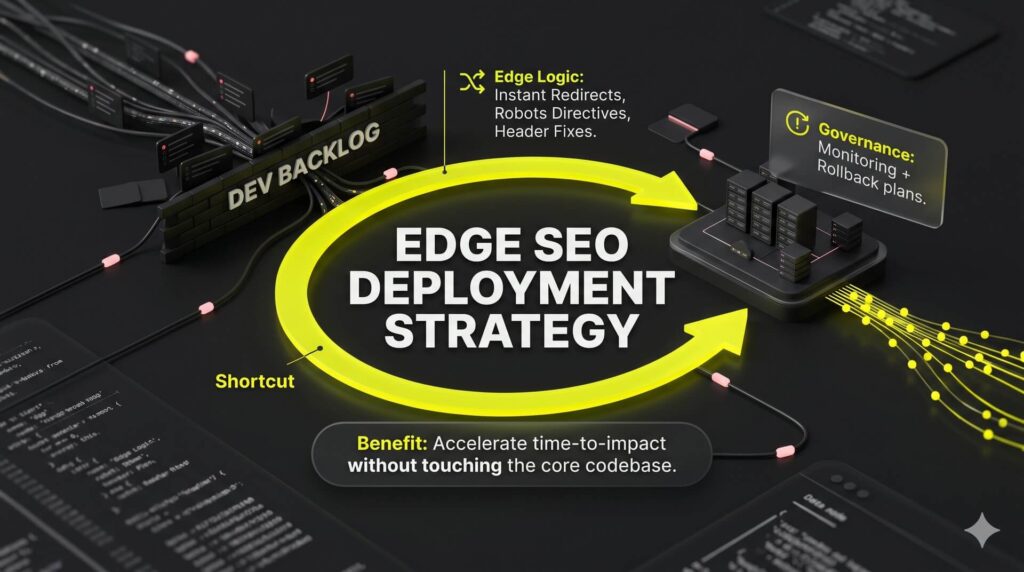
11. Bypass Engineering Bottlenecks with Edge SEO Deployment
Technical SEO checklist wins often die in engineering backlogs. Edge SEO bypasses these bottlenecks by injecting logic at the CDN level. Use it to deploy critical fixes without touching the core codebase:
- Redirect rules and canonical adjustments
- Security and performance headers
- Robots directives and selective prerendering
This accelerates fixes for issues that directly impact crawling, indexing, and search performance.
Governance prevents an undocumented shadow stack. Define which updates stay in the CMS versus the edge. Always implement staging environments, monitoring, and rollback plans to protect analytics, consent, and caching layers. This reduces time-to-impact, allowing your brand to ship high-priority fixes and secure authority without waiting for long development cycles.
12. Engineer Infrastructure for AI Search Extractability
B2B buyers research in Perplexity and ChatGPT before making decisions. Your technical SEO checklist must prioritize extractability to earn AI citations. Audit robots.txt to allow LLM crawlers like GPTBot and Google-Extended while aligning access with your business policy.
AI engines require structured data to synthesize answers. Use semantic HTML and stable heading hierarchies to reduce extraction friction. Support machine parsing with these technical standards:
- Lists and tables for service comparisons and pricing.
- Consistent entity identifiers and clear authorship.
- Schema markup for company and about information.
This stack ensures your brand is selected as a cited source in AI answers, not just indexed in traditional SERPs.
How to Prioritize Your Technical SEO Roadmap for Revenue
Most software tools generate hundreds of technical issues. Most of these never change your bottom line. Use this guide to transform a standard technical SEO checklist into a defensible roadmap that leadership will fund. Focus on removing the specific bottlenecks that block pipeline growth.
Prioritize your backlog using three key metrics:
1. Impact: Determine if the issue prevents indexing or harms UX signals across high-traffic templates.
2. Revenue Weight: Identify if errors sit on pricing pages, service pages, or primary lead-generation paths.
3. Effort and Risk: Compare a simple one-line header change against a complex framework refactor.
Follow this suggested execution sequence:
1. Indexability and Rendering (Items 1 to 2): Ensure Google and AI bots can fully render your content. If they cannot see it, your authority remains invisible to search engines.
2. Template-Level Performance (Item 3): Optimize speed on your top-converting templates. You will see improved ranking signals and better retention of high-value B2B buyers.
3. Architecture and Duplication (Items 4 to 6): Resolve redirect chains and consolidate duplicate content. This stops authority leakage and ensures ranking signals concentrate on primary commercial URLs.
4. Indexation Control and Structured Data (Items 7 to 8): Use sitemaps to dictate crawl priority. Deploy Schema to provide the machine-readable context required for citations in generative search engines.
5. Scale Levers and AI Readiness (Items 9 to 12): Reclaim crawl budget with log analysis and use Edge SEO to bypass engineering bottlenecks during global expansion.
Next Steps for Your Technical Strategy
Secure your organic revenue and AI visibility with a prioritized roadmap. Visit nuoptima.com to schedule a consultation or explore our specialized generative engine optimization services.