MSP buying guide

Best Domain Name System (DNS) Filtering for MSPs (2026)

Pick a filter by what it does on a client's laptop at home, including the moment that laptop cannot reach the service.

7  filters compared6  publish a list price5  document offline behavior

7 DNS filters, 6 with a published list price, verified November 19, 2026

A Domain Name System (DNS) filter earns its fee on the laptop at home, and it gets tested the day that laptop cannot reach the service. If you run a managed service provider (MSP), start the shortlist with DNSFilter for its MSP program and professional services automation (PSA) billing reconciliation, ScoutDNS for a $50 monthly MSP minimum, month to month, and Control D for a sub-organization per client with its cost shown. WebTitan suits clients who run on-premises Active Directory, SafeDNS lists roaming clients on five platforms, Cloudflare Gateway fits MSPs on an Enterprise partner contract, and Cisco Umbrella is here for MSPs planning their move off it.

The prices do not compare. Vendors bill per user, seat or endpoint; DNSFilter, ScoutDNS and Control D share MSP rates only after you ask or sign up, Cisco publishes no price, and DNSFilter Core omits roaming agents.

Five filters here are built around an MSP console; two put DNS filtering inside a larger security platform, so the contract follows the platform.

This is for MSP owners and service leads rolling one filter out to many small clients from a remote monitoring and management (RMM) tool, or deciding what to do with Umbrella tenants. Not for an in-house team buying for one company.

Where our money comes from

We do not sell any of these products, take commissions from any vendor on this page, or accept payment for placement.

methodology

How we built this list

  1. We included filters that MSP buyers and AI assistants name for this job, each with a documented way to manage many clients.
  2. Vendor facts come only from vendors' own pages, help centers and release notes, read November 19, 2026. No trials, testing or paid placement.
  3. Entries sit in two groups by model; numbering is navigational, not a ranking.
  4. Companies with "MSP" in their name are left out under our naming rule.
  5. "Not listed" and "not stated" mean not in the documentation we read, not that the feature is missing.
  6. Not checked: MSP per-seat price lists (DNSFilter, ScoutDNS and Control D), DNSFilter's offline behavior beyond Windows, and vendors' audit reports.

Last reviewed: November 19, 2026

comparison

The seven filters side by side

Billing, list price and MSP terms, read November 19, 2026
ToolBilling unitPublished list priceMSP terms publishedPer-client policy in one consoleFree trial
DNSFilterPer license (user)Core $1.00, Plus $2.25 per license per month billed annually; Enterprise on requestSeparate program from $150 a month; detailed pricing after trial signupYes, client organizations14 days
WebTitanPer user$2.78 per user per month, paid annuallyNot found on its partner pageYes, per-customer policiesFree trial offered; length not found
Control DPer endpoint$2 per endpoint per month, self-serve planThrough partnerships, on requestYes, unlimited sub-organizations14 days, no card
ScoutDNSPer seat (user or device)$11 to $15 per seat per year billed annually ($1.10 to $1.50 a month billed monthly)$50 a month minimum, month-to-month; rates on requestYes, one organization per customer14 days, no card
SafeDNSPer user$1.20 to $2.60 per user per month billed annually ($1.40 to $3.00 monthly); 15 to 35-user minimumsFrom $0.90 per user per month; conditions not publishedYes, a subaccount per client with its own filtering rules15 days, no card
Cloudflare GatewayPer userFree up to 50 users; $7 per user per month pay-as-you-go; contract customMulti-client tools on Enterprise plans onlyEnterprise plans only; otherwise separate accountsFree plan up to 50 users
Cisco UmbrellaNot publishedQuote onlyTwo buying routes described; no pricesYes, client hierarchyMSP trial on request

"Not published" and "not found" mean not on the pages we read. US dollars, November 19, 2026; DNSFilter's prices are for North America.

entries

The seven filters

DNS filters built around an MSP console

Dedicated filters that hold every client organization in one console.

01

DNSFilter

A dedicated DNS filter with a separate MSP program, client organizations and PSA billing reconciliation.

MSP programPSA billing reconciliationRoaming clients on Plus or Enterprise
MSP program
separate from Core and Plus; starts at $150 a month, detailed pricing sent after trial signup; joining asks for six months in business and two references or case studies
Published pricing
direct Core $1.00 or Plus $2.25 per license per month billed annually ($1.15 or $2.50 monthly), minimums $240 and $750 a year; Enterprise on request
Agents
Windows, macOS, iOS (through mobile device management only), Android and managed Chromebooks, all on Plus or Enterprise, not Core; no Linux agent (DNS Relay instead)
Offline behavior
the Windows agent (Plus or Enterprise) fails closed in its default Classic mode and open in DNS PreCheck mode; a Custom mode sets failover directly
Integrations
billing reconciliation with ConnectWise PSA, HaloPSA, Autotask, Kaseya Business Management Solution (BMS), Syncro and Pulseway PSA, at no cost to partners
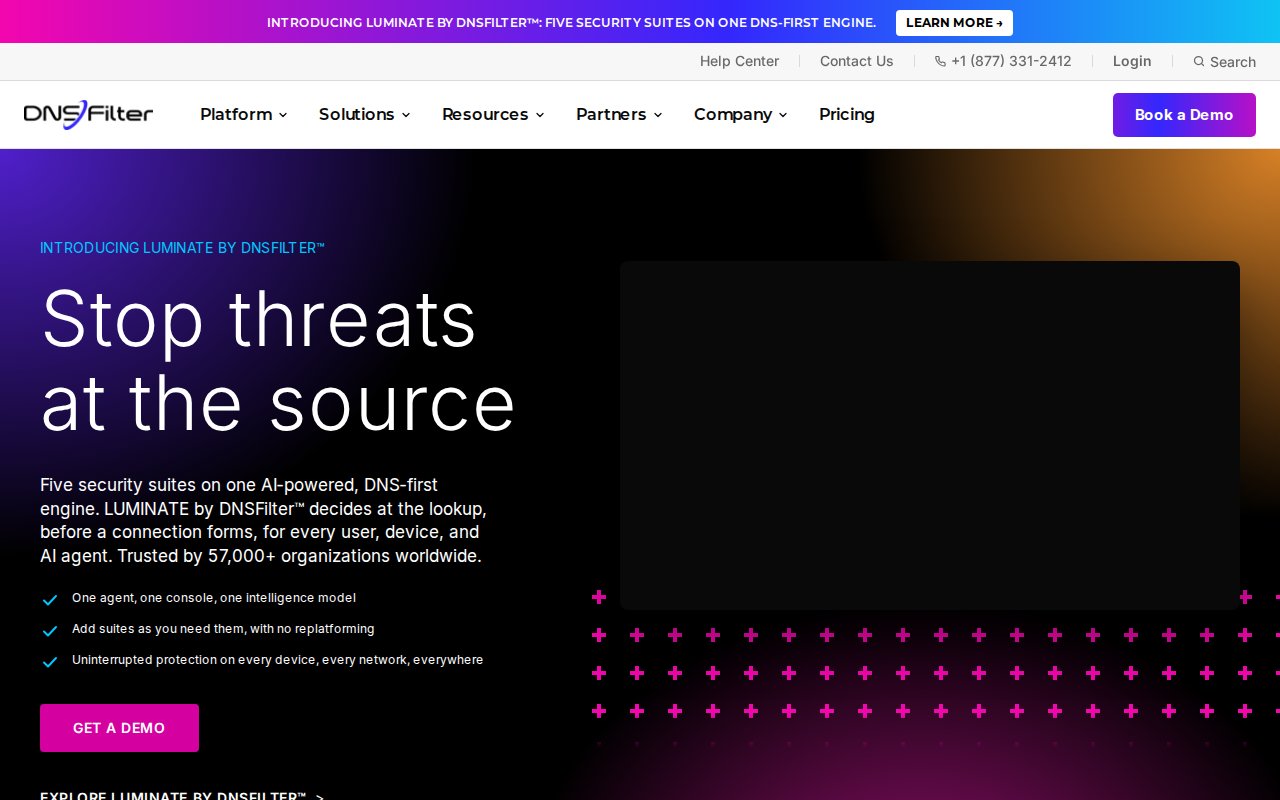
DNSFilter homepage with the headline Stop threats at the source
www.dnsfilter.com, captured November 19, 2026

DNSFilter sells to MSPs through a program priced apart from its Core and Plus plans: its MSP page says MSP pricing "starts at $150 per month" and sends detailed pricing after trial signup. The dashboard holds client organizations, with global policies and block pages you can apply to any client. "PSA integration" here means billing reconciliation; at Cisco, tickets and a daily seat sync.

Its pricing grid lists roaming clients on every platform, and DNS PreCheck, for Plus and Enterprise but not Core; iOS installs only through mobile device management, so ask which tier your MSP seats map to. Query logs are kept 9 days. One setup trap: the trial organization's policies, sites and roaming clients cannot move to client sub-organizations after partner activation. DNSFilter acquired Zorus in 2025, and N-able DNS Filtering is powered by DNSFilter.

Best fit:MSPs on ConnectWise PSA, HaloPSA, Autotask, Kaseya BMS, Syncro or Pulseway PSA that want filter seats reconciled against client billing.

Think twice if:Your clients run Linux desktops or your MSP is under six months old, because DNSFilter says Roaming Clients are not available for Linux and its partner program asks for six months in business.
02

WebTitan

TitanHQ's DNS filter, with a multi-tenant service-provider console and On-The-Go agents for Windows and macOS.

On-premises Active DirectoryFail Open on WindowsChromebooks on request
MSP console
one multi-tenant console with per-customer default and custom policies, scheduled reports per customer and white label
Published pricing
$2.78 per user per month, paid annually (US dollar view of its pricing page); MSP pricing and minimums not found on its partner page
Agents
On-The-Go (OTG) 2 for Windows 10 and 11 and for macOS Catalina to Sequoia; Chromebooks after a support request; virtual machines not supported; iOS, Android and Linux not listed
Offline behavior
OTG for Windows has Fail Open mode, on by default since version 2.2.23 (January 2026)
Integrations
Entra ID through its DNS Proxy, on-premises Active Directory through its own agent; Intune deployment guides; a 2018 TitanHQ announcement names an integration with Kaseya's RMM tool; no PSA named on the pages we read
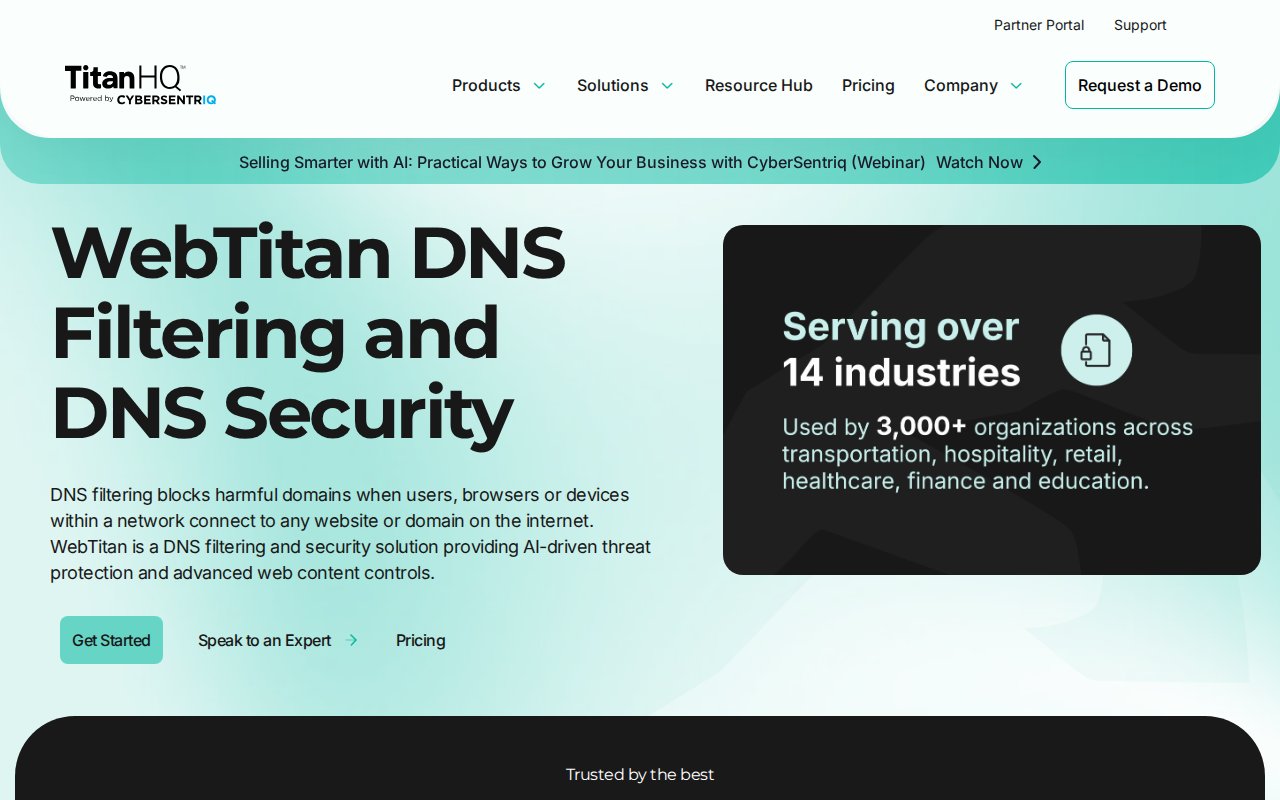
TitanHQ's WebTitan page headed WebTitan DNS Filtering and DNS Security
www.titanhq.com, captured November 19, 2026

WebTitan is TitanHQ's DNS filter, and TitanHQ is now part of CyberSentriq. Its console runs every customer from one place, each with default and custom policies and scheduled reports. Directory support is well documented: Entra ID syncs through an enterprise app in the WebTitan DNS Proxy, on-premises Active Directory through TitanHQ's own agent, and policies apply by network, group, user or device.

Off the network, OTG 2 agents cover Windows and macOS. TitanHQ's release notes say Fail Open has been on by default on Windows since January 2026; we found no macOS statement. Reporting data is kept 62 days by default, a report figure rather than a query log. Partners get a not-for-resale program, but MSP rates are not on the partner page.

Best fit:MSPs whose clients still run on-premises Active Directory and who want per-customer policies under their own brand.

Think twice if:Your clients need phones covered or you want an MSP price before a sales call, because the WebTitan documentation we read lists no iOS or Android agent and its partner page publishes no MSP pricing.

03

Control D

A DNS filter with unlimited client sub-organizations, an enforced global profile and the cost of each client shown in the console.

Per-endpoint list priceUnlimited sub-organizationsNamed RMM tutorials
MSP console
unlimited sub-organizations, one per customer, with cost per client shown; a parent global profile can be enforced on every client's endpoints; white label
Published pricing
$2 per endpoint per month on the self-serve small and midsize business plan; MSP pricing through partnerships, on request
Agents
ctrld command-line and desktop apps for Windows and macOS, and ctrld on Linux; setup helper apps on iOS and Android, plus a managed Android Enterprise app deployed through mobile device management; Chromebooks by Chrome Enterprise policy
Offline behavior
not stated on the DNS Intercept Mode page we read
Integrations
deployment tutorials for NinjaRMM, Intune, Datto RMM, N-able RMM and Atera; no PSA or directory group sync listed
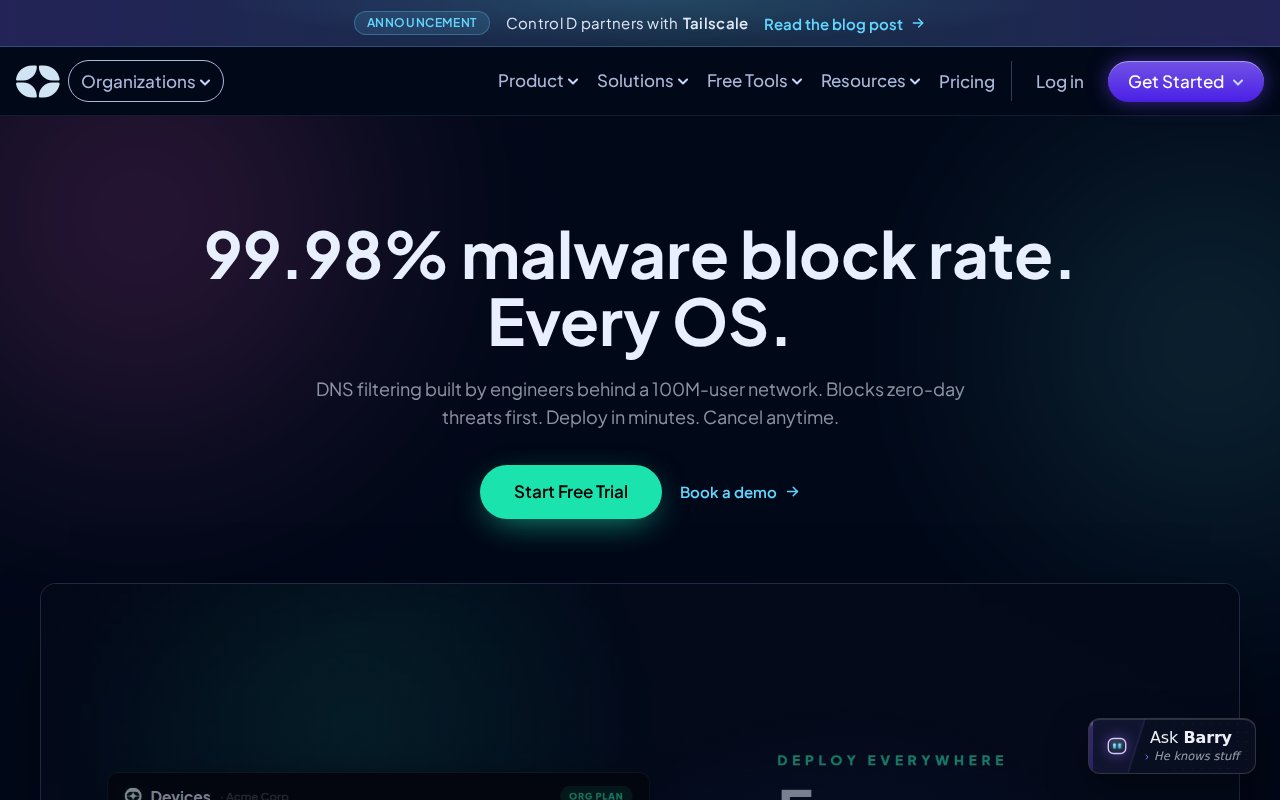
Control D homepage with its DNS filtering headline and a free trial button
controld.com, captured November 19, 2026

Control D is built around sub-organizations. Its documentation lists customer companies as one use and shows endpoints, members and cost for each. A global profile at the parent can be enforced on every client's endpoints, so you keep one baseline instead of rebuilding it for each client.

The ctrld agent sends every query to Control D, local domains included, unless you set split horizon; from version 1.3.10 it detects the Active Directory domain itself. Phones get setup helper apps or managed Android enrollment. Query logs last 30 days, analytics up to a year. The self-serve plan is $2 per endpoint per month, and MSP pricing goes through partnerships. What the agent does when it cannot reach Control D is not stated on the page we read.

Best fit:MSPs that want a sub-organization per client with its cost visible, one enforced baseline policy, and RMM deployment guides to follow.

Think twice if:Clients need Entra ID or Active Directory group policies, because Control D's pricing page lists no directory group sync and its Cisco Umbrella migration guide says it enforces policy at the endpoint.

04

ScoutDNS

A DNS filter whose MSP package turns every feature on, from a $50 monthly minimum, month to month.

$50 MSP minimumMonth-to-monthFail-open agent
MSP program
from a $50 a month minimum, month-to-month, usage billed monthly, every feature on; five-tier rate list on request; not-for-resale licenses
Published pricing
direct plans $11, $13 or $15 per seat per year billed annually, or $1.10, $1.30 or $1.50 a month billed monthly; a seat is a user or a device
Agents
Windows 10 and 11 and macOS (Intel and Apple silicon); Windows Client v2 in public beta; Relay for local domains on Debian or Docker
Offline behavior
fail-open; the agent restores the original DNS if ScoutDNS is unreachable
MSP console
one organization per customer, template policies at the parent, operators scoped to single clients; logs searchable for 30 days
ScoutDNS homepage with its protective DNS filtering headline for MSPs
www.scoutdns.com, captured November 19, 2026

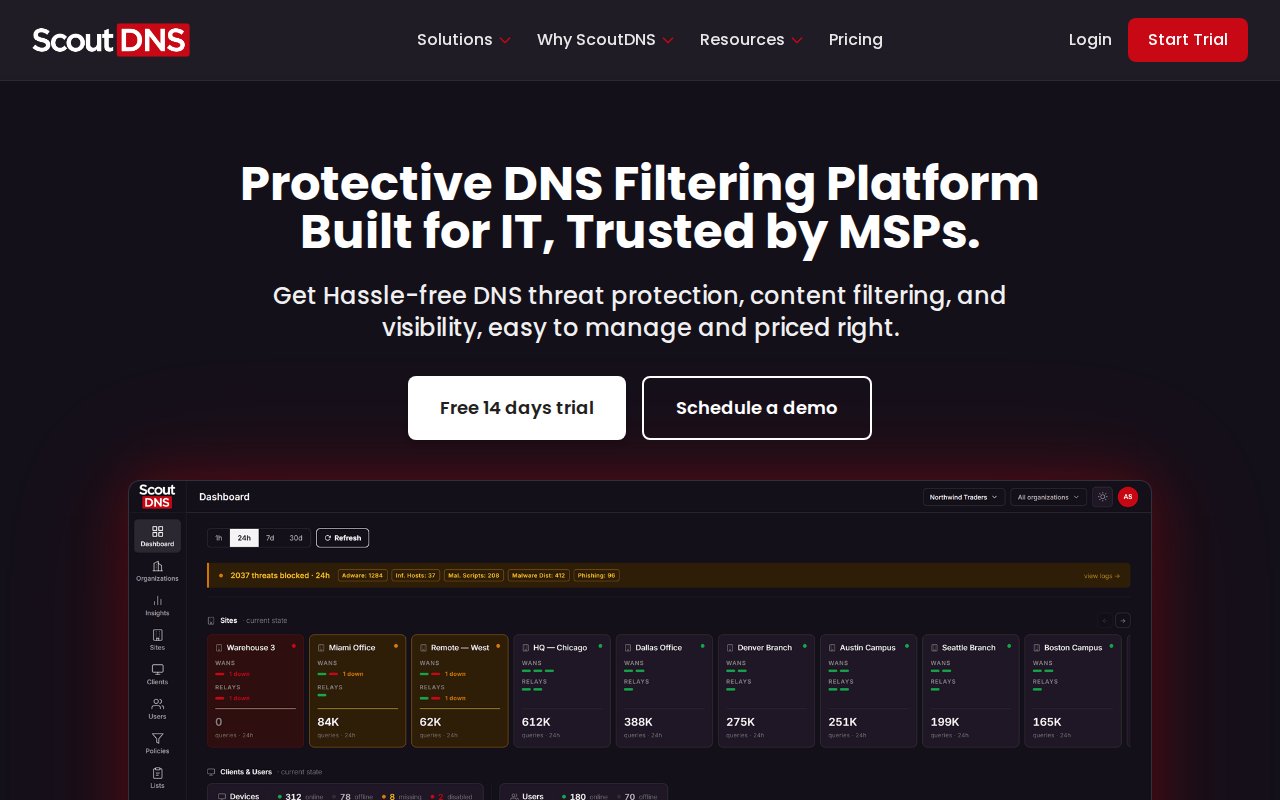
ScoutDNS sells MSPs one package with every feature on, so the gates on its commercial plans (roaming agents and directory policies only on Network 360, Relay from Network Plus) apply to direct buyers only. Its MSP page starts at a $50 monthly minimum, month to month, with the five-tier rate list on request, and ScoutDNS promises at least six months' notice before a price increase.

Each client is an organization, and external operators can be limited to one client's organization. Personas apply policy by Active Directory or Entra ID group. The agent forwards .local and domain-joined queries to local resolvers and fails open if the service is unreachable. ScoutDNS says it is not designed to process controlled unclassified information, which matters if you serve defense contractors.

Best fit:MSPs that want a $50 monthly floor, month-to-month terms and documented fail-open on Windows and macOS laptops.

Think twice if:Clients use phones, tablets or Chromebooks off the network, because the ScoutDNS pages we read list roaming agents for Windows and macOS only.

05

SafeDNS

A DNS filter with a multi-tenant panel for MSPs, white label and roaming clients on five platforms.

Roaming clients on five platformsMSP rate from $0.90White label
MSP console
"the multi-tenant panel", a subaccount per client with its own filtering rules, managed from one reseller dashboard, with your logo and custom domain
Published pricing
business plans Basic $1.20, Pro $2.00 and Pro + $2.60 per user per month billed annually ($1.40, $2.30 and $3.00 monthly), with 15, 25 and 35-user minimums
MSP program
from $0.90 per user per month; minimum and volume conditions not published
Agents
roaming clients for Windows, macOS, Linux, Android and iOS, on Pro and higher business plans; Chromebooks through Google Admin DNS policy or the OpenVPN app, no agent
Offline behavior
not stated on the MSP page we read
SafeDNS homepage headed Stop threats where they start with ProtectiveDNS
www.safedns.com, captured November 19, 2026

SafeDNS offers MSPs what its MSP page calls "the multi-tenant panel", white-labeled with your logo, and lists roaming clients for Windows, Linux, macOS, Android and iOS. On the business plans, roaming clients, Active Directory and per-user policy start at Pro: $2.00 per user per month billed annually, with a 25-user minimum.

The MSP rate starts at $0.90 per user per month, with the minimum and volume conditions unpublished. The thin part is the documentation behind it. The page's "RMM & PSA integrations" section names none, and we found no description of log retention or offline behavior. Ask for all three in writing before a pilot; the other dedicated filters here each document some of them.

Best fit:MSPs that want roaming clients on phones and Linux machines under a white-label panel, at a published MSP starting rate.

Think twice if:You deploy through your RMM, reconcile billing in your PSA or need Active Directory on the reseller route, because the SafeDNS MSP page names no RMM or PSA and its Active Directory guide asks for a business plan, not the Reseller one.

DNS filtering inside a larger security platform

DNS is one layer of a gateway product; fit depends on the contract.

06

Cloudflare Gateway

Cloudflare's secure web gateway and DNS resolver inside Cloudflare One, with a client for six platforms.

Clients on six platformsFail-closed by defaultMulti-client on Enterprise
MSP console
the Tenant application programming interface (API) is only for Cloudflare partners on Enterprise plans and covers DNS policies only; Organizations is Enterprise only; otherwise plan on one account per client
Published pricing
Free up to 50 users; pay-as-you-go $7 per user per month; contract pricing custom
Agents
Cloudflare One Client for Windows 11 or Windows 10 Long-Term Servicing Channel (LTSC), macOS Sequoia 15.1 or later, Linux, iOS and Android, and for Chromebooks made after 2019 through the Android app
Offline behavior
fail-closed by default, with emergency disconnect tools for admins
Logs
kept up to 24 hours on Free, 30 days on pay-as-you-go and 6 months on contract
Cloudflare Gateway page headed Secure Internet browsing without disruptions
www.cloudflare.com, captured November 19, 2026

Cloudflare Gateway is Cloudflare's secure web gateway and DNS resolver within Cloudflare One, so DNS policy is one layer of a broader product. Its client runs on Windows, macOS, Linux, iOS and Android, and on Chromebooks through the Android app. Cloudflare's business continuity guide says it fails closed by default: if the client cannot reach Cloudflare, it "remains connected and blocks traffic rather than failing open", with emergency disconnect tools for admins.

The catch is the contract. The Tenant API, which pushes parent policies to child accounts, is "only available for Cloudflare Partners on Enterprise plans" and supports DNS policies only. On Free or $7 pay-as-you-go, plan on one account per client. That suits MSPs already partnered with Cloudflare, or a handful of larger clients.

Best fit:MSPs already partnered with Cloudflare on an Enterprise plan, or running a few larger clients as separate accounts.

Think twice if:You want one console for many small clients on the published plans, because Cloudflare offers its multi-client tools only on Enterprise plans, and the Tenant API only to partners on them.

07

Cisco Umbrella

Cisco's DNS security service with a multi-tenant console for MSPs, on a published end-of-sale schedule with Cisco Secure Access as its successor.

New orders end in 2027Quote onlySuccessor Cisco Secure Access
Lifecycle
new orders end January 31, 2027; renewals and changes January 31, 2028; support January 31, 2029
MSP console
multi-tenant dashboard with a client hierarchy, settings in bulk or per client, policy templates and a co-branded login; detailed logs kept 30 days, summary data two years
Published pricing
no public price (request a quote); bought through Cisco's card-payment ordering portal for MSPs at non-negotiable monthly market pricing, or a Managed Service License Agreement with Cisco invoicing
Agents
Cisco Secure Client 5.0 and higher on Windows and macOS replaces the end-of-life roaming client; Cisco Security Connector on managed iPhones and iPads; Cisco Secure Client on managed Android devices; an Umbrella Chromebook client (phone and Chromebook clients from its Umbrella DNS guide; confirm your MSP package covers them); Linux not listed
Integrations
pre-written RMM scripts; automatic ticket creation in ConnectWise and Autotask on botnet callbacks; a daily sync of seats, deployed agents and usage into ConnectWise configuration records, and deployment and usage data into an Autotask product record
Offline behavior
fails open; the roaming client restores the original DNS settings when Umbrella is unreachable, and Cisco calls the Secure Client module's inactive state fail-open; iOS and Android fail open or closed, as the admin sets
Cisco Umbrella homepage headed Meet Cisco Secure Access
umbrella.cisco.com, captured November 19, 2026

Cisco Umbrella is on a published end-of-sale schedule. Cisco's bulletin EOL15975 ends new orders on January 31, 2027, renewals and changes on January 31, 2028, and support on January 31, 2029. Cisco says Umbrella "has evolved to Cisco Secure Access" and calls its DNS-only packages DNS Defense. The notice names Umbrella's DNS and secure internet gateway subscriptions, so confirm your MSP console contract dates with Cisco. The bulletin's replacement table maps Umbrella's service-provider subscriptions to "Provider Pricing" Secure Access.

Umbrella's MSP console keeps clients separate, with bulk or per-client settings, policy templates and Entra ID policy. Cisco publishes RMM scripts, opens ConnectWise or Autotask tickets on botnet callbacks, and syncs seat counts into ConnectWise daily. Cisco's roaming client fails open: when Umbrella is unreachable, it restores the original DNS settings.

Best fit:MSPs already running Umbrella tenants who need its console, RMM scripts and ticketing while they plan a move to Cisco Secure Access or another filter.

Think twice if:You are buying new, because Cisco's bulletin ends new Umbrella orders on January 31, 2027.

also considered

Also considered

  • Zorus: now a DNSFilter product; no public price, so the DNSFilter entry covers it.
  • N-able DNS Filtering: powered by DNSFilter, with no public price, so a full entry would duplicate DNSFilter.
  • Heimdal DNS Security: sold inside the Heimdal platform; no public price or operating system list found for the DNS module.
  • OpenText Core DNS Protection: formerly sold as Webroot DNS Protection; its product page shows no price, operating system list or MSP console.
  • DefensX: a browser-based secure workspace with DNS security included, a different product type.
  • NextDNS: a business plan priced for every 50 employees; no MSP or multi-tenant offering on its homepage or pricing page.
decision aid

Which filter covers remote laptops, phones and per-client policy

Start with your clients' devices; the third table covers console, directory and offline behavior.

  • Agent: the vendor documents an installable client for that platform.
  • Not listed: not in the documentation we read; ask.
Desktop agents on vendors' pages, read November 19, 2026
ToolWindowsmacOSLinux
DNSFilterAgent, Plus or Enterprise; no Windows Server or Windows 365Agent, Plus or EnterpriseNo agent; DNS Relay instead
WebTitanAgent (OTG 2); no virtual machinesAgent (OTG 2)Not listed
Control DAgentAgentAgent
ScoutDNSAgent on Network 360 or MSP; v2 in public betaAgent on Network 360 or MSPRelay only, not an endpoint agent
SafeDNSAgent, Pro and upAgent, Pro and upAgent, Pro and up
Cloudflare GatewayAgent; Windows 11 or Windows 10 LTSCAgent; Sequoia 15.1 or laterAgent
Cisco UmbrellaCisco Secure Client 5.0 and higherCisco Secure Client 5.0 and higherNot listed

OTG is WebTitan's On-The-Go agent; LTSC is the Windows Long-Term Servicing Channel. "Pro and up" means SafeDNS business plans; gating on its MSP route is not published.

Phone and Chromebook coverage, with the plan that gates it
TooliOSAndroidChromeOS
DNSFilterAgent through mobile device management only; Plus or EnterpriseAgent; Plus or EnterpriseExtension, managed Chromebooks; Plus or Enterprise
WebTitanNot listedNot listedAfter a support request
Control DSetup helper app or DNS profileSetup helper app; managed app through mobile device managementChrome Enterprise policy, no agent
ScoutDNSNot listedNot listedNot listed
SafeDNSAgent, Pro and upAgent, Pro and upNo agent; Google Admin DNS policy or OpenVPN app
Cloudflare GatewayAgent, iOS 15 and laterAgent, Android 5.0 and laterThrough the Android app, Chromebooks made after 2019
Cisco UmbrellaCisco Security Connector on managed devices; app for unmanaged devicesCisco Secure Client on managed devices; app for unmanaged devicesUmbrella Chromebook client

Plus and Enterprise are DNSFilter's direct plans; ask which applies to MSP seats.

Console, directory, local networks and offline behavior
ToolPer-client policyEntra ID or Active DirectoryLocal domains or on-site relayIf the agent cannot reach the service
DNSFilterClient organizations plus global policiesEntra ID sync; Active Directory sync tool; Plus or EnterpriseWindows agent sends local domains to local DNS; DNS RelayWindows: fail-closed by default (Classic mode); fail-open in DNS PreCheck mode
WebTitanPer-customer default and custom policiesEntra ID through the DNS Proxy; on-premises agentDNS Proxy on siteFail Open on by default on Windows
Control DSub-organization per client; enforced global profileGroup sync not listedSplit horizon; detects the Active Directory domainNot stated
ScoutDNSOrganization per client; parent templatesActive Directory and Entra ID groupsAgent forwards local domains; RelayFail-open; restores the original DNS
SafeDNSSubaccount per client with its own filtering rulesActive Directory on business plans (Pro and up), not the Reseller planActive Directory domain and local aliases set in the dashboardNot stated
Cloudflare GatewayEnterprise plans only; otherwise separate accountsUser and group selectors; Entra ID or Okta group syncDNS locations; Local Domain Fallback in the clientFail-closed by default
Cisco UmbrellaClient hierarchy; policy templatesEntra IDInternal domains list sent to local DNS; virtual appliancesFail-open; restores the original DNS (Open state); phones fail open or closed, admin's choice

What the tables show:

  • DNSFilter (Plus or Enterprise), Cloudflare Gateway, SafeDNS (Pro and up) and Cisco document agents on Windows, macOS, iOS and Android.
  • Six document per-client policy in one MSP console; Cloudflare reserves it for Enterprise plans.
  • Five document offline behavior: Cisco's roaming client, ScoutDNS and WebTitan on Windows fail open, Cloudflare fails closed, and DNSFilter's Windows agent fails closed by default and open in DNS PreCheck. Control D and SafeDNS do not say.
how to choose

How to choose a filter for your clients

In this order:

  1. Devices: strike any filter marked "Not listed" for a platform your clients use off the network.
  2. Console: each client needs its own organization; ask whether client staff can log in to theirs alone.
  3. Directory: with on-premises Active Directory, confirm the agent or a relay sends internal names to the domain controller.
  4. Offline behavior: fail-open keeps the laptop browsing, unfiltered, when the service is unreachable; fail-closed blocks its traffic until the service answers or an admin steps in. Pick the failure your clients can live with.
  5. Floor versus seats: check your seat count against the DNSFilter $150 and ScoutDNS $50 monthly floors.
  6. Route: N-able DNS Filtering is powered by DNSFilter, Cisco sells through its card-payment portal for MSPs or a Managed Service License Agreement, and Cloudflare's multi-client tools need an Enterprise plan. Ask who answers your tickets.

Know the layer's limit: a DNS filter decides at the domain lookup and does not see inside the encrypted page that follows, which is where browser layers such as DefensX and gateways such as Cloudflare's work.

Ask these on every demo:

  1. Which of our platforms does your agent cover on the MSP route, and on which tier?
  2. What does the agent do offline on Windows, on macOS and on phones?
  3. What is the MSP per-seat rate, and is there a minimum per client organization?
  4. How do we remove the old agent and its certificates at scale?

Red flags

  • An offline answer for Windows only, when clients also run macOS.
  • MSP rates that arrive only after you commit to a floor.
  • Phone coverage that turns out to be a setup helper or a higher tier.
pricing

What these filters cost at 100 and 400 seats

The first table prices one direct account at list price; the second shows what each MSP program publishes.

Direct list prices per month at 100 and 400 seats, read November 19, 2026
Tool and planBilling unit100 seats400 seats
DNSFilter Core (no roaming clients)Per license$100 billed annually; $115 monthly$400 annually; $460 monthly
DNSFilter PlusPer license$225 billed annually; $250 monthly$900 annually; $1,000 monthly
WebTitanPer user, paid annually$278$1,112
Control D self-servePer endpoint$200$800
ScoutDNS Network Standard / Plus / 360 (agents on 360 only)Per seat, billed annually$91.67 / $108.33 / $125.00$366.67 / $433.33 / $500.00
SafeDNS Basic / Pro / Pro +Per user, billed annually$120 / $200 / $260$480 / $800 / $1,040
Cloudflare Gateway pay-as-you-goPer user, one account$700$2,800
Cisco UmbrellaNot publishedQuote onlyQuote only

Seats times the monthly list price, above each plan's minimum; ScoutDNS yearly price divided by 12; ScoutDNS ($1.10 to $1.50) and SafeDNS ($1.40 to $3.00) cost more billed monthly; Cloudflare in one account.

MSP program terms as published, read November 19, 2026
ProgramWhat is published100 seats400 seats
DNSFilter MSP program$150 monthly minimum spend on user licenses, service included; detailed pricing after trial signupAt least $150At least $150
ScoutDNS MSP$50 a month minimum, month-to-month; rates on requestAt least $50At least $50
SafeDNS MSPFrom $0.90 per user per monthFrom $90From $360
Control DThrough partnershipsNot publishedNot published
WebTitanNot found on its partner pageNot publishedNot published
Cisco UmbrellaQuote only, two buying routesQuote onlyQuote only

SafeDNS figures use its starting rate and are not a quote.

List prices are not partner quotes, and no page we read says whether DNSFilter's or SafeDNS's plan minimums apply per client organization or per account. If you pass the cost on, what a per-user MSP price covers shows where web filtering sits in a client's monthly price.

faq

Frequently asked questions

Is Cisco Umbrella being discontinued?

Yes, on a schedule. Cisco's end-of-life bulletin ends new Umbrella orders on January 31, 2027, renewals and changes on January 31, 2028, and support on January 31, 2029. Cisco says Umbrella has evolved to Cisco Secure Access and calls its DNS-only packages DNS Defense. The bulletin names Umbrella's DNS and secure internet gateway subscriptions, so confirm your MSP console contract dates with Cisco.

Do I still need DNS filtering beside endpoint detection and response (EDR) and email security?

It does a different job. Endpoint detection and response watches what runs on the device and email security what reaches the inbox; a DNS filter blocks a domain at the lookup, for every app on a device running its agent. It cannot see inside encrypted pages or which account is signed in; browser tools such as DefensX and gateways such as Cloudflare's work there.

What happens to a remote laptop if the DNS filtering agent cannot reach the service?

Five of the seven vendors document it. ScoutDNS and Cisco's roaming client restore the original DNS settings, and Cisco lets admins set phones to fail open or closed. WebTitan's Windows agent has had Fail Open on by default since January 2026. DNSFilter's Windows agent fails closed by default; DNS PreCheck fails open. Cloudflare's client fails closed by default, blocking traffic. Control D and SafeDNS do not say on the pages we read.

Does DNS filtering cover phones and Chromebooks?

Only where the vendor documents a client. DNSFilter covers iOS, Android and managed Chromebooks on Plus or Enterprise. Cloudflare and Cisco cover iOS, Android and Chromebooks. SafeDNS lists iOS and Android roaming clients on Pro and up. Control D offers setup helper apps, and WebTitan covers Chromebooks after a support request. We found no phone agent listed for ScoutDNS or WebTitan.

Should I pay per seat or per site for DNS filtering?

Every filter here with a published price bills per user, seat or endpoint; none of the pages we read lists a per-site price. Site-level policy exists, such as DNSFilter subnets and Cloudflare DNS locations, but the bill follows seats. Count users or devices per client before you compare.

How do I switch DNS filters across 40 clients?

Pilot a few clients inside the new vendor's trial: 14 days at DNSFilter, ScoutDNS and Control D, 15 at SafeDNS. At DNSFilter, join the partner program first: the trial organization's policies, sites and roaming clients cannot move to client sub-organizations afterward. Push agents with your RMM scripts and remove old agents with each vendor's uninstall steps; DNSFilter, ScoutDNS, WebTitan and Control D publish theirs.

Screenshots captured from each vendor's live site on November 19, 2026.