Rankings still matter, but the future of seo lives in the answer layer. AI Overviews and chat engines are stealing attention. This shift transforms search from a traffic problem into a citation problem. To win, you must move beyond clicks. This experiment-ready playbook follows NUOPTIMA’s core directive: “Don’t Just Rank. Be The Answer.” We define four shifts to test and measure today, ensuring your brand becomes the cited authority in every generative search experience.
Key Takeaways
- The future of SEO lives in the answer layer, shifting search from a traffic problem into a citation problem as AI Overviews and chat engines capture attention.
- Search has split into ranking (classic SERP) and recommendation (GEO), where LLMs reward extractable facts, cross-source authority, and complete topical coverage.
- Restructure high-value pages with a direct answer block of 2 to 3 sentences at the top, followed by entity-rich supporting depth.
- LLMs treat authority as a calculation, so maintain one canonical name, description, and identifier across properties and link them with @id and sameAs to verified profiles.
- Agentic SEO turns your site into an API-like knowledge surface with stable URLs, sub-second renders, and task-ready data so AI agents can fetch and compare it.
1. Pivot to the Answer Layer: Optimizing for Citation over Clicks
AI-generated summaries shift user attention above traditional blue links. High-intent informational queries now resolve directly on the SERP, accelerating zero-click behavior. Visibility no longer guarantees a session, forcing a transition from traffic-chasing to citation-building across Google, Perplexity, and Gemini.
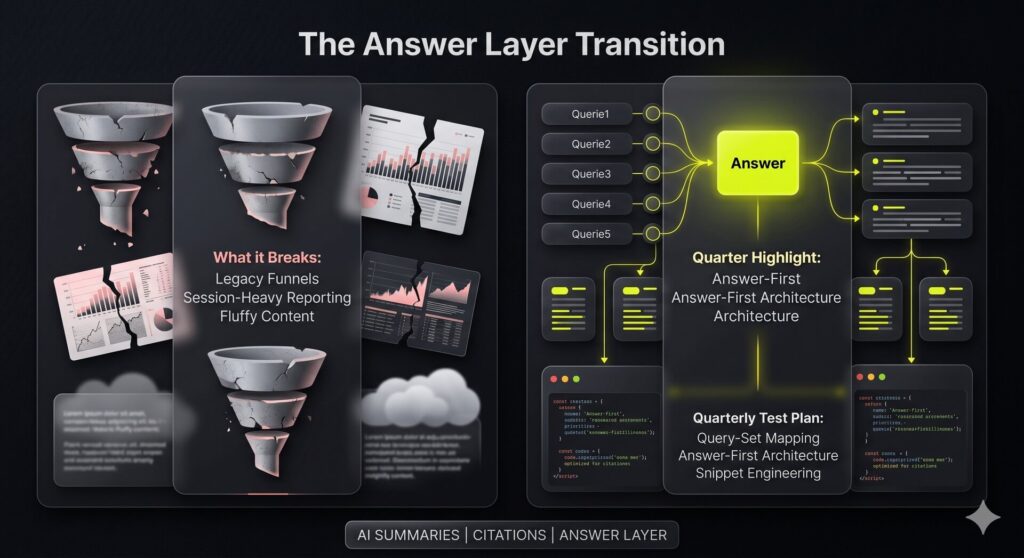
What it breaks
- The Rank-Click-Convert Funnel: When the SERP provides the solution, the traditional middle-of-the-funnel session disappears.
- Session-Heavy Reporting: Metrics focusing on organic traffic volume fail to capture the brand authority gained when LLMs cite you as the source.
- Legacy Content Formats: Long-form assets that hide answers behind fluff are ignored by both users and AI retrieval systems.
Quarterly Test Plan
- Query-Set Mapping: Audit your keyword portfolio to identify informational queries triggering AI Overviews versus transactional terms that still drive direct clicks.
- Answer-First Architecture: Restructure high-value pages with a direct answer block (2 to 3 sentences) at the top, followed by entity-rich supporting depth.
- Snippet Engineering: Deploy tables, definitions, and bulleted lists specifically formatted for LLM extraction and Knowledge Graph inclusion.
Strategic Measurement
- Visibility Deltas: Monitor the gap between impression growth and CTR decline by query class to quantify your answer layer market share.
- AI-Assist Attribution: Add a self-reported “How did you hear about us?” field to CRM workflows to capture AI-search recommendations.
Micro-example
- The Answer Pivot: Select one top-ranking legacy page. Convert it to an answer-first layout and monitor 28-day deltas in impression volume and citation frequency.
2. The Great Search Split: Engineering for Ranking vs. Recommendation
Search has bifurcated into two distinct mechanics: ranking and recommendation. Traditional SEO governs the classic SERP, while Generative Engine Optimization (GEO) determines whether your brand is synthesized, cited, or recommended by LLMs. This split defines the future of SEO. One surface prioritizes position; the other rewards being the primary data source within a unified infrastructure.
LLMs prioritize content based on three primary citation triggers:
- Engines prefer extractable, constraint-friendly facts. Precise claims, structured lists, and definitions are easier for models to reformat into direct answers.
- Authority reduces retrieval risk. Brands with consistent data across multiple authoritative sources are safer for models to cite without hallucination.
- Topical coverage wins. Being the “complete map” of a subject increases retrieval frequency across complex, long-tail queries.
To capture visibility across both surfaces, build these three asset types:
- Pillar pages plus short-answer follow-ups engineered for specific conversational prompts within a conversational SEO framework.
- Citable blocks featuring proprietary stats, “how-to” steps, and decision tables using tight, declarative wording and Schema.org markup.
- Comparative assets (X vs Y, alternatives) that allow AI engines to compress the buyer’s evaluation journey into a single response.
Practical Experiment
- Pick 10 high-intent prompts in ChatGPT or Perplexity where you currently lack visibility.
- Create one new citable block for each prompt and run weekly tests to log citation frequency and brand mentions.
NUOPTIMA GEO services is the strategic execution partner for brands looking to engineer their content infrastructure and become the default AI recommendation.
3. Engineering a Trusted Entity: From Vague Authority to Machine-Readable Proof
LLMs treat authority as a calculation, not a vibe. A trusted entity is a machine-readable identity built on consistent claims and cross-web corroboration. When brand data fluctuates across profiles, engines flag the source as unreliable. You must transition from subjective expertise to a verifiable knowledge graph presence. This architecture ensures your brand becomes the cited, trusted source in every generative experience.
Technical baseline for implementation:
- Schema Prioritization: Prioritize Organization/Person, Article, and FAQPage/HowTo schemas to define site identity and content intent.
- Entity Consistency: Maintain one canonical name, description, and identifier across all properties. Use @id and sameAs properties to link your domain to verified external profiles like LinkedIn or Crunchbase.
- Visible Alignment: Only mark up facts visible to the human user. Discrepancies between schema and on-page content trigger AI distrust and ranking volatility.
Authority proof for AI citation:
- Quantified Outcomes: Replace vague success stories with “Inputs → Actions → Outcomes” frameworks. Use specific data points that LLMs can easily extract as verifiable facts.
- Editorial Signals: Include author bios with credentials, first-hand experience markers, and methodology notes to satisfy E-E-A-T requirements.
- Corroboration Plan: Ensure core brand claims are mirrored on trusted third-party directories and review platforms to provide the external validation AI requires.
Execution experiment:
- Identify five high-value money pages and integrate advanced schema plus extractable proof blocks.
- Re-run ten target prompts in Perplexity or Gemini to track if your brand citations and mentions increase.
Mini-warning:
- Avoid schema spam. Accuracy and consistency always outweigh sheer volume in entity-based search environments.
4. Agentic SEO: Positioning Your Site as an AI-Actionable Knowledge Surface
Traditional traffic metrics often mask a quiet shift in buyer behavior. B2B researchers increasingly deploy AI agents to evaluate vendors and complete complex workflows without a traditional SERP journey, shifting the requirements for B2B content SEO. Agentic SEO treats your website as an API-like knowledge surface rather than a marketing brochure. This allows AI tools to fetch data, compare options, and make procurement decisions directly.
Optimizing for autonomous agents requires a technical pivot toward frictionless retrieval:
- Retrieval hygiene: Prioritize stable URLs, sub-second render times, and zero gating for high-value technical facts.
- Task-ready content: Document pricing logic, specific implementation constraints, and comparison data in formats agents can parse.
- Commercial indexability: Use granular robots directives to guide AI crawlers toward high-intent data while protecting proprietary assets.
Validate your agent-readiness with a structured testing framework:
- Task mapping: Identify 10 high-intent tasks an agent would perform, such as “summarize compliance requirements” or “extract vendor pricing tiers.”
- Structured task pages: Create dedicated pages for these tasks that combine human-readable text with structured data for machine extraction.
- Funnel attribution: Instrument downstream tracking to measure how many qualified leads originate from these agent-optimized evaluation pages.
Agentic search behavior will likely lower total session counts while improving lead qualification by filtering out low-intent traffic. Success should be measured by pipeline contribution and organic revenue rather than vanity metrics like total visits. This shift moves SEO from the discovery layer to the decision layer of the B2B funnel. For brands ready to engineer visibility across SEO and GEO, NUOPTIMA’s GEO services provide the technical architecture required for the agentic era.
The 12-Week SEO and GEO Execution Roadmap
Success in the future of seo requires moving beyond a “wait and see” approach. You must implement repeatable experiments to secure the answer layer. Use this 12-week framework to move your brand from speculative content to machine-readable authority.
Strategic Prerequisites
Establish your data baseline before launching the first sprint:
- Select 10 to 20 target AI prompts and 10 to 20 revenue keywords tied to high-value pages.
- Define your measurement stack. Include traditional rankings, CTR, AI citation frequency, and pipeline conversions.
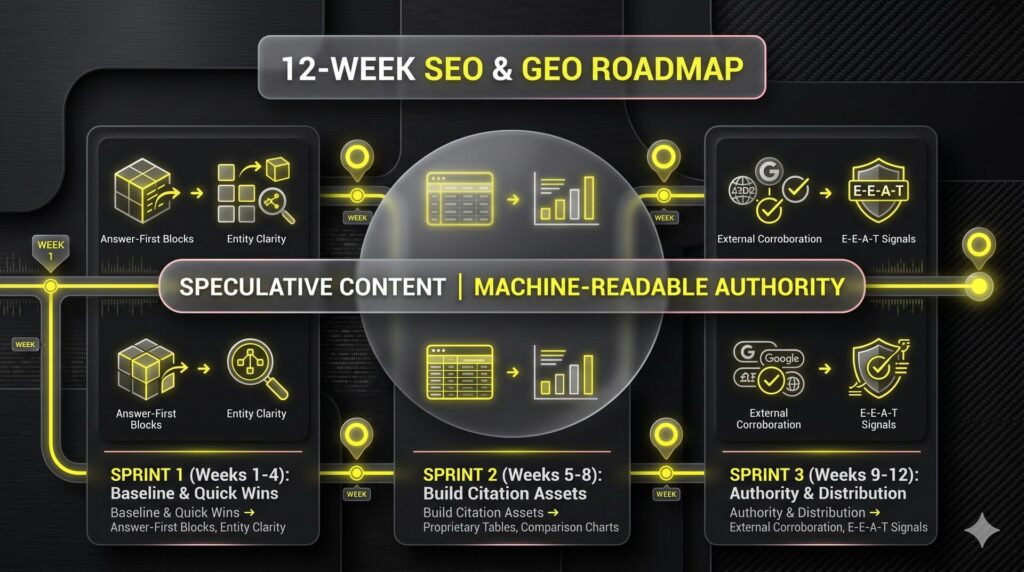
Sprint 1: Baseline and Quick Wins (Weeks 1 to 4)
Update existing infrastructure to improve AI retrieval.
- Inventory priority revenue pages and map them to specific user intents.
- Insert answer-first content blocks at the top of informational pages. You will see faster snippet acquisition.
- Deploy organizational and article schema to provide entity clarity for AI crawlers.
Sprint 2: Build Citation Assets (Weeks 5 to 8)
Transition to creating data-rich, retrieval-friendly assets.
- Publish 3 to 5 citable blocks such as proprietary tables, comparison charts, and expert definitions.
- Expand pillar-to-answer architecture to cover conversational long-tail queries.
- Verify all new assets are indexable by OpenAI and Gemini bots.
Sprint 3: Authority and Distribution (Weeks 9 to 12)
Reinforce external SEO trust signals to secure long-term citations.
- Secure corroborating brand mentions on authoritative third-party directories.
- Update author signals to satisfy entity-based E-E-A-T requirements.
- Refine prompt targets based on your citation performance in Perplexity and Gemini.
Reporting Template
Prepare one slide for each of these core specialist outputs:
- Google Performance: Rankings and organic CTR.
- AI Visibility: Citation frequency and brand mention share.
- Pipeline Impact: Lead attribution and organic revenue growth.
Partner with NUOPTIMA for GEO services to lead the shift in AI search.
Visit nuoptima.com to explore our GEO services and build your AI-native search strategy.
Where this fits in your MSP growth system
This is one piece of how NUOPTIMA makes MSPs and cybersecurity firms the provider buyers find on Google and in AI search. See how it connects to MSP SEO and GEO and AI-search, or get your free MSP lead forecast to see exactly where your firm shows up across ChatGPT, Gemini, and Perplexity today.