Co-managed IT is not a watered-down managed services plan. It is a deliberate positioning move to win larger clients with internal IT, bigger budgets, and longer retention, while securing a clear story for Google and AI search. This guide provides a clean definition, ideal-fit signals, the RACI operational split, ticketing integration realities, and ROI framing. Start with why this offer changes your pipeline quality, then lock down what it is and how to package it.
Key Takeaways
- Co-managed IT is a positioning move, not a watered-down offering. It opens the 200-to-2,000-seat market segment that would never consider full outsourcing.
- The model works only when every task has a single accountable owner: a RACI matrix with vague shared accountability creates finger-pointing during outages and destroys client trust.
- Ticketing integration is the most common delivery failure. If your PSA and the client's Jira or ServiceNow do not sync bi-directionally, techs waste hours copying data and internal staff blames your team for delays.
- Price co-managed IT against the cost of an additional FTE (salary, benefits, single-point-of-failure risk) rather than against a cheaper outsourced help desk. This framing survives CFO scrutiny.
- A paid onboarding phase is non-negotiable: it covers RACI alignment, tool integration, ticket-flow setup, and shared runbook authoring, and prevents the messy handoffs that destroy early-stage retention.
Co-managed IT is a collaborative service model where a managed service provider partners with a business's existing internal IT team, sharing defined responsibilities and SLAs rather than replacing the in-house function entirely.
1. Position Co-Managed IT as an Acceleration Layer to Access Larger Accounts
Internal IT leaders block standard outsourcing proposals because they fear replacement. What they actually want is coverage, bench strength, and fewer daily failure modes.
By positioning co-managed IT as an acceleration layer rather than a replacement strategy, you eliminate this procurement resistance. You sell specialized risk reduction instead of outsourcing. This shift opens access to lucrative accounts in the 200- to 2,000-seat range (your results will vary by market and vertical) that would otherwise never consider fully outsourcing their IT systems.
Consider a 250-user firm with one IT manager and a single technician. They are drowning in daily support tickets and cannot execute network upgrades. You step in to handle three specific burdens:
- After-hours monitoring and escalation
- Specialized security support
- Complex network projects
This partnership frees their internal team to focus on strategic corporate growth projects. The commercial outcome for your MSP is better logo quality, higher average contract value, and a highly defensible retention story that secures your recurring revenue over the long term.
2. Defining Co-Managed IT: Clarifying the Boundaries of Shared IT Responsibility
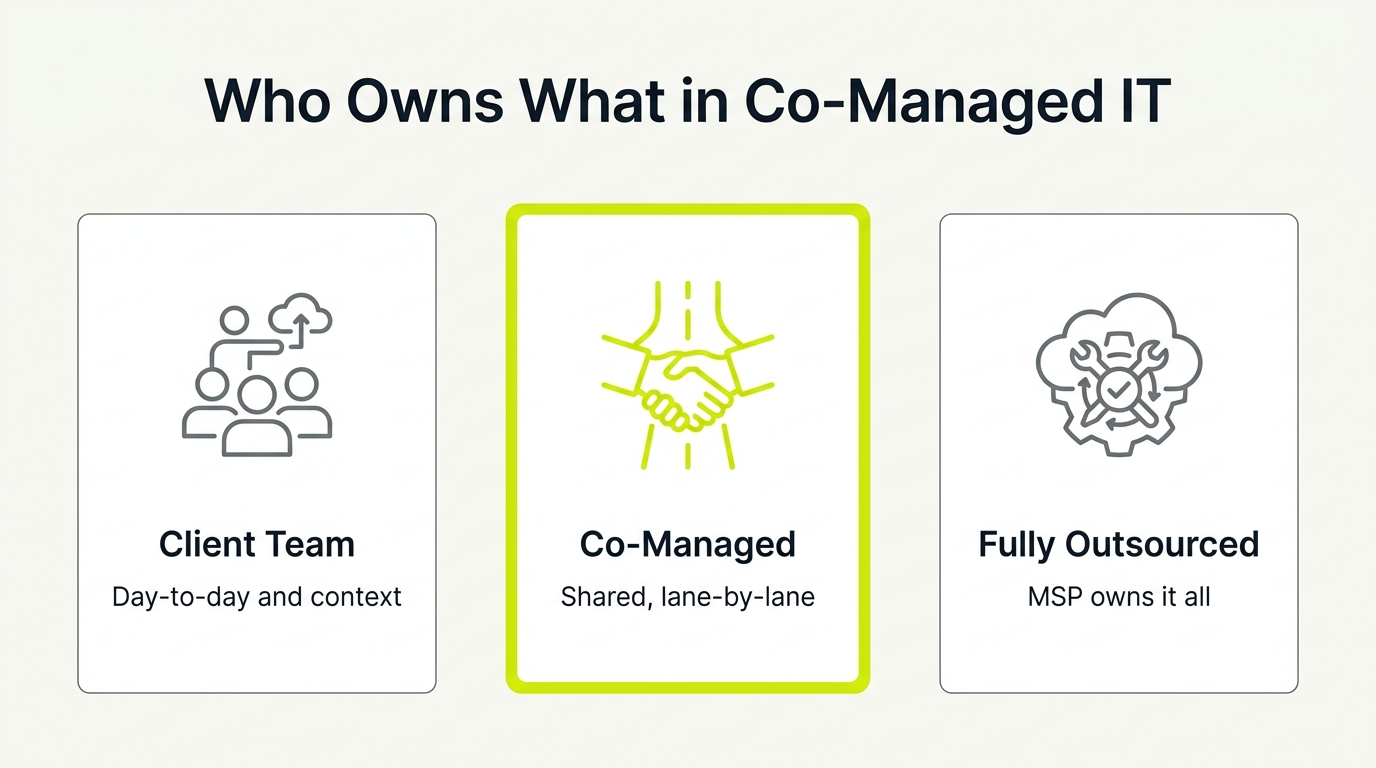
At its core, the co-managed model is a shared-ownership operating model where an MSP supports an internal IT team with specific responsibilities, tools, and SLAs. Rather than replacing the in-house director, this arrangement enhances existing technical capabilities with enterprise-grade platforms and deep engineering backup. Mid-market firms use shared IT delivery to bridge specific skill gaps while keeping internal staff focused on strategic growth.
To build a clean sales narrative, you must clarify what this model is not:
- Not full outsourcing: It does not replace the internal department entirely or cut local headcount.
- Not staff augmentation by the hour: It does not function as a temporary body shop without structural SLAs.
- Not competing helpdesks: It does not create two separate teams competing for the same user tickets.
The success condition for this partnership is simple: one accountable owner per task, documented escalation paths, and a single source of truth for ticket flow.
How the delivery models compare at a glance:
| Model | Who owns strategy | Who owns daily ops | Best fit |
|---|---|---|---|
| Internal IT only | Internal IT director | Internal team | Self-sufficient teams |
| Co-managed IT | Internal IT director | Shared (internal + MSP) | Growing mid-market firms |
| White-label / subcontracted MSP | Your MSP | Partner MSP | Capacity overflow |
| Outsourced L1 help desk | Your MSP | Specialist help-desk vendor | Pure ticket volume relief |
How the delivery models compare at a glance:
| Model | Who owns strategy | Who owns daily ops | Best fit |
|---|---|---|---|
| Internal IT only | Internal IT director | Internal team | Self-sufficient teams |
| Co-managed IT | Internal IT director | Shared (internal + MSP) | Growing mid-market firms |
| White-label / subcontracted MSP | Your MSP | Partner MSP | Capacity overflow |
| Outsourced L1 help desk | Your MSP | Specialist help-desk vendor | Pure ticket volume relief |
3. Qualify Fast: Best-Fit Signals and Red Flags for Co-Managed IT Deals
Chasing mismatched co-managed IT deals wrecks your gross margins and exhausts your engineers. To turn co-managed IT into a repeatable, high-margin offer rather than an operationally messy custom project, you must qualify fast during discovery.
Look for these high-yield buyer signals:
- Under-resourced teams: One to five internal IT staff struggling with ticket backlogs and constant on-call fatigue.
- Compliance pressure: Upcoming audits, strict regulatory demands, or severe cybersecurity skill gaps.
- Growth events: Active M&A activity, new site expansions, cloud migrations, or ERP rollouts.
Disqualify the lead immediately if you encounter these red flags:
- No tool control: Internal IT wants to offload accountability but refuses to share tool admin privileges.
- Vague boundaries: No willingness to document responsibility splits or sign off on formal SLAs.
A tight ICP reduces messy handoffs, secures buy-in from in-house IT stakeholders, and drives predictable contract revenue that scales.
4. The Co-Managed RACI: Mapping Ownership and Network Demarcation
Co-managed IT fails when responsibility is vague and both sides assume they own the same task. Without explicit boundaries, a network outage or firewall issue quickly devolves into a costly finger-pointing match where blame happens fast.
To protect your margins and prevent friction, establish a starter RACI matrix mapping ownership across these domains:
- Strategy and roadmap: Directing strategic business alignment and long-term IT budget planning.
- Helpdesk support: Routing triage paths clearly from internal Tier 1 up to MSP Tier 3 escalation.
- Monitoring and patching: Handling server maintenance and regular endpoint updates.
- Identity and access: Managing employee onboarding, offboarding, and credential control.
- Security: Differentiating corporate security policy from daily operational security tasks.
- Backup and disaster recovery: Running daily backup verification and restore testing.
- Networking demarcation: Defining specific ownership for firewall policies, core switches, wireless management, and ISP coordination.
Apply one non-negotiable rule: only one party can be designated as Accountable per task. Review this responsibility map quarterly, and document P1 escalation and leadership communication protocols before the first incident occurs.
5. System Integration: Bridging the Co-Managed IT Ticketing Gap
When you deliver co-managed IT, system friction is the fastest way to lose a client. If your MSP runs a traditional PSA while the internal IT team uses Jira or ServiceNow, the ticket handoff usually breaks. When notes, attachments, and updates do not sync automatically, internal staff blames your team for delays, and your techs waste hours copying data.
A co-managed help desk is the specific expression of this integration: a shared ticket queue where the client's internal Tier 1 staff and your MSP's engineers work the same backlog under one set of routing rules. The internal team keeps the desk-side relationships and first-touch triage; your bench absorbs overflow, after-hours, and Tier 3 escalation. It is not a second competing help desk sitting beside the client's own. One queue, one SLA clock, one escalation path, with responsibility mapped in the RACI so a stalled ticket always has a named owner.
To protect delivery margins and maintain accountability, you must choose a proven integration approach:
- iPaaS tools: Best for simple workflows and fast pilots.
- Dedicated connectors: Essential for production-grade, bi-directional sync.
- Custom API builds: Reserved for enterprise clients with custom requirements and matching budgets.
To secure a clean operational sync, your integration scope must map:
- Ticket statuses and priorities
- Assignment groups
- SLA clocks
- Attachments and audit notes
- Error logging and conflict resolution systems
Solving this integration gap gives your sales team a clear, operational story to sell. You eliminate manual data entry, protect your margins, and prevent the operational chaos that destroys trust.
6. How to Price, Onboard, and Frame the ROI of Co-Managed Contracts
Pricing co-managed IT must be defensible, or the prospect's finance partner will block the deal to protect margins. To survive CFO scrutiny, align your proposal with one of three structured models:
- Per-user per-month: A flat fee covering defined baseline needs like patching, monitoring, after-hours support, and security operations.
- Block-of-hours: A pre-purchased monthly pool of hours dedicated to tier-1 overflow and specialized projects.
- Hybrid: A flat per-user base fee for core tools, paired with a monthly hourly bank for escalation.
Every co-managed contract requires a paid onboarding phase. This non-negotiable phase covers the labor to align your RACI matrix, integrate system tools, set up bi-directional ticket sync, and write shared runbooks.
When framing ROI, compare the contract to hiring a full-time employee. Adding an FTE introduces fixed overhead, benefits, and single-point-of-failure risk. Co-managed IT buys an entire engineering bench and 24/7 coverage with variable scope. This defensible structure allows you to quote with confidence, leading the buyer to a controlled pilot with a clear expansion path.
7. Convert Co-Managed IT Delivery Design into a High-Visibility Demand Engine
Co-managed IT sales often stall because internal IT directors fear replacement. To solve this, position your offer with "we make your team faster and safer" language. Commit to a documented RACI and shared weekly reporting to prove you support, rather than replace, the internal team.
To capture high-intent search and AI engine queries, publish this minimum asset set:
- A definition-first co-managed IT page: Define the service plainly to capture search intent.
- A responsibility split section: Map out a RACI summary with concrete networking and firewall examples.
- A pricing model explainer: Detail your co-managed pricing tiers and what your onboarding includes.
- A short job-security FAQ: Provide direct answers addressing career stability and ticketing system integration.
Next, run a quick GEO test. Query 10 buyer terms in Google and AI tools like ChatGPT. Score whether your MSP is cited and pinpoint which authority proofs are missing from your pages.
To build a predictable demand engine around this offer, book a co-managed positioning review with our team at nuoptima.com.
How to Launch Your Co-Managed IT Offering in 90 Days
Co-managed IT programs fail when sold before delivery mechanics and ownership are defined. Before pitching, lock down your prerequisites: clear definitions, ideal customer profile (ICP) signals, RACI boundaries, and ticketing plans.
1. Package Your Modules
Select two to three co-managed IT modules to offer, such as helpdesk overflow, after-hours coverage, security operations, or network operations.
Outcome: A standardized, repeatable menu of services.
2. Build the RACI and Escalation Map
Document the exact responsibility split for each module. Define P1 communication protocols and assign a single accountable owner for every task.
Outcome: A signed operational agreement that prevents finger-pointing during outages.
3. Configure the Ticket Flow
Decide between a single queue or a bi-directional sync. Document status triggers and field mappings to keep engineering teams aligned.
Outcome: An automated integration that eliminates manual ticket entry.
4. Run a 30 to 90 Day Pilot
Launch a narrow-scope pilot with clear success metrics. Measure response times, ticket backlog reduction, and ensure fewer P1 surprises.
Outcome: Proven delivery telemetry to validate your model.
5. Publish Your Buyer Assets
Publish targeted assets to secure Google and AI citations: a definition page, pricing model, RACI summary, and FAQ.
Outcome: Indexable web assets ready for search engine and AI citations.
6. Measure Shortlist Visibility
Run query tests monthly across Google and AI search tools. Track whether search answers name your firm and cite your assets.
Outcome: A measurable visibility score.
To build your technical demand engine, visit nuoptima.com and read our content marketing guide for MSPs.