
Evaluating MSP vs internal it is rarely a strict either-or choice. An MSP wins when you need predictable coverage, faster expertise, and lower hiring risk. Internal IT wins on embedded control and deep business context. This guide delivers clear definitions, cost models, risk trade-offs, and co-managed hybrid options to help you decide.
Quick comparison: Internal IT vs MSP vs Co-managed IT
| Dimension | Internal IT | MSP | Co-managed IT |
|---|---|---|---|
| Cost model | Variable. Salary, benefits, recruiting, turnover | Predictable flat monthly retainer | Retainer + reduced internal headcount |
| Coverage hours | Business hours + on-call risk | 24/7 via team rotation | Mixed, MSP covers after-hours |
| Expertise depth | One or two generalists | Specialist team across security, cloud, compliance | Internal context + MSP specialist depth |
| Business control | High. Daily task direction | Governance-level. You set policy | Shared. Internal owns strategy, MSP executes |
| Scaling risk | Hiring lag, single points of failure | Provider lock-in, tool standardization | Low. Scope adjusts quarterly |
If your seat count is under 100 and you lack a compliance mandate, an MSP or co-managed model typically costs less and deploys faster. Internal IT makes sense once headcount, complexity, or embedded context justify the fully burdened cost.
Start with definitions so procurement and leadership are comparing the same thing.
Key Takeaways
- For organizations under 100 seats without a compliance mandate, an MSP or co-managed model typically costs less and deploys faster than internal IT.
- Comparing a single salary to an MSP retainer is a financial trap. The fully burdened internal IT cost includes recruiting fees, benefits, turnover gaps, and on-call risk.
- An MSP delivers operational coverage in weeks; internal hiring takes quarters. Default to MSP when a hard deadline like a compliance audit or M&A integration is approaching.
- Co-managed IT is the practical default for 50 to 500 seat organizations: internal staff retain strategic ownership while the MSP handles high-volume tickets and after-hours monitoring.
- Outsourcing shifts control from daily task micromanagement to strategic governance. Leadership retains authority over budget, risk tolerance, and compliance policy.
A Managed Service Provider (MSP) is an external company that delivers ongoing IT management. Including helpdesk, network monitoring, and cybersecurity. Under a Service Level Agreement for a predictable monthly fee.
1. Defining the Operating Models: Internal IT vs. MSP
Buying decisions stall when leadership views a managed service provider as a temporary contractor rather than a strategic operating model. To enable an apples-to-apples comparison, you must define the two approaches clearly.
Internal IT relies on W-2 employees on your payroll. This team handles day-to-day user support, local infrastructure, and business alignment. Work is prioritized reactively, constrained by individual capacity and skill gaps.
Internal IT gives you daily task control, but that control evaporates when critical network knowledge is siloed in one technician's head.
An MSP (Managed Service Provider) is an external operating model delivering ongoing IT management under a Service Level Agreement (SLA). It provides proactive operations and predictable outcomes through collective team expertise, rather than individual contractor hours.
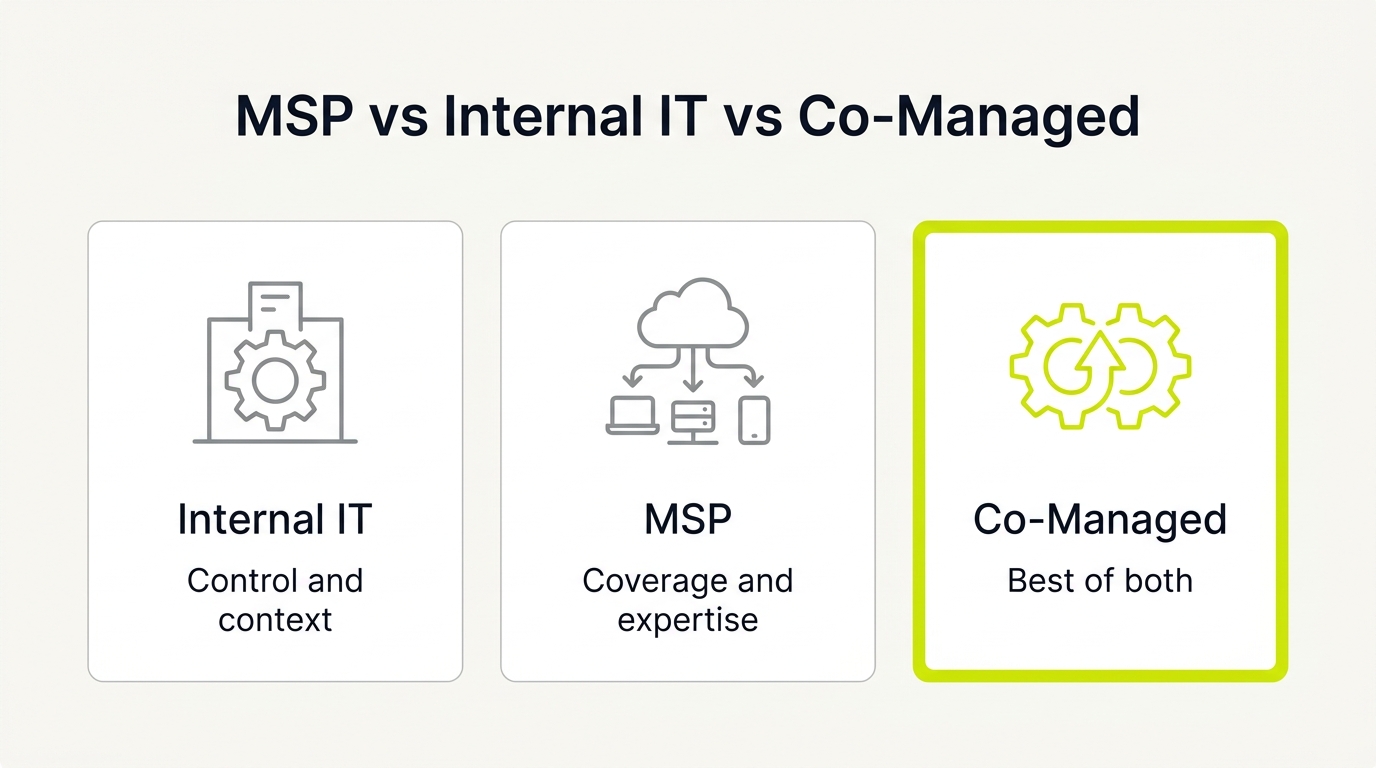
Outsourced IT is not all-or-nothing. It spans from fully outsourced infrastructure to co-managed models that support your existing team.
2. The True Cost of MSP vs Internal IT
Comparing a single internal salary to an MSP monthly retainer is a financial trap that ignores fully burdened expenses. To evaluate these two models accurately, a finance partner must weigh true operational costs against hiring risks.
Your internal IT checklist must include:
- Base salary, payroll taxes, and benefits
- Recruiting fees, onboarding time, and continuous training
- Turnover disruption and coverage gaps (vacation, sick, on-call)
Your MSP checklist must include:
- Monthly recurring retainer fee
- Onboarding and scheduled project fees
- Out-of-scope, after-hours, and on-site support
To compare these models, build a 3-year total cost of ownership model that projects seat growth and future infrastructure projects.
A 3-year TCO model is the only honest way to compare these models. It surfaces the recruiting, benefits, and turnover costs that make a single-salary comparison misleading. This boardroom-level math prevents budget surprises and highlights the financial predictability of outsourcing.
3. Time-to-Value: Speed of Deployment vs. Hiring Lag
Attempting to hire your way out of an IT capability gap to meet tight deadlines introduces severe operational risk. While internal hiring requires quarters to source, onboard, and document systems, an MSP delivers operational coverage in weeks.
An MSP provides immediate day-one access to critical infrastructure:
- Dedicated helpdesk support
- Constant network monitoring
- Specialized security operations (SOC)
An internal build creates immediate documentation debt and vulnerable single points of failure.
Apply this decision rule: if your business timeline is compressed by a hard deadline, default to an MSP or co-managed IT first.
When a compliance audit, M&A integration, or office launch creates a hard deadline, internal hiring introduces unacceptable lag. An MSP deploys operational coverage in weeks, not quarters. This strategy secures immediate coverage for critical events:
- Compliance audit milestones
- M&A transaction integrations
- New office launches
4. Reclaiming Control: Governance vs. Task Execution
The fear of losing control is the primary psychological barrier when choosing between outsourced and in-house IT. Keeping IT internal feels secure because you direct daily tasks, but accountability evaporates when critical network knowledge is siloed in one technician's head.
Outsourcing shifts your control from micromanagement to strategic governance. Service standardization ensures repeatable security, while your leadership team retains authority over:
- Strategic budget allocation
- Risk tolerance thresholds
- Compliance and security policies
To prevent dangerous ownership gaps during security incidents, establish a formal responsibility matrix. Assign a single, documented owner to every IT asset and maintenance protocol. Never leave critical tasks marked as shared by default.
5. Co-Managed Security: Blending Internal Context with MSP Scale
Co-managed IT resolves this security debate by separating policy governance from execution. This hybrid framework helps midmarket firms avoid the false trade-off between keeping operational control and achieving continuous, round-the-clock protection.
An MSP delivers scale and repeatability through standardized controls, 24/7 monitoring, and hardened configurations tested across dozens of environments. Meanwhile, internal IT brings essential business context, managing sensitive workflows, internal politics, and strategic risk decisions.
The best-practice setup divides labor to maximize defense:
- Internal IT retains governance, setting the overall security policy.
- The MSP executes technical operations, deploys updates, and monitors alerts.
- Clear, documented escalation paths guarantee rapid, coordinated incident response.
6. Co-Managed IT: The Friction-Free Division of Labor
For 50 to 500 seat organizations, choosing between an MSP and internal IT is a false dichotomy. Co-managed IT offers a practical middle ground, allowing internal teams to retain strategic ownership while the MSP absorbs high-volume tasks or specialized functions.
This hybrid model solves coverage, burnout, and specialist access gaps without sacrificing internal control. Two common operational patterns deliver immediate scale:
- Tier 1 helpdesk augmentation: The MSP handles daily tickets and basic troubleshooting, freeing internal staff for strategic projects.
- 24/7 monitoring and after-hours coverage: The MSP manages overnight alerts to prevent internal staff fatigue.
Successful deployment requires three operational pillars: a formal RACI responsibility matrix, unified ticket visibility via a shared queue, and clearly documented escalation rules. Nail these down in writing before go-live; our guide to structuring co-managed IT contracts covers the scope, ownership, and exit terms that keep this division of labor friction-free.
Compliance as the Decision Trigger: When Regulation Forces Your Hand
For a regulated business, the MSP versus internal IT question is often settled by your auditor, not your budget. Seat count and cost models matter until a framework like HIPAA, PCI DSS, SOC 2, or CMMC enters the picture, at which point the deciding factor becomes who can produce evidence on demand. Many small internal teams simply cannot staff the continuous monitoring, log retention, and documented controls a 2026 audit expects.
Read the trigger this way:
- Regulation demands specialist depth you cannot hire fast: An MSP or co-managed model brings pre-built control frameworks, security operations, and audit-ready reporting far quicker than recruiting a compliance-literate hire.
- Proprietary or classified systems demand embedded custody: Where data sensitivity or contractual restrictions require hands-on-keyboard staff you directly control, internal IT keeps the chain of custody clean.
- Mixed reality is the common outcome: Internal leadership owns the risk posture and policy while the MSP runs the monitoring and generates the artifacts, which is exactly the shared model this guide recommends elsewhere.
An 80-seat healthcare or fintech firm frequently needs outside compliance muscle sooner than a 300-seat business with no regulatory exposure. Let the audit scope, not the headcount, cast the first vote.
7. The Internalization Threshold: At What Size Should You Transition?
CFOs often seek a single headcount threshold to settle the outsourcing debate. Treating user count as a rigid law is a financial mistake.
True thresholds are heuristics. Proper timing depends on specific business variables:
- Application complexity
- Regulatory and compliance demands
- Geographic dispersion
An 80-user healthcare firm may need internal staff sooner than a 200-user logistics office.
While reaching several hundred users justifies internal hires, the shift is rarely a clean switch. Most scaling companies keep their MSP for specialized security lanes or round-the-clock coverage.
Avoid the cliff. Never fire your MSP expecting a single hire to replace an entire technical team. Transition through co-managed IT, phasing down the provider's scope only as your in-house capabilities prove themselves.
8. VAR vs MSP: Why Licensing Partners Are Not Operations Partners
Assuming the vendor who sold your IT stack will keep it running is a costly mistake. To protect your budget, you must distinguish a Value-Added Reseller (VAR) from a Managed Service Provider (MSP).
VARs optimize for product resale and project-based setup. From them, you buy hardware procurement, licensing, implementation, and occasional support. Once the deployment wraps, their financial incentive ends.
MSPs optimize for ongoing outcomes, system uptime, and strict Service Level Agreements (SLAs). You buy continuous operational accountability and proactive management under a defined scope.
Do not assume "they sold it" means "they can operate it." Align your budget to the long-term incentives your business actually needs.
9. MSP vs. VMS: Software Platforms vs. IT Operations
Procurement teams often stall technology evaluations because of an acronym collision. They confuse an IT Managed Service Provider (MSP) with a Vendor Management System (VMS) or a staffing MSP.
An IT MSP is an outsourced services company that manages your servers, security, and user support. A VMS is a software platform used by HR to track staffing vendors and contingent labor, while a staffing MSP simply coordinates recruitment agencies.
If your bottleneck is IT uptime or security, you are evaluating an IT MSP. A VMS is a procurement tool to track vendors, not the expert partner executing your IT strategy. Clearing this confusion ensures the right stakeholders are involved and prevents derailed procurement cycles.
How to Choose Between MSP vs Internal IT: A 5-Step Decision Framework
Evaluate your IT operational model with this repeatable decision framework. Use these steps to translate business constraints into an aligned technical strategy when deciding which model fits your stage.
Step 1: Document Your Required Operational Outcomes
Define your baseline operating requirements before comparing models. Write down your required uptime targets, such as 99.9% network availability, target response times for support tickets, necessary security posture certifications, compliance constraints, and three-year headcount growth plans.
Step 2: Score Both Models Across 6 Core Criteria
Rate internal IT and an MSP from 1 to 5 across six core dimensions:
- Coverage: Clear hours and on-call availability.
- Speed to capability: Time required to deploy new systems.
- Security maturity: Existing framework and compliance alignment.
- Business context: Deep understanding of your specific workflows.
- Cost predictability: Flat monthly rates versus variable expenses.
- Vendor risk: Exposure to internal employee turnover or MSP lock-in.
Step 3: Run the Hidden Cost Audit
Do not compare base salaries directly to monthly retainers. For internal IT, calculate the fully burdened cost including payroll taxes, benefits, recruiting overhead, and productivity losses from coverage gaps. For the MSP, audit onboarding fees, anticipated project costs, out-of-scope definitions, and contract exit terms.
Step 4: Use Co-Managed IT as the Default Tie-Breaker
Choose a co-managed IT model if the scores are within two points. Draft a Responsibility Assignment Matrix (RACI) to divide operational tasks. Pick specific internal escalation owners and set a recurring quarterly review cadence to adjust scope.
Step 5: Draft the Three-Paragraph Decision Memo
Convert your findings into a one-page decision artifact for leadership:
- Paragraph 1: State the chosen model and the strategic business reasons why it fits your current stage.
- Paragraph 2: Identify the primary risk of this model and the exact mitigation plan to address it.
- Paragraph 3: List the three quantitative metrics that define success over the first 90 days.