
Buying outsourced help desk capacity is how most owner-operator MSPs reclaim technician time without adding headcount. It is not white-label IT, where a third party delivers the whole service under your brand, and it is not co-managed IT, where you augment the client’s own internal team. It is a targeted purchase of L1 and after-hours capacity that your internal engineers no longer have to cover.
Get that distinction right and the economics are compelling: you stop paying senior-engineer hourly rates for password resets and after-hours calls, you protect gross margin, and you free your best people for vCIO and project work. Get it wrong and you hand a vendor the primary voice of your support without the controls to protect your referrals.
This guide covers the models, pricing, controls, and a 90-day rollout plan to make the capacity purchase work without eroding client relationships.
Key Takeaways
- Outsourced help desk is a targeted purchase of L1 and after-hours capacity. Not white-label IT (full brand delivery) or co-managed IT (client team augmentation).
- Senior-engineer rates applied to password resets and after-hours calls are the primary margin drain the model solves; reallocating that capacity to vCIO and project work is the payoff.
- The "wet read" pattern. Vendor triages, internal team reviews before close. Keeps relationship intelligence and referral trust in-house.
- Pricing models (per-user, per-ticket, hourly, flat-rate) each create different incentive misalignments; benchmark against 60 to 90 days of your own PSA data before committing.
- A phased 90-day rollout starting with low-risk ticket types prevents CSAT damage during the transition.
Outsourced help desk is a delivery model where an external provider handles L1 triage, password resets, and after-hours coverage on behalf of an MSP, under the MSP's brand, while the MSP retains full ownership of client relationships, escalation decisions, and strategic account management.
1. Match Your Outsourcing Scope to Your Escalation Readiness
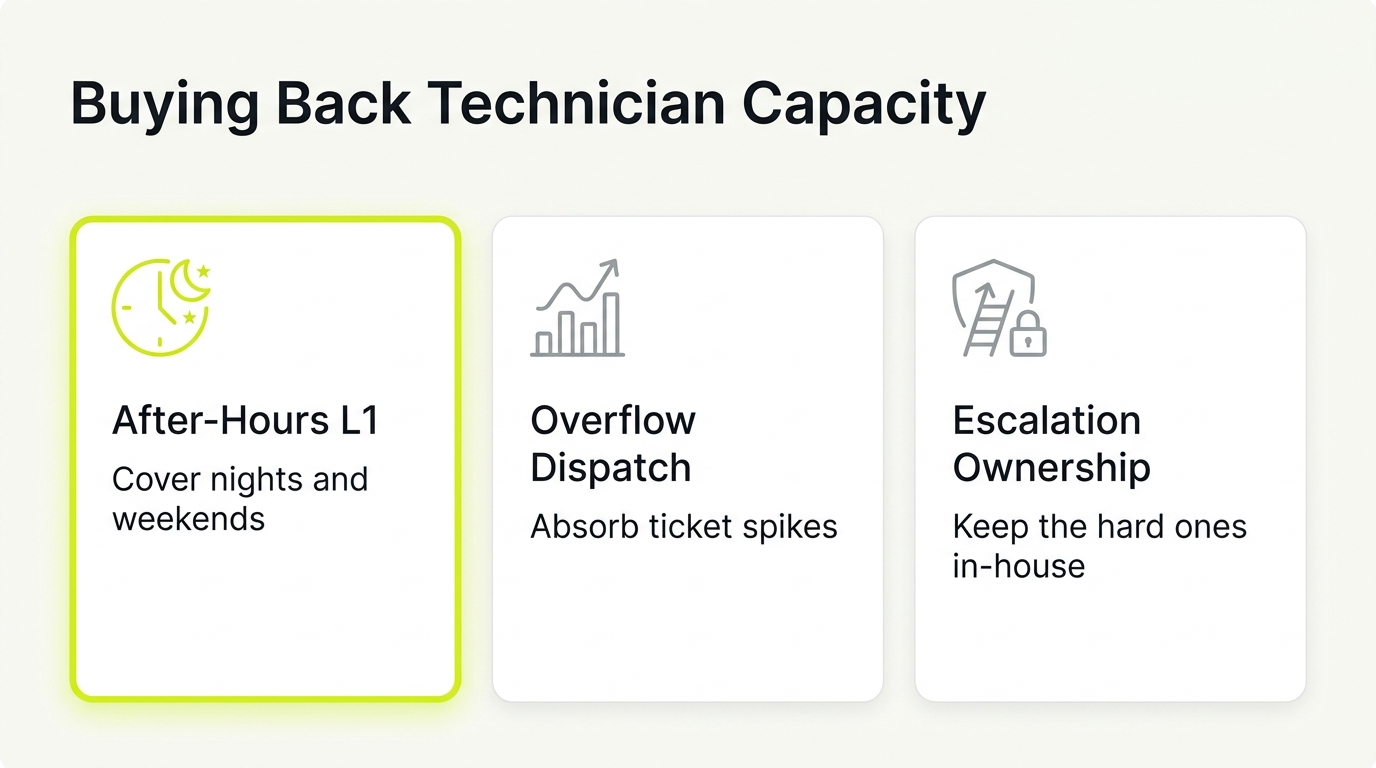
Choosing a help desk outsourcing model is not a binary decision. You must balance responsiveness against relationship proximity across three distinct scopes:
Unlike white-label managed IT (where a third party runs the full service) or co-managed IT (where you supplement a client’s internal team), outsourced help desk is specifically about buying technician capacity: L1 triage, password resets, and after-hours coverage your engineers no longer handle. That narrower scope is what keeps margin intact and control in-house.
- After-hours stabilization: Secures 24/7 coverage. Success is empty queues by morning.
- Overflow queue relief: Absorbs seasonal spikes and hiring lags. Success is holding SLAs during peak hours.
- Full L1 desk takeover: Powers rapid growth spurts. Success is consistent first-contact resolution.
The hidden risk is outsourcing the primary voice of your support, not just your labor. If an external team owns the first touch, they own the client relationship. If you cannot write your escalation rules on a single page, you are not ready for full takeover.
2. Adopt the Wet Read Pattern to Retain Technical Control
You can scale coverage without losing control of client relationships. Borrow the medical "wet read" model: an outsourced provider performs immediate triage, but your internal team conducts the final diagnostic review.
This is the ideal operational workflow for an outsourced L1 desk. The external vendor stabilizes late-night issues, but the ticket stays open for next-day internal review.
Apply this pattern to high-risk areas:
- VIP user profiles
- Recurring ticket trends
- Early churn signals or upsell opportunities
To implement this, configure automated PSA rules to flag these tickets, mandate internal follow-up, and log all client interactions. You retain critical account intelligence and referral-building trust without paying for 24/7 in-house shifts.
3. Use an Apples-to-Apples Pricing Model to Neutralize Vendor Games
Outsource pricing is a shell game. Vendors package services into four structures: per-user (incentivizes deflection), per-ticket (incentivizes volume), hourly (incentivizes slow resolution), or flat-rate (incentivizes basic coverage over speed).
To compare options, request exact definitions for included hours, excluded work, L1 versus L2 boundaries, monthly minimums, after-hours rates, and what constitutes a ticket.
Next, run your last 60 to 90 days of PSA data through each model. Calculate your projected cost per supported user and cost per resolved ticket to forecast gross margin impact and prevent scope creep.
Reject any provider that lacks written scope, documented QA, and clear escalation ownership.
The table below summarises the three primary delivery models and their key trade-offs.
| Model | Best for | Main risk |
|---|---|---|
| In-house L1 | Full brand control, complex environments | High fixed cost; senior engineers on low-value tickets |
| Outsourced white-label help desk | After-hours coverage, overflow, rapid scale | Vendor owns first touch if controls are weak |
| After-hours / overflow only | Augmenting a core in-house team | Scope creep into daytime tickets without guardrails |
4. Secure Your Core Systems with a Strict Partner Access Matrix
Handing system credentials to an external team creates obvious security anxiety. To secure an external help desk partner, you must control the integration layer across four core systems:
- PSA and ticketing tools
- Documentation platforms
- Remote access and RMM software
- Identity management and MFA suites
Never accept shared credentials. Build an access matrix you own that defines named roles, granular permissions, approval paths, audit requirements, and offboarding steps.
Enforce named accounts, mandatory MFA, minimal write access, and documented logs. Finally, budget for vendor seat licenses in your PSA and documentation systems early to prevent unexpected platform fees from shrinking your gross margins.
5. Formalize a Hybrid Service Blueprint to Stop Vendor Drift
Outsourcing fails when your internal team feels threatened and your partner drifts into work they cannot handle. Prevent this by defining your tier split by ticket category, not job titles. Route password resets and basic how-tos to your external L1 team. Reserve environment-specific fixes and complex project work for internal engineers.
Next, establish a strict escalation contract:
- Time-to-escalate rules
- Required notes, logs, and diagnostic screenshots
- A "never close without internal review" condition
Run weekly calibration calls during the first month, then transition to monthly reviews. Frame this shift to your staff as buying consistency and coverage. It shields your engineers from Tier 1 interruptions so they can focus on high-value client roadmaps.
6. Establish a Single-Page Scorecard to Govern Performance
Operational governance is the difference between an outsourcing partnership that scales and one you fire. To govern your help desk partner, establish a clear measurement stack:
- SLA compliance and first response time
- Reopen and escalation rates
- CSAT and internal QA scores
During the first 90 days, sample tickets weekly to tag specific failure modes like tone, incorrect fixes, poor documentation, or bad routing.
If failure rates cross your thresholds, trigger immediate retraining and pause any expansion of scope.
Compile these metrics into a single-page scorecard. This dashboard provides the objective control system needed to protect your client experience and align internal leadership.
7. Reallocate Your Reclaimed Capacity into Boardroom-Valued Growth
Reclaiming technician capacity is only half the win. That headroom evaporates unless you deliberately redirect it to strategic priorities. Using freed hours only to stop operational bleeding misses the margin and valuation payoff.
Convert this capacity into enterprise value through two high-ROI reallocations:
- vCIO Account Planning: Transition senior engineers to proactive vCIO roles to reduce churn and expand contract values.
- Demand Generation: Build a compounding pipeline engine so revenue is no longer referral-dependent.
Track your progress by measuring shortlist visibility. Test common buyer questions in Google and ChatGPT to see if your brand is cited. To build your pipeline blueprint, read the roadmap at nuoptima.com/content-marketing-MSP-growth-guide. If you want a second opinion on your current tools and delivery stack, request a stack review at nuoptima.com.
In-House vs Outsourced Help Desk: How to Decide
The decision is not in-house versus outsourced in the abstract. It is which specific ticket types you can no longer afford to staff internally. Owner-operator MSPs almost never move the whole desk at once. They move the parts that punish gross margin first, then hold the rest.
Lean toward keeping the desk in-house when:
- Ticket volume is predictable and low: A steady queue that two engineers clear before lunch does not justify a vendor's minimums or the governance overhead of a partner access matrix.
- Environments are complex and non-standard: Heavy custom line-of-business apps, tight compliance scopes, or bespoke networks raise the cost of teaching an external L1 team and shrink the deflection an outsourced desk can deliver.
- First touch is your relationship moat: If early-ticket rapport is how you win referrals in a tight vertical, the primary voice of support is worth protecting even at a higher labor cost.
Lean toward outsourcing specific scopes when:
- Senior engineers are stuck on password resets: Paying L3 rates for L1 work is the clearest signal to buy after-hours or overflow capacity and reclaim that time for vCIO and project work.
- Coverage gaps are causing SLA misses: Nights, weekends, and hiring lags are exactly what a targeted capacity purchase is built to absorb without adding a full shift.
- Growth is outrunning hiring: When new logos land faster than you can recruit and train, an outsourced desk buys elastic capacity that a job posting cannot deliver in the same quarter.
Most MSPs that scaled through 2026 landed on a hybrid: internal engineers own complex, relationship-heavy, and after-review work, while a vendor absorbs L1 overflow and after-hours under the wet-read pattern. Run 60 to 90 days of your own PSA data through the decision before you commit, and treat the split as a scope choice by ticket category, not a whole-desk switch.
How to Implement an Outsourced Help Desk for Your MSP: A 90-Day Rollout Plan
A rushed transition to an outsourced help desk is a fast track to lost clients and margin erosion. Implement a phased 90-day transition to protect your CSAT and prevent a brand break while you measure the vendor's real-world quality. Do not route a single ticket until you lock down four prerequisites: a defined scope, a documented tier split, a wet-read rule for documentation updates, and a partner access matrix.
Phase 1 (Weeks 1 to 2): Operational Alignment Workshop
- Conduct a formal kickoff meeting with the vendor to lock down exact SLA metrics, escalation triggers, and acceptable communication tone.
- Document a strict list of actions the vendor is banned from executing, such as modifying firewall policies or communicating directly with your VIP clients.
Phase 2 (Weeks 2 to 4): Technical Integration and Access Provisioning
- Configure individual named accounts with strict Multi-Factor Authentication (MFA) across your PSA and documentation platforms.
- Apply Role-Based Access Control (RBAC) to limit write permissions and protect your client data.
- Establish standardized documentation protocols and formalize your written offboarding plan to ensure you can revoke credentials instantly.
Phase 3 (Weeks 4 to 6): Shadow Shifts and Pilot Launch
- Route a small, low-risk subset of clients or specific ticket types, like password resets, to the external team.
- Require your internal engineers to perform QA reviews on a 100 percent sample of resolved pilot tickets. You will see immediately if the vendor's technical documentation meets your standards before scaling.
Phase 4 (Weeks 6 to 10): Scorecard Governance and Calibrations
- Review a single-page scorecard weekly with the vendor's account lead.
- Tag common failure modes, focusing specifically on slow response times, incomplete notes, or incorrect ticket routing.
- Execute immediate retraining protocols when quality drops below your agreed performance threshold.
Phase 5 (Weeks 10 to 13): Scope Expansion or Exit Execution
- Evaluate the vendor against your predefined expansion criteria. If they pass, safely scale their ticket volume.
- If performance fails, initiate your contract termination clause and use your offboarding checklist to securely revoke all system access and pull operations back in-house.
What Success Looks Like: At day 90, you will see stable response times, consistent documentation, and unchanged or improving CSAT. Your internal engineering team will reclaim substantial capacity, allowing you to reallocate their time to high-value vCIO planning and building your marketing demand engine.