
Reselling beats building when client demand is real but hiring speed limits your growth. New services sell quickly, but scaling 24/7 delivery bandwidth linearly destroys MSP margins. Reselling a partner's delivery under your brand expands your catalog without adding fixed overhead. This guide defines the model, compares adjacent delivery structures, and provides a pilot checklist to protect your brand, SLAs, and unit economics. Here is how the model works and where it goes wrong.
Key Takeaways
- White-label managed IT services let MSPs retain 30 to 50 percent gross margin on resold delivery by converting fixed payroll into a variable cost that scales with contracted revenue.
- Strategic functions. Pricing, QBRs, escalation policy, and client communication. Must stay in-house; only repetitive L1 and after-hours workflows are safe to outsource.
- The model fails when owners mistake outsourcing execution for outsourcing accountability: you own the client relationship and 100 percent of the reputational risk.
- Mismatched billing structures (flat per-user vs. volume-tier vendor pricing) are the most common cause of margin leakage. Convert every vendor quote into an effective cost per user before signing.
- A 12-week pilot with a finance gate at 30 days of zero brand leakage is the minimum test before scaling.
1. Defining the Boundaries of White-Label IT
White-label managed IT services is an operational delivery model where a third-party partner executes technical support under your brand, while your MSP retains sole ownership of the client relationship, strategic roadmap, and contract margins.
This definition eliminates ambiguity, allowing you to evaluate service contracts without getting trapped in vague vendor sales language.
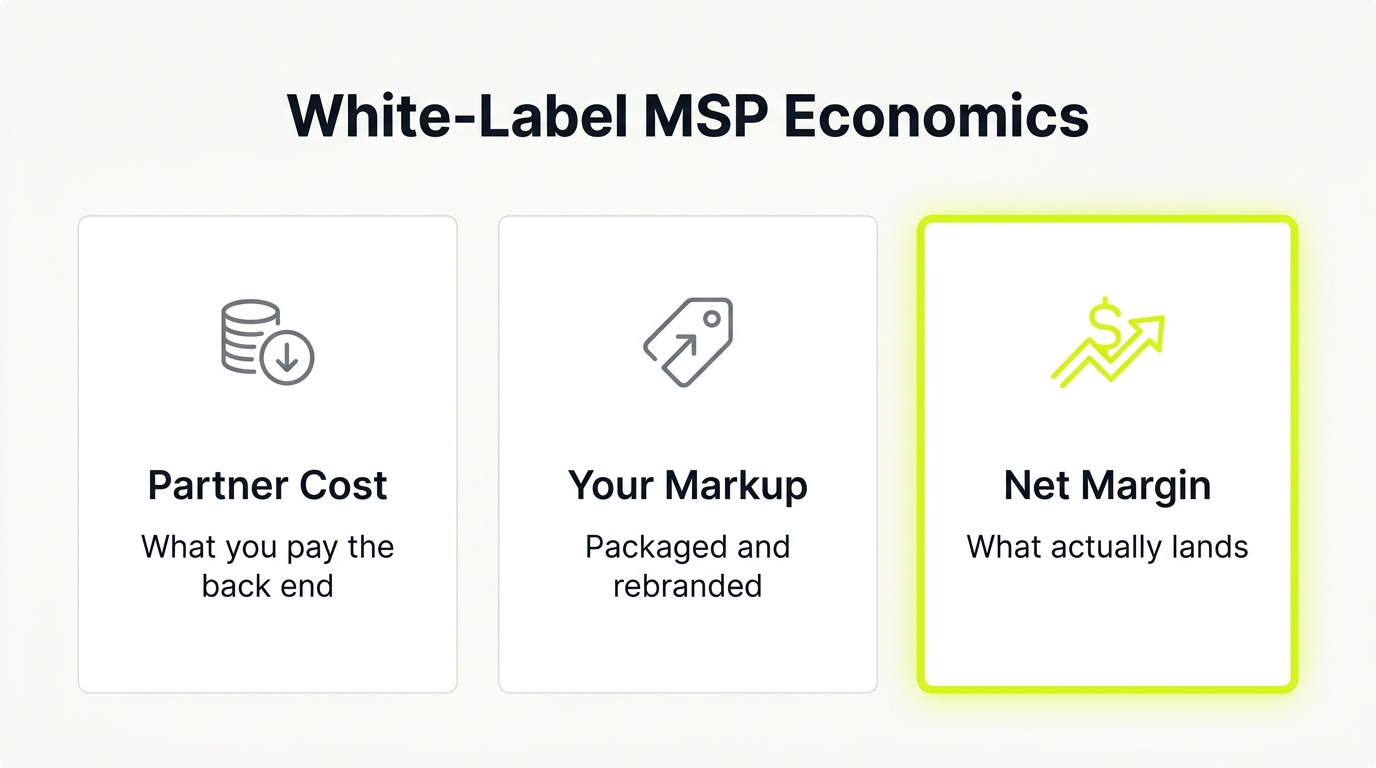
The margin case is equally clear. MSPs that white-label typically pay a partner 40 to 60 percent of their own per-user billing rate, retaining a gross margin that often ranges from 30 to 50 percent on the resold service. Those are estimates, not guarantees. Your actual spread depends on ticket volume, contract type, and the partner's pricing model. But the structural advantage over hiring is consistent: you convert a fixed payroll cost into a variable cost that scales with contracted revenue.
The model fails when owners mistake outsourcing execution for outsourcing accountability. You sell outcomes and trust, not labor.
These strategic functions must remain strictly internal:
- Pricing, packaging, and contract margins
- Quarterly Business Reviews (QBRs) and high-level account management
- Escalation policies and client-facing standards
Conversely, you can safely offload repetitive, linear workflows to protect engineering capacity. Reliable candidates for white-labeling include:
- After-hours L1 support and overflow helpdesk dispatch
- Automated monitoring workflows and ticket triage
- Scoped project execution with strict guardrails
Be skeptical of partners with critical red flags. If a vendor uses branded portals, sends emails from their own domain, or offers unclear SLA accountability, it is not true white-label delivery.
2. White-Label vs. Subcontracting, Staff Augmentation, and Co-Managed IT
Many MSP owners purchase raw technical capacity when they actually require guaranteed SLA coverage, resulting in margin bleed. Disambiguating these four delivery models is critical for protecting both your brand reputation and your contract unit economics.
| Model | Brand Visibility | Who Manages Workflow? | What You Buy |
|---|---|---|---|
| White-Label MSP | Your brand only | Partner executes, you own client | Outcomes and coverage |
| Subcontracting | Partner or disclosed | Partner manages delivery | Specialized project skills |
| Staff Augmentation | Your brand | You manage day-to-day QA | Raw technical labor |
| Co-Managed IT | Explicitly shared | Shared with client’s internal IT | Co-delivery capacity |
Your decision rule is simple: select a partner model based on whether you are outsourcing labor, outcomes, or regional coverage.
The margin distinction matters here too. Co-managed IT typically supplements a client's internal team and carries different contract terms and margin profiles; see our guide on co-managed IT contracts for a side-by-side pricing breakdown.
If you want to direct daily engineering tasks, choose staff augmentation. If you need overnight helpdesk coverage without operational overhead, a white-label arrangement is your vehicle.
Never lie to yourself during vendor selection. If you cannot explicitly specify who owns response time, resolution path, and QA, you do not have an operational model. You have hope.
3. Three Scenarios Where White-Label Delivery Outperforms Hiring
Scaling delivery capacity without collapsing net margins requires transforming your underlying delivery economics. Instead of hiring ahead of demand, white-label delivery lets you treat capacity as a variable lever. This shift aligns with the standard roll-up thesis, converting fixed payroll into a variable cost matched to contracted revenue, preventing margin erosion.
First, coverage gaps. You can offload after-hours, weekend, and holiday support without burning out your tier-one engineers.
Second, service line expansion. You can launch 24/7 security monitoring or win new vertical deals instantly, avoiding a capital-intensive hiring sprint for a specialized engineering bench.
Third, sales enablement. When pipeline demand is clear but delivery constraints block you from signing new logos, white-labeling clears the bottleneck.
To protect your long-term enterprise valuation, your in-house team must retain key strategic touchpoints. Always keep client communication standards, the vCIO roadmap, and the QBR motion strictly in-house.
4. Navigating the Mismatched Economics of White-Label Pricing
MSP owners often celebrate a new client contract only to watch their net margins vanish because their client billing model mismatches their vendor's cost structure. This is the risk of two-layer unit economics. While you likely bill clients on a flat per-user, per-device, or hybrid basis, your white-label vendor may bill you using volume tiers, cost-plus models, or flat capacity.
To prevent margin leakage and help your finance partner underwrite the decision with real unit economics, run this diagnostic checklist before signing:
- Estimate monthly ticket volume and the specific endpoint mix for your target clients.
- Convert the vendor pricing structure into an effective cost per user and per ticket.
- Back into your required gross margin to establish a strict minimum contract size.
Finally, establish clear definition guardrails. Define exactly what constitutes a user and a billable device in writing to avoid disputes. If these definitions remain opaque, your projected gross margin is imaginary until the first invoice arrives.
For further guidance on structuring client-facing pricing to protect your spread, see how to price MSP services.
5. Structuring Your White-Label SLA and Operational Controls
If your partner drops a ticket, your client does not fire them. They fire you. Because white label managed IT services run under your brand, you carry 100 percent of the reputational risk. Protecting your business requires translating vague operational promises into measurable, non-legalistic controls.
First, demand an owner-readable SLA that explicitly separates response time (acknowledgment) from resolution targets (remediation). Define P1 through P4 severity levels clearly, establishing exactly when a ticket escalates back to your internal team.
Second, enforce strict QA guardrails to protect your brand. Ticket notes must use professional, client-ready language, assuming the customer will read every internal log. Call handling requires your brand greeting, identity verification, and clear callback expectations.
Finally, establish a strict reporting cadence: a weekly operations summary and a monthly trend analysis tracking top categories, repeat incidents, and reopen rates. If the partner misses an SLA, the contract must trigger automatic service credits, a root-cause review, and immediate process changes to prevent churn.
6. Operational Integration: Preventing Brand Leakage and Tool-Stack Chaos
When outsourcing IT delivery under your brand, operational misalignment exposes your backend partners and shatters client trust. If an external engineer replies to a high-value account using the wrong brand, your operational illusion breaks instantly.
To prevent tool-stack chaos, choose between two high-level operating models. The preferred path is direct integration, where the partner works inside your PSA for absolute brand continuity. The alternative is a ticket-forwarding model, acceptable only if you enforce strict, bi-directional communication controls to mask the operational handoff.
Secure your brand identity and data with this baseline checklist:
- Branded Touchpoints: Standardize email templates, matching signatures, and customized caller ID or voicemail rules.
- Unified Language: Mandate consistent client-facing terminology and clear ticket status updates to keep communication uniform.
- Access Control: Implement least-privilege roles, secure credential handoffs, and clear audit trail tracking.
The underlying technology matters less than the daily client experience. Your clients must experience one team, one standard, and one clear escalation path.
How to Implement White Label Managed IT Services: A 12-Week Playbook
A pilot is your operational shield, not a leap of faith. Before shifting entire client accounts, validate your unit economics, cost-to-serve, and brand experience. This 12-week playbook provides a risk-free path to integrate outsourced delivery without risking your MSP reputation.
Step 1: Establish Operational Alignment (Week 1)
- Define support windows: Specify in-hours, after-hours, overflow, and holiday coverage parameters. You will establish clear service boundaries.
- Set the communication model: Define whether to use phone, email, or a portal, and assign clear escalation ownership.
Step 2: Configure Technical Integration (Weeks 1 to 2)
- Map PSA workflows: Configure ticket routing rules, assign least-privilege technician roles, and secure API credential exchanges.
- Deploy branded communications: Set up customized email signatures, white-labeled portal domains, and standardized phone-answering scripts. You will prevent brand leakage.
Step 3: Run Testing and Training (Weeks 2 to 4)
- Execute synthetic tests: Generate test tickets and conduct mock phone calls to verify quality.
- Initiate shadowing: Let your internal engineers shadow partner technicians before transferring absolute ticket ownership.
- Standardize QA metrics: Codify what constitutes a resolved ticket and establish strict QA checkpoints.
Step 4: Tune Performance and Pass the Finance Gate (Weeks 4 to 12)
- Review operational metrics: Audit service level agreements, ticket reopen rates, and client satisfaction scores weekly.
- Calculate effective cost per user: Convert partner invoices into unit cost metrics to verify your true gross margin.
- Enforce the finance gate: Do not expand service scope until the pilot achieves your target margin with zero brand leakage for 30 consecutive days.
Scale Your Expanded Service Catalog
Know Your Valuation Before You Scale
Adding a white-label tier changes your cost structure and, eventually, your exit multiple. Buyers will scrutinize whether resold margin is recurring, contractual, and defensible. Before scaling, understand how your MSP is valued so you are building toward a number, not just revenue. Review our MSP valuation guide for the multiples and margin thresholds that matter most to acquirers.
Once delivery is stable, document your new operational capabilities. Buyers must find this expanded catalog when they search Google or ask AI engines for recommendations. Want your expanded service catalog to surface in Google and AI shortlists? Book a free MSP content audit with NUOPTIMA and see exactly where your pages are missing visibility.