Most content gap analysis tutorials focus on ranking parity. They teach you to chase keywords that overlap your competitors’ own. This is a losing strategy. Search dominance now requires owning the entities and machine-readable relationships used by generative engines to build answers. This framework provides a prioritized cross-engine plan covering queries, entity edges, and citation formats. Map your entity footprint before looking at competitor keywords to lead the answer layer.
Key Takeaways
- Modern content gap analysis means owning entities and machine-readable relationships used by generative engines, not just chasing keywords your competitors already rank for.
- Distinguish missing nodes (pages you lack) from missing edges (relationships you have not made explicit); fixing edges with internal links and definitions is often the fastest authority gain.
- Your cheapest gaps are queries in Google Search Console positions 7 to 15, where high impressions and flat clicks show Google is auditioning your page for subtopics you have not addressed.
- Audit the answer layer by running fixed prompt sets through ChatGPT, Gemini, and Perplexity to log citation gaps, entity framing gaps, and evidence gaps against competitors.
- Prioritise gaps with a pipeline-first score across business value, AI visibility upside, current momentum, and effort, then assign the right fix: refresh, new page, internal links, or format add-on.
1. Define Your Entity Architecture to Stop Fragmented Content
Standard content gap analysis often creates disjointed site structures that confuse search engines. This happens when teams optimize for keyword strings while AI engines search for entities. Chasing keyword overlaps without a stable entity model fragments your content and limits organic revenue. It leaves your brand’s expertise implicit and undiscoverable.
Move beyond simple keyword exports. List your hub entities (core products and services) and supporting entities (proprietary methods, standards, and use cases). Add external identifiers like Wikidata or Wikipedia references to disambiguate your brand. This ensures search engines recognize your specific authority instead of confusing it with generic industry terms.
Your primary output is a one-page Entity Profile. This document maps your knowledge graph by listing:
- Hub entities and core concepts
- Supporting entities and methods
- Synonyms and semantic variations
- Canonical page URLs for every entity
From a GEO perspective, entities are the primitives LLMs retrieve. Machine-readable definitions transform your brand from a possible result into a cited authority. Precise entity mapping increases your citation eligibility by removing retrieval friction for generative engines and answer layers.
2. Audit Relationship Gaps to Build a Connection Moat
Competitors often outrank you with fewer pages because they prioritize connection density over content volume. Advanced gap analysis is graph work. While standard audits identify missing pages (nodes), you must find missing relationships (edges). These connections represent your fastest authority gains by explicitly defining how concepts interact.
Compare top competitor pages for core topics to extract co-occurring entities. Map implied relationships including:
- Causation (X causes Y)
- Classification (X is a type of Y)
- Comparison (X vs Y)
Execute this manually by highlighting recurring terms or use NLP tools for scalable entity extraction grouped by frequency and adjacency. This reveals exactly what competitors have taught LLMs about the topic graph.
Your output is a “Missing Nodes vs. Missing Edges” list. If you own the node but lack the edge, fix the connection before writing new content. Use internal links and definitional blocks to encode these relationships. This approach closes authority gaps without defaulting to the endless content trap.
3. Leverage GSC Impression Data for High-Efficiency Refreshes
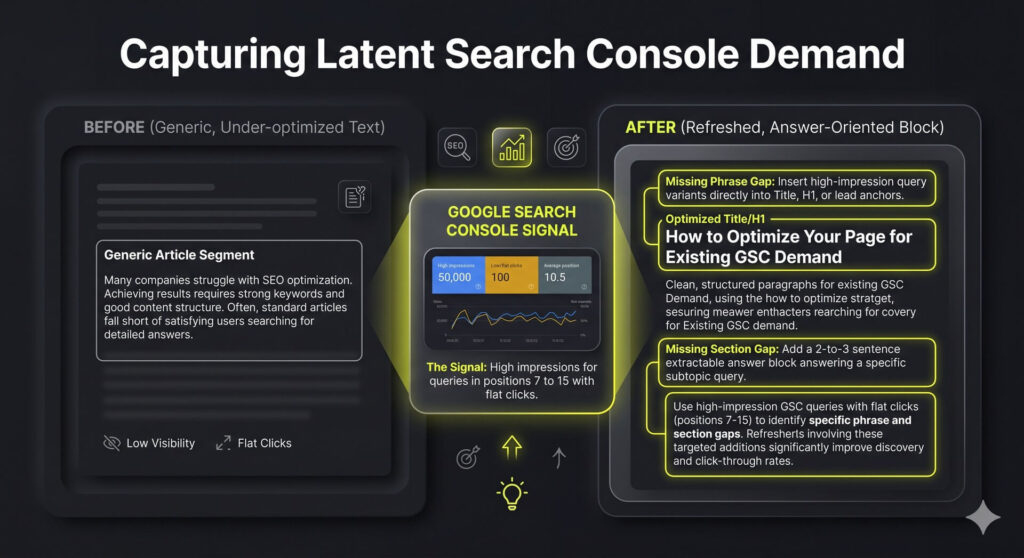
Your cheapest content gaps are the ones Google is already testing. While competitors chase net-new keywords, Search Console signals existing demand you haven’t yet satisfied. High impressions for queries in positions 7 to 15, or pages with rising impressions but flat clicks, indicate Google is auditioning your page for subtopics you don’t explicitly address.
Identify the specific gap type using GSC data:
- Missing Phrase Gap: High-impression query variants that are absent from your Title, H1, or lead anchors.
- Missing Section Gap: Queries implying a subtopic or buyer intent your current page ignores entirely.
To capture this latent traffic, add the exact query phrase naturally in a prominent location. Include a two-to-three sentence extractable answer block to satisfy both Google and AI retrieval systems within a conversational SEO framework. Link this section to a deeper supporting page to build entity authority and keep users in your funnel.
Finalize your analysis by building a prioritized refresh queue: Page + Query + Action + Expected Pipeline Impact. This transforms vague content needs into a measurable backlog that produces faster ranking movement than net-new assets.
4. Conduct Manual SERP Scans to Identify Format Gaps
Keyword difficulty scores mask high-revenue opportunities. Blunt metrics ignore when top results fail to satisfy intent or use outdated formats. Perform a manual SERP scan of the top 10 results to identify where high-authority domains are structurally weak. This prevents building the wrong asset type and captures visibility where the SERP is under-optimized despite high competitor domain ratings.
Evaluate current winners using this checklist:
- Do titles and H1s address the exact query intent?
- Are results outdated, off-topic, or structurally thin?
- Which formats dominate (video, templates, tools, lists, or FAQs)?
Identify format-gap opportunities such as video results dominating text-only pages or “People Also Ask” blocks appearing where you lack Q&A sections. Document findings in a SERP Gap Sheet mapping query to dominant format to what you will publish. Pair your assets with machine-readable markup like VideoObject or FAQPage blocks. This engineering ensures LLMs and search engines cite your content as the definitive answer.
5. Audit the Answer Layer for AI Citation Gaps
In 2026, ranking #1 on Google is insufficient if your brand is absent from the citation pool when users query ChatGPT, Gemini, or Perplexity. This answer layer invisibility creates a strategic blind spot that traditional content gap analysis misses.
Measure your status as a cited source, brand mention frequency, and your role as a canonical entity for industry definitions. Execute a fixed prompt set for your category, covering “best,” “vs,” implementation, and troubleshooting queries, to identify which domains get cited. Record entity framing and evidence patterns like data, checklists, and frameworks that AI engines prioritize.
Log three gap types:
- “Citation Gap”: Competitors are cited while you are absent.
- “Entity Framing Gap”: A competitor is positioned as the canonical authority for a concept.
- “Evidence Gap”: Competitors provide the specific numbers, methodologies, or templates the AI extracts.
Maintain a monthly AI Citation Gap Log. This ensures your content infrastructure supports knowledge-graph positioning and drives pipeline from generative engines, not just blue-link traffic.
6. Prioritize Gaps Using a Pipeline-First Scoring Model
Advanced teams lose because they cannot prioritize gaps. Transforming a content gap analysis into an execution sequence requires a scoring rubric (1 to 5) that rewards entity authority and pipeline impact over raw volume.
Rate each gap across four categories:
- Business Value: Maps the query to a product line, use case, or specific sales motion.
- AI Visibility Upside: Likelihood of the content serving as a primary citation source for LLMs.
- Current Momentum: Existing impressions or partial rankings for the target entity.
- Effort: Requirement for a net-new page, a content refresh, or simple schema and internal linking.
After scoring, assign the correct fix type. Use refreshes for impression-backed gaps and new pages for missing nodes. Apply internal linking and definitions to fix missing edges, or use format add-ons for structural gaps.
The final artifact is a ranked backlog with owners and expected outcomes, specifically Google gains and AI citation growth. This model transforms ideas into a sequence optimized for entity authority and pipeline revenue.
7. Execute Structural Closure to Secure AI Citations
Content gap analysis fails if it ends at the “Publish” button. Closing a gap requires making entities and relationships explicit, crawlable, and extractable for Google and LLM retrievalby executing the indexing playbook. If concepts remain implicit, they stay invisible to the answer layer.
Implement this minimum effective set for every asset:
- Definition Block: A two-sentence extractable definition near the intro.
- Relationship Paragraph: Explicitly connect entities (e.g., “X impacts Y”).
- Internal Links: Use hub-and-spoke and comparative links to reflect topical architecture.
- Structured Data: Deploy Organization, Service, or Article schema with selective sameAs for entity clarity.
Expand closure actions by adding video transcripts, tables, or FAQs when SERPs reward specific formats. Verify results by re-checking GSC query coverage and re-running AI prompts to confirm your brand is the cited answer. Document updates in a “Gap Closed” changelog to prevent regressions. This process ensures your content changes how machines understand your brand, building a defensible knowledge moat that drives pipeline and AI visibility.
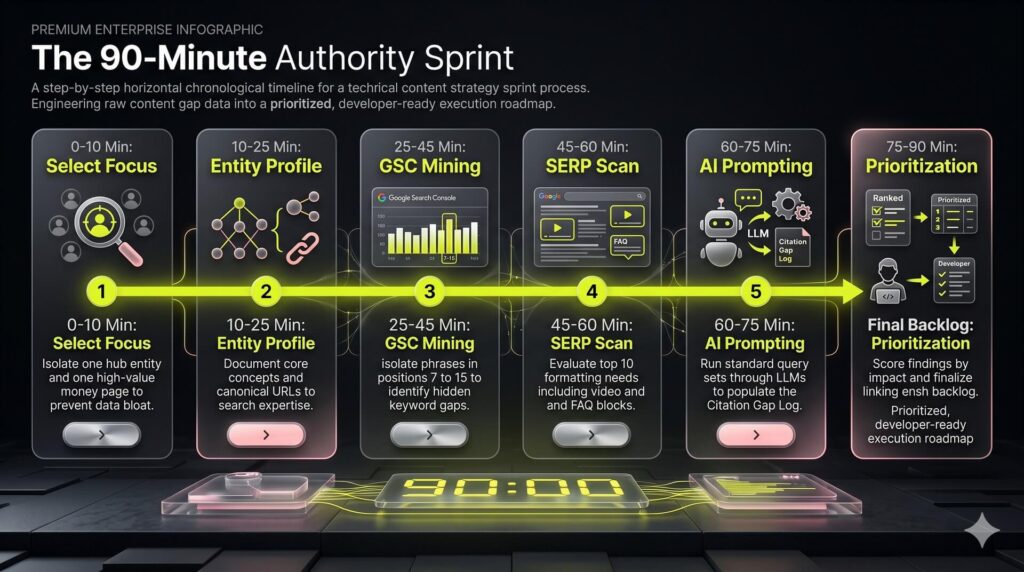
The 90-Minute Authority Sprint: How to Operationalize Content Gap Analysis
Operationalize your content gap analysis into a repeatable procedure for advanced enterprise SEO teams. Execute this sprint when entering new categories, addressing stalled authority, or responding to rising competitor AI citations. Gather three inputs: a Google Search Console (GSC) export, your top three competitors, and a single tracking spreadsheet.
- 0 to 10 minutes: Select one hub entity and one high-value money page. A narrow focus prevents data bloat and ensures actions remain measurable for leadership.
- 10 to 25 minutes: Build an Entity Profile that lists core concepts and canonical URLs. This semantic anchor helps search engines verify your expertise and knowledge graph ownership.
- 25 to 45 minutes: Mine GSC for phrases ranking between positions 7 and 15. Identify missing content sections where high impressions signal clear keyword gaps.
- 45 to 60 minutes: Scan SERPs for five target queries to evaluate format requirements. Note if competitors utilize video or FAQ blocks to dominate the answer layer.
- 60 to 75 minutes: Run standardized AI prompt sets through ChatGPT and Perplexity. Populate the AI Citation Gap Log to visualize where your brand lacks visibility in generative summaries.
- 75 to 90 minutes: Score findings by business impact and technical effort. Commit to a specific mix of page refreshes, new content nodes, and internal linking updates.
Final deliverables include a prioritized gap backlog, a five-page refresh list, two net-new page briefs, and an internal linking plan. Operationalize these advanced SEO frameworks at scale with NUOPTIMA’s GEO services to ensure your brand becomes the cited authority across all generative search surfaces.
FAQ
It is the process of identifying missing intent satisfaction and entity relationships rather than chasing keyword strings. While traditional audits look for ranking parity, advanced analysis identifies missing evidence or formats that prevent your brand from becoming the canonical answer. The goal is a prioritized plan to satisfy search intent and secure knowledge graph positioning.
No. Keyword gap analysis identifies queries where competitors rank and you do not. Content gap analysis identifies missing coverage or entity connections that hinder both rankings and AI citations. While keyword gaps focus on raw volume, content gaps focus on the structural authority of your topical clusters. See Section 2 above for more on relationship gaps.
No. While paid tools help scale exports, you can drive significant value using Google Search Console and manual SERP inspection. These native methods provide clearer signals for actual user intent. Use third-party tools for monitoring competition, but build your strategy around your own entity architecture and GSC data for the fastest results.
Shift your focus to citation eligibility. Track which brands AI engines cite and the specific evidence they extract. If competitors provide the frameworks or data that LLMs prefer, you have an evidence gap. Adapt by adding extractable definition blocks and machine-readable markup to ensure your brand is the primary source in the answer layer.
Engage a partner when citation gaps impact your pipeline and you lack the infrastructure to track LLM visibility. If your organic strategy is stuck in the blue-link era, you need a cross-surface plan.
Visit nuoptima.com or explore our GEO services to align your content with the requirements of generative search.
Where this fits in your MSP growth system
This is one piece of how NUOPTIMA makes MSPs and cybersecurity firms the provider buyers find on Google and in AI search. See how it connects to MSP content marketing and MSP SEO, or get your free MSP lead forecast to see exactly where your firm shows up across ChatGPT, Gemini, and Perplexity today.