B2B organic growth is fragile. Managing multiple services and stakeholders across long sales cycles makes scaling search visibility nearly impossible. Enterprise SEO is not a generic checklist. It is a governance operating system defined by scale, automation, and organizational complexity. This guide provides eight systems to maintain quality across Google and generative engine optimization layers. It begins with the diagnostic that determines every strategic decision for your pipeline.
Enterprise SEO is search execution governed at scale: managing thousands of pages, many services, and multiple stakeholders through systems, automation, and quality controls rather than ad hoc tasks. It differs from traditional SEO mainly in complexity and coordination, not tactics. The work is governance, keeping a large, fast-changing site coherent enough to rank and to be cited.
Key Takeaways
- Enterprise SEO is governance at scale: managing thousands of pages, many services, and multiple stakeholders through systems and quality controls, not ad hoc tasks.
- It differs from traditional SEO mainly in complexity and coordination rather than tactics, so the core work is keeping a large, fast-changing site coherent.
- Start with an SEO maturity diagnostic across five pillars (technical, content, analytics, cross-department integration, governance) before building any roadmap.
- Audit by template-level sampling, about 15 URLs per page type, because roughly 90% of technical issues originate from a handful of global templates.
- Embed SEO guardrails into engineering's Definition of Done and report revenue-first across executive, program, and operational tiers to secure budget.
Why it matters for MSPs and cybersecurity firms
- Multi-location and multi-service MSPs accumulate structural rot fast, and shipping more pages into a fractured site flatlines pipeline.
- Long, multi-stakeholder sales cycles need consistent authority across every service line, not a few strong pages.
- AI engines reward sites that stay internally consistent, so governance directly affects whether you get cited.
We start with an SEO maturity diagnostic before any roadmap, because the system you have decides every move that follows. That governance-first approach is how we scaled Eden Data to roughly 11.6x organic in six months and underpins our cybersecurity SEO work.
1. Build a Strategic Roadmap via the SEO Maturity Model
Enterprise teams often scale content volume while ignoring structural rot. Shipping more pages into a fractured system leads to flat pipelines and wasted quarters. To scale sustainable search visibility, move beyond reactive firefighting and evaluate five core maturity pillars:
- Technical infrastructure: Crawl efficiency and site architecture.
- Content execution: Topic cluster authority and entity optimization.
- Analytics and reporting: Revenue attribution and pipeline tracking.
- Cross-department integration: Engineering and product alignment.
- Governance and scalability: Internal SOPs and quality control.
Score each pillar from 1 to 4. Identify the one or two constraint pillars stifling your speed and prioritize them in a focused 90-day roadmap. This ensures you are implementing infrastructure changes rather than just archiving audits.
Success is measured by maturity score gains and cycle time reduction. Shorten the window between identifying an issue and shipping the technical fix to protect your search moat. This diagnostic prevents random scaling by identifying the real bottleneck in process, data, or alignment. It ensures your enterprise seo strategy translates into measurable organic revenue.
2. Standardize SEO Governance to Eliminate Technical Regression
Every release is a potential SEO catastrophe. Enterprise performance rarely dies in a single crash. It fails through a thousand technical regressions buried in the engineering backlog. Treating SEO as a post-launch audit is a losing strategy.
Shift SEO upstream by establishing non-negotiable guardrails within your Definition of Done (DoD). Standardize these requirements to prevent technical drift:
- Canonical and indexability logic
- Internal link conventions
- Schema markup standards
Publish and maintain these rules in a living SEO playbook within Notion or Confluence. Integrate acceptance criteria templates for migrations, pagination, and architecture changes. This ensures product teams treat SEO as a mandatory shipping requirement rather than an optional backlog request.
Measure success through your regression rate, defined as the number of SEO incidents per release. Track the percentage of launches passing SEO QA on the first attempt. This makes search visibility an automated outcome of your delivery workflow, stopping organic degradation at scale while protecting revenue.
3. Build an SEO Shipping Machine Through Product Discipline
Enterprise SEO initiatives often stall because they are not packaged in engineering language. When presented as suggestions rather than technical tickets, they lose priority to product roadmap features. To win internal buy-in, you must replace persuasion with a rigorous shipping discipline.
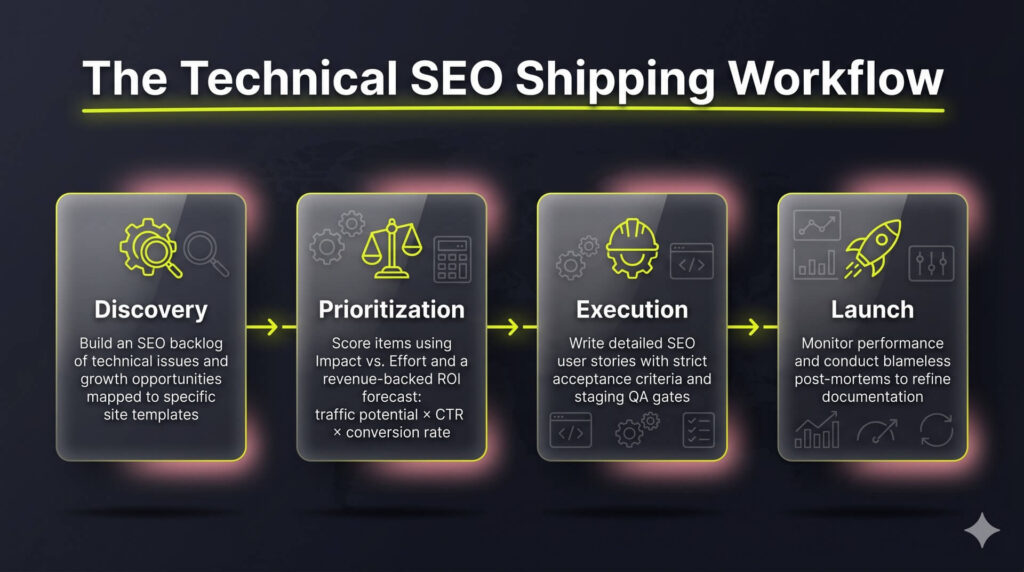
The workflow requires four stages:
- Discovery: Build a dedicated SEO backlog of technical issues and growth opportunities mapped to specific site templates and services.
- Prioritization: Score items using Impact vs. Effort and a revenue-backed ROI forecast (traffic potential × CTR × conversion rate).
- Execution: Write detailed SEO user stories with strict acceptance criteria and establish staging QA gates to catch code regressions.
- Launch: Monitor performance and conduct blameless post-mortems to refine internal guardrails and documentation.
Success is measured by backlog throughput (tickets shipped per quarter) and directional forecast accuracy. This discipline transforms SEO from a vague request list into a high-velocity execution engine that product and engineering teams can reliably run.
4. Solve Scale Through Template-Level Sampling
Enterprise SEO at 100k+ pages is a systems design problem, not a crawling task. Brute-force crawling millions of URLs is slow, expensive, and buries teams in noise. You do not need to audit every page when 90% of technical issues originate from a handful of global templates.
Transition from URL-level audits to representative sampling. First, inventory your core page types:
- Service and category pages
- Location hubs
- Resource centers
- Faceted search pages
Select 15 representative URLs per template across production and staging. Audit these samples for systemic logic errors:
- Indexability and canonical rules
- Pagination and facet behavior
- Internal linking blocks
- Structured data and schema
One template error often affects millions of URLs. Stop tracking total error counts. Instead, monitor your template-level defect rate and time-to-fix. Measure success by how quickly affected URLs recover in the index after a template deployment. This shifts technical SEO into a high-velocity engineering workflow.
5. Use Server Log Analysis to Prevent Indexing Disasters
Enterprise SEO teams often detect indexation failures only after organic pipeline drops. Relying solely on Google Search Console is dangerous because the data is sampled and delayed. Server log analysis reveals exactly how Googlebot navigates your architecture, often exposing wasted crawl budgets on low-value facets while high-converting templates remain ignored.
Build a continuous monitoring system to alert your team to:
- Sudden indexability drops or 404 spikes
- Accidental robots.txt or canonical changes
- Unintended shifts in bot request patterns
Coordinate with IT to establish crawl rate limits and avoid self-inflicted performance incidents. Prioritize monitoring frequency for high-value URL cohorts over the low-value long tail to ensure revenue-driving pages stay visible.
Measure performance by the percentage of crawl hitting priority templates and your Mean Time to Detection (MTTD). Shortening the gap between failure and resolution transforms crawling into a managed system that protects your organic revenue.
6. Treat Programmatic SEO as a Scalable Product
“Scalable SEO” often fails when mass content creates index bloat and technical debt without driving revenue. To multiply coverage across enterprise services, treat programmatic SEO (pSEO) as a product launch rather than a volume play.
Begin with a service and intent map that identifies core offerings and industry-specific problems. Only deploy programmatic pages when you possess proprietary data or unique angles. Spun text invites penalties. Differentiated data earns rankings and naturally drives passive link building as other domains cite your statistics.
Every page template must pass strict quality gates:
- Unique value per page type
- Strategic internal linking architecture
- Automated schema and FAQ blocks
- Direct conversion paths
Maintain domain health by using automated auditing to prune or merge thin pages. Evaluate success based on your indexed to created ratio and assisted conversions from service-cluster cohorts. This methodology ensures you expand coverage without creating a low-quality footprint that compromises your search infrastructure or entity authority.
7. Prevent Global Visibility Decay Through International Governance
Enterprises often mistake internationalization for a linguistic task. It is actually a technical governance challenge. International enterprise SEO breaks quietly when systematic errors, such as hreflang tags pointing to non-existent URLs, suppress visibility across entire regions. Governance requires shifting from simple translation to delivering localized proof, currency, and offers tailored to specific regional intent.
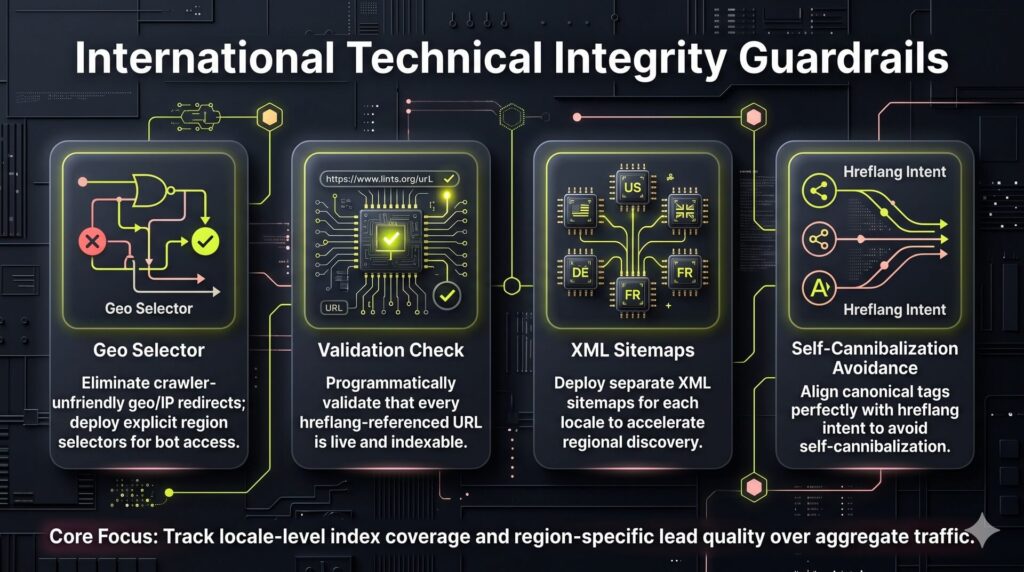
Enforce technical integrity through these specific guardrails:
- Avoid crawler-unfriendly geo/IP redirects; use explicit region selectors to ensure bots can access all versions.
- Programmatically validate that every hreflang-referenced URL is live and indexable to prevent crawling dead ends.
- Deploy separate sitemaps for each locale to accelerate regional discovery.
- Ensure canonical tags align perfectly with hreflang intent to avoid self-cannibalization.
Measure success through locale-level index coverage and region-specific lead quality rather than aggregate sessions. High traffic is a vanity metric if the regional pipeline fails to convert. Protect global revenue by treating every region as its own search ecosystem and preventing the systemic targeting errors that enterprises repeat at scale.
8. Replace Vanity SEO Dashboards with Revenue-First Reporting
Executives do not fund dashboards. They fund pipeline impact. Enterprise SEO reporting often fails by operating at the wrong layer, highlighting vanity metrics instead of commercial value. To secure long-term buy-in, connect search performance directly to revenue and market risk.
Use a three-tier model to align stakeholders. The Executive tier tracks pipeline contribution and market risk. The Program tier monitors initiative progress and growth forecasts. The Operational tier manages technical health and template-level fixes.
Stop reporting on individual keywords. Aggregate data by service line, market, and page type to reveal which business units drive growth. Overlay an AI-search layer to track LLM visibility and citations for priority entities. Monitoring how ChatGPT or Perplexity cites your brand versus competitors provides the directional trend needed to justify GEO investment.
For teams requiring a unified SEO and GEO reporting stack that connects search to revenue, book a strategy call at nuoptima.com.
How to Implement a 90-Day Enterprise SEO Operating Plan
Enterprise SEO programs fail when teams attempt to optimize every variable simultaneously without a sequenced operating model. This lack of structure leads to fragmented execution, technical debt, and stagnant pipeline growth. Use this implementation sequence to move from disconnected tasks to a compounding search program built for both Google and generative engines.
Week 0: Gather Technical Prerequisites
- Compile a comprehensive service inventory detailing core products and high-margin revenue drivers.
- Secure administrative access to GA4, Google Search Console, and server log monitoring tools.
- Audit the engineering release calendar to identify upcoming technical deployments and product updates.
- Construct a stakeholder map identifying the developers, product owners, and content leads essential for collaboration.
Days 1 to 30: Governance and Maturity Assessment
- Perform a maturity assessment to identify the two primary constraint pillars for the organization.
- Document the SEO Playbook to standardize execution across departments and maintain brand authority.
- Embed an SEO QA gate into the engineering Definition of Done (DoD) to stop technical decay at the source.
- Execute a template-level audit to identify and correct systemic logic errors on high-value service pages.
Days 31 to 60: Execution and Visibility Monitoring
- Build the SEO backlog by converting audit findings into engineering tickets within your project management tool.
- Prioritize the backlog using revenue-backed forecasting to ensure high-impact fixes ship first.
- Activate server log monitoring to detect and resolve indexing issues and crawl budget waste instantly.
- Implement three high-visibility template quick wins that demonstrate immediate pipeline value to stakeholders.
Days 61 to 90: Scaling and GEO Expansion
- Launch programmatic SEO systems to expand coverage for secondary service clusters and long-tail queries.
- Expand into Generative Engine Optimization (GEO) by deploying entity-rich declarations across the domain.
- Harden structured data to target specific LLM citation markers for ChatGPT, Gemini, and Perplexity.
- Conduct the first SEO Business Review (SBR) using a revenue-first reporting model that connects visibility to MRR.
Cross-Team Alignment Mechanics
- Appoint SEO Champions in every product squad to own quality assurance and advocate for search health.
- Run recurring SEO Business Reviews to maintain transparency and strategic alignment with executive leadership.
For organizations seeking a strategic authority to manage this transition, partner with nuoptima.com for enterprise SEO and GEO scaling. Visit our generative engine optimization (GEO) services page to secure your position in the AI search layer.
To dominate both surfaces, contact nuoptima.com or view our generative engine optimization (GEO) services.
Where this fits in your MSP growth system
This is one piece of how NUOPTIMA makes MSPs and cybersecurity firms the provider buyers find on Google and in AI search. See how it connects to MSP SEO and GEO and AI-search, or get your free MSP lead forecast to see exactly where your firm shows up across ChatGPT, Gemini, and Perplexity today.