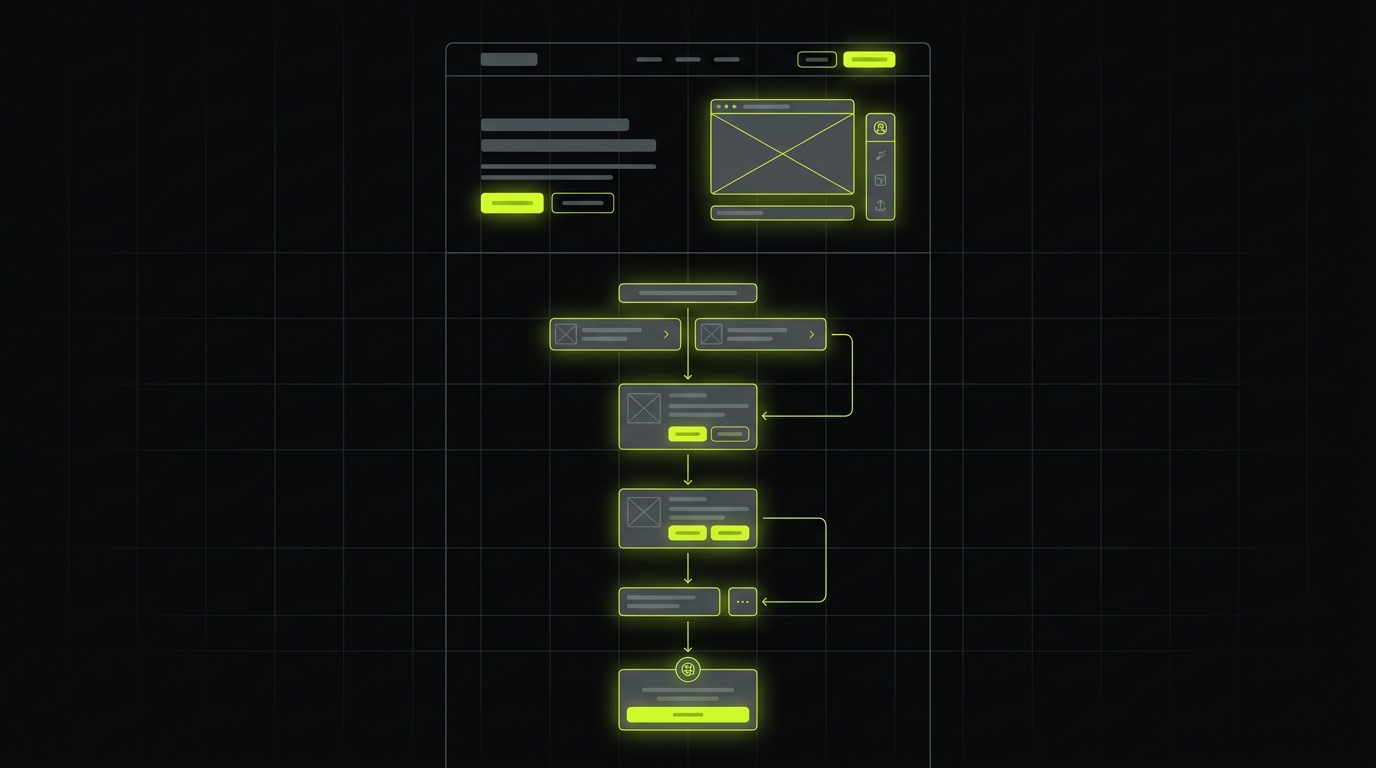
Your MSP marketing website is a critical qualification engine for referrals, SEO, and AI discovery, not a static brochure. Yet, if you ask five employees what you do, you get five different answers. Buyers quickly detect that confusion. This framework provides 10 structure elements that compel buyers to take action while ensuring Google and AI engines easily shortlist and cite your firm.
We start with the positioning layer because every other asset inherits it.
Key Takeaways
- Your website is a qualification engine, not a brochure. If five employees describe your business differently, buyers and AI models cannot shortlist you.
- Build two parallel homepage conversion paths: one for the CEO (strategy, roadmap, productivity) and one for the finance partner (SLAs, compliance, onboarding timelines, contract terms).
- Replace a catch-all services page with dedicated intent pages per service, Google and AI engines cannot map query relevance to a single dumped-together page.
- Publish transparent pricing ranges with clear cost drivers; hiding rates causes finance partners to disqualify you before the first call.
- Add structured FAQ blocks and short sections with descriptive subheadings so AI models can extract and cite your proof points directly.
An MSP marketing website is a structured qualification and shortlist engine that establishes credibility with buyers and AI search models through unified positioning, dedicated intent pages, layered proof, and AI-extractable content. Not a static brochure describing technical services.
1. Establish One Unified Positioning Statement
If your engineering and sales teams describe your business differently, a skeptical buyer or AI model cannot categorize you. Internal misalignment causes messaging drift, killing conversions and excluding you from AI-generated shortlists. Fix this by making your site the single source of truth for who you serve, what you do, and why you are credible.
Place this positioning formula at the top of your homepage:
"We help [ICP] in [region] achieve [business outcome] with [core managed service offer], backed by [proof]."
Follow it with three supporting bullets:
- Primary service category
- Vertical niche
- Risk reducer (SLA, compliance posture, or certifications)
Deploy this copy across your homepage, About page, and service pages, then add a "We are not" line to filter out mismatched leads. See our MSP website design checklist for visual placement examples.
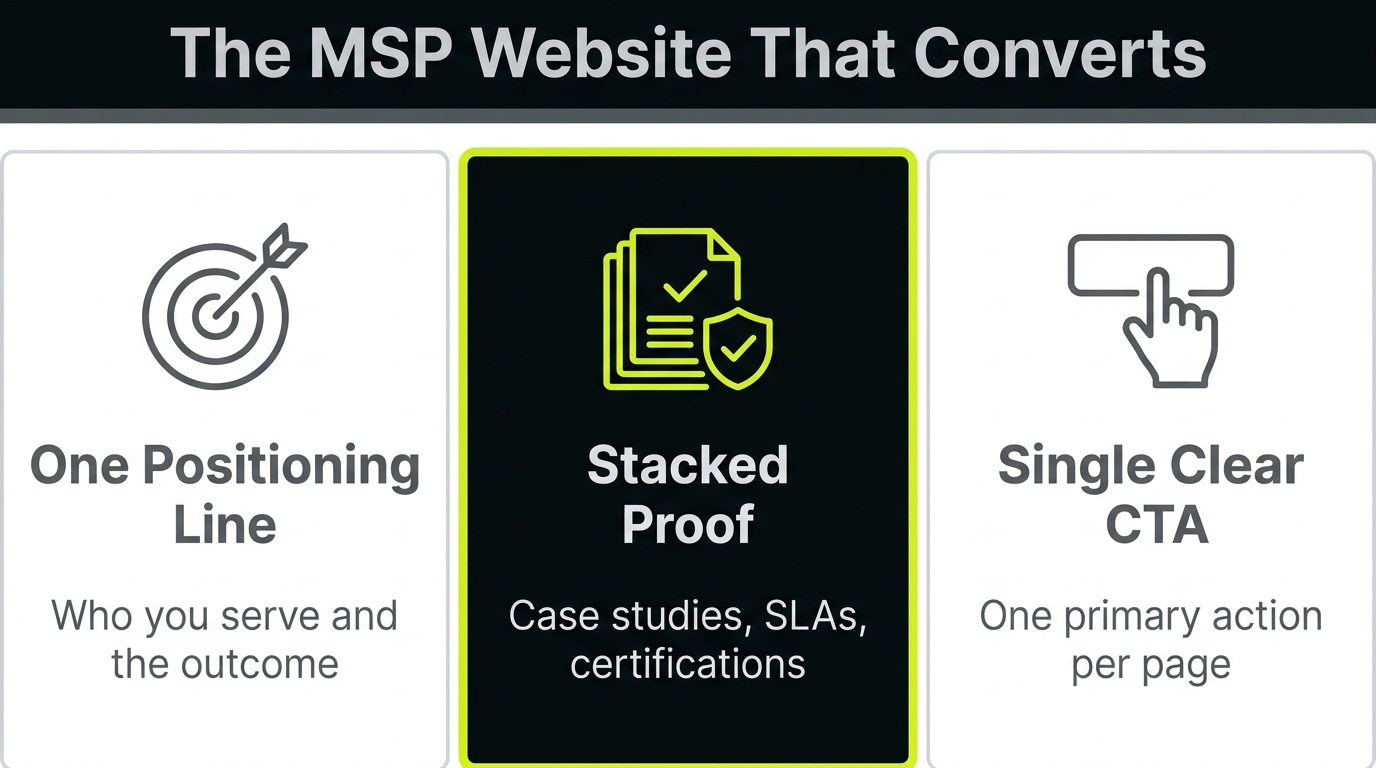
2. Architect Dual Conversion Paths on Your Homepage
Most MSP deals stall when a referred CEO agrees to a proposal, but the finance partner asks what happens if the migration fails. This bottleneck occurs because your site speaks only to the technical enthusiast, completely ignoring the stakeholder who manages business risk.
To accelerate mid-funnel velocity, build two parallel proof paths directly from your homepage:
- Path A (The Founder & CEO): Address high-level business growth, strategic technology roadmaps, disaster recovery, and productivity.
- Path B (Finance & Operations): Address practical onboarding timelines, SLAs, regulatory compliance posture, contract terms, and reporting cadence.
Implement this architecture by adding a "How We Work" section with clear milestone timelines and a "What Changes in the First 30 Days" block. Track which path generates more meeting conversions to preempt internal boardroom objections before they derail your sales cycle.
3. Replace Catch-All Services Pages with Dedicated Intent Pages
A single catch-all services page kills search visibility and buyer conversion on your site. When you dump every offering onto one page, Google and AI search engines cannot map your query relevance, and prospects cannot self-qualify.
The fix is to build dedicated pages targeting specific buying intents:
- Managed IT Services
- Co-Managed IT
- Cybersecurity Services
- Microsoft 365 management
- Backup and disaster recovery
Each page must answer who the service is for, what is included, what changes after onboarding, and how you resolve typical objections. To filter out bad-fit leads before they reach sales, add distinct "Who we are a fit for" and "Who we are not" sections. If you are starting from a pre-built theme, our roundup of MSP website templates shows which layouts already support this page structure.
4. Implement a Layered Proof Stack to De-Risk the Buying Decision
Unverified claims on an IT website trigger immediate buyer skepticism. If your site promises high performance without showing verifiable data, technical and finance prospects will simply click away.
To convert these skeptical buyers, you must build a layered proof stack across your core pages:
- Level 1: Display recognizable client logos or permitted target industries.
- Level 2: Feature compliance signals like SOC 2, HIPAA alignment, or CMMC readiness.
- Level 3: Provide quantified case study outcomes, including incident reduction rates, onboarding timelines, and uptime.
Place these proof blocks contextually on matching service pages rather than hiding them on a generic testimonials page. Add a "What we measure" section to signal operational maturity to finance buyers. Finally, enforce strict editorial discipline: only publish verified claims, because skeptical buyers spot exaggerations instantly.
5. Deploy a Clean, Two-CTA Conversion Hierarchy
Prospects often leave your site because too many conflicting options cause decision fatigue. When interested visitors cannot see the clear next step, pipeline velocity stalls.
Fix this with a strict two-CTA system aligned to buying readiness. The primary CTA must target high-intent buyers ready to talk: "Book a fit call" linked directly to a calendar scheduler. The secondary CTA captures research-stage buyers: "Get a security or IT assessment" via a short form, or "See pricing ranges."
Place the primary CTA above the fold and repeat it at logical decision points. Remove low-intent distractions like newsletter sign-ups from the top navigation entirely. Routing diagnostic-led conversions to a dedicated page, similar to how NUOPTIMA designs strategic audits at nuoptima.com, clarifies the path and increases meeting rates for right-fit visitors.
6. Publish Transparent Pricing Ranges and Cost Drivers
Hiding rates out of fear of competitors backfires. When pricing is invisible on your site, the prospect's cautious finance partner assumes your service is too expensive and disqualifies you before the first call.
The fix is to publish target monthly pricing ranges governed by clear cost drivers:
- User and device count
- Regulatory compliance requirements
- After-hours coverage and co-managed scope
To frame this strategically, build distinct blocks explaining "What makes this cheaper" and "What makes this more expensive." Always pair these ranges with an onboarding timeline and service-level overview so your services do not look like a basic commodity grid.
This transparency filters out bad-fit prospects before they reach your calendar. It reduces sticker-shock risk, shortens the sales cycle, and improves the gross-profit payback of every sales meeting you book.
7. Map Landing Pages to Real Google and AI Search Queries
You lose high-value contracts before the first sales call because you are absent from shortlist research. Buyers and their finance partners do not search for generic terms; they ask Google and AI models specific, intent-driven questions.
To capture this demand, treat your MSP marketing website as the crawlability layer of your demand engine. Publish dedicated pages mapped to real query patterns:
- Local: "Managed IT Services in [City]" for your service area.
- Vertical: "IT Support for Healthcare Practices" or "MSP for Law Firms."
- Comparison: "In-house IT vs MSP" and "Co-managed IT" explainers.
Avoid generic filler. Each page must include verified proof, specific constraints, and a clear next step. Cross-link services, verticals, and case studies. Read our deep dive on generative engine optimization services to see how we get clients cited in AI answers.
8. Structure Your Content for Direct AI Extractability
If your best proof points are buried in dense paragraphs, neither human buyers nor AI models can reuse them. To build a high-performing site, you must make your copy easily extractable.
Organize your service pages into short sections with descriptive subheadings. Define technical terms once in plain language for non-technical finance partners, and explicitly state your key operational constraints:
- Geographic regions served
- Minimum seat counts
- Supported industry verticals
Next, add a structured FAQ block to core pages targeting real buyer objections like response times, onboarding disruption, and security responsibilities. Keep these claims identical across your site to prevent search models from detecting contradictions. This structural clarity is why our generative engine optimization services drive shortlist presence, turning plain text into clean, quotable data.
9. Eliminate Technical Site Friction to Secure Baseline Trust
Your website signals your operational standards before a prospect ever speaks to your team. A slow site indicates technical sloppiness. When pages lag, skeptical buyers and their finance partners assume your actual IT support will be just as sluggish.
You must secure baseline trust by optimizing your digital foundation for speed and mobile UX:
- Build fast-loading pages with mobile-first CTAs.
- Use clean, highly accessible forms.
- Maintain a strict security posture with modern TLS encryption, secure cookie handling, and minimal third-party tracking bloat.
To protect your credibility and prevent conversion leaks, verify that every calendar link works on mobile and strip out redundant scripts that break analytics tracking. For a fully redesigned site built around these principles, see our MSP website design service.
For a complete step-by-step technical and migration breakdown, follow our MSP website design checklist.