Ranking first on Google is no longer the finish line. While rankings still drive volume, “answer selection” now dictates visibility in AI Overviews and zero-click environments. To remain the cited source, you must master knowledge graph seo to solidify your entity authority. Optimizing entity signals ensures LLMs understand exactly what your brand offers. Here are eight actionable moves for your next refresh cycle. For a systemized approach, explore our GEO services.
Key Takeaways
- Knowledge graph SEO is optimizing entity signals (entity, attributes, relationships) so search engines and LLMs can identify, classify, and connect your brand to topics, not just match keywords.
- Designate a single canonical Entity Home, usually your About page, with a plain-language declarative definition and stable facts like founding year, HQ, and leadership near the top.
- Use reconciliation-focused schema: mainEntityOfPage to mark the Entity Home and sameAs to link authoritative IDs like Wikidata, Crunchbase, or industry associations.
- You do not need Wikipedia to build entity authority; Wikidata entries, Crunchbase, government registries, and niche directories provide accessible third-party corroboration.
- Audit identity with the Google Knowledge Graph Search API each quarter to verify entity resolution, correct @type, and an accurate description pulled from your Entity Home.
1. Shift from Keywords to Entity Architecture
Why does Google recommend a competitor even when your page has higher keyword density? Search engines have shifted from matching strings to identifying things.
Knowledge graph SEO is the optimization of entity signals so engines can identify, classify, and connect your brand to topics. This relies on three building blocks:
- Entity: The unique node representing your brand, product, or leadership.
- Attributes: Factual data including founding date, location, and service category.
- Relationships: Explicit links such as “founder of,” “operates in,” or “serves industry.”
This structural clarity is the foundation of Google knowledge graph SEO. It reduces ambiguity and allows engines to confidently surface your brand in knowledge panels and entity-based results.
Every update must clarify entity identity and topic connections instead of keyword frequency. This stops teams from wasting refresh cycles on tweaks that don’t improve entity understanding or answer eligibility. Engineering this infrastructure is the key to sustainable organic dominance.
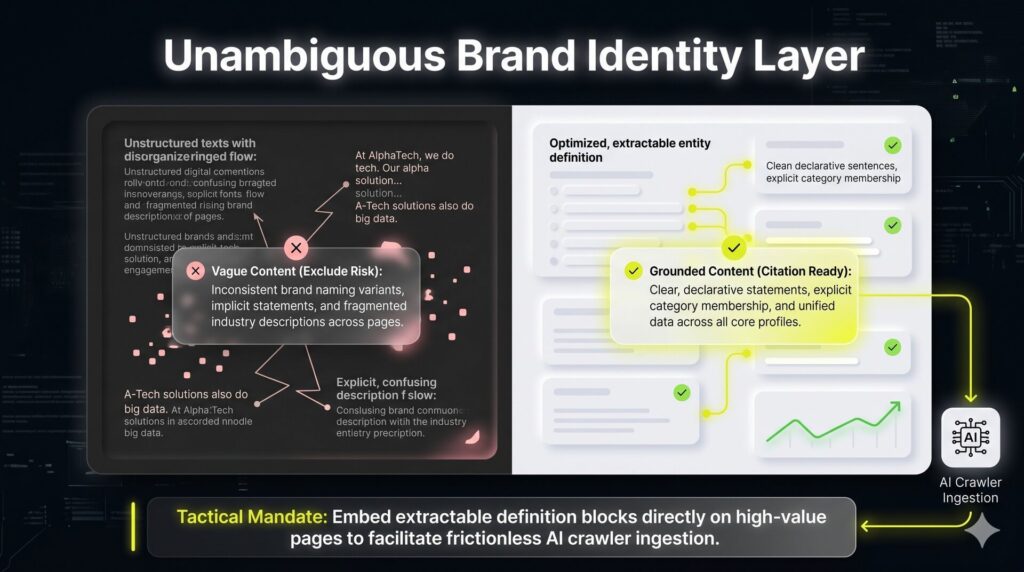
2. Ground Content in Unambiguous Entity Definitions
When queries imply specific entities like “top SaaS SEO firm” or require you to compare SEO pages for “X vs Y,” engines require a stable identity layer to resolve ambiguity. Vague brand identity causes exclusion from AI Overviews because engines prioritize low-risk citations. Grounding your content in a definitive identity layer ensures you remain the primary source, maximizing the impact of your SEO conversion optimization strategies.
Entity-grounded content relies on three pillars:
- Declarative definitions: Use clear “NUOPTIMA is…” statements.
- Category membership: Explicitly state service types and industry sectors.
- Factual consistency: Sync data across About, Service, and Author pages.
Operationally, embed extractable definition blocks on every high-value page. This allows AI crawlers to ingest core facts without friction. Use consistent naming conventions and avoid brand variants that fragment entity recognition across the knowledge graph.
Strong grounding prevents misattributions and increases selection probability for high-intent summaries. You stop being a generic mention and become a cited authority. This architecture ensures your brand is the answer even if weak entity grounding would otherwise exclude you from AI-generated answers.
3. Designate a Canonical Entity Home Page
Fragmented brand identities force AI engines to guess which version of your story is accurate. To fix this, designate a single Entity Home. Usually your About page, this asset acts as the canonical anchor for entity reconciliation and knowledge graph seo. It creates a single identity source so engines do not synthesize conflicting brand versions.
Place a plain-language, declarative definition near the top of the page. Below this, include an extractable paragraph with zero marketing hype. Lead with “[Brand] is a…” and incorporate stable operational data:
- Founding year and HQ location
- Leadership team members
- Primary business functions
- Links to proof pages like press, policies, and profiles
Reinforce entity-topic relationships by linking to core service hubs. Implementation must be crawl-friendly. Use clean HTML and ensure identity data is never hidden behind accordions or scripts. This structure allows LLMs to ingest your identity without friction, moving your brand from a collection of keywords to a verified, cited authority.
4. Prioritize Reconciliation-Focused Schema Markup
Schema is not a “magic ranking” checkbox; it is your brand’s machine-readable identity layer. Knowledge graph SEO succeeds through reconciliation. This process proves to search engines that a LinkedIn profile, a Crunchbase listing, and your homepage all describe the same entity.
Prioritize properties that bridge fragmented data across the web. Use mainEntityOfPage to designate your official Entity Home. Map sameAs to authoritative third-party IDs such as Wikidata, Crunchbase, or professional associations.
Maintain absolute consistency for:
- name
- url
- description
- logo/image
Implement a “Single Source of Truth” for brand facts. This governance rule prevents schema, copy, and PR from drifting. Inconsistency triggers entity fragmentation, leading to incorrect knowledge panels and skewed AI summaries.
Avoid these common pitfalls:
- Linking to low-quality sameAs targets, such as spam directories, which dilutes entity authority.
- Creating multiple competing “About” pages with conflicting claims that force engines to guess which data is accurate.
5. Build Third-Party Corroboration Without Wikipedia
Most brands cannot meet Wikipedia’s strict notability standards. Forcing an entry often triggers immediate deletion and wastes strategic effort. You can build entity authority by leveraging accessible corroborating targets that LLMs use to resolve identity and establish trust.
Prioritize these sources to build decentralized evidence:
- Wikidata entries to create a structured, machine-readable record of your brand identity
- Crunchbase and niche company databases to verify your commercial footprint and funding history
- Government business registries and high-authority industry directories to prove legal existence
Your content team should implement a corroboration checklist to ensure the Name, Founders, Headquarters, and Category match your Entity Home across all external platforms. Factual alignment increases perceived legitimacy and ensures your brand is the cited answer for AI search engines like Perplexity, Gemini, and ChatGPT. When multiple independent sources confirm these attributes, search engines can confidently resolve your identity and generate a Knowledge Panel. This decentralized evidence provides a realistic, scalable path to knowledge graph SEO dominance when a Wikipedia page is not an option.
6. Audit Your Identity with the Knowledge Graph Search API
Visual Knowledge Panels are often cached or incomplete, making them unreliable for precise validation. The Google Knowledge Graph Search API provides a read-only diagnostic window into how Google resolves your brand identity. It does not push updates, but it acts as a definitive QA tool to confirm entity recognition rather than guessing based on SERP appearances.
During a quarterly refresh, use the API to verify these data points:
- Entity Resolution: Does your brand map to a consistent, unique entity ID?
- @type Accuracy: Is the classification correct (e.g., Organization vs. LocalBusiness)?
- Description Source: Is the snippet accurate and pulled from your designated Entity Home?
Use these findings to harden your knowledge graph seo. Incorrect data requires tightening Entity Home copy, schema deployment, and sameAs targets to fix misaligned authority signals. If the brand is missing, increase your corroboration footprint to force internal clarity. Document all API results as an operational guardrail, re-verifying after site migrations or PR surges to ensure your entity remains the definitive answer.
7. Operationalize Your Internal Knowledge Graph for Content Ops
Factual updates shouldn’t take weeks. Most teams suffer from “factual drift” because they treat pages as isolated documents instead of nodes in a connected system. Mastery of knowledge graph seo requires utilizing proven frameworks for growth SEOto distinguish between Google’s Knowledge Graph (external influence) and your internal knowledge graph (internal control).
Operationalizing an internal graph requires standardizing entity fields. Define core attributes and approved synonyms to ensure consistency across every URL. Content teams can implement this without heavy engineering by mandating internal linking rules:
- Entity-to-topic (defining core concepts)
- Entity-to-service (connecting commercial solutions)
- Author-to-entity (verifying topical expertise)
This governance eliminates contradictory copy, enables faster refreshes, and ensures a single update propagates site-wide. It creates “extractable” answer blocks that AI retrieval systems can easily parse and cite. While enterprise organizations might use graph databases like Neo4j, most brands scale faster through disciplined schema and content governance. This transforms knowledge graph seo into a scalable operational layer that prevents content decay and ensures your brand is the definitive answer across every search surface.
8. Prevent Entity Drift with Active Reputation Monitoring
Entity SEO is reputation infrastructure, not a theoretical tactic. As external sources evolve, your entity representation drifts. Outdated press releases or unverified directory edits cause engines to display the wrong founder, business category, or brand logo. This fragmentation kills trust when prospects research your brand before a high-value purchase.
Maintain authority by monitoring three critical surfaces:
- Branded SERP: Audit Knowledge Panel fields and Knowledge Graph facts for factual accuracy.
- Third-party profiles: Verify the high-authority pages linked in your sameAs schema.
- Press snippets: Identify outdated descriptions that engines use as default sources.
Remediate drift by updating your Entity Home with declarative schema and facts. Align data across your About, Leadership, and Press pages to eliminate inconsistent signals. Strengthening authoritative corroboration forces engines to reconcile back to your canonical identity. This protects brand legitimacy and ensures generative engines cite your current leadership and services rather than outdated records.
FAQ
Google’s Knowledge Graph is a sophisticated database of entities: people, places, and things: and the relationships that connect them. Instead of merely matching keyword strings, the engine understands that your brand is an organization providing specific services to a defined audience. This matters because it bridges the gap between branded and non-branded queries. When the graph associates your entity with a category like B2B SEO, you become the definitive answer for broader industry searches.
No. Schema.org acts as a machine-readable map, but it is not a guarantee of search surface visibility. While markup helps engines disambiguate your data, Google requires third-party corroboration and high domain authority to trigger a Knowledge Panel or an AI citation. Schema reliably improves factual consistency and reduces the risk of misattribution. To secure citations in generative engines, you must combine technical schema with external confirmation from authoritative databases and industry registries.
You do not need Wikipedia to establish entity authority. Start by designating a canonical Entity Home, typically your About page, and implementing reconciliation schema using the sameAs property. Map this to authoritative third-party profiles like Wikidata, Crunchbase, or high-authority niche directories. Consistent identity data across these diverse sources builds the trust necessary for Google to generate a panel. Patience is required, as engines must observe and verify these signals across multiple crawl cycles.
The primary difference is influence versus control. Google’s Knowledge Graph is an external ecosystem where you provide signals to influence how the engine perceives your brand. In contrast, an internal knowledge graph is a content infrastructure you own. It organizes your content as a network of interconnected facts and nodes. This internal structure enables higher content refresh velocity and ensures factual consistency across your site, providing the organized data that AI engines prefer to cite.
Bring in an agency when your brand facts are inconsistent across search surfaces or when non-branded organic growth has plateaued. If your brand is invisible in AI Overviews or ChatGPT despite having high rankings, you likely have an AI visibility gap. Enterprise-scale organizations often require specialists to engineer the complex entity architecture needed for sustainable dominance.
Visit nuoptima.com to see how our GEO services turn your brand into the definitive, cited answer.
Where this fits in your MSP growth system
This is one piece of how NUOPTIMA makes MSPs and cybersecurity firms the provider buyers find on Google and in AI search. See how it connects to GEO and AI-search and answer engine optimization, or get your free MSP lead forecast to see exactly where your firm shows up across ChatGPT, Gemini, and Perplexity today.