
Evaluating a managed IT services franchise is not a question of technical capability. It is a choice between renting a packaged operating system forever, or building an enterprise asset you fully own. While a franchise reduces early uncertainty, it caps your brand equity and demand control. Franchisors rarely solve client acquisition, leaving owners stuck in unforecastable referral dependency. Here are eight critical trade-offs, a comparison table, and a 90-day decision framework, starting with the contract terms.
Key Takeaways
- An MSP franchise charges ongoing royalties (typically a percentage of recurring revenue) that permanently compress gross margin. Model this before signing.
- Franchisors rarely generate pipeline; local sales, networking, and outbound remain the owner’s job regardless of brand recognition.
- Franchise brand ownership is rented, not built. This caps long-term exit valuation and restricts niche positioning in sectors like healthcare or legal.
- Independent MSPs take longer to ramp but fully own their brand equity, demand engine, and exit multiple.
- Co-managed delivery models let franchisees access centralized help desk or NOC without hiring. But verify whether this is included, optional, or a separately priced add-on.
A managed IT services franchise is a licensed business model where an operator pays upfront fees and ongoing royalties to run a managed service provider under a franchisor’s brand, tools, and operational playbook.
1. Translate Franchise Fees into Unit Economics
To evaluate this model, your finance partner must model its direct effect on gross profit payback. Do not rely on promises. Quantify the exact costs across two categories:
Upfront capital:
- The initial franchise fee
- Technical launch costs
- A six-month working capital runway
Ongoing cash drag:
- Percentage-based monthly royalties
- Mandatory national ad fund contributions
- Markup fees on required vendor tools
If recurring royalties permanently compress your gross margin, you trade long-term enterprise value for short-term safety. Conversely, if fees are modest and the franchisor's central support replaces overhead hires you would otherwise make, the unit economics become rational.
Before signing, demand the current Franchise Disclosure Document (FDD), the full fee schedule, and written confirmation of which tools are included versus which carry mandatory extra costs.
Before signing, demand the current Franchise Disclosure Document, the complete fee schedule, and written clarity on which tools are included versus which require mandatory extra payments.
2. Decipher the Operational Split in Service Delivery
Many buyers enter this decision without realizing what they are actually purchasing operationally. This operational split dictates your cash burn, quality control, and capacity to scale.
You typically choose between two operating models:
- Brand plus playbook: You license the trademark and processes but recruit, hire, and manage the engineers yourself.
- Centralized delivery: The franchisor provides help desk, NOC, or SOC coverage, often through shared partner resources.
While centralized delivery offers faster launch times and immediate 24/7 SLA coverage, you lose direct control over client satisfaction.
Centralized delivery reduces time-to-launch but transfers SLA accountability to the franchisor’s shared partner pool. Always confirm who owns escalations and client communications before committing.
Before signing, verify who owns SLAs, escalations, and client communications. Confirm whether centralized delivery is included, optional, or required, and map how these fees scale with your contracted recurring revenue.
3. Challenge the Franchise "National Marketing" Promise
The uncomfortable truth is that an IT franchise does not hand you a pipeline. They hand you brand assets and a system, while actual client acquisition remains your job.
To expose reality, ask exactly what qualified lead sources are produced centrally. Usually, the answer is none. As the owner, you must still drive the local sales motion weekly:
- Local networking
- Strategic partner referrals
- Outbound cold outreach
National brand awareness does not generate pipeline. You must evaluate whether you will own a compounding demand engine. If the franchisor cannot make your business visible in Google searches and AI shortlists, you are still solely responsible for demand. Without local search and AI answer visibility, you are running a traditional sales business while paying royalties on your contracted revenue.
4. Weigh the Brand Ceiling Against Day-One Credibility
Renting a franchise name buys immediate trust with local small businesses. It bypasses the early credibility gap but imposes a strict brand ceiling. You forfeit the ability to build a profitable niche position in sectors like healthcare, legal, or manufacturing if the franchisor mandates generic corporate messaging.
This restriction directly limits your long-term valuation. Owning your positioning is the critical third growth lever alongside hiring and referrals.
Franchise brand restrictions directly limit your addressable market and your exit valuation. If specialist niche positioning is part of your growth plan, full brand ownership is non-negotiable. Without it, you cannot build the custom proof assets needed to transform a local IT shop into a highly acquirable specialist.
Your decision signal depends on your exit strategy:
- Premium niche strategy: If you want premium margins and defensible authority, you must own the brand narrative.
- Local volume strategy: If you want local, relationship-led SMB volume, renting a shared banner is sufficient.
5. Evaluate Territory Rights as a Growth Constraint
A protected territory prevents internal competition and keeps local focus, but it often operates as a growth ceiling. While exclusive ZIP codes keep other franchisees out, they simultaneously block you from chasing larger regional accounts, expanding into adjacent verticals, or executing mergers.
Before signing, verify:
- Territory definitions: Confirm exactly how boundaries are drawn and whether renewal terms allow modifications.
- Transfer rules: Confirm you can freely sell your contracted revenue and customer contracts to private equity.
- Acquisition rights: Verify what happens if you want to buy out a neighboring territory or independent competitor.
If your vision includes multi-region scale, evaluate geographic constraints as carefully as support claims. The boundaries that protect your local brand in year one are the same rules that limit your ultimate enterprise value in year ten.
6. Plan Your Cash Runway Around Hard Reality
Your franchise fee is only the first check. Assuming immediate recurring profitability is a fast track to operational insolvency.
Early cash flow is highly uneven. Upfront onboarding fees and one-off projects must fund your payroll while high-margin managed IT contracts slowly accumulate.
To manage risk, your finance partner should establish a downside plan with 6 to 12 months of liquid working capital. This runway sustains the business while your local sales pipeline matures, which varies based on your personal sales capability.
The decision signal is simple. If you lack this capital cushion, a franchise does not eliminate your business risk. It merely changes the shape of it.
As a next step, interview three active owners. Ask when they became cash-positive and what operational drivers caused it, rather than focusing on top-line revenue.
7. Plan for Your Final Multiple: Enterprise Value at Exit
You do not build an MSP to buy yourself a high-stress job. You build it to secure a premium valuation multiple at exit.
Professional buyers pay for three clear assets:
- Predictable, contracted recurring revenue
- Low founder dependency in daily operations
- A repeatable, scalable customer acquisition channel
If you operate under a franchise agreement, exit complexity rises. Franchisor transfer fees, approval rights, and complete brand dependence restrict your buyer pool and complicate deal structures.
With an independent MSP, you fully own your positioning. However, you must prove your demand engine is institutionalized rather than tied to the founder’s personal network.
If you want maximum strategic options and a premium exit multiple, prioritize complete ownership of your positioning and your demand generation capability.
8. Audit the Operational Lock-In and Brand Dependencies
Buying into a franchise model does not eliminate vendor lock-in; it often multiplies it. Before signing, you must audit the operational dependencies that dictate your daily overhead and long-term exit options.
Evaluate three critical lock-in categories:
- Contract terms: Long-term agreements and automatic renewals that tie up your capital.
- Tool stack mandates: Required RMM or PSA platforms that strip away your vendor negotiation use.
- Reputation spillover: Security breaches or operational failures by other franchisees that instantly damage your local brand.
Review the franchise agreement carefully for termination rights, restrictive non-competes, resale restrictions, and actual franchisor support obligations.
The decision signal: if your growth relies on service quality and specialist positioning, do not sign away the operational levers that protect your reputation.
How to Choose Between an MSP Franchise and an Independent Model
Share this three-step decision framework with your finance partner to evaluate a franchise versus an independent model.
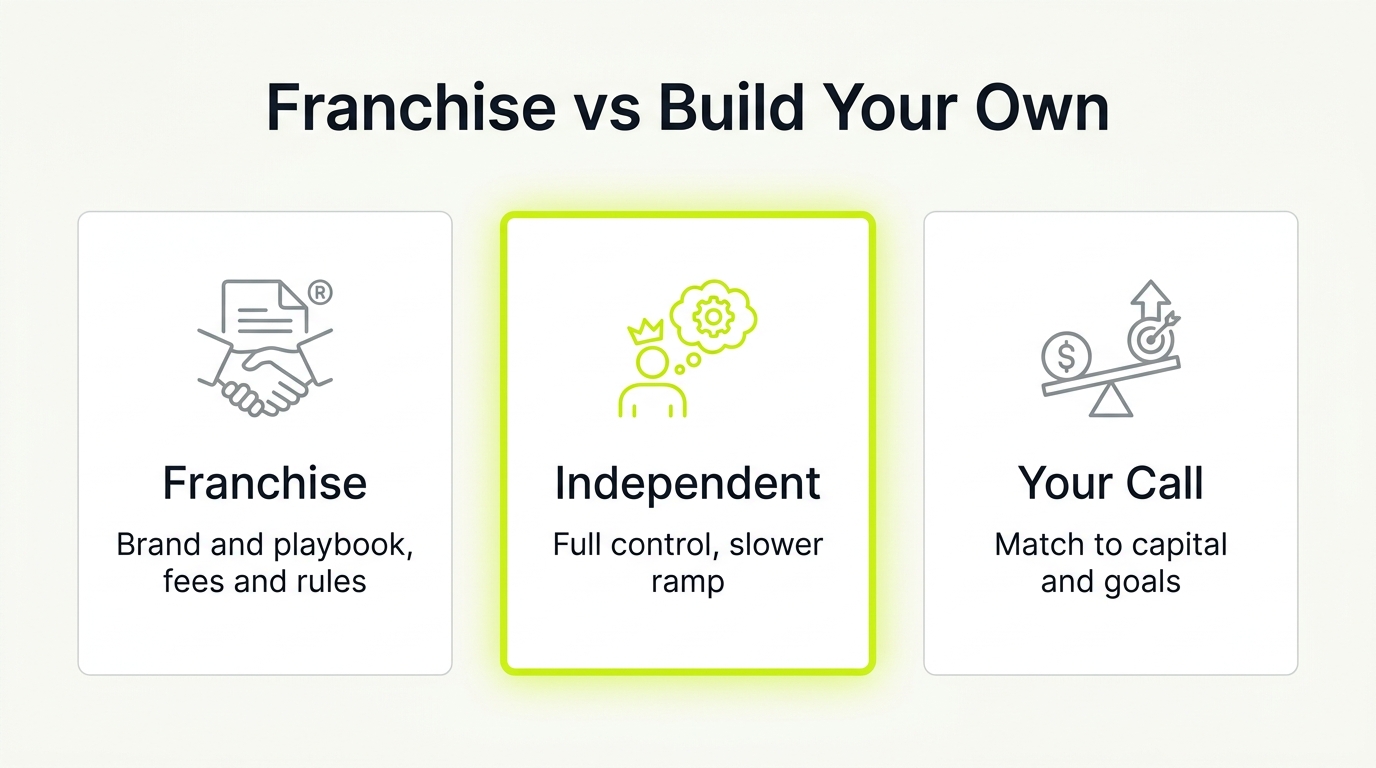
Short answer: Franchises like TeamLogic IT and CMIT Solutions give you a faster start, but you pay for it in perpetual royalties and a capped brand. Independent MSPs take longer to ramp but fully own their equity, positioning, and exit. Here is how the two paths compare across the five decisions that matter most:
| Factor | Franchise (e.g. TeamLogic IT, CMIT Solutions) | Build Your Own |
|---|---|---|
| Upfront cost and fees | Higher entry cost plus ongoing royalties and ad-fund contributions | Lower entry cost; no royalties |
| Speed to revenue | Faster launch with brand recognition and shared playbooks | Slower ramp; brand credibility built over time |
| Brand and playbook | Proven systems and national brand, but messaging is standardised | Full control over niche positioning and proof assets |
| Independence | Franchisor approval required for key decisions, tool stack, and resale | Complete operational and strategic freedom |
| Exit and valuation | Transfer fees and approval rights reduce buyer pool and complicate deals | Full equity ownership; no franchisor restrictions on sale |
Step 1: Compare the Business Models
Use this table to analyze how renting a franchise system compares to building an independent enterprise.
| Metric | Franchise | Independent |
|---|---|---|
| Upfront Cost | High fees | Tech setup only |
| Ongoing Fees | Royalties | Zero royalty |
| Lead Gen | Local sales | Owned engine |
| Delivery | Mandated stack | Flexible tools |
| Territory | Restricted | Unlimited |
| Brand Equity | Rented brand | 100% owned |
| Exit Path | Restricted | Strategic buyers |
Step 2: Run a 10-Query Shortlist Visibility Test
Verify your local AI find-ability. Run ten queries in Google, ChatGPT, and Perplexity using these terms:
- "best MSP for [vertical] in [city]"
- "managed IT for [industry] compliance"
- "co-managed IT [city]"
Score the output. Note if you appear, if competitors appear, and what proof is cited.
Step 3: Pick Your Growth Path
If you choose the independent model, prioritize building owned positioning and a compounding demand engine.
To build a predictable pipeline, read our content marketing MSP growth guide or book a free MSP growth strategy call at nuoptima.com.