
Nobody switches their MSP because they read a blog post. The fastest pipeline meetings always come from two actions: amplifying referrals and arming your sales team with proof assets.
These practical MSP marketing ideas are each tagged by Effort, Payback, Compounds (organic/GEO) versus Fast layer (paid/outbound), and DFY-ability. Slot the winners into a stage-gated MSP marketing strategy so each play carries a budget and a decision gate.
Because real marketing must be measured in meetings and contracted revenue, not traffic, we start with the exact plays that turn your next warm referral into three closed deals.
Key Takeaways
- The highest-closing channel is referral amplification; a two-part referral kit (forwardable email + one-page ICP sheet) converts goodwill into bookings in 30 minutes.
- Trust verification is the real reason superior MSPs lose to weaker competitors; a three-part proof pack (case studies, onboarding one-pager, security posture summary) fixes this directly.
- Personalized 5-minute Loom video audits break outreach fatigue and book cold meetings without a marketing team.
- Reactivation sprints targeting lost deals from the last 12 months generate near-term pipeline at near-zero acquisition cost.
- Local review velocity and Google Business Profile hygiene drive both map-pack rankings and AI citation credibility.
MSP marketing ideas are targeted, effort-tagged demand tactics that a managed service provider uses to book qualified meetings, ranging from low-effort referral kits to paid search experiments, each measured strictly in pipeline created and contracted revenue.
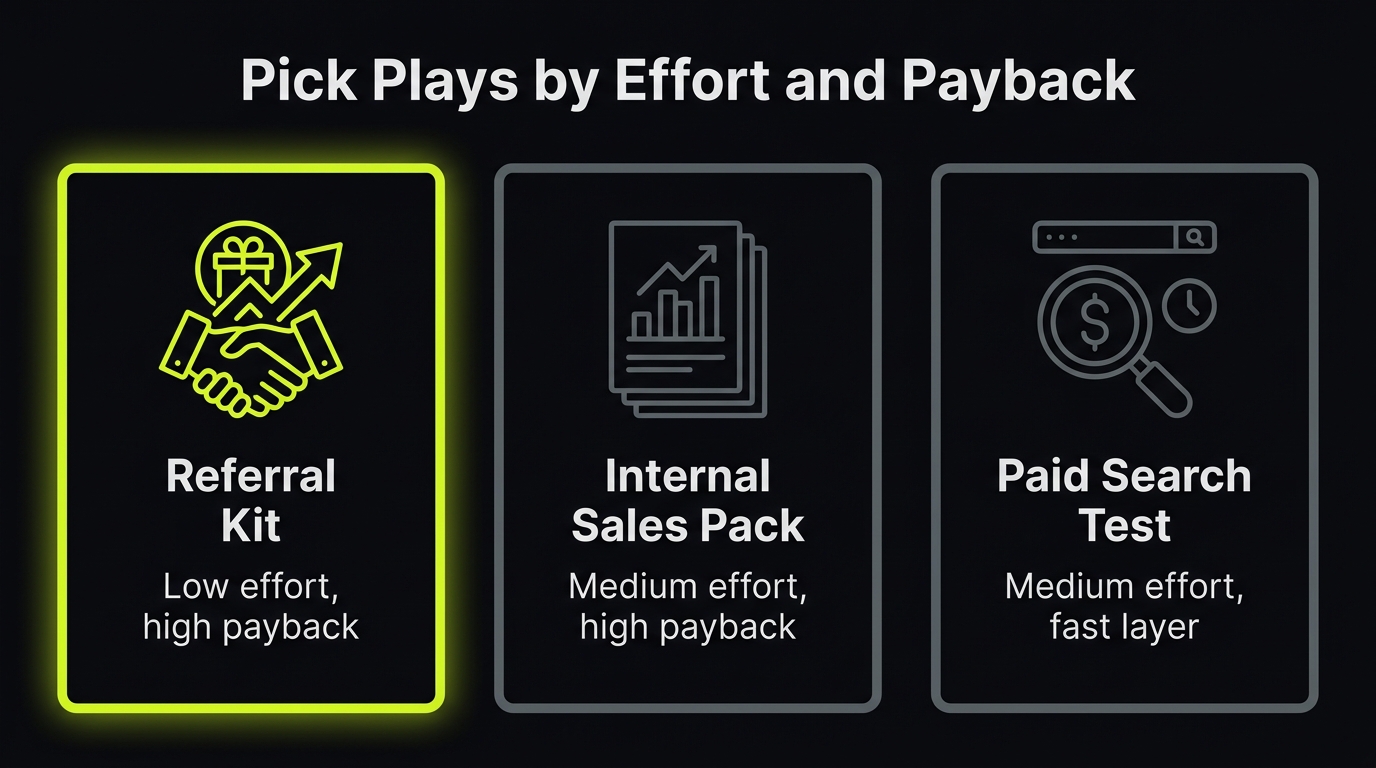
1. Arm Happier Clients with a Referral Kit
- Effort: Low
- Payback: High
- Motion: Compounds (organic)
- DFY-able: Yes
Referral amplification is the highest-closing channel in your pipeline. Do not make clients write your pitch; arm them with a two-part referral kit:
- A 6-sentence forwardable email for one-click sharing.
- A 1-page "Who We Help" sheet outlining your target verticals, size, geography, and triggers.
Ask for introductions at QBRs or right after a win, like a resolved ticket backlog or passed audit.
To execute in 30 minutes: select one client win, set a reminder, and send the kit. Track intros requested, intros made, and meetings booked to build a repeatable meeting source without hiring a salesperson.
2. Deploy a 2-Page "Internal Share" Sales Pack
- Effort: Medium
- Payback: High
- Motion: Compounds (organic)
- DFY-able: Yes
Deals stall when champions cannot justify switching costs to their CFO. To overcome this, build a two-page internal sales pack to send immediately after discovery calls. This is one of the most practical plays to prevent mid-funnel drop-off.
- Page 1: Outlines the cost of inaction, highlighting downtime, security exposure, and productivity leaks.
- Page 2: Details a 30-day transition timeline and a pricing frame ($150 to $250 per user monthly), noting variables like compliance and locations.
Measure success by tracking your discovery-to-proposal conversion rate and average time-to-close. This asset arms your champion to sell internally, accelerating your sales cycle.
3. Build a Three-Part Proof Pack to Secure the Shortlist
Why do superior MSPs lose deals to weaker competitors? The bottleneck is trust verification. Buyers and AI engines need immediate, structured proof to shortlist your business.
- Effort: Medium
- Payback: High
- Motion: Compounds (organic/GEO)
- DFY-able: Yes
Solve this by building a three-part proof pack:
- Two case studies: Highlight before-and-after metrics and precise transition timelines.
- Onboarding one-pager: Map out the first 30 days to eliminate transition anxiety.
- Security posture summary: Detail your controls, tooling philosophy, and response protocols.
Host these assets on a vertical landing page and in a shareable folder. Deploy them in proposals and on high-intent pages. This execution reduces price objections from finance partners and improves overall win rates.
4. Reactivate Cold Leads with a 3-Touch Sequence
- Effort: Low
- Payback: Medium to High
- Motion: Fast layer (outbound)
- DFY-able: Yes
Most MSPs sit on a quiet database of near-misses and old conversations. Instead of cold starting with expensive lists, build a fast-layer pipeline using:
- Lost deals from the last 12 months
- Stale inbound leads
- Past event attendees
Run this three-touch sequence to book meetings quickly without paying for clicks:
- Email 1: Ask "Still a priority or parked?" with a two-choice reply.
- Call: Confirm timing and current technical pain.
- One-page letter: Mail a physical sheet detailing three current operational risks.
Offer a 15-minute options call rather than a full audit. Measure success by trackable replies, booked meetings, and reactivated pipeline.
5. Land Cold Accounts with 5-Minute Video Audits
- Effort: Medium
- Payback: High
- Motion: Fast layer (outbound)
- DFY-able: Partially
Book meetings without a marketing team by sending personalized video audits. This outbound play breaks outreach fatigue by proving technical authority upfront.
Target one vertical, geography, and size band. Record a five-minute Loom screen-share:
- 30 seconds: State why you recorded.
- 3 minutes: Highlight three public gaps, like missing DMARC or exposed portals.
- 60 seconds: Invite them to a sanity-check call.
Use this email:
"Hi [Name], I noticed three public security exposures on your domain. I broke them down here: [Loom Link]. Let's run a quick security sanity check: [Calendar Link]"
Track your reply rate and meetings booked per 25 videos.
6. Co-Host a Local Micro-Seminar to Generate Shortlist Meetings
- Effort: Medium
- Payback: Medium to High
- Motion: Compounds (organic)
- DFY-able: Yes
Most seminars waste resources chasing raw attendance instead of qualified pipeline. Solve this by co-hosting a structured session with a non-competing partner like a CPA firm, compliance consultant, or local bank. This generates high-trust referral conversations without ongoing content production.
Run a 30-minute presentation and a 15-minute Q&A. Theme the event around: "Top 5 avoidable risks we see in [vertical] operations." You only need two reusable assets: one slide deck and a one-page follow-up checklist PDF.
Post-event, send two emails inviting attendees to a 20-minute risk prioritization call. Measure success on attendees, booked meetings, and partner-sourced introductions to keep this among your highest-yield acquisition channels.
7. Turn Client Reviews and Local Signals into Compounding Visibility
- Effort: Low
- Payback: Medium
- Motion: Compounds (organic/GEO)
- DFY-able: Yes
Reviews and local signals dictate map pack rankings and AI credibility scores, helping local searchers and warm referrals trust and choose you faster.
Replace ad-hoc requests with a systematic review engine. Trigger asks at key milestones like closed tickets, onboarding, or QBRs using a direct, two-sentence script:
"We are glad we resolved this issue quickly. Could you share a brief review of your experience here: [Direct Link]?"
Maintain Google Business Profile hygiene:
- Align services and categories.
- Publish weekly posts and monthly photos.
- Keep NAP (Name, Address, Phone) consistent.
With client permission, build a website review page to feed AI crawlers. Track review velocity, map pack impressions, and branded search lift.
8. Capture Late-Stage Shortlists with High-Intent Comparison and Vertical Pages
- Effort: Medium
- Payback: High
- Motion: Compounds (organic/GEO)
- DFY-able: Yes
Buyers stall when they cannot compare your delivery model to competitors. Capture this demand by publishing vertical and comparison pages that match shortlist criteria. This gives sales a credible asset to resolve objections.
Prioritize two page types:
- “MSP for [vertical] in [city]: what to look for”
- “Co-managed IT vs fully managed: which fits your team”
Structure pages with decision criteria, transition failure modes, what good looks like, and proof. This is among the best plays to capture active buyers. Use our content marketing MSP growth guide to build this playbook. Track performance via inbound comparison leads and assisted conversions on pages shared in proposals.
9. Run a Narrow Paid Search Experiment for Immediate Bottom-Funnel Demand
- Effort: Medium
- Payback: Medium
- Motion: Fast layer (paid)
- DFY-able: Yes
Paid search generates immediate meetings without becoming a money pit if you run it as a tight, 30-day experiment.
Focus exclusively on high-intent, bottom-funnel keywords:
- "managed IT services [city]"
- "IT support for [vertical] [city]"
- "co-managed IT"
Route traffic to a dedicated landing page with one offer, regional targeting, and a vertical proof pack. Ensure CRM integration, call tracking, and form tracking are active on day one. Measure cost per qualified meeting and actual close-rates, and execute a hard kill rule if meeting quality fails to hit targets within the first month.
Layer in Three Compounding Channels: SEO, Content, and Email Nurture
The fast-layer plays above book meetings this quarter; these three channels build the pipeline that keeps booking meetings after you stop paying for clicks. The strongest MSP marketing strategies pair the outbound and referral tactics you just read with organic channels that compound, so by 2026 your firm shows up on its own when a buyer starts searching. Treat each as a channel with an owner and a weekly metric, not a one-off campaign.
- Search visibility as a channel: Rank for the bottom-funnel terms your buyers type, like "managed IT services [city]" and "IT support for [vertical]". Fix technical hygiene, publish city and vertical service pages, and earn local citations so the map pack and AI shortlists name you. Our guide to IT services lead generation through SEO lays out the query targets that turn organic search into booked meetings.
- Content that answers buying questions: Skip generic news posts. Write decision-stage assets like "co-managed IT vs fully managed", migration checklists, and compliance explainers that a prospect reads while building a shortlist. Each piece doubles as sales enablement your team drops into proposals, so the same work drives search rankings and closes deals.
- Email nurture that keeps you on the shortlist: Most MSP prospects sit inside a multi-year contract when you first meet them, so a monthly nurture keeps you top of mind until their renewal window opens. Send a short operational risk note, one proof asset, and a clear next step; segment by seat band and vertical. Our MSP email marketing system shows the cadence that turns a stale list into booked calls.
Run these three alongside your fast-layer plays and the paid experiment in idea 9, and your pipeline stops depending on any single channel firing every month.
How to Turn These MSP Marketing Ideas into an Actionable Execution Plan
You run tight change-management processes for clients, yet market your own firm on gut feel. Stop trying to run ten campaigns at once. Build a minimum viable system that satisfies your growth goals and your finance partner's need for predictable payback.
Step 1: Select Your Minimum Viable Stack
Do not execute every tactic. Select three plays to start:
- One referral amplifier like a client referral kit.
- One sales enablement asset like a two-page internal decision pack.
- One fast layer channel using paid media or outbound outreach.
Step 2: Establish the Boardroom Scorecard
Define your baseline metrics before writing copy or launching campaigns. Show your finance partner how these plays translate into contracted revenue by tracking these five weekly data points:
- Meetings booked
- Qualified meeting rate
- Proposal rate
- Win rate
- Expected three-year gross profit per logo
Step 3: Assemble Your Asset Toolkit
Build the baseline collateral to run your chosen plays. Focus only on high-yield, done-for-you materials:
- A forwardable referral email for warm introductions.
- An internal decision pack for your technical champions.
- A proof pack landing page with case studies and onboarding timelines.
- One automated follow-up sequence for stale leads.
Step 4: Execute the Four-Week Sprint Cadence
Treat your marketing like an engineering sprint. Organize your month into strict blocks:
- Week 1 (Build): Finalize all copy, landing pages, and tracking links.
- Week 2 (Outreach): Deploy your fast-layer campaigns and request referral introductions.
- Week 3 (Follow-up): Run your call and email follow-up sequences.
- Week 4 (Review): Audit your scorecard metrics and optimize the lowest-performing step.
Step 5: Run Shortlist Visibility Checks
Verify whether search engines and generative AI engines can find you. Test 10 high-intent buyer queries in Google and an AI tool. Use terms like "best MSP for [your vertical] in [your city]" to see if your brand appears and record what proof is missing.
Pick your three starting plays and get hands-on execution help at nuoptima.com. Run the diagnostic and we will map the right stack for your pipeline.