The real tension in search today is faster production versus ranking stability. Most teams treat AI as a shortcut to generic drafts, but market leaders use AI writing seo as a throughput multiplier for authority. This guide provides 7 tactical steps to secure Google rankings and AI citations while preserving brand authority and E-E-A-T, aligning your execution with modern conversational SEO principles. We optimize for the answer layer and pipeline revenue by starting where most AI content fails: before the first prompt.
Key Takeaways
- The core tension in AI writing for SEO is faster production versus ranking stability; leaders use AI as a throughput multiplier for authority rather than a shortcut to generic drafts.
- Shift from prompt-first to brief-first workflows: every page needs a structured brief defining primary intent, required entities, and success metrics before generation begins.
- Treat Human-in-the-Loop editing as a control layer, not a polish: fact-check claims, replace generic advice with specifics, and inject first-hand experience until an editor can name three lines only your brand could write.
- Force information gain with proprietary frameworks and competitor-gap analysis so content adds value instead of mirroring existing consensus.
- Embed technical SEO during drafting (internal links, FAQ and HowTo schema, reusable definition blocks) so every page is citation-ready for Google and generative engines the moment it goes live.
AI writing SEO is the practice of using AI as a production multiplier within a brief-first, human-edited workflow to create content that ranks in Google and earns citations in AI answer engines while preserving brand authority and E-E-A-T.
1. Build a Brief-First Infrastructure for AI Writing SEO
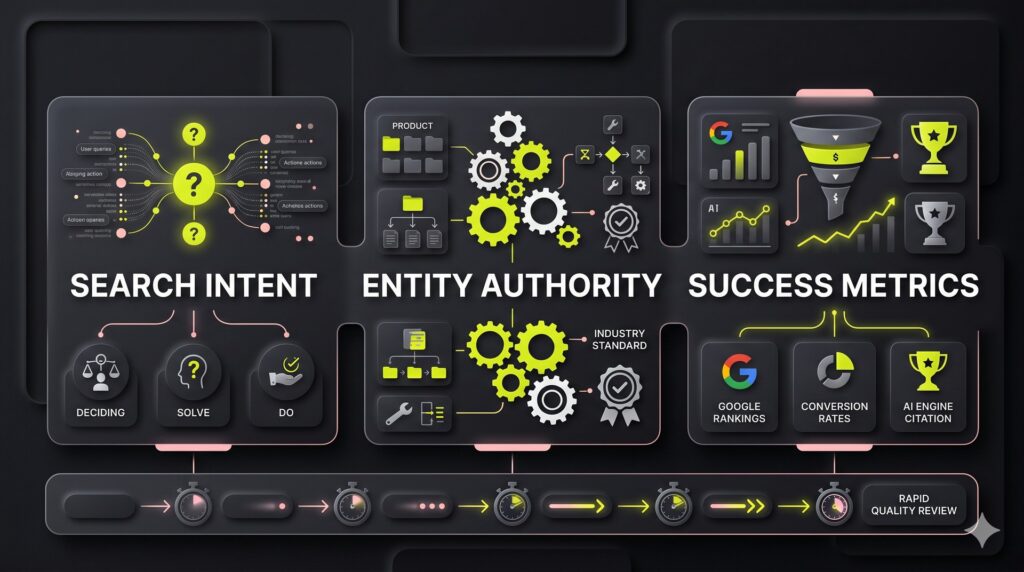
AI mirrors your ambiguity. Vague prompts produce generic pages that fail to rank or earn citations. To dominate the answer layer, shift from prompt-first to brief-first workflows. High-quality output requires granular clarity on search intent and entity authority before generation begins.
Every page requires a structured brief defining three pillars:
- Primary intent: What the searcher is trying to decide, solve, or do.
- Required entities: Specific product categories, methods, tools, and industry standards.
- Success metrics: Target Google rankings, conversion rates, or AI engine citation volume.
Use AI to generate 10 to 15 must-answer questions based on these parameters to ensure topical depth, establishing the foundation for robust content clusters SEO. Implement a strict 60-second quality gate for every brief. If it takes longer to review, it lacks the focus needed to prevent AI drafts from drifting off-intent or producing thin SEO-only content.
2. Systematize Human-in-the-Loop Editing
The failure mode in AI writing seo is copy that looks publishable but remains generic or unverifiable. AI mimics quality without a pulse on reality, producing “manufactured” footprints that erode E-E-A-T and trust. To protect brand authority, treat Human-in-the-Loop (HITL) editing as a rigorous control layer rather than a final stylistic polish.
Apply a strict HITL checklist to every draft:
- Fact-check non-obvious claims and verify all statistics or named references.
- Replace generic advice with specific steps, thresholds, and constraints.
- Inject first-hand experience (what you tested, observed, or measured in your operations).
- Simplify sentences to improve readability while maximizing information density.
The output standard is definitive: an editor must identify three lines that only your brand could write. This systematic layer eliminates hallucination risks and ensures content remains the citation-worthy answer for both Google and generative search engines.
3. Force Information Gain with Proprietary Frameworks
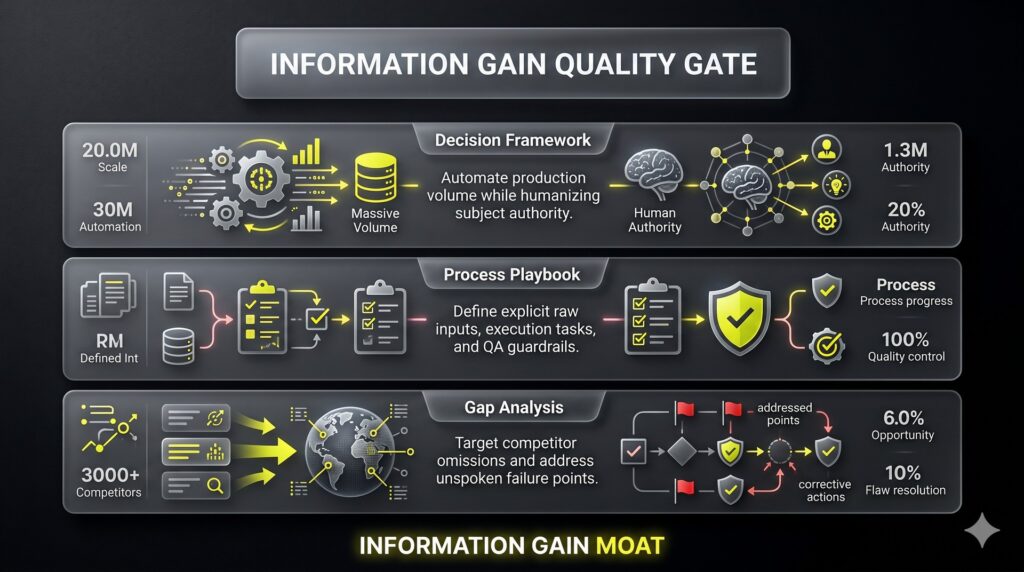
Interchangeable content is invisible. Most AI writing seo strategies fail by mirroring existing consensus instead of adding value. To earn citations and dominate the answer layer, engineer a deliberate mechanism for information gain.
- Decision Gate: Define when to automate versus when to deploy SMEs.
- Mini Playbook: Map the workflow from raw inputs and execution to QA and outputs.
- Failure Patterns: Document common operational errors that break search rankings.
Use AI to identify competitor omissions. Task the model with finding operational details or risks top-ten results ignore. Verify these gaps with proprietary data to build a unique, defensible content moat.
Information Gain Quality Gate
| Feature | Implementation |
| Decision Framework | Automate volume; humanize authority |
| Process Playbook | Define inputs and QA guardrails |
| Gap Analysis | Address unspoken failure points |
4. Architect Content for Extraction and Readability
AI answer engines prioritize extractable architecture over stylistic prose. Most AI writing seo fails because it lacks clear hierarchy, making brand data invisible to LLM summaries. Content architecture drives engagement and provides a clean map for generative extraction.
Use AI to re-engineer page structure for machine consumption:
- Rewrite H2s to resolve specific user intent instead of keyword variants.
- Generate a three-bullet TL;DR that mirrors the page promise for rapid extraction.
- Insert a direct answer sentence under key headings defining the concept and its application.
Human editors must ensure headings map to actual user questions rather than search volume metrics. Prune filler introductions and sharpen topic sentences to maximize scannability. This high-density architecture establishes your brand as the definitive source for both users and algorithms, boosting on-page performance signals.
5. Embed Technical SEO Architecture During Drafting
Stop treating technical SEO as a post-publishing chore. Reactive optimization leads to orphaned pages and invisible content. Build authority by embedding schema and linking logic directly into yourAIi writing seo drafting phase.
Define these elements before the first draft is complete:
- Map 3 to 5 internal links using anchor intent rather than exact-match spam.
- Identify schema opportunities for FAQ, HowTo, and Author entity signals.
- Build reusable blocks like definitions and checklists for seamless LLM extraction.
Leverage AI to propose anchor variants and generate FAQ candidates based on intent-mapped queries. This quality gate ensures links support user tasks rather than just PageRank flow.
Launching with technical completeness prevents the “unfinished” AI content trap that ranks poorly. Every page must be citation-ready for both Google and generative engines from the moment it goes live.
6. Standardize Your Input Architecture for Consistency
Debating which LLM is superior is a distraction in competitive AI writing seo. High-performance output stems from rigid constraints and task-based selection rather than model choice. Align specific engines to distinct workflow stages: research synthesis, structural outlining, and rewriting for clarity.
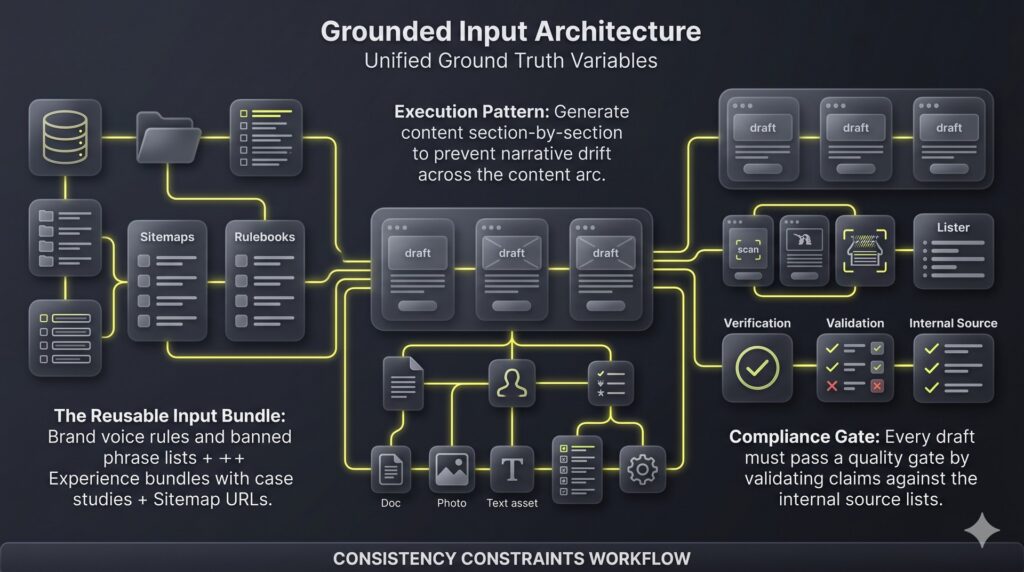
Standardize your process by providing reusable input bundles to prevent narrative drift:
- Brand voice rules and banned phrase lists
- “Experience bundles” containing proprietary metrics, case studies, and proof points
- Internal link maps using sitemap CSVs or priority URLs
Generate content section-by-section instead of using one-shot drafts to maintain precision over the narrative arc. Every draft must pass a quality gate by citing a specific internal source list. This grounding ensures content reflects your entity authority rather than generic training data. This architecture makes high-quality output repeatable across different writers and clients.
How to Operationalize Your AI Writing SEO Workflow
Operationalize your ai writing seo workflow by converting tactical advice into a rigid execution sequence for generative engine optimization visibility.
Stage 1: Research + Brief
Map intent and entities before prompting. Identify must-answer questions and define an information gain angle. You’ll see a granular brief that prevents generic AI drift.
Stage 2: Outline + Structure
Map H2 headers to solutions instead of keywords. Insert a TL;DR block and high-density answer sentences. This optimizes architecture for Google rankings and LLM citations.
Stage 3: Drafting
Execute sectional drafting with rigid brand voice constraints. Integrate proprietary frameworks and case study data to anchor the draft in your unique domain authority.
Stage 4: HITL Edit + QA
Fact-check every claim and remove AI linguistic footprints. Verify that each section provides original information to protect your search authority.
Stage 5: Publish Complete
Apply FAQ schema, insert an FAQ block, and use intent-mapped internal links. Include author trust signals and entity-rich declarations to finalize the asset.
Measurement Loop
Track rankings and conversions while monitoring AI visibility and citation frequency to ensure your brand becomes the cited authority.
Book a strategy call at nuoptima.com to explore our GEO services and become the answer layer.
FAQ
Google penalizes low quality content produced for search engines, not the tool used to create it. If your content provides original value and demonstrates E-E-A-T, it remains safe. The primary risk is unedited automation that produces thin or repetitive drafts. A hybrid workflow that combines AI production with human verification ensures your content meets Google’s helpfulness standards.
The level of automation is irrelevant if the draft cannot pass a Human-in-the-Loop checklist. Use a control metric focused on information gain. If you cannot identify specific claims, data points, or original insights that only your brand provides, you have used too much AI. Every page must contain human-verified expertise to secure ranking stability.
The best model depends on the specific task. GPT is excellent for research synthesis and technical outlining. Claude often produces more natural, rhythmic drafting. Gemini excels at integrating real-time search data. Instead of constantly switching models, focus on building standardized internal templates that force any LLM to follow your brand’s authority guardrails.
You must treat Generative Engine Optimization (GEO) as a distinct discipline. Structure your content into clear, extractable blocks with direct answers and FAQ schemas. Use entity-rich declarations that allow LLMs to identify your brand as the definitive source. For a complete strategy on dominating the answer layer, explore the NUOPTIMA GEO services page.
Direct the AI to remove filler phrases and sharpen topic sentences instead of simplifying the vocabulary. Force the model to use shorter sentences and tighter heading structures to maximize scannability. This preserves information density while making complex expertise easier for readers to navigate. Focus on removing linguistic fluff to highlight your core insights.
Where this fits in your MSP growth system
This is one piece of how NUOPTIMA makes MSPs and cybersecurity firms the provider buyers find on Google and in AI search. See how it connects to GEO and AI-search and answer engine optimization, or get your free MSP lead forecast to see exactly where your firm shows up across ChatGPT, Gemini, and Perplexity today.