
Referrals close, but they do not forecast. Platform specialisation is not a branding exercise; it is a valuation and pricing strategy.
Narrowing your delivery to Apple-first, Linux-native, or open-source environments concentrates authority, improves Google and AI shortlist visibility, and secures pricing power that buyers can underwrite. This guide covers the operational requirements and packaging rules to make your platform niche investable.
The shift begins with how focus changes the economics.
Key Takeaways
- Platform specialisation (Apple-first, Linux-native) directly increases MSP valuation multiples because acquirers can underwrite repeatable delivery with fewer exceptions and predictable margins.
- A Mac-first MSP requires zero-touch provisioning via Apple Business Manager plus an MDM platform (Jamf, Kandji, or Intune). Manual MacBook configuration is an ad-hoc helpdesk, not a managed service.
- Tooling choice is your operating model: Jamf suits larger regulated fleets; Kandji lowers the training burden for mid-market scaling; Intune fits mixed environments anchored on Microsoft 365 identity.
- Microsoft 365 is the security control plane for platform-specialised MSPs. Licence audits, conditional access, and device compliance gating convert a basic subscription into a premium recurring contract.
- Measure your niche visibility by running 10 buyer queries in ChatGPT, Gemini, and Perplexity; low citation share means your specialisation is invisible to the buyers and AI engines that build shortlists.
A platform-specialised MSP is a managed service provider that concentrates delivery on a defined technology environment (such as Apple or Linux) to build concentrated authority, command premium pricing, and deliver the repeatable operations that acquirers and AI shortlists can verify.
For a deeper look at how buyers price platform-specialised providers, see our guide to MSP valuation. If you are still building predictable revenue before you consider a sale, our guide to predictable MSP growth covers the recurring revenue foundations acquirers look for.
Apple MSP vs Traditional MSP: What Actually Differs
An Apple MSP is a managed service provider that runs macOS, iOS, and iPadOS fleets as a standardised managed service through Apple Business Manager and a dedicated MDM, rather than treating Macs as exceptions inside a Windows-first helpdesk.
Most traditional MSPs support Apple devices reactively: a technician configures each Mac by hand and forwards Apple problems as one-off tickets. An Apple-first provider treats the fleet as a managed system with enrolment, security baselines, and lifecycle policy defined once and enforced automatically. That difference is what a buyer underwrites, and by 2026 it is what a Mac-heavy client screens for.
- Provisioning: A traditional MSP images or hand-configures each device; an Apple MSP uses zero-touch enrolment through Apple Business Manager so a device is production-ready out of the box.
- Security model: A generalist bolts endpoint tools onto whatever ships; an Apple MSP enforces native baselines like FileVault encryption and application restrictions through MDM profiles.
- Update strategy: A traditional shop patches Macs ad hoc; an Apple MSP aligns updates to Apple's declarative management model so policy holds without manual checks.
- Economics: Fewer exceptions mean cleaner packaging, shorter sales cycles, and the predictable margins that lift your multiple.
If you want the valuation math behind that margin difference, our MSP valuation guide shows how repeatable delivery converts into a higher multiple.
1. Why Niched MSPs Command Higher Valuations
Why does a generalist MSP with double your revenue struggle to match the valuation multiple of a focused specialist? Acquirers value predictability. A platform-specialized MSP reduces risk because the buyer can underwrite repeatable delivery.
Focus optimizes your metrics across three core areas:
- Packaging: Cleaner inclusions, fewer exceptions, and zero scope creep.
- Proof: Niche-specific case studies and targeted compliance artifacts.
- Sales cycles: Shorter timelines that shift from prospect education to confirmation.
This clarity directly drives your AI visibility score. Generative engines reward precise entity definitions and consistent signals, turning repeatable answers into dominant citation share.
The evidence is there. NUOPTIMA’s engagement with Cortavo (a managed IT provider) produced $210,000+ contracted value and $1,000,000+ MQL pipeline by December 2025, with 4x more AI citations than the closest competitor, and $403,330 in contracted sales value at a 4.6x return by month twelve. See the Cortavo case study for the full breakdown.
Establish this position instantly: “We are the Mac-first MSP for creative agencies, and we use Microsoft 365 as the identity and security layer.”
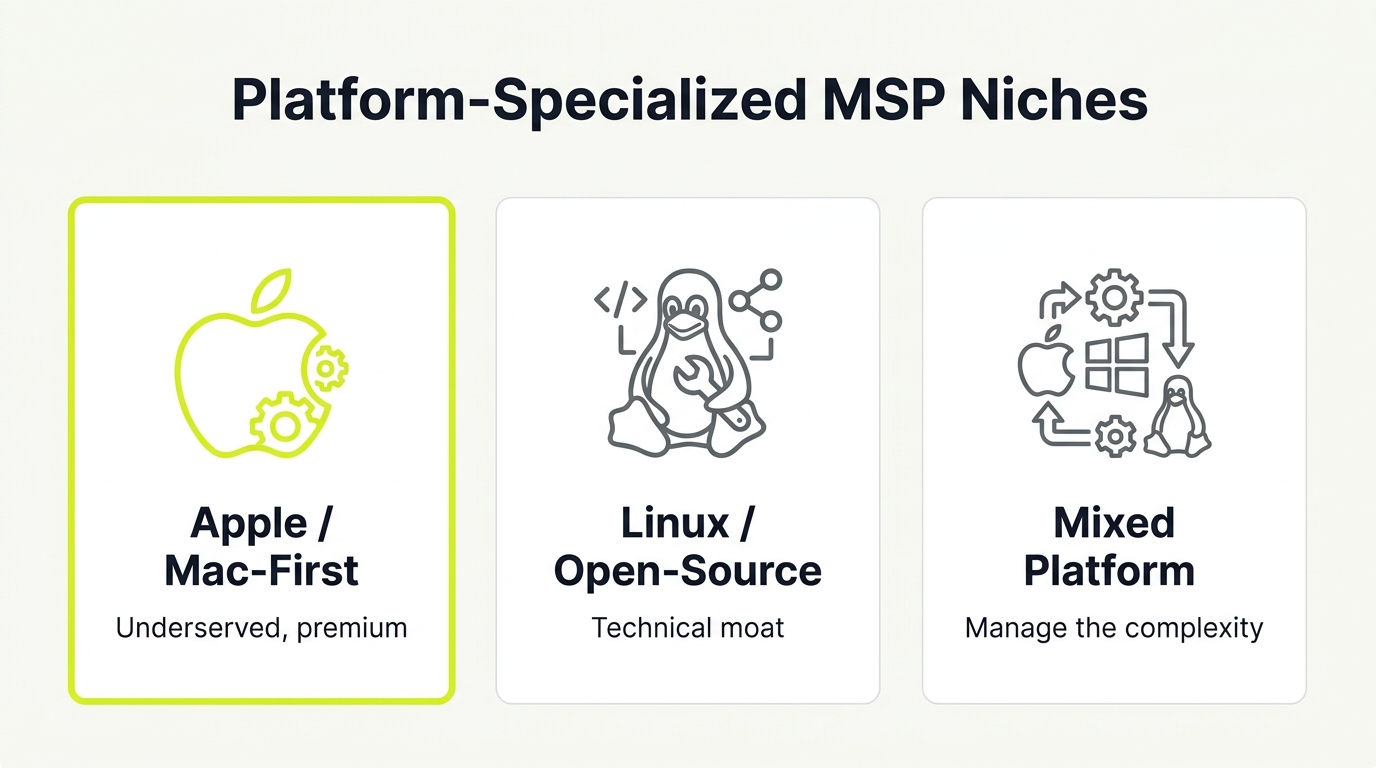
2. What Is an Apple MSP? Scope and Tooling Decisions
If your engineering team manually configures MacBooks, you run an ad-hoc helpdesk, not a managed service.
A Mac-first managed service provider standardises enrollment, security baselines, patching, and lifecycle operations for macOS, iOS, and iPadOS fleets, typically through Apple Business Manager plus an MDM.
To scale, your delivery team must operationalise:
- Zero-touch provisioning via Apple Business Manager enrollment and policy enforcement.
- Device security baselines: FileVault disk encryption, local admin controls, and application restrictions.
- Update strategies that align with Apple’s modern declarative management model.
Your architecture hinges on a tooling decision: deep, Apple-first platforms like Jamf, lighter automation-first tools, or Microsoft Intune when Microsoft 365 is your identity control plane. This choice determines if your team is truly Apple-native.
The Apple Business Manager Enrolment Workflow, Step by Step
Zero-touch provisioning is the line between a managed Apple service and a helpdesk that happens to fix Macs. The workflow that makes it repeatable is the same one a buyer expects to see documented in your operations, and it runs on the tooling this page already covers: Apple Business Manager linked to your MDM.
- Link the accounts: Connect Apple Business Manager to your MDM so devices your client buys are assigned to the right tenant automatically at the point of purchase.
- Build the baseline: Define the enrolment profile once, covering FileVault encryption, local admin controls, and application restrictions, so every device inherits the same secure posture.
- Assign by group: Map devices to client and role groups so a new hire's Mac provisions with the correct apps and policies without a technician touching it.
- Enforce and report: Let the MDM hold policy under Apple's declarative model and produce a compliance readout your client and a future acquirer can both read.
Document this flow as a named SOP with an owner. A repeatable enrolment process is exactly the transferable operating system that raises your valuation, because it proves delivery does not depend on any one engineer.
3. Jamf vs. Intune vs. Kandji: How Tooling Shapes Your MSP Operating Model
Your MDM tooling choice is your operating model. It dictates your staffing costs, onboarding speed, and service margins. The wrong stack causes margin loss through support complexity.
- The Jamf Path (Apple-First): Best for larger, regulated fleets. It delivers absolute control but demands expensive Apple specialists, custom scripting, and structured onboarding protocols.
- The Intune Path (Microsoft-First): Fits mixed environments where Microsoft 365 anchors identity. It consolidates licensing but demands heavy testing and process rigor for deep macOS management.
- The Kandji Path (Automation-First): Built for rapid mid-market scaling. Standardized, blueprint-driven deployments lower the training burden, allowing tier-one helpdesk staff to manage Apple endpoints.
Pick the stack that matches the clients you want in 24 months, not the client you can sign next week.
4. Defining the Linux MSP: Distribution Standards and Lifecycle Controls
If your engineers still patch production servers manually via SSH on Friday nights, you face operational drift and compliance failure.
A Linux MSP is a managed service provider that takes ongoing responsibility for Linux server reliability, patching, security baselines, and automation across specific distributions in production.
Buyers expect named competence in RHEL and Ubuntu lifecycles, not general open-source enthusiasm. Operational maturity requires structured patch staging, defined maintenance windows, and automated reporting. Drift control ensures security baselines remain locked across all systems without manual checks.
Remediation must follow a risk-based SLA model that ties response times to CVE severity and exposure. This structured approach prevents your support from being commoditized, justifying premium pricing.
5. Translating Linux Operations into Boardroom Value
Unpatched, internet-facing Linux servers are not an IT hygiene issue. They represent a severe business risk to uptime, compliance, and enterprise value. Secure your clients and your margins by packaging Linux operations into a clear three-part model:
- The Baseline: Implement a CIS-style hardening standard, tight account controls, and centralized logging.
- The Patching Pipeline: Deploy via staged rollouts, scheduled maintenance windows, and formal exception handling.
- The Executive Report: Report monthly on compliance percentage, patch age, critical exposures, and actions taken.
Govern this delivery with a typical SLA ladder pattern:
- Critical risks: Remediated within hours to days.
- High risks: Resolved within days to weeks.
- Low risks: Addressed monthly.
Standardization combined with automation is the only way to scale a Linux MSP profitably.
A strong Linux practice is also relevant to small-business buyers. Our guide to managed IT services for SMBs outlines what smaller clients expect from a Linux-capable provider.
6. Microsoft 365 as the Security Layer for Platform-Specialised MSPs
Treating cloud tenants as static setups leaves high-margin recurring revenue on the table. Whether your primary niche is Apple or Linux, Microsoft 365 is the control plane that ties the fleet together: identity, security policy, device compliance, and licence governance as an ongoing managed service, not a one-time setup.
Effective M365 governance must include:
- Licence audits: Monthly right-sizing to eliminate SaaS waste instead of pushing upsells.
- Identity and access: Strict MFA, conditional access, and automated responses to risky sign-ins.
- Data protection: Standardised retention policies, DLP posture, and shared mailbox lifecycles.
- Endpoint compliance: Restricting tenant access based on real-time device health states.
This framework protects data access across every endpoint in your platform niche and converts a basic licence into a premium recurring contract.
7. Productising Your Platform Niche with Microsoft 365
Your margin is a direct function of exceptions. Platform-specialised MSPs protect profitability by eliminating operational variance. Packaging Apple or Linux endpoints under a unified Microsoft 365 security layer reduces delivery chaos and justifies higher per-seat rates.
Structure your offering into three repeatable tiers:
- Core: Monitoring, automated patch cadence, baseline security, and standard apps.
- Plus: Conditional access tuning, device compliance gating, and advanced reporting.
- Premium: Faster remediation SLAs, continuous compliance support, and a strategic quarterly roadmap.
Protect delivery economics by documenting hard boundaries:
- Supported macOS versions and Linux distros
- Onboarding prerequisites
- Approved maintenance windows
This translates into a single pane of glass for the client:
- One account team
- One monthly risk report
- One unified escalation model
This repeatability turns platform-specialised delivery into a premium asset that acquirers can underwrite, directly supporting a stronger valuation multiple.
8. How to Convert Platform Specialisation into AI and Search Demand
Being specialized is useless if buyers and AI cannot verify your expertise. Turn your niche into shortlist visibility by building a minimum authority hub.
Publish targeted content to capture this high-intent demand:
- Definitions: Apple MSP, Linux MSP, and Office 365 MSP.
- Management: MDM, tenant security, patch SLAs, and reporting.
- Comparisons: Jamf vs Intune for MSP use, macOS and M365, and Linux patching SLAs.
Run a visibility score test. Run 10 buyer queries in Google and AI tools, then record where you appear and what proof is cited. To win recommendations, feed engines third-party signals like testimonials, partner listings, case studies, and digital PR.
We help MSPs build this authority engine. If you want to know how your niche positioning translates into a higher valuation multiple, request a niche authority and valuation review at nuoptima.com, or compare partners in our guide to the best MSP marketing agencies.