
Your MSP sales collateral is not a vague brand exercise. It is close-support material designed to reduce deal friction. Even referred prospects will search Google, query AI models, and forward PDFs to their CFOs to justify your contract. You do not need more collateral. You need the right proof at the right time. Here are seven MSP sales collateral assets you can build quickly to accelerate your pipeline, starting with the one-pager prospects forward the most. (This is collateral for a managed service provider, not MSP in staffing, where the term means a managed service program for contingent labor.)
Key Takeaways
- An MSP brochure is a close-support tool, not a brand exercise. Its job is to reduce deal friction at each stage of the sales process.
- A minimum viable collateral kit of three assets (post-call one-pager, 30-day onboarding roadmap, one-page SLA snapshot) is enough to move most deals forward.
- Vertical one-pagers shift the conversation from generic IT support to specialized risk mitigation, letting you justify premium pricing over generalist competitors.
- A verified authority sheet. Containing one or two quantified, public-domain proof points. Reduces vendor-risk perception with CFOs and finance partners.
- Each piece of collateral must drive a single, clear next step; attaching five PDFs to one email dilutes the call to action and stalls the deal.
MSP collateral is a set of purpose-built sales documents. One-pagers, SLA snapshots, onboarding roadmaps, and proof sheets. Designed to reduce deal friction and move a prospect through each stage of the buying process without additional selling time.
1. The Post-Call One-Pager
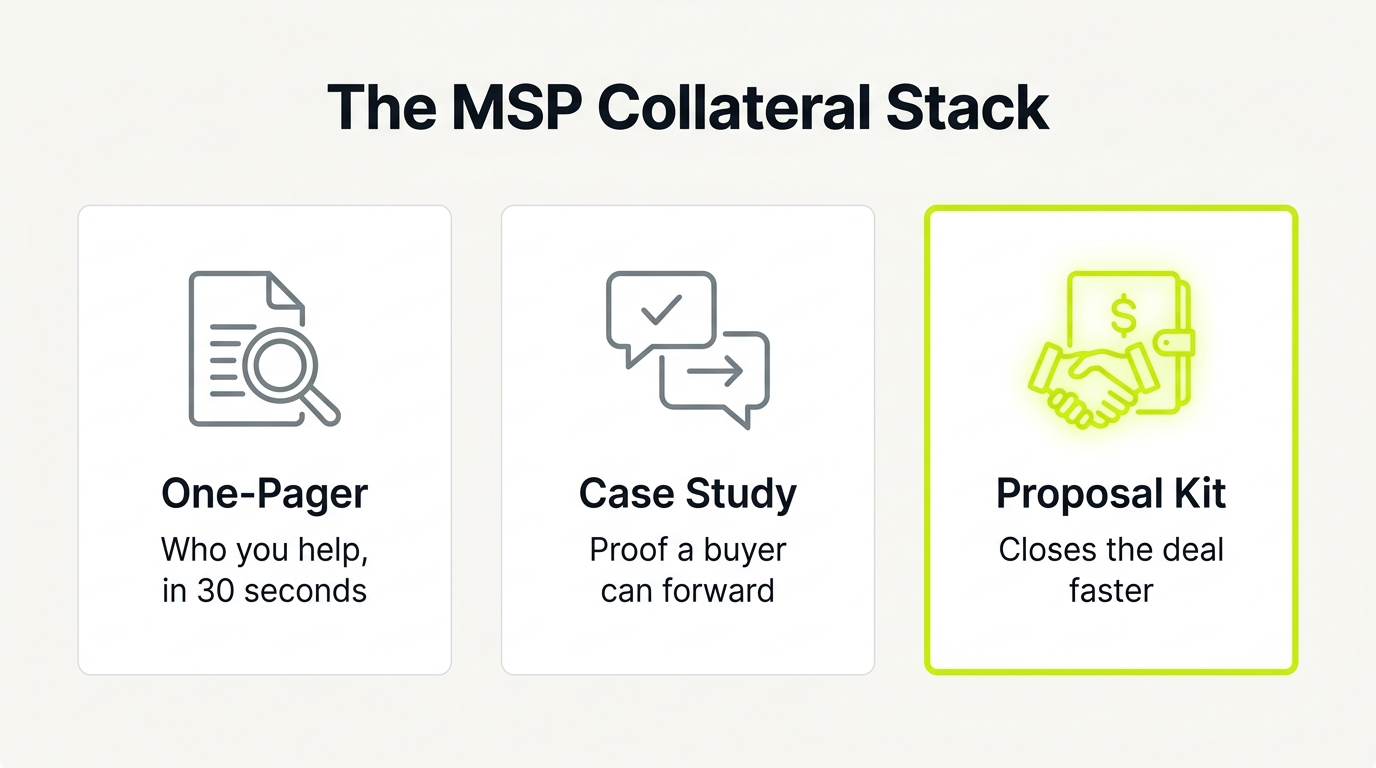
The moment you hang up, your internal champion must sell your services to a skeptical CFO who sees you as a cost. A heavy sales kit fails here. You need a highly legible one-pager that travels inside the prospect organization to keep the deal moving.
Send this asset immediately after your first call, attach it to your onsite follow-up, or leave it behind. To make your MSP legible in 30 seconds, structure the page with:
- One outcome-led headline focused on predictable spend or risk reduction.
- Three core offers (helpdesk, security, and cloud) framed strictly as business outcomes.
- A single call to action to book a 15-minute diagnostic next step.
This forwardable document makes your competence safe to recommend to any operations lead.
2. The Industry-Specific Risk Cheat Sheet
If you sell to every industry on a single page, buyers compare you on price. A vertical one-pager gives your champion the exact vocabulary to justify premium rates to their board and helps your sales sheet stand out.
Create a dedicated sheet for your primary vertical instead of blending sectors. Structure the content around specific risks and operational outcomes:
- Top 3 failure modes we prevent in [Vertical]: Address industry-specific risks like application downtime, compliance exposure, or ransomware.
- What we standardize: Outline your onboarding sequence, documentation standards, and review cadence.
This shifts the conversation from generic IT support to specialized risk mitigation. For example, standardizing document management systems helped one legal client reduce billable hour leaks by 90%.
3. The Verified Authority Sheet
Most sales sheets fail because they ask prospects to take technical competence on faith. The verified authority sheet solves this by proving your credibility before the buyer ever asks for references. This converts your collateral from a generic sales pitch into an active asset that supports Google and AI shortlist visibility.
The single-page document contains one or two quantified, public-domain proof points, such as a 30% reduction in client ticket volume or a screenshot of your citation in ChatGPT recommendations.
Deploy this asset to reduce vendor-risk perception during:
- Late-stage discovery
- Security reviews
- CFO evaluations
- Internal forwarding
This sheet provides the objective, defensible validation finance partners require to confidently approve your contract.
4. The One-Page SLA Snapshot
MSP deals often stall when buyers face ambiguous response times and scopes. To prevent this friction without turning your sales kit into a dense legal contract, include a one-page SLA snapshot.
This snapshot acts as a pre-proposal expectation setter, not a binding agreement. Include only three high-impact details to streamline the sales process:
- Support hours and the escalation path.
- Target response times by ticket severity.
- Plain-language boundaries for what is in-scope and out-of-scope.
End with a clear note that full legal terms reside in the final proposal or MSA appendix. This protects your operating margins while giving procurement the clarity needed to greenlight the deal.
5. The 30-Day Onboarding Roadmap
Switching IT providers feels like high-risk surgery to a cautious operations partner. While a standard leave-behind offers vague promises of a safe transition, a concrete onboarding roadmap provides the operational proof that de-risks the change.
This framework acts as a risk-reduction blueprint, showing exactly how the first 30 days run without disrupting daily operations:
- Week 1 (Discovery & Capture): The client provides current vendor contacts and master credentials. The MSP audits network architecture and captures documentation.
- Weeks 2 to 4 (Stabilization & Launch): The MSP deploys agent software and security baselines. The client introduces the helpdesk, and the MSP conducts user onboarding sessions.
Defining these responsibilities upfront eliminates hidden workloads and overcomes the switching-cost objection.
6. The Security Controls Proof Sheet
Security remains a checkbox for prospects until a skeptical CFO or board member pauses your sales cycle over vendor risk. To bypass this friction, your collateral needs a controls sheet that translates technical defenses into clear business outcomes:
- Minimized ransomware blast radius
- Fewer credential-hijacking incidents
- Safer, compliant remote work
Skip the tool dumps. Instead, list the high-level disciplines you standardize across client environments, such as MFA enforcement, automated backups with scheduled restore testing, patch discipline, and hardened endpoint baselines.
Finally, show what verifiable proof looks like by detailing your monthly reporting cadence, executive summaries, and audit-ready artifacts. This moves the conversation from blind trust to documented, boardroom-ready risk mitigation.
Map Each Piece of Collateral to a Funnel Stage
The fastest way to waste good collateral is to send every asset at once. Each piece earns its place by clearing one specific objection at one specific stage of the buying process. Deploy them in this order so every document drives a single next step:
| Funnel stage | Buyer question | Collateral to send |
|---|---|---|
| Awareness | Do these people understand my problem? | Industry-specific risk cheat sheet |
| Consideration | Are they credible and safe to shortlist? | Verified authority sheet |
| Post-call handoff | Can my champion sell this internally? | Post-call one-pager |
| Evaluation / security review | Will their controls survive a CFO or board question? | Security controls proof sheet |
| Proposal / procurement | What exactly am I signing up for? | One-page SLA snapshot |
| Decision / switching-cost objection | How risky is the transition? | 30-day onboarding roadmap |
The mapping is qualitative, not a rigid script: a security-led buyer may pull the controls sheet forward, and a referral may skip Awareness entirely. The discipline that matters is one asset, one objection, one next step. Tie this to your MSP sales funnel so each stage has the exact proof it needs and nothing it does not.
How to Build Your Core MSP Brochure Stack in 7 Days
Build a modular collateral stack in one week to accelerate sales and handle objections at key deal stages.
Day 1: Define Your Message and CTA
Write one sentence detailing your value proposition and a next-step action. Address the objection of complexity by keeping this message simple.
Day 2: Draft the "What We Do" One-Pager
Write text for your general services overview first. Focus on outcomes over tool names, then hand to design.
Day 3: Create a Vertical One-Pager
Create one sheet targeting your best-fit niche. Map services to the specific operational failures your target vertical fears.
Day 4: Map Operations and Finance Gates
Draft your SLA snapshot and 30-day onboarding timeline. Use this asset to bypass the operations partner's switching-cost objections.
Day 5: Outline Security Controls
Build your security posture page. List the specific technical baselines you standardize across client environments to neutralize risk objections.
Day 6: Compile Verified Proof
Document three quantified client outcomes. Keep this asset brief and boardroom-ready for the cautious finance partner.
Day 7: Package and Distribute
Export web and print PDF versions. Store in a shared folder with standardized filenames. To build these assets as part of an inbound demand engine, visit NUOPTIMA and request a collateral stack review to see which assets are missing from your pipeline.