
The MSP meaning you need depends entirely on your industry context, because MSP is an overloaded acronym. In staffing it names a Managed Service Programme, in IT a Managed Service Provider, in project management the Managing Successful Programmes framework. This guide breaks down each definition in plain English, flags the common mix-ups, and explains how the term is used in sales, so you can identify which version you are looking at in seconds.
Key Takeaways
- MSP has three distinct meanings: Managed Service Provider (IT), Managed Service Programme (staffing/procurement), and Managing Successful Programmes (project management framework by AXELOS).
- In staffing, an MSP is a people-and-process outsourcing layer that manages an enterprise's contingent workforce across multiple staffing suppliers, not a single agency placing candidates.
- An MSP is not the same as a VMS: the MSP is the outsourced management team; the VMS (e.g. SAP Fieldglass, Beeline) is the software platform they use.
- In IT, MSP fees are recurring monthly retainers tied to SLAs, not project invoices. This predictability is the core commercial distinction from a break-fix contractor.
- For IT MSPs, AI shortlist visibility is now a primary growth risk: buyers shortlist providers inside ChatGPT and Perplexity before making the first call.
A Managed Service Provider (IT MSP) is an external company that proactively manages a client's technology infrastructure and end-user systems under a Service Level Agreement for a fixed recurring fee.
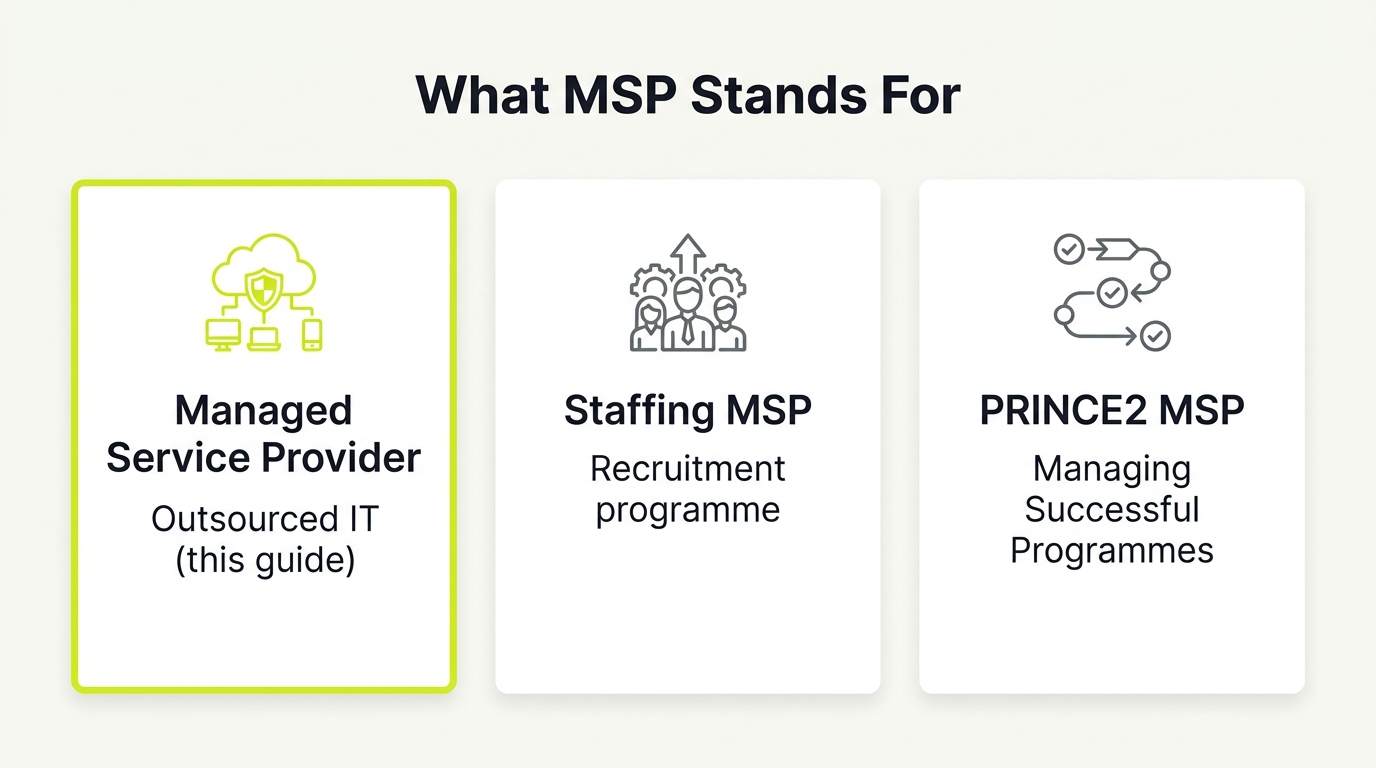
Quick disambiguation: "MSP" means three distinct things. In IT, it stands for Managed Service Provider, a company that delivers ongoing technology management for a recurring fee. In staffing and procurement, it refers to a Managed Service Programme, an outsourced team that runs a company's contingent workforce. In project management, MSP is the PRINCE2-related Managing Successful Programmes framework from AXELOS. This article covers all three, with the heaviest focus on the IT Managed Service Provider, which is the meaning most people are searching for.
1. MSP in Staffing: The Contingent Workforce Manager
The biggest source of confusion is treating an MSP as just another staffing agency. In staffing, an MSP refers to a Managed Service Programme, an outsourced team that runs a company's contingent workforce program end-to-end.
In staffing, an MSP is an outsourced program manager running the entire contingent workforce ecosystem, not a staffing agency filling individual roles. It is a people and process solution, acting as an outsourced program manager rather than a single vendor sending resumes.
A staffing MSP (Managed Service Programme) is an outsourced team that runs an enterprise's contingent workforce across multiple staffing suppliers, handling supplier selection, rate benchmarking, compliance, and consolidated reporting. It manages the program, it does not place candidates itself.
The MSP manages the entire talent ecosystem. Key operational responsibilities include:
- Supplier management: Coordinating and scoring third-party staffing agencies.
- Rate benchmarking: Standardizing pay and bill rates to control costs.
- Compliance oversight: Auditing tax classifications, contracts, and background checks.
- Consolidated reporting: Unifying invoicing and program performance data.
This setup is standard in enterprise hiring, procurement-led contingent labor, and large vendor ecosystems. For example, a large bank uses an MSP to control dozens of staffing suppliers and enforce rate cards.
Staffing MSP vs IT MSP: A Side-by-Side Disambiguation
Both share the acronym and nothing else. If you are trying to work out which MSP a job post, contract, or sales email refers to, this table sorts it in one read.
| Staffing MSP (Managed Service Programme) | IT MSP (Managed Service Provider) | |
|---|---|---|
| What it manages | Contingent workforce and staffing suppliers | Technology infrastructure and end-user systems |
| Who buys it | Enterprise procurement and HR leaders | Business owners and IT decision makers, often at SMBs |
| Core deliverable | Supplier governance, rate cards, compliance oversight | Monitoring, cybersecurity, helpdesk under an SLA |
| How it is paid | Percentage of labor spend or vendor-funded fee | Recurring monthly retainer tied to service levels |
| Tell-tale vocabulary | VMS, tier 1 supplier, rate card, contingent labor | MRR, retainer, SLA, break-fix, helpdesk |
2. MSP vs. VMS: The Crucial Difference Between Team and Tech
Staffing buyers often conflate the human service with the software platform. The distinction is simple: the MSP is the outsourced team running the program, while the VMS (vendor management system) is the software system of record.
A VMS typically automates transactional workflows:
- Requisitions and candidate submissions
- Time and expense approvals
- Consolidated invoicing and analytics
The MSP partner owns the strategic oversight:
- Policy and rate-card enforcement
- Supplier tiering and scorecarding
- Program governance and issue resolution
Some organizations run a VMS (such as SAP Fieldglass or Beeline) without an MSP. However, most enterprise staffing programs pair them to ensure the technology is actually adopted.
3. MSP Staffing Fees: Who Actually Pays for the Program?
MSP pricing depends entirely on program design and who funds the management layer.
These programs operate under three common structures:
- Client-funded fee: The enterprise pays the MSP directly, typically as a small percentage of contingent labor spend.
- Vendor-funded model: The MSP fee is embedded in the supplier’s bill rate, meaning staffing vendors fund the program.
- Hybrid fees: A transaction-based mix of flat fees per hire, processed timecard, or operational event.
Because pricing is negotiated, fee ranges vary and no single percentage is universal. Always ask: "Is the MSP fee a separate line item or baked into our bill rates?"
4. How Staffing MSPs Score Suppliers: The SLA Layer
To grasp how these programs actually operate, you must look at the metrics layer. These programs run on strict service level agreements (SLAs) and automated supplier scorecards.
MSPs track five core KPIs to rank their vendor lists:
- Time to submit: How fast a supplier shares candidates.
- Time to fill: The total days to close the role.
- Submittal-to-interview: Candidate quality.
- Interview-to-offer: The final selection rate.
- Compliance: Document completeness and background check passing rates.
Because poor scorecard metrics can get a vendor removed, MSPs enforce rigid process compliance. This dynamic explains why recruiters experience a portal "black hole" where submission speed often beats "perfect" fit.
5. MSP in IT: The Managed IT Services Partner
In the technology sector, a Managed Service Provider (MSP) delivers ongoing IT management for a recurring fee.
An IT MSP delivers proactive, ongoing management under an SLA. The defining difference from a break-fix contractor who bills only when something goes wrong. Instead of fixing systems on demand, they proactively handle critical operations:
- Network monitoring and cloud infrastructure
- Cybersecurity management
- Helpdesk support
You will see this concept described as:
- IT MSP or managed IT services
- Outsourced IT support
- Co-managed IT
While it shares an acronym with the staffing world, the categories are entirely distinct. Staffing MSPs manage workforce procurement, whereas IT MSPs manage digital infrastructure. For a direct cost comparison, see our breakdown of MSP vs. internal IT.
Small and mid-sized businesses are the fastest-growing segment adopting managed IT services. If you serve that market, the managed IT services for SMBs guide covers pricing models and service tiers tailored to that buyer.
In 2026, buyers increasingly ask Google and AI tools to recommend top regional providers. For an IT MSP, the ultimate business risk is no longer engineering quality. It is invisibility when those systems generate shortlists.
6. MSP in Project Management: Frameworks and Software
In global project management, MSP officially stands for Managing Successful Programmes. Maintained by AXELOS and PeopleCert, this structured framework coordinates related projects to deliver strategic benefits. You will typically see it referenced during:
- Programme governance design
- Large-scale organizational change initiatives
- Professional certification and training
To be clear, this framework is entirely distinct from managed IT services.
Teams also use "MSP" as a quick shorthand for the scheduling tool Microsoft Project. To tell them apart, analyze the surrounding vocabulary. Look for "AXELOS," "PeopleCert," or "programme benefits" versus software-specific terms like "Gantt charts," "schedules," or ".mpp" files.
If the conversation focuses on enterprise governance, it refers to the AXELOS framework.
7. MSP Sales: Deciphering the Three Different Definitions
Searching "MSP sales" on job boards reveals an identity crisis. The term represents three entirely different roles depending on your industry context:
Always clarify which MSP definition applies in the first line of any outbound campaign or job post. Context collapse between the three meanings wastes pipeline.
- IT MSP sales: Selling managed IT support retainers and security contracts to business owners.
- Staffing MSP sales: Selling outsourced contingent labor programs to enterprise procurement leaders.
- Selling into an MSP: Recruiting agencies pitching candidates to clients where a third-party MSP controls the process.
To spot the difference, check the keywords. "MRR, retainer, and SLA" signal IT services, while "VMS, tier 1, and rate cards" indicate staffing.
Always clarify the acronym in the first sentence of any outbound campaign or job post to avoid wasted pipeline.
How to Audit and Improve Your MSP’s Shortlist Visibility
In 2026, buyers build their shortlists directly inside Google and generative AI engines. While procurement teams use the term for contingent workforce management, IT service providers must focus on digital discoverability. If your IT firm is missing from these AI-generated recommendations, you lose the deal before the first call.
The 10-Minute AI Visibility Test
Follow these steps to audit your current market presence:
1. Query three major engines. Enter 10 realistic buyer queries into ChatGPT, Perplexity, and Google Gemini.
2. Use specific search terms. Search for terms like "best managed IT services for healthcare in Atlanta" or "SOC 2 ready MSP for finance in Dallas."
3. Analyze and score the results. Verify if the engine recommends your firm, prefers your competitors, or describes your services accurately.
Build Your Citation Readiness Foundation
Configure these core elements so LLMs can crawl and repeat your value proposition:
- Publish one clear positioning statement. State exactly what you do, whom you serve, and your geographic locations.
- Deploy indexable proof assets. Post clear case studies, vertical pages, partner certifications, and third-party media mentions.
- Enforce strict entity consistency. Keep your business name, physical address, and service menu identical across your website, directories, and social profiles.
Next Steps for Your Growth Engine
To capture this demand, read our guide on [AI search and answer engine optimization](/ai-search-answer-engine-optimization). To go deeper on growth, the MSP marketing blueprint covers the full channel strategy for building a predictable pipeline. You can also visit nuoptima.com to book a free AI citation audit.
Note for the finance partner: Measure marketing success by shortlist visibility and qualified meetings that yield contracted revenue, not raw web traffic.